Safra Catz and John Stankey: Two Leaders Shaping Oracle and AT&T in 2026
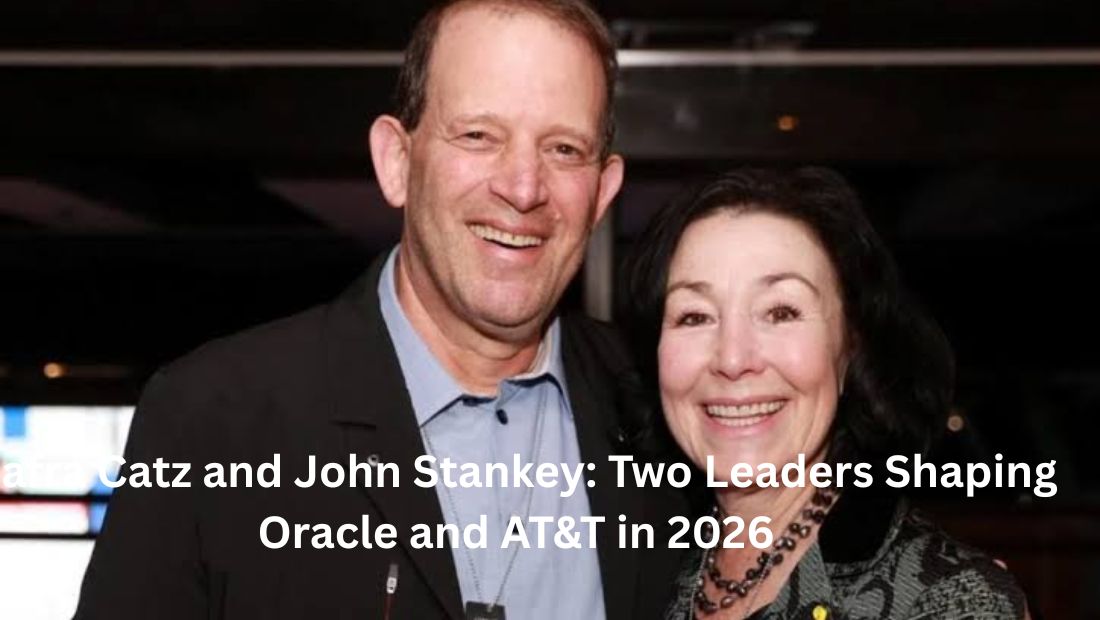
Safra Catz and John Stankey have spent decades leading major American technology and communications businesses. Catz built her career around finance, acquisitions, enterprise software, and cloud infrastructure at Oracle, while Stankey developed his career inside AT&T, moving through technology, strategy, media, and telecommunications.
Their paths are very different, but both became central figures during periods of major business transformation. Catz helped Oracle expand its cloud business and strengthen its position in AI, while Stankey has reshaped AT&T around connectivity, fiber, wireless, and 5G.
Who Is Safra Catz?
Safra Catz is an American business executive who currently serves as Executive Vice Chair of the Oracle Board of Directors. Before moving into that role, she held several senior positions at Oracle, including president, chief financial officer, executive vice president, and CEO.
Catz began her professional career in investment banking after studying at the University of Pennsylvania. Before joining Oracle, she worked at Donaldson, Lufkin & Jenrette, where she became managing director in investment banking and worked with technology clients.
Her financial background became an important part of her leadership style. Rather than coming from an engineering or traditional software-development career, Catz brought experience in technology finance, corporate transactions, and corporate strategy to one of the world’s major enterprise technology companies.
Safra Catz’s Early Career and Finance Background
Catz joined Oracle in 1999 and became a member of its board in 2001. Her responsibilities expanded quickly, and she became president in 2004 and chief financial officer in 2005. Oracle’s records show her involvement in major financial and acquisition decisions during this period.
One of the most important transactions associated with Catz was Oracle’s acquisition of PeopleSoft. Oracle announced the approximately $10.3 billion agreement in December 2004, making the deal one of the major software acquisitions of that era.
The transaction illustrates why acquisitions became closely associated with Catz’s career. Oracle used acquisitions to expand its applications portfolio, customer base, and enterprise technology capabilities rather than depending only on organic product development.
How Safra Catz Built Her Career at Oracle
Safra Catz’s career at Oracle developed through a combination of financial management, acquisitions, executive leadership, and technology strategy. Her influence grew as Oracle moved from being primarily known for databases toward a much broader enterprise technology platform.
The company acquired businesses across applications, databases, hardware, and infrastructure. Examples included Hyperion, Sun Microsystems, and PeopleSoft. Catz was involved in evaluating the financial and strategic value of these transactions.
Oracle Acquisitions and Business Strategy
The PeopleSoft transaction was especially important because it expanded Oracle’s enterprise applications business. Oracle said the deal would give it greater scale and momentum in applications, while Catz was already serving as a senior executive during the acquisition process.
The later purchase of Sun Microsystems broadened Oracle beyond software. The approximately $7.4 billion transaction gave Oracle control of technologies that included servers, storage, and the Java platform, supporting its broader cloud computing and enterprise technology ambitions.
Catz also became closely involved in Oracle’s transition toward cloud infrastructure. During her time as CEO, Oracle invested heavily in Oracle Cloud Infrastructure, cloud applications, databases, and technologies designed for large enterprise workloads.
Oracle described Catz’s leadership as part of its transformation into a hyperscale cloud company. When she moved from CEO to the board in 2025, Larry Ellison credited her with helping Oracle become a major cloud infrastructure business.
From Oracle CEO to Executive Vice Chair
Catz became co-CEO of Oracle in 2014 alongside Mark Hurd and became sole CEO after Hurd’s death in 2019. She then led the company for several more years while Oracle expanded its cloud and infrastructure operations.
In September 2025, Oracle announced that Clay Magouyrk and Mike Sicilia would become co-CEOs. Catz moved into the position of Executive Vice Chair of the Oracle Board of Directors, changing her role from day-to-day CEO leadership to board-level leadership.
As of 2026, Catz remains connected to Oracle’s strategic direction through the board. Oracle’s current leadership page lists her as Executive Vice Chair, alongside Executive Chairman and CTO Larry Ellison and co-CEOs Clay Magouyrk and Mike Sicilia.
Milaine Desaulniers: Everything To Know About Brie Larson’s Younger Sister
Who Is John Stankey?
John Stankey is the Chairman and Chief Executive Officer of AT&T. He became CEO and president in July 2020 and was elected chairman of the board in February 2025. His career at AT&T began in 1985 and has covered more than four decades.
Stankey studied finance at Loyola Marymount University and later earned an MBA from UCLA. Unlike Catz, whose early career was in investment banking, Stankey spent almost his entire professional career inside the same corporate family.
That experience gave him exposure to many parts of the business. His previous roles included Chief Information Officer, Chief Technology Officer, Chief Strategy Officer, CEO of AT&T Operations, CEO of AT&T Business Solutions, and CEO of WarnerMedia.
John Stankey’s Long Career Across AT&T
Stankey’s career reflects the evolution of the telecommunications industry itself. He worked through periods when traditional telephone services were joined by broadband, mobile communications, digital media, wireless data, streaming, and large-scale enterprise technology.
His experience therefore extends beyond telecommunications. He has worked across wireless, enterprise services, media, technology, operations, and corporate strategy, giving him a broad view of how AT&T’s different businesses fit together.
John Stankey’s Climb Through AT&T
John Stankey’s rise through AT&T was gradual. He held technical and operational positions before taking on broader strategic responsibilities and eventually becoming one of the company’s most senior executives.
He served as Chief Technology Officer during the 2000s and later became Chief Strategy Officer. He then moved into business leadership, including responsibility for entertainment and media operations before taking charge of WarnerMedia.
From Technology Executive to AT&T CEO
Stankey became president and chief operating officer in 2019 before succeeding Randall Stephenson as AT&T CEO in July 2020. He later became chairman, giving him responsibility across both the company’s executive leadership and board structure.
His tenure has included a major change in AT&T’s portfolio. The company has moved away from the large media structure created through earlier acquisitions and returned its strategic focus toward telecommunications, broadband, fiber, wireless, and advanced connectivity.
AT&T and the Shift Away From DirecTV
A clear example is DirecTV. AT&T announced in 2024 that it would sell its remaining 70% stake in DirecTV to TPG for $7.6 billion, completing its exit from the satellite television business after the earlier transaction that gave TPG a 30% stake.
The transaction was part of a wider effort to concentrate AT&T on its core wireless 5G and fiber connectivity businesses. It also provided cash that could support the company’s balance sheet and investment priorities.
What Stankey Changed Inside AT&T
Stankey’s strategy has focused heavily on simplifying AT&T’s portfolio and putting connectivity at the center of the company. Instead of maintaining a broad media empire, AT&T has emphasized wireless services, fiber broadband, network investment, and customer relationships.
In 2024, AT&T outlined a plan to expand its fiber network toward more than 50 million total locations while continuing to modernize its wireless network. The company also described its approach as investment-led and customer-centric.
A Customer-Focused Business Strategy
Stankey has described a shift toward a more customer-led mindset. In a 2026 Harvard Business Review interview, he discussed changing AT&T’s culture, making the organization more market-driven, and using AI to reshape products and employee performance.
That approach connects technology investment with customer demand. AT&T’s strategy is not simply about adding network capacity. It also involves combining fiber networks, 5G wireless, broadband, and other services into a more integrated connectivity offering.
AT&T’s 2026 results show how central this strategy has become. In the second quarter, the company added more than one million Advanced Connectivity subscribers, with growth across fiber, fixed wireless, and postpaid phone services.
AI and Technology at AT&T
Artificial intelligence is another part of Stankey’s current strategy. His public comments show that he views AI disruption as a significant business issue rather than a technology trend limited to software companies.
The Harvard Business Review discussion in 2026 described his efforts to integrate AI into products and performance while changing how employees collaborate. This places AI alongside network modernization and customer experience within AT&T’s broader technology transformation.
AT&T’s network strategy also remains capital intensive. The company says it invested more than $150 billion in wireless and wireline networks between 2021 and 2025, including capital investments and wireless spectrum acquisitions.
In 2026, AT&T also announced a commitment of more than $250 billion aimed at expanding U.S. connectivity and its fiber and wireless networks. Stankey presented the plan as a long-term investment in the company’s network and America’s connected economy.
Safra Catz and John Stankey: A Side-by-Side Look
Safra Catz and John Stankey operate in different parts of the technology economy. Catz’s career is closely connected with enterprise software, cloud infrastructure, databases, acquisitions, and AI. Stankey’s career centers on telecommunications, wireless services, fiber, broadband, and media.
| Area | Safra Catz | John Stankey |
|---|---|---|
| Company | Oracle | AT&T |
| Current role in 2026 | Executive Vice Chair | Chairman and CEO |
| Main industry | Enterprise technology | Telecommunications and connectivity |
| Career background | Investment banking and technology finance | Long-term AT&T operations |
| Major focus | Cloud, AI, enterprise technology | Fiber, 5G, wireless, broadband |
| Leadership path | Acquisitions and financial strategy | Operations, technology, strategy and media |
| Major portfolio change | Expansion into cloud infrastructure | Refocus toward connectivity |
Different Industries, Similar Corporate Responsibilities
The comparison becomes clearer when looking at their responsibilities rather than their industries. Catz helped manage Oracle’s expansion through company acquisitions, cloud investments, and enterprise technology. Stankey has managed AT&T’s transformation through asset sales, network investment, and operational changes.
Both have also dealt with businesses undergoing rapid technological change. Oracle has had to respond to the rise of AI, cloud computing, and large-scale data infrastructure. AT&T faces changes in communications, broadband consumption, wireless technology, and AI-enabled services.
Their companies also have important relationships with the media industry, although their roles differ. Stankey directly led WarnerMedia, while Catz served on the board of Disney from 2018 to 2024. Their media experience therefore came through different corporate structures.
Two Different Paths to Corporate Leadership
Catz entered Oracle after establishing herself in finance. Her professional history includes Donaldson, Lufkin & Jenrette, investment banking, technology clients, acquisitions, and corporate finance.
Stankey, by contrast, joined AT&T in 1985 and progressed through the company’s technology and operating divisions. His career included CIO, CTO, strategy, business operations, entertainment, and WarnerMedia before reaching the CEO position.
The difference is useful when understanding their leadership histories. Catz developed expertise across finance and corporate transactions before becoming Oracle’s CEO, while Stankey gained experience by moving through many operating functions within one large telecommunications organization.
Safra Catz and John Stankey in 2026
By September 2026, Catz is no longer Oracle’s chief executive. Her current position as Executive Vice Chair places her at board level while Clay Magouyrk and Mike Sicilia run the company as co-CEOs.
Stankey remains directly responsible for AT&T as chairman and CEO. The company continues to emphasize fiber, 5G, advanced connectivity, customer relationships, and long-term network investment under his leadership.
Both companies are therefore entering an important technology period, but from different directions. Oracle is expanding infrastructure for cloud and AI workloads, while AT&T is investing in the physical networks that connect consumers, businesses, and digital services.
Where Each Leader Stands in 2026
Safra Catz’s Current Role at Oracle
Safra Catz remains an important figure at Oracle through her board position. Oracle lists her as Executive Vice Chair, while she also serves as a lecturer at the Stanford Graduate School of Business and chairs the Oracle Education Foundation. She is also a trustee of In-Q-Tel.
Her transition followed more than a decade as CEO. Oracle’s leadership change placed day-to-day executive responsibility with Magouyrk and Sicilia, whose backgrounds include Oracle Cloud Infrastructure and Oracle Industries.
The change is significant because Oracle’s current strategy is strongly connected to AI infrastructure. Its Gen2 OCI platform is being positioned for large-scale cloud and AI training workloads, while the company continues developing AI applications and databases.
John Stankey’s Current Role at AT&T
John Stankey remains Chairman and CEO of AT&T in 2026. The company’s leadership page says he has led AT&T as CEO and president since July 2020 and has served as chairman since February 2025.
AT&T reported more than $125 billion in 2025 revenue and says it serves more than 100 million U.S. subscribers across wireless and broadband, along with nearly 2.5 million business customers.
The company’s current strategy centers on its fiber and 5G networks. AT&T reported more than one million Advanced Connectivity customer additions in the second quarter of 2026, showing how central bundled connectivity has become to its current operating model.
What Their 2026 Positions Show
The current roles of Safra Catz and John Stankey highlight two different forms of senior corporate leadership. Catz has moved from CEO responsibilities to board-level leadership, while Stankey continues to manage AT&T’s daily operations and long-term strategy.
Their companies also represent different layers of the digital economy. Oracle provides databases, applications, cloud infrastructure, and AI-related technology, while AT&T operates networks that carry data, voice, and video between people, businesses, and digital platforms.
Frequently Asked Questions
Who are Safra Catz and John Stankey?
Safra Catz is Oracle’s Executive Vice Chair, while John Stankey is AT&T’s Chairman and CEO, leading companies focused on enterprise technology and connectivity.
What is Safra Catz’s role at Oracle in 2026?
Safra Catz serves as Executive Vice Chair of Oracle’s Board after leading the company as CEO. Clay Magouyrk and Mike Sicilia became co-CEOs.
What is John Stankey’s role at AT&T?
John Stankey serves as AT&T Chairman and CEO. He has led the company since 2020 and became board chairman in February 2025.
How did Safra Catz influence Oracle?
Catz helped guide Oracle through major acquisitions, financial strategy, cloud expansion, enterprise technology growth, and its transition toward large-scale cloud infrastructure.
What changed at AT&T under John Stankey?
Stankey led AT&T toward a stronger connectivity focus, including fiber and 5G investment, while the company exited DirecTV and reduced its exposure to media assets.
Final Thoughts
Safra Catz and John Stankey represent two distinct corporate leadership paths. Catz built her reputation through finance, acquisitions, Oracle, cloud infrastructure, and enterprise technology before moving to the board. Stankey developed across AT&T’s technology, operations, media, and strategy businesses before becoming chairman and CEO. In 2026, Catz remains involved in Oracle’s board-level direction, while Stankey continues leading AT&T’s connectivity strategy. Their careers show how large companies can evolve through different forms of leadership, from technology acquisitions and cloud investment to network expansion, fiber, wireless, and AI-driven transformation across major American businesses.

Washim is a passionate sports writer and editor at SportsVell.com, covering the latest sports news, match updates, player performances, and expert analysis. He focuses on football, cricket, basketball, NFL, NBA, UFC, and other major sports. His goal is to provide sports fans with accurate, engaging, and easy-to-understand content from around the world.