How Long Is a Football Game? NFL, College, High School, Overtime, and Real Time Explained
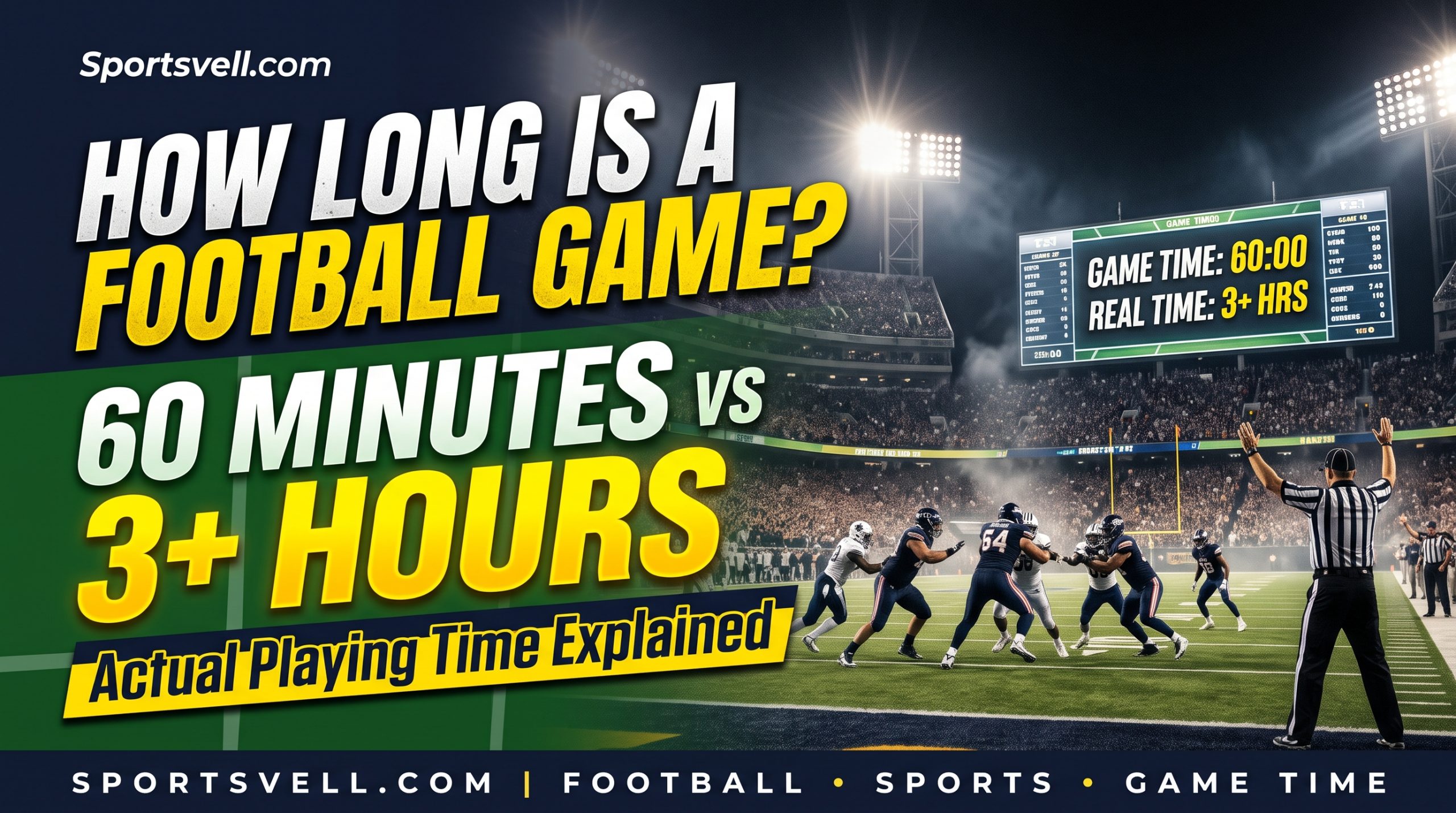
How long is a football game has two correct answers, and confusing them is why the question gets asked millions of times. On the clock, a game is 60 minutes. In real time, it takes over three hours.
Both numbers are true; they belong to different clocks.
This page separates the three clocks every game runs on. The game clock, the real time broadcast clock, and the roughly 11 minutes of actual action, with a league by league table and the end time math for planning your evening.
SportsVell keeps its football coverage honest the same way throughout. Rulebook figures are labelled as such, real time averages carry their sources and seasons, and disagreements are printed instead of hidden.
The Short Answer, by League
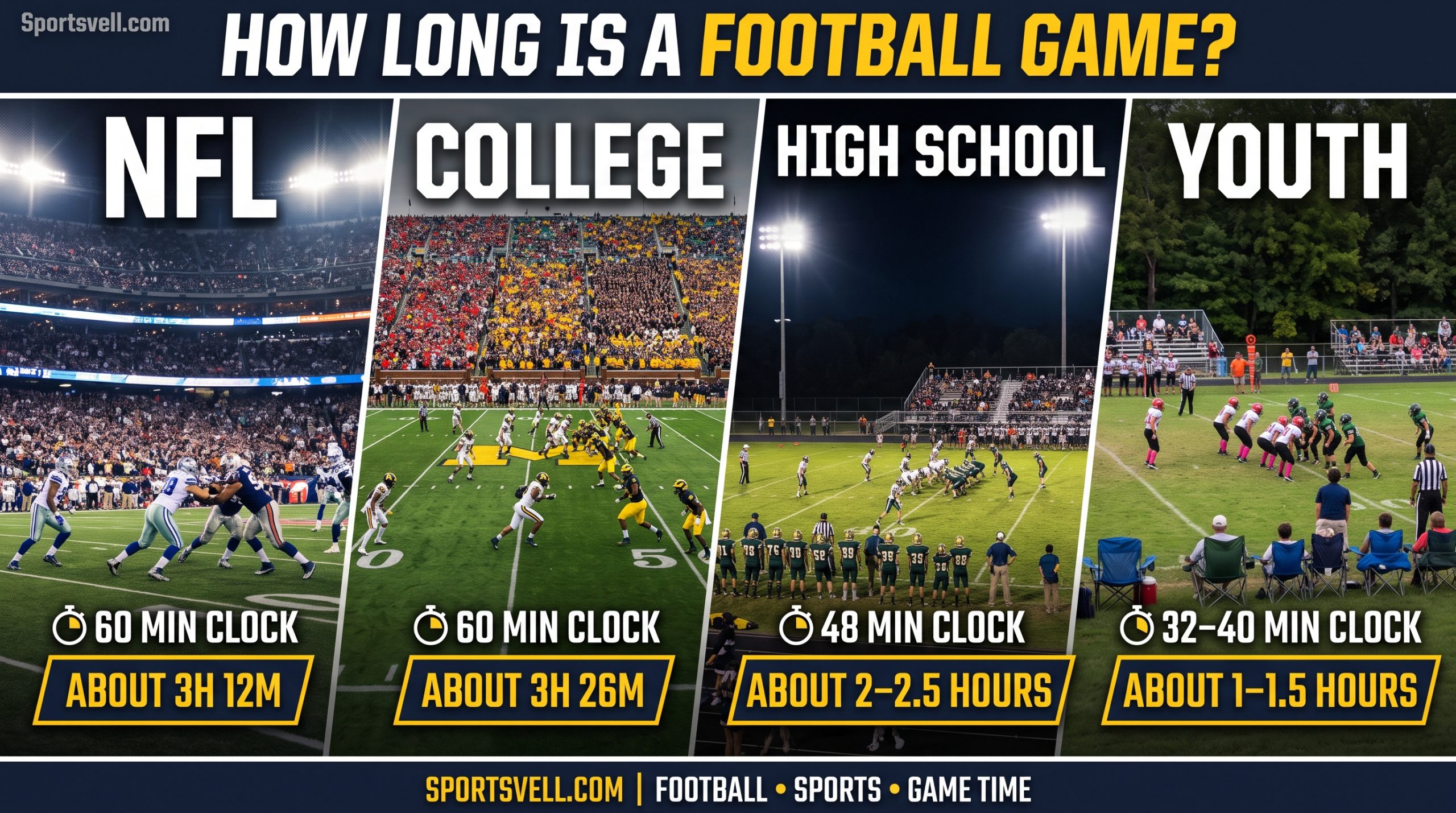
Here is the whole answer in one table. The clock column comes from the rulebooks. The real time column comes from named, dated sources, printed as ranges where they differ.
| Level | Game clock | Halftime | Real time | Overtime |
|---|---|---|---|---|
| NFL | 4 x 15 min = 60 | 12 min | About 3h 12m | 10 min period (regular season) |
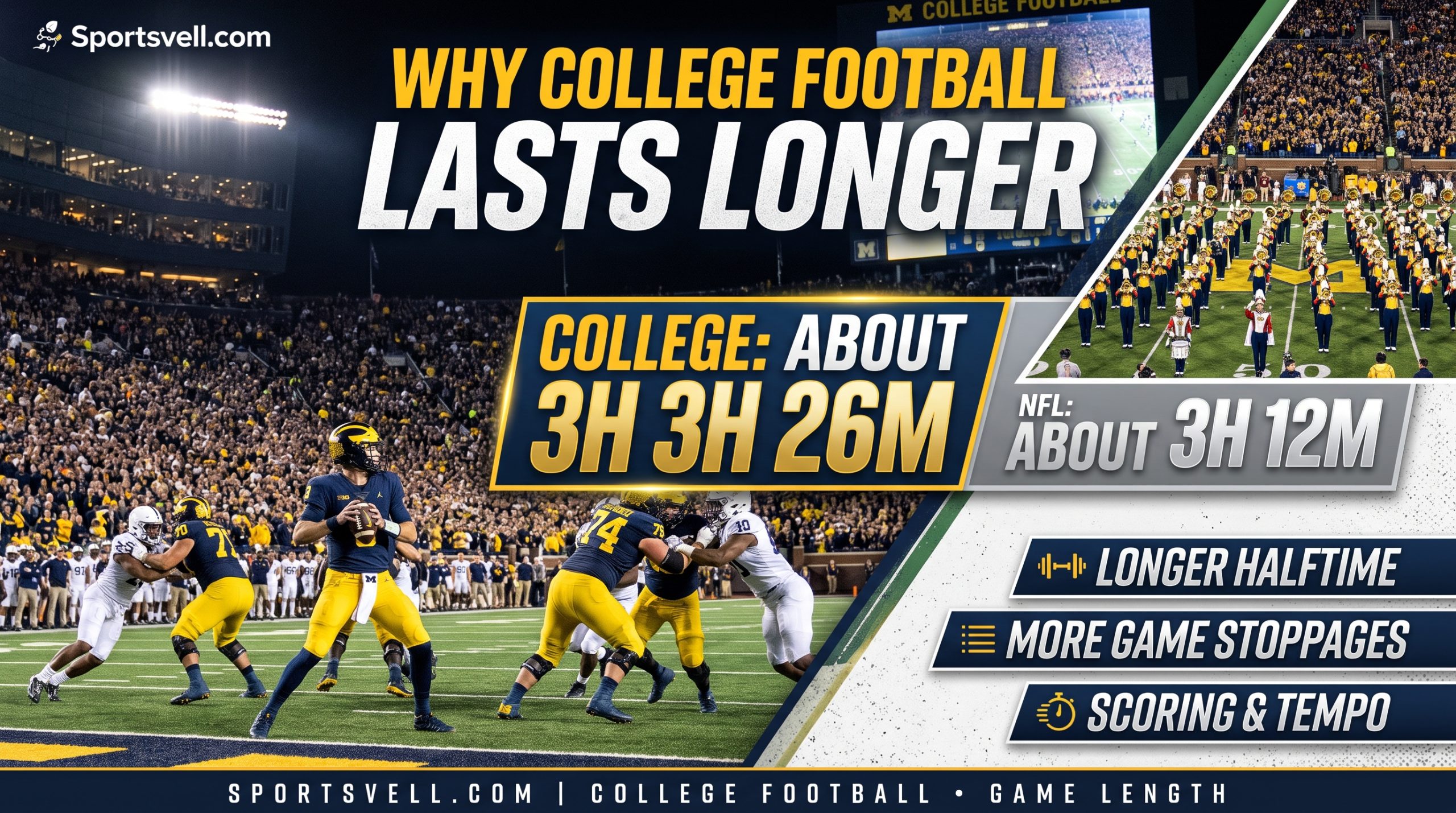
| College (NCAA) | 4 x 15 min = 60 | 20 min | About 3h 26m (2025 FBS) | Alternating possessions |
| High school (NFHS) | 4 x 12 min = 48 | 15 to 20 min | About 2 to 2.5 hours | Varies by state |
| Youth (Pop Warner) | 4 x 8 to 10 min | Short break | About 1 to 1.5 hours | Rarely played out |
| Flag football | 2 x 20 min halves | Short break | About 45 to 60 min | Varies by league |
The NFL figure is the consensus of current explainers. The rulebook based game length guide, built from league data and the rulebook, lands in the same place as the long running guides. Reported strands run from about 3:02 to 3:20 by season and sample.
The college figure is fresher than most pages show. Per NCAA statistics, FBS games averaged 3 hours 27 minutes in 2024 and about 3 hours 26 minutes in 2025. The college football game length data tracks the same NCAA data year by year.
Everything else on this page explains why those two columns disagree. Three clocks run at once in every game. Tell them apart, and every timing question in the sport becomes easy.
Clock One: The Game Clock
The game clock is the one on the scoreboard: 60 minutes in the NFL and college, 48 in high school. It moves only during parts of play. Knowing when it runs and when it stops is the entire secret of football timing.
The clock stops on the events that fill a game. An incomplete pass stops it. A score stops it. A change of possession, a penalty, an injury, a measurement, a replay review, and every charged timeout stop it too.
A runner going out of bounds stops it in most situations. Late in each half the rules tighten, and the details differ slightly between the NFL and the NCAA. Those fine print differences are where close games are won on the clock.
Between plays, a second clock does the quiet damage. The play clock gives the offense 40 seconds to snap the ball after the previous play ends. The game clock does not move during those 40 seconds, but your evening does.
After administrative stoppages, the play clock resets to 25 seconds instead. A timeout, an injury, a change of possession, or a media break restarts the rhythm at 25. Either way, most of a game’s real time passes between plays, not during them.
Each team gets three timeouts per half. A charged timeout is a full broadcast pause, and coaches hoard them for late in halves. The two minute warning adds one automatic timeout at the two minute mark of the second and fourth quarters.
Clock Two: Real Time, or Why 60 Minutes Takes Over 3 Hours
Add the stoppages up and the arithmetic explains itself. Roughly 130 plays, each followed by up to 40 seconds of reset, plus halftime, breaks, reviews, and commercials. That is how a 60 minute game becomes a 3 hour 12 minute evening.
Commercials are built into the structure, not pasted on top. One widely cited estimate puts them at roughly 50 minutes of an NFL broadcast. Breaks attach to quarter breaks, scores, turnovers, timeouts, and injuries, so the broadcast clock diverges from the game clock by design.
Passing teams stretch the real clock; running teams shrink it. Every incomplete pass freezes the game clock while real time keeps spending. A pass heavy shootout and a run heavy grind can share a 60 minute clock and differ by 40 real minutes.
Replay review is the modern addition. Coaches’ challenges and official reviews pause games several times a night. The football game structure guide walks through how stoppages and reviews stack inside a game’s flow.
Overtime adds its block when it comes. The rulebook based game length guide puts 2025 NFL overtime games at about 3 hours 26 minutes on average, roughly 25 minutes beyond a regulation finish. About one game in ten needs the extra period.
Clock Three: The Action Clock, or the Famous 11 Minutes
The most quoted number in football timing is about 11 minutes. A Wall Street Journal study of NFL broadcasts measured the time the ball was actually in play. Across a three hour telecast, the plays themselves totaled roughly 11 minutes.
Other measurements run higher, and the disagreement is about definitions. Estimates of 15 to 20 minutes count more of the play’s life, from the snap through the whistle and the immediate aftermath. A range of 11 to 18 minutes, depending on definition, is the honest print.
The math underneath is simple. A play lasts about four to seven seconds from snap to whistle. Multiply by roughly 130 plays and you land somewhere between nine and fifteen minutes of motion in a three hour show.
None of this makes the other 2 hours 50 minutes fake. The play clock chess, the huddle, and the formations are the sport’s strategy made visible. Football is a turn based game wearing a real time costume.
College Football: The Longest Games in the Sport
College football shares the NFL’s clock (four 15 minute quarters) and outlasts it anyway. NCAA statistics put the FBS average at about 3 hours 27 minutes in 2024, tied for the second longest since tracking began in 2008, and about 3 hours 26 minutes in 2025.
Halftime is the first cause: 20 minutes, against the NFL’s 12. The break exists partly for the marching bands, and it sets the day’s rhythm. The college football game length data shows the year by year averages behind the recent figures.
The first down clock was the second cause, for over fifty years. From 1968, college football stopped the clock after every first down while the chains moved. Generations of games absorbed hundreds of extra stoppages the NFL never had.
The NCAA changed that rule in 2023. The clock now keeps running after first downs except in the final two minutes of each half. Analysis of the first season credited the change with saving about four minutes a game at the FBS level.
Then 2024 gave much of it back. The NCAA added a two minute timeout, an automatic media timeout at the two minute mark of the second and fourth quarters, modeled on the NFL’s warning. The 2024 average climbed right back to 3 hours 27 minutes.
Scoring and tempo do the rest. Over 130 top division programs, many running up tempo pass heavy offenses, produce shootouts the NFL’s parity rarely allows. Four hour college games are a scheduling category of their own.
High School and Youth Football: Built for the Schedule
High school football runs a shorter clock by design: four 12 minute quarters, 48 minutes total. The NFHS rulebook sets the frame and state associations adopt it. The football game times explainer gives the same level ladder this page uses.
Real time on a Friday night runs about 2 to 2.5 hours. Halftime is usually 15 to 20 minutes, often shared with the band and homecoming ceremonies. A 7 p.m. kickoff typically has everyone home by 10.
The mercy rule protects the schedule and the losing team. When a lead passes a state set threshold, commonly 35 points in the second half, the clock runs continuously. A running clock second half can cut half an hour from a blowout.
Overtime in high school ball belongs to the states. Most use an alternating possession format from a short field position, similar in spirit to the college system. Formats, starting yard lines, and whether regular season games can end tied all vary by state.
Youth football shrinks the clock again. Pop Warner plays 8 minute quarters for its youngest division and 10 minute quarters up through 14U. Real time lands around 1 to 1.5 hours, often with running clock stretches that keep Saturday mornings predictable.
Middle school and junior varsity follow the same pattern. Eight or 10 minute quarters, real time around 1.5 to 2 hours. JV games played before varsity often run on deliberately tight clocks so the varsity kickoff stays on schedule.
Flag football is the shortest form of all. Two 20 minute halves with a mostly running clock finish in about 45 minutes to an hour. It is the one version of football whose games end when the schedule says they will.
Halftime at Every Level, and the Super Bowl Exception
NFL halftime is 12 minutes of rest inside a 13 minute intermission. The league shortened it from 15 minutes in 1990. One rulebook based guide notes the full intermission window, 13 minutes including the teams leaving and returning, which is why both numbers circulate.
College halftime is 20 minutes. The extra eight minutes over the NFL belong to the bands and the ceremony of the college day. High school halftimes sit at 15 to 20 minutes by state.
The Super Bowl plays by different rules. Its halftime stretches to roughly 30 minutes to build a stage, run the show, and tear it down inside the break. That single change explains most of why the Super Bowl broadcast runs 3.5 to 4 hours.
Overtime at Every Level: The Rules Just Changed
NFL regular season overtime is one 10 minute period, and since 2025 both teams are guaranteed a possession. The owners approved the change on April 1, 2025, aligning the regular season with the playoff format used since 2022. A first possession touchdown no longer ends the game.
Two details of the new rule matter for length. The 10 minutes are a hard cap, so a game can end before the second possession finishes. The only early finish is a defensive safety on the opening drive.
If the score is level at the end, the game is a tie. The Packers and Cowboys proved it with a 40 to 40 draw in 2025.
The overtime rules breakdown, an officiating site, documents the change precisely. Its breakdown of the new provisions, including the two timeouts per team in overtime, is the cleanest public summary of how the rulebook now reads.
Playoff overtime runs on 15 minute periods until there is a winner. Both teams possess, then the next score wins, and periods repeat as needed. A playoff game that reaches overtime should be budgeted at four hours.
College overtime has no clock at all. Teams alternate possessions from the 25 yard line. From the second overtime, touchdowns must be followed by two point tries; from the third, the format becomes alternating two point plays.
Most college overtimes end within about 10 to 20 real minutes. The record book also holds seven, eight, and nine overtime marathons.
What Time Will the Game End? The Planner’s Table
The question behind the question is always a schedule. Dinner, a flight, a bedtime, a DVR. The working rule is kickoff plus the planning number, per level, below.
| Kickoff (ET) | NFL ends about | College ends about | High school ends about |
|---|---|---|---|
| 1:00 p.m. | 4:10 to 4:20 p.m. | 4:30 p.m. | 3:30 p.m. |
| 4:25 p.m. | 7:35 to 7:45 p.m. | 7:55 p.m. | 6:55 p.m. |
| 8:15 p.m. | 11:25 to 11:35 p.m. | 11:45 p.m. | 10:45 p.m. (7 p.m. local starts vary) |
Use the planning numbers, not the averages. Plan on kickoff plus 3.5 hours for the NFL, 4 hours for college, and 2.5 hours for high school. That buffer absorbs reviews, injuries, and a close fourth quarter without ruining the evening around the game.
Add 30 minutes when the game is close late. A one score game inside the final five minutes activates every clock stoppage at once. The final two minutes of a close game regularly take 15 to 25 real minutes, the most reliably shocking number in this whole topic.
For a stadium trip, the outing is bigger than the game. Arrive 60 to 90 minutes early, and budget an exit half hour. A night game is a five hour door to door commitment for most fans.
For the DVR, pad the recording. Thirty extra minutes covers most overruns; an hour covers overtime. The football coverage on SportsVell is full of fans who learned that lesson the hard way.
Prime time games drift later than listed. The listed time is when coverage starts; kickoff follows introductions, the anthem, and the coin toss, usually 5 to 10 minutes later. The sports news desk listings use coverage time, like everyone else’s.
Football vs Soccer, and the Other Sports
A share of this question’s searchers mean the other football. A soccer match runs 90 minutes of clock in two 45 minute halves, and its clock almost never stops. With halftime and stoppage time, the real total is about 1 hour 55 minutes to 2 hours.
The two sports are mirror images. Soccer has the longer clock and the shorter day. American football has the shorter clock (60 minutes) and the longer day (about 3 hours 12 minutes), because its clock stops constantly and its plays sit 40 seconds apart.
| Sport | Clock | Real time (typical average) |
|---|---|---|
| American football (NFL) | 60 min | About 3h 12m |
| College football (FBS) | 60 min | About 3h 26m |
| Soccer | 90 min | About 1h 55m to 2h |
| Hockey (NHL) | 60 min | About 2h 30m |
| Baseball (MLB, pitch clock era) | None | About 2h 40m |
| Basketball (NBA) | 48 min | About 2h 15m |
Canadian football sits closest to the NFL. The CFL uses four 15 minute quarters, three downs, and a 20 second play clock. Games run around three hours: faster rhythm, same total.
The comparison reframes the complaint. Football is the longest major American sports event per game, which is why its windows anchor network Sundays. Its length is the product, not an accident.
Frequently Asked Questions
How long is a football game?
Two answers, both correct.
On the clock, an NFL or college game is 60 minutes: four 15 minute quarters.
In real time, an NFL game runs about 3 hours 12 minutes, because the clock stops for incomplete passes, scores, timeouts, and reviews.
High school games use 12 minute quarters (48 minutes) and finish in about 2 to 2.5 hours.
How long does an NFL game last in real time?
About 3 hours 12 minutes on average, the consensus figure across current explainers, with reported strands from about 3:02 to 3:20 by season and sample.
Overtime games in 2025 averaged about 3 hours 26 minutes.
A run heavy, low penalty game can finish under three hours; a pass heavy game with reviews and overtime can pass three and a half.
Why does a 60 minute football game take 3 hours?
Because the game clock only runs during parts of play.
It stops on incomplete passes, scores, changes of possession, timeouts, penalties, injuries, and reviews. Between plays, the 40 second play clock lets real time pass without the game clock moving.
Add a 12 minute halftime, quarter breaks of two to three minutes, and structured commercial breaks, and roughly two extra real hours accumulate around the 60 minutes of clock.
How long is a college football game?
The clock matches the NFL (four 15 minute quarters), but real time runs longer: NCAA statistics put FBS games at 3 hours 27 minutes in 2024 and about 3 hours 26 minutes in 2025.
Halftime is 20 minutes instead of 12, passing and scoring are frequent, and the two minute timeout added in 2024 offset the savings from the 2023 first down clock change.
High scoring games regularly pass four hours.
How long is a high school football game?
High school games use four 12 minute quarters, 48 minutes on the clock, under NFHS rules adopted state by state.
Real time typically runs 2 to 2.5 hours.
Halftime is usually 15 to 20 minutes.
Overtime formats and mercy rule running clocks vary by state, so two Friday night games can end very differently.
How many quarters are in a football game, and how long is each?
Four quarters at every level.
Quarters are 15 minutes in the NFL and NCAA, 12 minutes in high school, and 8 to 10 minutes in youth football. The first and third quarters end with a short break of about two to three minutes.
Halftime follows the second quarter.
Total clock time is therefore 60, 48, or roughly 32 to 40 minutes by level.
How long is halftime in football?
In the NFL, 12 minutes of rest inside a 13 minute intermission (the league shortened it from 15 in 1990; the rulebook’s full window includes the teams leaving and returning).
In college, 20 minutes.
In high school, usually 15 to 20 minutes by state rule.
The Super Bowl is the outlier: halftime stretches to roughly 30 minutes for the show, one reason its broadcast runs 3.5 to 4 hours.
How much actual playing time is in a football game?
The famous figure is about 11 minutes: a Wall Street Journal study of broadcasts found the ball in play for roughly 11 minutes of a three hour telecast.
Other estimates run higher, 15 to 20 minutes, or 11 to 18 depending on definition, because each play lasts only about four to seven seconds.
Print the range with its sources; the disagreement is about what counts as action, not about the plays.
How long is overtime in the NFL?
In the regular season, one 10 minute period, and since 2025 both teams are guaranteed a possession (approved April 1, 2025, copying the playoff format from 2022).
Only a defensive safety on the opening drive ends it early; if the score is level at the end, the game is a tie.
In the playoffs, periods are 15 minutes and repeat until there is a winner.
How does college football overtime work and how long does it take?
College overtime has no game clock: teams alternate possessions from the 25 yard line until one outscores the other in a round.
From the second overtime, touchdowns must be followed by two point tries, and from the third, the format becomes alternating two point plays.
Most overtimes resolve in one or two rounds, adding roughly 10 to 20 real minutes; the record book also holds seven, eight, and nine overtime marathons.
Can an NFL game end in a tie?
Yes, in the regular season: if the score is level after the 10 minute overtime period, the game is recorded as a tie, as the Packers and Cowboys’ 40 to 40 draw in 2025 showed.
Ties are rare but legal.
Playoff games cannot end tied; they continue with 15 minute periods until someone wins.
College and most high school formats guarantee a winner through alternating possessions.
What time will a football game end if it starts at 1 p.m.?
Plan on a 1:00 ET NFL kickoff ending about 4:10 to 4:20, using the roughly 3 hour 12 minute average with a small buffer.
A noon college kickoff commonly ends around 3:30 or later.
The safe planning rule: kickoff plus 3.5 hours for the NFL, plus 4 hours for college, plus 2.5 hours for high school, and add 30 minutes if the game is close late.
How long is a youth football game?
Youth leagues such as Pop Warner play 8 minute quarters for the youngest division and 10 minute quarters up through 14U, so 32 to 40 minutes on the clock.
Real time usually runs about 1 to 1.5 hours including a short halftime.
Many youth leagues use running clock stretches, which keeps mornings predictable.
Exact timing sits in the league handbook, set by age division, so check there first.
How long is a flag football game?
Flag football is built shorter.
School and league formats commonly run two 20 minute halves with a mostly running clock, stopping mainly near the end of each half, which puts a full game at roughly 45 minutes to an hour in real time.
With no play clock chess and few stoppages, flag games finish close to their scheduled slot, unlike tackle football at any level of the sport.
How long is the Super Bowl?
The game follows NFL timing (60 minutes on the clock), but everything around it stretches: pregame ceremonies, a halftime of roughly 30 minutes for the show, and heavier commercial loads.
The broadcast typically runs 3.5 to 4 hours from kickoff to the trophy presentation, and the full telecast with pregame coverage spans much of the day.
It is the longest routine event on the American sports calendar relative to its clock.
How long are commercial breaks in a football game, in total?
One widely cited estimate puts commercials at roughly 50 minutes of an NFL broadcast, around a quarter of its length; treat it as a reported estimate, since the league publishes no standard total.
Breaks are structured into the telecast at quarter breaks, scores, turnovers, timeouts, and injuries, which is why the two clocks diverge so completely.
Why do college football games last longer than NFL games?
Four compounding causes.
Halftime is 20 minutes against the NFL’s 12. Passing volume and scoring create more stoppages.
The first down clock stop, a tradition from 1968 until the 2023 reform, froze the clock on nearly every series for decades.
And up tempo offenses across 130 plus programs produce shootouts.
The NCAA’s own numbers show it: about 3 hours 26 to 27 minutes for FBS games in 2024 and 2025.
What is the play clock and how does it affect game length?
The play clock gives the offense 40 seconds to snap the ball after the previous play ends (25 seconds after administrative stoppages like timeouts and injuries).
It never advances the game clock; it disciplines the pace between plays.
It is the main reason a 60 minute clock consumes three real hours: most real time passes with the game clock stopped and the play clock quietly running down, about 130 times a game.
When does the game clock stop in football?
The standard stoppages: **an incomplete pass, a runner out of bounds (with late half exceptions), a score, a change of possession, a penalty, an injury, a measurement or review, a charged timeout.
And the end of a quarter.** The college clock also stops after first downs inside the final two minutes of each half, a remnant of the pre 2023 rule.
What is the two minute warning?
An automatic timeout when the clock reaches two minutes in the second and fourth quarters.
It began in the NFL as a practical notice in the era before stadium clocks were official, and it survives as a strategic landmark and a commercial break.
College football had no equivalent for decades; the NCAA adopted a two minute timeout in 2024, modeled on the NFL’s and designed to synchronize its late half timing rules.
How long is a CFL game?
Canadian football uses the same skeleton (four 15 minute quarters) with three downs, a wider field, and a 20 second play clock.
Games typically run around three hours in real time, comparable to the NFL.
The faster play clock and fewer downs change the rhythm more than the total.
CFL timing is a comparison point in North American explainers, not a separate system, and its championship day follows the same three hour broadcast pattern.
How long is a soccer game compared to a football game?
A soccer match is 90 minutes of clock in two 45 minute halves, and the clock almost never stops.
So the real time total is about 1 hour 55 minutes to 2 hours including a 15 minute halftime and stoppage time.
An NFL game inverts it: a shorter clock (60 minutes) but about 3 hours 12 minutes of real time.
Soccer has the longer clock; football has the longer day.
What is the longest football game ever played?
In the NFL, the 1971 Christmas Day playoff between Miami and Kansas City is the standard answer: it ran into a second overtime and remains the league’s longest game at over 82 minutes of playing time.
In college, the alternating possession format has produced seven, eight, and nine overtime games that stretch real time far beyond four hours.
How long is a football game on TV with the broadcast window?
Networks schedule NFL windows of about 3 to 3.5 hours: the early Sunday window feeds the late window, then prime time follows.
Pregame and postgame shows run longer, but the game itself, kickoff to final whistle, is the roughly 3 hour 10 minute product viewers plan around.
Overruns matter because the programming after the late window absorbs them.
Do preseason games last as long as regular season games?
On the clock, yes: the same four 15 minute quarters and timing rules apply. In real time, preseason games often finish somewhat quicker, with second halves that move faster and less broadcast ceremony.
But they are scheduled in the same roughly three hour windows.
Do not plan a preseason evening shorter than a regular season one without checking the specific telecast, especially in the final preseason week.
How long is a playoff football game?
Longer than the regular season average, as a rule.
Playoff games carry more commercial inventory, more replay scrutiny, and overtime that cannot end in a tie, running in 15 minute periods until a winner emerges.
Budget about 3 hours 20 minutes to 3:30 before overtime, and past four hours if overtime arrives.
The Super Bowl is the extreme end of the same pattern, with its 30 minute halftime on top.
What is a running clock in football?
A clock that does not stop for the usual reasons (incomplete passes, first downs, out of bounds) except in limited situations.
High school mercy rules trigger it when a lead passes a state set threshold, often 35 points in the second half, and youth leagues use it broadly.
Its purpose is mercy and schedule keeping: a running clock second half can cut 30 minutes or more from a blowout’s real time on a Friday night.
What is the 10 second runoff?
A rule that subtracts 10 seconds from the game clock in late game situations when certain fouls or injury stoppages occur inside the final minute of a half, so a team cannot profit from stopping the clock by fouling.
The opposing team can sometimes avoid the runoff by spending a timeout.
It is one of the fine print timing rules that decides how long, and how dramatically, a close game is allowed to end.
How many plays are in a football game?
Roughly 120 to 160 total plays (both teams’ offensive snaps plus special teams plays) in a typical NFL or college game.
Multiply by the roughly four to seven seconds each play lasts and you land near the 11 to 18 minute estimates for live action.
The snap count is also the pace metric coaches use: up tempo college teams push the total toward the top of the range, which is part of why their games run longest.
Why do the last two minutes of a football game take so long?
Because everything stops the clock at once: the trailing team throws, uses its timeouts, spikes the ball, and works the sidelines, while reviews check every close catch and the two minute warning adds its own break.
The final two clock minutes regularly consume 15 to 25 real minutes in a close game.
Blowouts, by contrast, end almost on schedule, which is why the average hides two very different endings.
How long is a middle school or JV football game?
Most middle school and junior varsity programs play 8 or 10 minute quarters (32 to 40 minutes on the clock), set by the state association or district.
Real time is typically 1.5 to 2 hours.
JV games played before varsity on the same night often run on deliberately tight clocks so the varsity kickoff stays on time, a scheduling detail families tend to learn the hard way on their first Friday.
Does weather delay make football games longer?
Weather delays pause everything and can add hours.
Lightning policy at most levels requires a 30 minute wait from the last strike or thunder, restarted with each new one, so a stormy evening game can stretch past midnight or be postponed.
The game clock is safe, since it only runs during play; the real time commitment is not.
How long is an arena or indoor football game?
Indoor leagues play on a 50 yard field with the same four quarter structure at 15 minutes in most rule sets, but a faster real time profile, typically around 2 to 2.5 hours.
Thanks to running clock design in many leagues and minimal broadcast ceremony at most levels.
Formats vary by league more than in the outdoor game, so the specific league’s rulebook is the source to check for its timing page.
How long should I plan to be at a stadium for a football game?
For the NFL: arrive 60 to 90 minutes before kickoff for gates, security, and warmups, then budget roughly 3.5 hours from kickoff to the final whistle, plus exit traffic.
The full outing is about 5 hours door to door for many fans.
The outing around the game is the bigger number, and the one first time visitors underestimate.
Is a football game longer than a baseball, basketball, or hockey game?
In real time, yes, against most.
A basketball game (48 minute clock) runs about 2 hours 15 minutes. Hockey (60 minute clock) runs about 2 hours 30.
Baseball’s pitch clock era average is around 2 hours 40.
Football’s roughly 3 hour 12 minute NFL average is the longest of the major US sports per event, which is why its windows anchor network days.
How long is a football game without commercials?
There is no official published split, but the arithmetic is instructive: remove a reported estimate of roughly 50 minutes of commercials from a 3 hour 12 minute broadcast and about 2 hours 20 minutes remain, still containing halftime, reviews, timeouts.
And the play clock between snaps.
The length is structural, not just commercial.
Condensed replays, at about 30 minutes, are the practical answer.
Why did college football change its clock rules in 2023?
Game length was the stated reason: from 2023, the NCAA clock keeps running after first downs except in the final two minutes of each half, a break with a rule dating to 1968.
The aims were shorter games and fewer plays, and therefore fewer injury exposures, per game.
First season analysis credited about four minutes saved per FBS game, modest rather than transformative, because passing volume and scoring kept climbing across the sport.
How long is halftime at the Super Bowl compared to a normal game?
Roughly 30 minutes against the NFL’s normal 12.
The stage build, the performance, and the teardown happen inside that window, rehearsed to the minute by the league and the network.
Combined with expanded pregame ceremonies and heavier advertising, it is why the Super Bowl’s total runtime reaches 3.5 to 4 hours despite an ordinary 60 minute game clock and, usually, no overtime at all on the night.
Do football games start exactly at the listed kickoff time?
Rarely to the minute.
Listed times are television window starts; actual kickoff usually follows a few minutes later after introductions, the anthem, and the coin toss.
Treat the listed time as when coverage starts and expect the ball in the air roughly 5 to 10 minutes later on most Sundays, longer for standalone national games.
How long is a 7 on 7 or six man football game?
Scholastic variants shrink the clock.
Six man and eight man football, played by small schools in states like Texas, typically use 10 or 12 minute quarters with strong mercy rules, finishing in about 1.5 to 2 hours.
7 on 7 passing tournaments are not full games at all: short running clock periods, often 20 to 25 minutes per match, in a bracket format built for the schedule rather than the broadcast.
What is the shortest an NFL game can be?
Games with heavy rushing, few penalties, few reviews, and no overtime finish fastest.
One competitor reports the shortest game of the past decade at 2 hours 38 minutes; treat that as a site reported figure pending a league source.
Even the floor is instructive: an NFL game has a structural minimum near two and a half hours.
How can I watch a full football game in less time?
Use the condensed replay: league streaming services cut each game to roughly 30 minutes by removing the time between snaps while keeping every play.
The full replay keeps the broadcast intact for purists, and the all 22 coaches film serves study rather than entertainment.
For live viewing, whip around channels remove breaks by switching games.
There is no way to shorten the live game itself; its length is the product.
Conclusion
How long is a football game comes down to three clocks. Sixty minutes on the game clock, about 3 hours 12 minutes of real time in the NFL and closer to 3 hours 27 on a college Saturday, and roughly 11 minutes of live action.
Keep the three separate and every timing question answers itself.
Plan with the planner’s numbers, not the averages. Kickoff plus 3.5 hours for the NFL, plus 4 for college, plus 2.5 for high school, and half an hour more whenever the game is close late.
Follow the football coverage on SportsVell through the season. The timing rules keep moving, the overtime format changed as recently as 2025, and this page’s tables are rechecked against the rulebooks and the new season’s averages as they land.