India National Cricket Team vs England Cricket Team Match Scorecard
India national cricket team vs England cricket team match scorecard searches ask for one thing first: the record of the match. Not a preview or an opinion, but the full card: every innings, every dismissal, and the result line.
This page is built as the hub that query deserves. The latest scorecards sit at the top, the series archive and dated head to head records beneath them, and a plain language guide to reading any card alongside.
SportsVell runs its cricket coverage the same way across fixtures. Dates and sources are printed beside the numbers throughout, because in a rivalry played since 1932, an undated record is a wrong record waiting to be quoted.
Latest Meetings: The July 2026 White Ball Tour of England
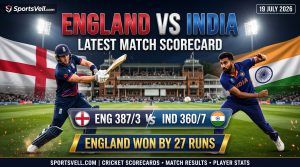
The most recent completed series between the sides is England’s home white ball tour of July 2026. England won the T20I series 4-0, with the first match washed out. England also took the ODI series 2-1.
Those series outcomes come from the head-to-head records feature. Its figures are sourced to ESPNcricinfo Statsguru and dated to 19 July 2026. Dated sourcing is the standard this page holds itself to throughout.
First ODI, Edgbaston, 14 July 2026. England won the toss and chose to bat. They were bowled out for 258 in 47.5 overs, and India chased the target inside 46 overs.
|
Team |
Score |
Overs |
Note |
|---|---|---|---|
|
England |
258 all out |
47.5 |
Duckett 43 off 45 |
|
India |
262 for 4 |
45.2 |
Won by 6 wickets |
Ben Duckett’s 43 off 45 balls tops the England lines the provider card preserves. Virat Kohli fell early in the chase for 5, lbw to Jofra Archer.
The T20I of 11 July 2026 was a batting exhibition. England posted 257 for 3, the kind of total that ends contests early. India replied with 201 for 8 and lost by 56 runs.
|
Batter (England) |
Dismissal |
R |
B |
4s |
6s |
SR |
|---|---|---|---|---|---|---|
|
Jos Buttler |
c Suryansh Shedge b Shivam Dube |
131 |
64 |
12 |
8 |
204.68 |
|
Harry Brook (c) |
not out |
95 |
45 |
4 |
8 |
211.11 |
|
Phil Salt |
c Suryansh Shedge b Prasidh Krishna |
6 |
9 |
1 |
0 |
66.66 |
The full T20I scorecard keeps every row of that card. England’s fall of wickets tells the innings shape in one line. The second and third wickets both fell at 241, after the damage was done.
India’s chase had one real stand. Ishan Kishan made 56 off 35 balls, with Samson adding 27 and Iyer 28, before the innings closed at 201 for 8.
The 2025 Anderson-Tendulkar Trophy: A Series for the Ages
The defining recent chapter of this rivalry is the 2025 Test series in England. Five Tests, every one reaching a fifth day. The Anderson-Tendulkar Trophy finished drawn 2-2, and the series produced a reported aggregate of 7,187 runs.
|
Test |
Venue |
Scores in brief |
Result |
|---|---|---|---|
|
1st |
Headingley |
England chased in the fourth innings |
England by 5 wickets |
|
2nd |
Edgbaston |
India 587 and 427/6 dec; England 407 and 271 |
India by 336 runs |
|
3rd |
Lord’s |
England 387 and 192; India 387 and 170 |
England by 22 runs |
|
4th |
Old Trafford |
India 358; England 669; India 425/4 |
Drawn |
|
5th |
The Oval |
India 224 and 396; England 247 and 367 |
India by 6 runs |
Edgbaston was Shubman Gill’s match. The India captain made 269 off 387 balls, with 30 fours and 3 sixes, in a first innings of 587. India won by 336 runs to level the series.
Gill finished the series with 754 runs. No batter on either side came close to that aggregate.
Lord’s produced the strangest symmetry of the summer. Both sides made exactly 387 in their first innings. England’s 192 then set a target India chased down to 170, falling 22 runs short.
The Lord’s Test scorecard keeps all four innings of that card. Its fall of wickets lines show how the match tightened session by session. England’s first innings wickets fell in clusters at 43 and 44, then rebuilt to 387.
The Oval finale is already part of the rivalry’s permanent furniture. India 224 and 396, England 247 and 367 chasing 374. India won by 6 runs, the narrowest victory in their entire Test history.
Mohammed Siraj took 5 for 104 in the final innings. Harry Brook made 111 and Joe Root 105 in the chase, and it still was not enough. BBC Sport called it one of the all time great Tests, and the card backs the claim.
Head-to-Head Records, Dated and Sourced
Every number in this section carries its date, because in this rivalry an undated number is a wrong number waiting to happen. The table below is the freshest set available, sourced to ESPNcricinfo Statsguru to 19 July 2026 via the head-to-head records feature.
|
Format |
Played |
India won |
England won |
Drawn, tied, or no result |
|---|---|---|---|---|
|
Tests |
141 |
37 |
53 |
51 |
|
ODIs |
113 |
62 |
46 |
5 |
|
T20Is |
35 |
18 |
16 |
1 |
|
All formats |
289 |
117 |
115 |
57 |
The pattern reverses by format, which is the single most useful fact in the table. England lead the Tests clearly. India lead both white ball formats. Anyone quoting one overall number is hiding the interesting part.
The ODI column holds two ties, and both came in 2011. One was the World Cup game in Bengaluru, the other a rain affected game at Lord’s. The remaining three in that column are no results, and abandoned games are not counted.
Why does another website show different totals? Because its page was written earlier. Pages built before the July 2026 tour show 110 ODIs and 29 T20Is; some older pages still show pre 2025 figures.
Neither page is lying; both are snapshots. The correct response is not to average them. It is to read the as of date, prefer the newest dated source, and treat any undated aggregate as unusable.
The recent window is dead level. Across the 19 internationals played between January 2024 and July 2026, the timeline features count nine wins each and one draw. The all time table says history; the recent window says the present is even.
How to Read a Scorecard: Notation, Fall of Wickets, Extras
A scorecard is a standard document, and it has read the same way since 1932. Learn the notation once and every card in this rivalry opens up, from the first Test at Lord’s to the latest T20I.
The batting table lists every batter in order. The dismissal text comes first: c means caught, b means bowled, so c Brook b Archer reads as caught by Brook off Archer’s bowling. Then come R (runs), B (balls), 4s, 6s, and SR (strike rate).
Strike rate is runs per 100 balls. Buttler’s 131 off 64 balls prints as a strike rate of 204.68. In the bowling table, the columns read O (overs), M (maidens), R (runs conceded), W (wickets), and ECO (economy, runs per over).
The fall of wickets line is the innings story in one string. It lists the team score at each dismissal, the batter, and the over. Two wickets at the same score, like England’s second and third at 241 in the July 2026 T20I, marks a sudden cluster.
The archive scorecard on Cricbuzz shows the classic extras line. It prints the breakdown as b (byes), lb (leg byes), w (wides), and nb (no balls) before the total. In a 6 run finish, extras are part of the margin.
Markers carry whole events. An asterisk means not out. f/o means the side followed on, batting again immediately, as one archive card in this rivalry shows against a total line. A d or dec marks a declared innings, and DLS marks a target revised for weather.
The format changes which columns tell the story. A Test card holds up to four innings, sessions, declarations, and the follow on. An ODI or T20I card holds two innings, and the phases (powerplay, middle overs, death) do the storytelling instead.
Records of the Rivalry: Margins, Totals, and Leaderboards
Narrowest Test win: 6 runs, The Oval, 2025. The timeline features describe it as the narrowest victory in India’s Test history, inside their 13 run win over Australia at Mumbai in 2004. The same series gave England a 22 run win at Lord’s, the summer’s second tightest finish.
Biggest win in this research window: 336 runs, Edgbaston, 2025. India’s 587, built on Gill’s 269, set up a rout. The rivalry’s innings victories and ten wicket wins live in the longer record, and any margins list must separate wins by runs from wins by wickets.
Highest totals in the recent cards run both ways. India’s 587 at Edgbaston and England’s 669 at Old Trafford came in the same series. The Old Trafford Test produced 1,452 runs across three completed innings and still ended drawn, which is its own kind of record.
The tied matches are both ODI classics from 2011. Bengaluru’s World Cup game finished 338 apiece, and the Lord’s game later that year also finished level. Drawn Tests are common here (51 in the dated count); tied Tests do not feature.
Run scoring leaderboards belong to the modern giants. In Tests, Tendulkar and Root anchor this fixture’s run charts, Root still adding through 2025. In T20Is, the timeline features credit Kohli with 648 runs against England, Buttler close behind with 644.
The bowling record of the fixture has a name on the trophy. James Anderson built the defining wicket taking record of this rivalry across two decades. India’s spin attacks own the home side of the ledger, with Ravichandran Ashwin the modern standard before his Test retirement.
Every leaderboard on this page is a dated snapshot. Root and Buttler remain active, so the orders can still move. A records page that hides its date is asking you to trust a number it has already stopped checking.
Famous Scorecards: The Cards Fans Actually Search For
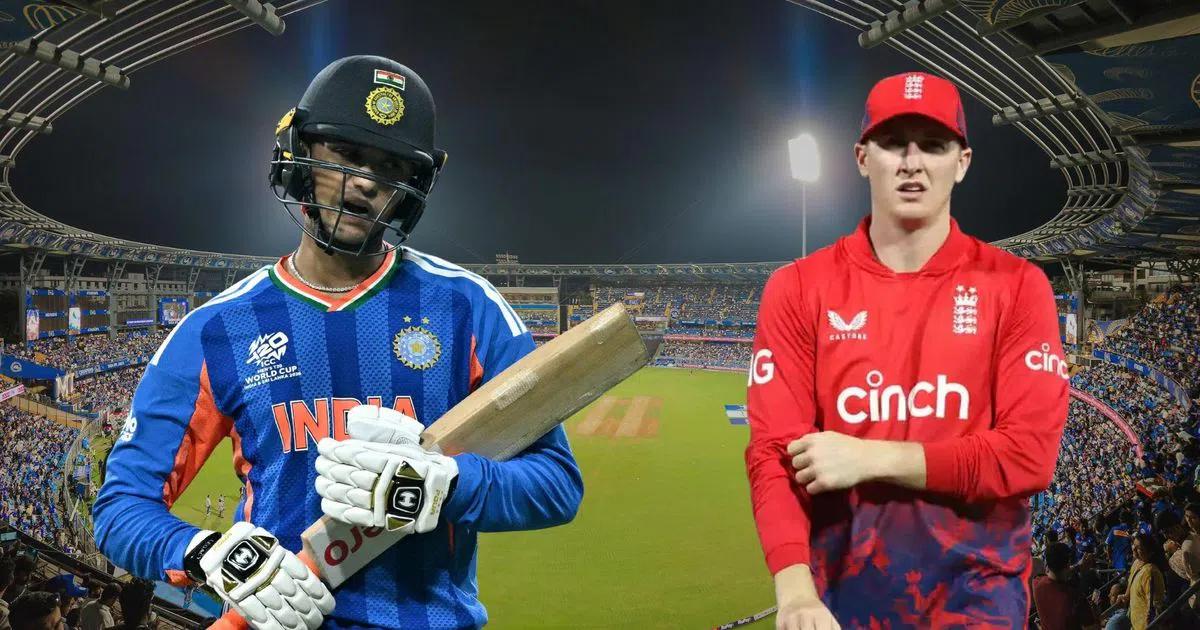
The Oval, 2025. Covered above, and already the most searched card of the modern rivalry. India 224 and 396, England 247 and 367. Six runs, a drawn series, and a fifth day nobody who watched it will forget.
Bengaluru, 2011. The World Cup tie, 338 against 338, in a group game that felt like a final. It remains one of a handful of tied matches in World Cup history, and the card shows two full batting efforts cancelling each other exactly.
Lord’s, 2002. The NatWest final, where India chased 326 to beat England at the home of cricket. The card is remembered for two young batters rebuilding a lost chase in the middle order, and it changed what Indian fans believed an ODI chase could be.
Old Trafford, 1983. The World Cup semi final, India’s win on the way to their first World Cup title. The card is modest by modern totals and enormous in consequence, which is why archive cards reward reading beyond the numbers.
Lord’s, 1932. The first Test of the rivalry, and India’s first Test match anywhere. England won by 158 runs. The notation on that card is identical to the notation on the July 2026 cards, which is the format’s quiet marvel.
Where the Official Cards Live: Platforms Compared
The full card lives on the scoring platforms; this hub points you to the right one and keeps the context they omit. All of them render the same official scoring feed, so their facts agree.
|
Platform |
Best for |
Watch out for |
|---|---|---|
|
ESPNcricinfo and Statsguru |
Records, queries, the deepest archive |
The card sits inside heavy navigation |
|
Cricbuzz |
The canonical fan scorecard layout, fast live updates |
Presentation varies by app and region |
|
ICC match centre |
Official cards for ICC events |
Only covers ICC tournaments, not bilaterals |
|
Provider cards (Sportradar type) |
The at a glance summary search engines surface |
Opaque URLs, zero context around the card |
|
Publisher cards (Moneycontrol type) |
Cards carried inside news sites |
Live page furniture clutters the permanent record |
The full T20I scorecard shows the publisher pattern well. Its T20I page keeps the full card after the match ends, result line in the title. The Lord’s Test scorecard shows the fantasy platform pattern: complete innings and fall of wickets, framed for prediction traffic.
Mirror and farm pages are the layer to avoid. Pages that scrape cards can freeze a mid match state as if it were final, and summaries that paraphrase cards introduce wrong margins. When a summary and a card disagree, the card on a primary platform is right.
This hub’s promise is maintenance, not magic. After every match in this rivalry, the latest card moves to the top, the archive gains an entry, and the head to head table gets a new date. The sports news desk carries the reports.
The same treatment already runs on this site for India’s other great rivalry fixture. The South Africa vs India scorecard hub applies the identical hub pattern to that fixture pair. The cricket coverage gathers all of it in one place on SportsVell.
Frequently Asked Questions
What is the India vs England match scorecard?
The official ball by ball record of a match between the two national teams, set out as tables: batting rows with dismissals, runs, balls, and strike rate, bowling figures, extras, the fall of wickets.
And the full match information block: venue, toss, umpires, result.
The full team name phrasing is the fixture title format used by Google Sports and data providers.
Where can I see the full scorecard of the latest India vs England match?
On the major match centres: ESPNcricinfo and Cricbuzz carry the canonical full cards, the ICC match centre carries official cards for ICC events, and provider feeds power the summaries search engines surface.
The latest completed meeting is the July 2026 tour of England: the 1st ODI at Edgbaston finished England 258 all out, India 262 for 4, India by 6 wickets.
Check the date on any card; this fixture has hundreds of matches.
What was the result of the last India vs England series?
The most recent series is England’s home white ball tour of July 2026: England won the T20Is 4-0 (the first match washed out) and the ODIs 2-1, per records sourced to ESPNcricinfo Statsguru to 19 July 2026.
Before that, the 2025 Anderson-Tendulkar Trophy drew 2-2, and India’s home white ball series of early 2025 finished 4-1 and 3-0 to India.
Series answers expire fast in this rivalry; date stamp them.
What is the head-to-head record between India and England?
Use the dated set, sourced to ESPNcricinfo Statsguru to 19 July 2026: 289 internationals, India 117 wins, England 115, with 57 drawn, tied, or no result.
By format: Tests 141 (India 37, England 53), ODIs 113 (India 62, England 46, including two ties), T20Is 35 (India 18, England 16).
Older pages show smaller totals because they predate the 2026 tour.
The gap is a dates difference, not an error.
Who won the 2025 Anderson-Tendulkar Trophy series?
Nobody: the five Test series in England drew 2-2.
England won at Headingley by 5 wickets and at Lord’s by 22 runs; India won at Edgbaston by 336 runs and at The Oval by 6 runs; Old Trafford was drawn.
Every match reached a fifth day, the series produced a reported aggregate of 7,187 runs, and the Oval finish was India’s narrowest victory in their Test history.
What happened in the Oval Test of 2025?
One of the great Test finishes.
India made 224 and 396 (Jaiswal 118 in the second innings), England replied with 247 and then 367 (Brook 111, Root 105) chasing 374.
Mohammed Siraj took 5 for 104 as India won by 6 runs on the fifth day, drawing the series 2-2.
BBC Sport called the win one of the all time great Tests, and the compact card supports it.
What did Shubman Gill score at Edgbaston in 2025?
269 in India’s first innings of 587, caught Pope bowled Tongue, from 387 balls with 30 fours and 3 sixes, per the provider card of the match.
India won by 336 runs after England chose to bowl.
Gill’s series as captain became its statistical spine: the timeline features credit him with 754 runs across the five Tests, the highest aggregate on either side.
How do I read a cricket scorecard?
Work down each innings.
The batting table gives dismissal text first (c means caught, b means bowled), then R (runs), B (balls), 4s, 6s, and SR (strike rate, runs per 100 balls).
The extras and total follow.
The bowling table reads O, M, R, W, and economy.
The fall of wickets line shows the score at each dismissal with its over, which is the innings story in one string.
What does fall of wickets mean in a scorecard?
The running list of the team score when each wicket fell, with the dismissed batter and the over.
A line like 43-1 (Duckett, 13.3), 44-2 (Crawley, 13.6) means the first wicket fell at 43 in the 14th over and the second at 44 two balls later.
Read in sequence it exposes partnerships, collapses, and recoveries at a glance.
Analysts check it first when a total looks strange for its conditions.
What do the abbreviations on a scorecard mean?
The standard set: c caught, b bowled, lbw leg before wicket, st stumped, run out, not out (asterisk), DNB did not bat, ret hurt retired hurt.
In the extras line: b byes, lb leg byes, w wides, nb no balls.
In bowling: O, M, R, W, ECO.
In the match shape: f/o follow on, dec declared, DLS a weather revised target, RR run rate.
Learn these and any card from 1932 onward reads fluently.
What is the difference between a live score and a scorecard?
A live score is the current state: running total, batters at the crease, required rate.
A scorecard is the complete record: every innings in full, every dismissal, every bowling spell, fall of wickets, and match information.
During play the card builds behind the live score ball by ball.
After the match, the card is the permanent artifact and the live page is frozen or discarded.
This keyword asks for the artifact.
Why do different websites show different head-to-head totals for India vs England?
Because the totals are snapshots from different dates, and this fixture keeps being played.
A page written in 2024 counts roughly 268 meetings; the Statsguru based count to 19 July 2026 counts 289.
Formats drift the same way: pre-2026 pages show 110 ODIs and 29 T20Is, the updated count 113 and 35.
Read the as of date, prefer the newest dated source, and never average two snapshots.
How many Tests have India and England played?
141 as of 19 July 2026, per the Statsguru sourced figures, with England ahead 53 wins to India’s 37 and 51 drawn or undecided.
The rivalry began at Lord’s in 1932, making it one of Test cricket’s oldest.
England dominated the early decades; India’s first series win in England came in 1971.
The modern era is far tighter: India won the 2024 home series 4-1 and drew 2-2 away in 2025.
How many ODIs and T20Is have India and England played?
As of 19 July 2026, per the Statsguru sourced page: 113 ODIs (India 62 wins, England 46, two ties, both in 2011, and three no results) and 35 T20Is (India 18, England 16, one no result).
India lead both white ball formats, reversing the Test pattern.
Any T20I total below 35 is an older snapshot from before England’s 4-0 home series win of July 2026.
What is the Anderson-Tendulkar Trophy?
The trophy contested in Test series between England and India, renamed ahead of the 2025 series in England to honour James Anderson and Sachin Tendulkar, the two countries’ defining modern Test cricketers.
Its first edition under the name drew 2-2 across five Tests with a reported aggregate of 7,187 runs.
The same trophy now covers series in both countries, replacing the separate names each host once used.
When is the next India vs England match?
Check a live fixtures source rather than any static page, because this rivalry’s schedule shifts with the Future Tours Programme and tournament draws.
The pattern: ICC events most years and a bilateral series roughly every two years, alternating home advantage.
The last completed meetings were the July 2026 white ball series in England.
Any page answering this without a visible update date should be treated as stale by default.
What was the scorecard of the India vs England match on 11 July 2026?
A T20I in England’s home series: England 257 for 3 (Jos Buttler 131 off 64 with 12 fours and 8 sixes, Harry Brook 95 not out off 45), India 201 for 8 (Ishan Kishan 56 off 35).
England won by 56 runs.
England’s fall of wickets shows the second and third wickets both fell at 241: a platform, then a late burst.
The full card is preserved on publisher score pages.
What was the scorecard of the 1st ODI at Edgbaston in July 2026?
Per the provider card surfaced for this exact query: England won the toss, chose to bat, and were bowled out for 258 in 47.5 overs.
India chased with 262 for 4 in 45.2 overs and won by 6 wickets.
Lines on that card include Ben Duckett 43 off 45 for England and a brief Virat Kohli innings of 5, lbw to Jofra Archer, in the chase.
It opened the ODI series England eventually took 2-1.
Who has scored the most runs in India vs England matches?
In Tests, the rivalry’s modern giants anchor the charts: Sachin Tendulkar and Joe Root sit at the top for this fixture, with Root’s tally still growing through 2025.
In T20Is, timeline features credit Virat Kohli with 648 runs against England and Jos Buttler close behind with 644.
Present every such list with its date: Root and Buttler remain active, so the order can still change with one more series.
Who has taken the most wickets in India vs England Tests?
James Anderson built the defining bowling record of this fixture across two decades of tours, and his name now sits on the series trophy itself, which tells you where the record book places him.
India’s home era spin attacks own their side of the ledger, with Ravichandran Ashwin the modern standard bearer before his Test retirement.
Both attacks have since turned over, so current pages should date the record and note who is still active.
What is India’s highest team total against England?
The modern benchmark in this research is 587 all out at Edgbaston in July 2025, built on Gill’s 269, with India’s 427 for 6 declared in the same match behind it.
Historically, India’s 664 at The Oval in 2007 and their 631 at Mumbai in 2016 sit in the same conversation, while England’s 669 at Old Trafford in 2025 shows the traffic runs both ways.
Totals records are format specific; name the match, not just the number.
What is the narrowest win in India vs England Tests?
India’s 6 run win at The Oval in August 2025, described by the timeline features as the narrowest victory in India’s entire Test history, inside their 13 run win over Australia at Mumbai in 2004.
The same series produced England’s 22 run win at Lord’s, its second tightest finish.
Margins by wickets keep their own list, headed by one and two wicket wins scattered across the rivalry’s history.
Have India and England ever tied a match?
Yes, in ODIs: two ties, both in 2011, the World Cup group game in Bengaluru at 338 apiece and a rain affected game at Lord’s later that year, per the records pages.
Drawn Tests are plentiful (51 in the dated count) but a draw and a tie are different results: a draw means time expired, a tie means scores level with the innings complete.
Tournament T20I ties are settled by a Super Over and recorded as a win and a loss.
What does 262/4 mean on a scorecard?
262 runs scored for the loss of 4 wickets. The runs slash wickets format is the standard compact notation across the scorecard tradition; some databases write 262-4 instead.
In a chase, the winning card stops at the target with wickets in hand, exactly as India’s 262 for 4 does in the Edgbaston ODI of July 2026.
India needed 259.
The card ends when the winning run is scored, not when the overs run out.
What is strike rate and economy on a scorecard?
Strike rate (SR) is runs per 100 balls faced: Buttler’s 131 off 64 prints at 204.68.
Economy (ECO) is runs conceded per over: 33 runs in 4 overs is an economy of 8.25.
Together they are the fastest quality check on any innings, turning raw totals into pace.
Modern cards print both beside every player line, which is why a fan can judge an innings from the table alone.
How can I find an old India vs England scorecard, like from 1983 or 2002?
The deep archives live on ESPNcricinfo and Cricbuzz, which carry full cards back to the fixture’s start in 1932.
Search by the match, not the series: the 1983 World Cup semi final, the 2002 NatWest final at Lord’s, or the 2011 Bengaluru tie all hold permanent match pages.
Howstat and the ICC archive supplement the two big databases.
A good hub links the famous cards directly, because fans remember matches, not tours.
What is the difference between the ESPNcricinfo and Cricbuzz scorecards?
Content, almost nothing: both publish the same official scoring in the same table structure, and both are trusted records.
The differences are presentation and extras.
ESPNcricinfo pairs its card with Statsguru, the deepest public statistics database in the sport; Cricbuzz pairs its card with faster live updates and heavier fan features.
For records research Statsguru is the differentiator.
Either is a valid citation; name the one you used.
Do scorecard pages include ball by ball commentary?
The big platforms archive their ball by ball commentary with the match, so the scorecard usually sits one tab away from the over by over text.
Provider cards generally carry tables only.
If you need to know how an innings turned, combine the two: the fall of wickets shows what fell and when, while the commentary shows the pressure that built before it.
Reports alone rarely preserve either layer completely.
What is the player of the match record for the 2025 Test series?
The series award went to India’s captain Shubman Gill, on 754 runs including the 269 at Edgbaston.
Match awards across the five Tests tracked the decisive performances: Edgbaston and The Oval belonged to India’s winners, Headingley and Lord’s to England’s.
Player of the match is printed in the match info section of every full card, which is why the card, not the report, is the citation of record for awards.
Why does the scorecard show extras separately?
Because extras are runs the batting side did not score off the bat: byes, leg byes, wides, and no balls, gifted by the bowling side or the conditions.
Cards print the breakdown as a line (for example b 15, lb 7, w 1, total 23) between the batting table and the total.
In a finish as tight as the Oval’s 6 runs, the extras column is not a footnote; it is part of the margin.
Can I download the India vs England scorecard?
The platforms do not generally offer an official PDF of a single card, but the cards are permanent web pages, and printing to PDF from a browser produces a clean copy of the tables.
The signed official scoresheet lives with the match referee’s report and is not published.
For structured data work, ESPNcricinfo’s Statsguru allows proper queries of the same information, which is the practical route for records and content building.
What is a match centre and how is it different from a scorecard page?
A match centre is the hub the scorecard lives inside: scorecard tab, commentary tab, squads, venue guide, session timings, and links to reports and highlights.
A scorecard page is the single tab.
Governing bodies (ICC, BCCI, ECB) run match centres for their events; media platforms run their own.
Search engines increasingly surface the data layer directly, which is why this keyword’s results are provider cards rather than articles.
How accurate are scorecards on data provider sites?
The major feeds score from the official scoring at the ground, and errors are rare and usually corrected within the match.
The risks are downstream: mirror domains that scrape cards can freeze a mid match state as if final, and content farms paraphrasing cards introduce wrong margins.
The discipline is simple: trust the card on a primary platform, and treat any summary that disagrees with the card as the error, not the other way round.
What happened in the India vs England T20 World Cup semi final of 2024?
India won by 68 runs in Providence, Guyana, and went on to lift the trophy, a result the timelines describe as revenge for England’s 10 wicket win in the 2022 semi final at Adelaide.
The knockout pattern is a modern storyline of the rivalry: India keep winning the World Cup meetings that eliminate England.
England’s white ball strength at home is the standing counterweight.
They showed it again in the 4-0 T20I series win of July 2026.
What is India’s record against England at Lord’s?
Lord’s is the fixture’s spiritual home: the rivalry began there in 1932, and the ground holds its most retold cards, from the 2002 NatWest final chase to England’s 22 run win in 2025.
India’s Lord’s Test wins are rare enough to be individually famous (1986, 2014, 2021), which is why venue splits matter here more than in most rivalries.
A dated venue records table is one of the highest value additions any hub can publish.
Which India vs England match had the most runs?
The 2025 series is the modern benchmark, with a reported aggregate of 7,187 runs across five Tests, noted by the timeline features as a series record.
At match level, the Old Trafford Test of 2025 produced 1,452 runs across three completed innings (India 358, England 669, India 425 for 4) without producing a result.
Always name whether an aggregate claim means a match, a series, or a tour; the three lists have different leaders.
How are scorecards kept in cricket?
By official scorers appointed for the match, traditionally one per side, recording every ball: batter, bowler, runs, extras, dismissals.
The scorebook has become scoring software that feeds the broadcast, the apps, and the databases simultaneously, which is why every platform’s card agrees on the facts while layouts differ.
The Laws of Cricket assign scoring duties formally, and the signed scoresheet is the document of record if a number is ever disputed.
What does it mean when a scorecard says a batter retired hurt?
The batter left the field through injury or illness without being dismissed, and may resume the innings later if fit.
The card marks the line retired hurt rather than out, and the fall of wickets does not advance.
If the batter cannot return, the innings closes one short.
Cards preserve the distinction from not out and did not bat because it affects averages, records, and the honest reading of the innings.
Why do some scorecard pages rank for this keyword instead of news articles?
Because the query is a data request wearing a sentence’s clothes.
The phrasing is the exact fixture title Google Sports and providers generate, so engines answer with the data object itself: provider cards, platform scorecards, live pages.
News reports rank only when they carry the card or a records angle, like the head to head features in the same results.
To compete for fixture queries, a publisher must publish the data layer, not only write about the match.
What should a good India vs England scorecard page include?
The complete standard card, nothing summarised away: all innings in full with batting and bowling tables, extras breakdowns, fall of wickets for every innings, and match info (venue, dates, toss, umpires, result, player of the match).
Around it, what the data pages omit: the series state the match leaves behind, a dated head to head snapshot, a short report of how the match turned, and links to the other cards of the series.
Is the scorecard the same for Tests, ODIs, and T20Is?
The tables are identical in structure; the match shape differs.
A Test card can hold four innings across five days with declarations and a follow on marker.
An ODI card holds two innings of 50 overs, with a DLS line if weather intervened.
A T20I card holds two 20 over innings and may add a Super Over, recorded separately.
Reading skill transfers completely; what changes is which columns carry the story.
What was the first ever India vs England match scorecard?
The rivalry’s first Test was played at Lord’s in June 1932, England winning by 158 runs, and its card survives in the ESPNcricinfo and Cricbuzz archives like every other match in the fixture.
It was India’s first ever Test match, captained by C K Nayudu, against Douglas Jardine’s England months before the Bodyline tour.
The notation is identical to today’s, so a fan who reads the latest card can read 1932’s without translation.
Conclusion
India national cricket team vs England cricket team match scorecard searches end the same way every time: with the card. The latest meetings sit at the top, the 2025 series and the dated record book beneath them, and the reading guide turns those tables into a story.
Keep the discipline this page runs on. Trust the card over the summary, read the date beside every aggregate, and let the fall of wickets tell you how an innings actually lived and died. The rivalry will add new numbers soon enough; it always does.
Follow the cricket coverage on SportsVell for the next card the day it is played. Every new fixture in this rivalry will be added to this page with its date, venue, and full card.