
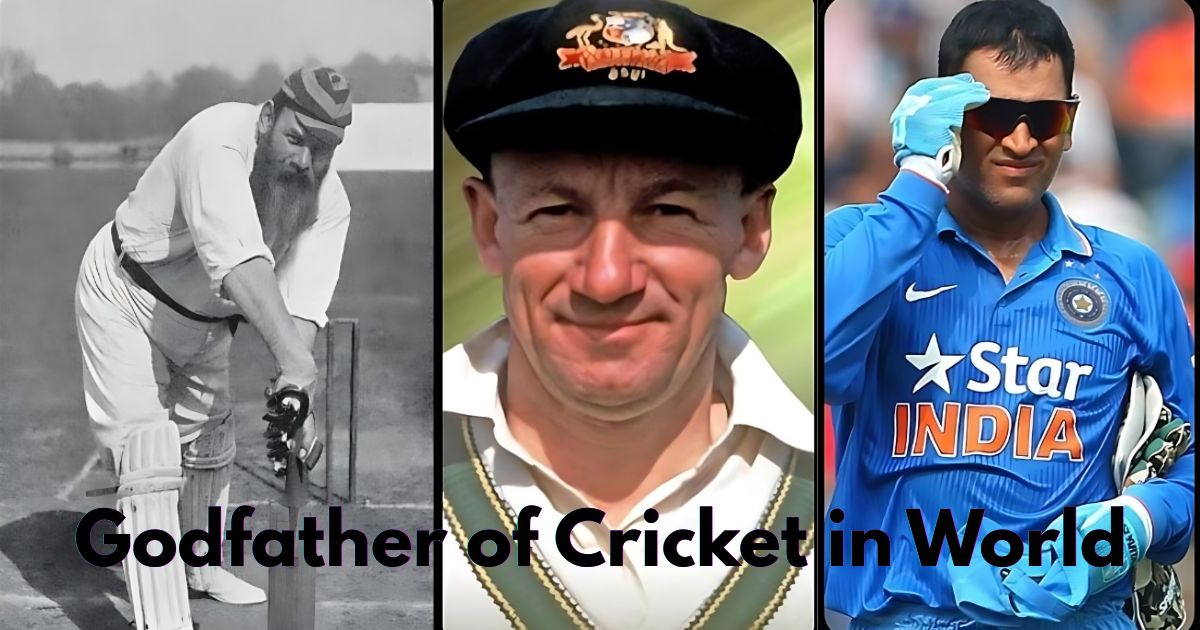
Cricket has produced gods. Genuinely. Players whose names get whispered with reverence in living rooms, school playgrounds, and stadium stands across continents. But the term “Godfather” is something different entirely. It carries weight. It implies that without this person, the game itself would look different.
So who is the Godfather of Cricket in world? That is the question worth spending real time on. Not just listing names — but understanding why certain individuals transcended the sport and rewired it permanently. This article walks you through every serious contender, every compelling argument, and every unforgettable legacy.
How The Term “Godfather of Cricket” Came About
Nobody sat in a boardroom and officially handed out the title. It emerged organically — the way all truly powerful reputations do. Fans started using it. Journalists picked it up. And over decades, certain names became so synonymous with the soul of cricket that calling them anything less felt like an understatement.
The phrase “Godfather of Cricket” first gained real traction when discussions about W.G. Grace dominated Victorian sporting journalism. Grace was so dominant, so larger-than-life, that ordinary cricket vocabulary simply could not contain his influence. From there, the title became an informal but deeply meaningful badge — awarded by collective memory rather than any official body. Today, when people ask who is the Godfather of Cricket in world, they are really asking who left the deepest fingerprints on the game’s DNA.
What Makes Someone the ‘Godfather’ of Cricket?
Before diving into the names, it is worth establishing the criteria. Because greatness alone does not qualify someone. There have been hundreds of great cricketers. The Godfather title demands something more. Something rarer.
1. Legacy off The Field
True Godfathers shaped cricket beyond the boundary rope. They influenced how the game was administered, how it was perceived culturally, and how future generations related to it. Their impact did not end when they hung up their boots. It compounded.
2. Leadership Under Criticism
Every legend on this list faced enormous pressure, public scrutiny, or outright opposition at some point. What separated them was the ability to perform — and lead — precisely when the world was watching and doubting. That composure under fire is a Godfather quality.
3. Records And Consistency
Numbers matter. Not because cricket is purely statistical, but because consistency over long periods is the most honest proof of genuine mastery. The Godfathers of this game were not one-season wonders. They showed up, decade after decade, and delivered.
4. Innovation And Courage
Each person on this list changed something. A batting technique. A leadership philosophy. The very structure of how cricket is organised and consumed. Innovation requires courage because it means doing something before the world tells you it is acceptable.
5. Emotional Connection
Perhaps the most important criterion of all. The Godfathers of cricket made people feel something. They turned casual viewers into lifelong fans. They gave nations something to rally around. That emotional magnetism is what separates legends from icons.
Read more related article: Green Bay Packers vs Dallas Cowboys Match Player Stats Analysis
1. W.G. Grace – The First Godfather of Cricket
If you are asking who is the Godfather of Cricket in world from a purely historical standpoint, William Gilbert Grace is where the conversation must begin. Born in 1848, Grace did not just play cricket well — he invented what professional cricket looked like. Before Grace, the sport was largely an aristocratic pastime with inconsistent rules and minimal public spectacle. Grace changed all of that single-handedly. He turned batting into an art form when it was still largely agricultural slogging. He understood footwork, timing, and placement in ways that his contemporaries simply could not match. His beard became as iconic as his batting average. His presence on a cricket ground guaranteed crowds that organisers had never seen before.
Grace essentially created the concept of the cricket celebrity — the player whose name alone sells tickets. He played first-class cricket for an almost incomprehensible 44 years, scoring nearly 55,000 runs across all formats. Those numbers from an era with uncovered pitches, rudimentary equipment, and gruelling travel are almost supernatural. When people debate who is the Godfather of Cricket in world, Grace’s name deserves to lead every serious list because without him, the entire professional structure of the game might have taken another generation to emerge.
2. Sir Donald Bradman – Godfather of Perfectionism
There are statistics, and then there is Don Bradman. The Australian’s Test batting average of 99.94 is not just a record — it is a mathematical anomaly that statisticians still struggle to contextualise properly. The next best average in history sits around 60. Bradman’s gap above everyone else is so vast that it has no parallel in any major sport. He is, by every quantitative measure, the greatest batsman who ever lived. But calling him simply the greatest batsman undersells what he meant to Australia and to cricket’s global reputation. Bradman played during the Great Depression.
When Australia was economically devastated and nationally deflated, Bradman gave the country something to believe in. His performances were not just sporting achievements — they were acts of national restoration. The 1932-33 Bodyline series, where England deliberately targeted him with intimidatory short-pitched bowling, became one of the most politically charged episodes in cricket history. And through it all, Bradman adapted, endured, and kept scoring. He retired with a Test average that would have been 100 had he scored just four runs in his final innings. He was dismissed for a duck. That tiny fragment of vulnerability in an otherwise flawless career somehow makes him even more human. When the question of who is the Godfather of Cricket in world is framed around pure technical mastery and statistical perfection, Bradman’s answer is essentially unanswerable.
3. Sir Ranjitsinhji – Batting Artist
Some cricketers play the game. Ranjitsinhji painted it. The Indian-born Prince who represented England at the turn of the 20th century introduced a style of batsmanship so fluid, so wristy, and so aesthetically revolutionary that English cricket writers genuinely struggled to describe it. They had simply never seen anything like it. Ranji, as he was universally known, pioneered the leg glance — a stroke that redirected the ball behind square leg with a flick of the wrists that appeared almost impossibly casual. Before Ranji, that was not considered a legitimate cricket shot. After him, it became a staple of the batting vocabulary. His contribution was not just technical. He proved that cricket could absorb different cultural influences and become richer for it. He was, in many ways, the first global cricketer — a man who straddled two worlds and enriched both. His legacy lives in every batsman who uses their wrists to manipulate the ball rather than purely playing with brute power.
4. Sir Garfield Sobers – The Complete Cricketer
Ask any cricket historian who is the Godfather of Cricket in world in terms of all-round brilliance, and Garfield Sobers will emerge as the definitive answer. The Barbadian genius was quite simply the most complete cricketer the game has ever produced. He could open the batting or come in at number six with equal authority. He bowled three distinct styles — orthodox left-arm spin, chinaman, and left-arm fast-medium — and was genuinely dangerous with all three. He was an electric fielder. He led the West Indies with intelligence and flair. In 1958, he set the Test batting record with 365 not out — a score that stood for 36 years. In 1968, playing for Nottinghamshire against Glamorgan, he became the first batsman in history to hit six sixes in a single over. That moment — six balls, six sixes, off Malcolm Nash — is not just a cricket highlight. It is a permanent entry in the mythology of human sporting achievement. Sobers did things on a cricket field that simply should not have been possible from a single human being. His name belongs in any serious answer to who is the Godfather of Cricket in world, precisely because he mastered every single dimension of the sport simultaneously.
5. Kapil Dev – The Indian Godfather of Confidence
Before 1983, Indian cricket had talent. It had beauty. It had Gavaskar’s technical perfection and a rich domestic structure. But it lacked one thing — the belief that India could win a World Cup. Kapil Dev supplied that belief, spectacularly, on 25 June 1983 at Lord’s Cricket Ground. The 1983 World Cup win was not just a sporting triumph. It was a cultural earthquake. It transformed how India related to cricket and how cricket related to India. Within years of that victory, the BCCI began its ascent toward becoming the world’s most powerful cricket board.
The IPL, the broadcast billions, the global influence India now commands in the sport — all of it traces its roots back to Kapil Dev lifting that Prudential Cup trophy. His knock of 175 not out against Zimbabwe in that same tournament — made without a single television camera recording it, since the feed was cut — remains one of the great what-if moments in sporting history. Those who saw it say it was the greatest ODI innings ever played. Kapil Dev did not just win a World Cup. He gave an entire nation permission to dream bigger about cricket. For India specifically, he is the Godfather of that confidence.
6. Sachin Tendulkar – The Emotional Godfather
No conversation about who is the Godfather of Cricket in world reaches its natural conclusion without spending real time on Sachin Ramesh Tendulkar. He is not just a cricketer. He is a generational experience. For hundreds of millions of Indians who grew up between 1989 and 2013, Sachin’s innings were the punctuation marks of their lives. Examinations were rescheduled around his batting. Families gathered around televisions. Streets fell quiet when he walked to the crease. The weight of a nation’s expectations sat on his shoulders for over two decades, and he carried it with a grace that still defies comprehension. His numbers are staggering — 100 international centuries, over 34,000 international runs, records that may never be broken. But the numbers, extraordinary as they are, do not capture the real story.
The real story is what Sachin meant to people. He gave India’s middle class a hero who looked like them, came from an ordinary Mumbai neighbourhood, worked harder than everyone else, and became the best in the world through sheer dedication. When he finally won the World Cup in 2011 at home, the emotional release across India was unlike anything the country had collectively experienced in sport. Tendulkar is the emotional Godfather of cricket — the figure around whom an entire generation built their relationship with the game.
7. MS Dhoni – The Modern Godfather
If Sachin is the emotional Godfather, MS Dhoni is the strategic one. The man from Ranchi who became the most successful captain in Indian cricket history reshaped what leadership in the sport could look like. Calm where others panicked. Decisive where others hesitated. Willing to bat at number seven in a World Cup final and then deliver the winning six — that is a kind of psychological architecture that coaching manuals cannot fully teach. Dhoni won the 2007 T20 World Cup, the 2011 ODI World Cup, and the 2013 Champions Trophy — making India the first team to hold all three major ICC trophies simultaneously. His wicketkeeping instincts were preternatural. His running between wickets redefined what was possible. But his greatest contribution was perhaps cultural — he proved that world-class cricketers could emerge from small Indian cities, not just Mumbai and Delhi. He opened the floodgates for an entire generation of cricketers from Tier-2 and Tier-3 Indian towns. In the IPL, his CSK legacy stands as the most consistent franchise achievement in the tournament’s history. When people ask who is the Godfather of Cricket in world in the modern era, Dhoni’s name carries enormous weight — not just for what he did, but for how he changed what Indian cricket believes about itself.
8. Kerry Packer – The Godfather Off the Field
Not every Godfather of cricket held a bat. Kerry Packer never played a single professional match. But what he did in 1977 changed the sport more dramatically than almost any player in history. The Australian media mogul, frustrated after the Australian Cricket Board refused to sell him broadcast rights, simply built his own cricket competition — World Series Cricket. He signed 51 of the world’s best players, including the West Indies legends, Tony Greig, and most of Australia’s top stars. He introduced coloured clothing. Day-night matches. Helmets. Fielding restrictions. Marketing and presentation that treated cricket like entertainment rather than an institution.
The cricket establishment was furious. They called it a circus. They tried to ban the players. They failed on every front. Because Packer’s cricket was genuinely better — better presented, better lit, more exciting, and more fairly compensating the players who made the sport worth watching. Within two years, the establishment capitulated completely and adopted almost everything Packer had introduced. The modern game — the helmets, the coloured kits, the floodlights, the broadcast deal culture — is his legacy. Any honest answer to who is the Godfather of Cricket in world must include the man who blew up the old structure and forced the sport to reinvent itself.
9. Sir Vivian Richards – The Fearless Godfather
Viv Richards did not just bat. He made statements. Every time he walked to the crease — no helmet, chest puffed, chewing gum working overtime — he was communicating something to the bowler, the crowd, and the cricket world. The message was simple: I am not afraid of you. Richards averaged over 50 in Tests and over 47 in ODIs. He scored the fastest Test century of his era. He anchored the most dominant cricket team in history — the West Indies sides of the 1970s and 1980s — at the top of the batting order. But his numbers, impressive as they are, underrepresent his actual impact.
Richards played in an era when the West Indies’ dominance in cricket carried profound cultural and political meaning. For the Caribbean, for Black communities across the world, West Indies cricket was not just sport. It was a statement of excellence and dignity in the post-colonial world. Richards embodied that statement more powerfully than anyone. His fearlessness, his refusal to wear a helmet as a deliberate act of defiance, his unyielding self-belief — these qualities made him a symbol far beyond cricket. He belongs in every serious conversation about who is the Godfather of Cricket in world, because his legacy operates on multiple levels simultaneously.
Conclusion
So who is the Godfather of Cricket in world? The honest answer is that it depends on which dimension of the game you value most. If you want historical foundation — W.G. Grace built the house. If you want statistical perfection — Bradman set the standard no one has matched. If you want all-round genius — Sobers remains untouchable. If you want emotional connection and cultural transformation — Sachin Tendulkar changed what cricket means to a billion people. If you want modern strategic brilliance — Dhoni redefined leadership. If you want structural revolution — Kerry Packer tore down the old order and rebuilt something better. Every name on this list earned their place through a different kind of greatness. But if one person must be named the single Godfather of Cricket in world for reshaping the sport across every dimension — its culture, its audience, its emotional hold — Sachin Tendulkar carries that argument most powerfully into the modern era, while W.G. Grace anchors the historical foundation. Cricket is richer, more global, more beloved because all of them existed.
FAQs
Who is called the Godfather of Cricket?
There is no single official title holder, but W.G. Grace is widely regarded as the original Godfather of Cricket for building the sport’s professional foundation in the 19th century. In the modern era, Sachin Tendulkar carries that recognition for his unmatched cultural and statistical impact.
Who is called the Godfather of Indian Cricket?
Sachin Tendulkar and MS Dhoni both carry this informal title in India. Tendulkar for inspiring generations through his batting, and Dhoni for transforming Indian cricket’s winning mentality and global dominance.
Who changed the world the most without playing cricket?
Kerry Packer. His World Series Cricket revolution in 1977 introduced coloured clothing, helmets, day-night matches, and broadcast-driven cricket culture — changes the sport still operates within today.
Can anyone from the modern era become the next Godfather of cricket?
Virat Kohli is the strongest current candidate. His records, intensity, and global fan base position him as a generational figure. Joe Root and Steve Smith are other names with lasting legacy potential, but only time and continued consistency will confirm that status.
Why is the title “Godfather of Cricket” so important?
It represents the highest recognition a cricketer or cricket figure can receive from the sport’s collective memory. It signals that this person did not just play the game — they permanently changed it, expanded its reach, and deepened its meaning for millions of people worldwide.
