
How Many Acres Is a Football Field? 1.32 Acres Explained
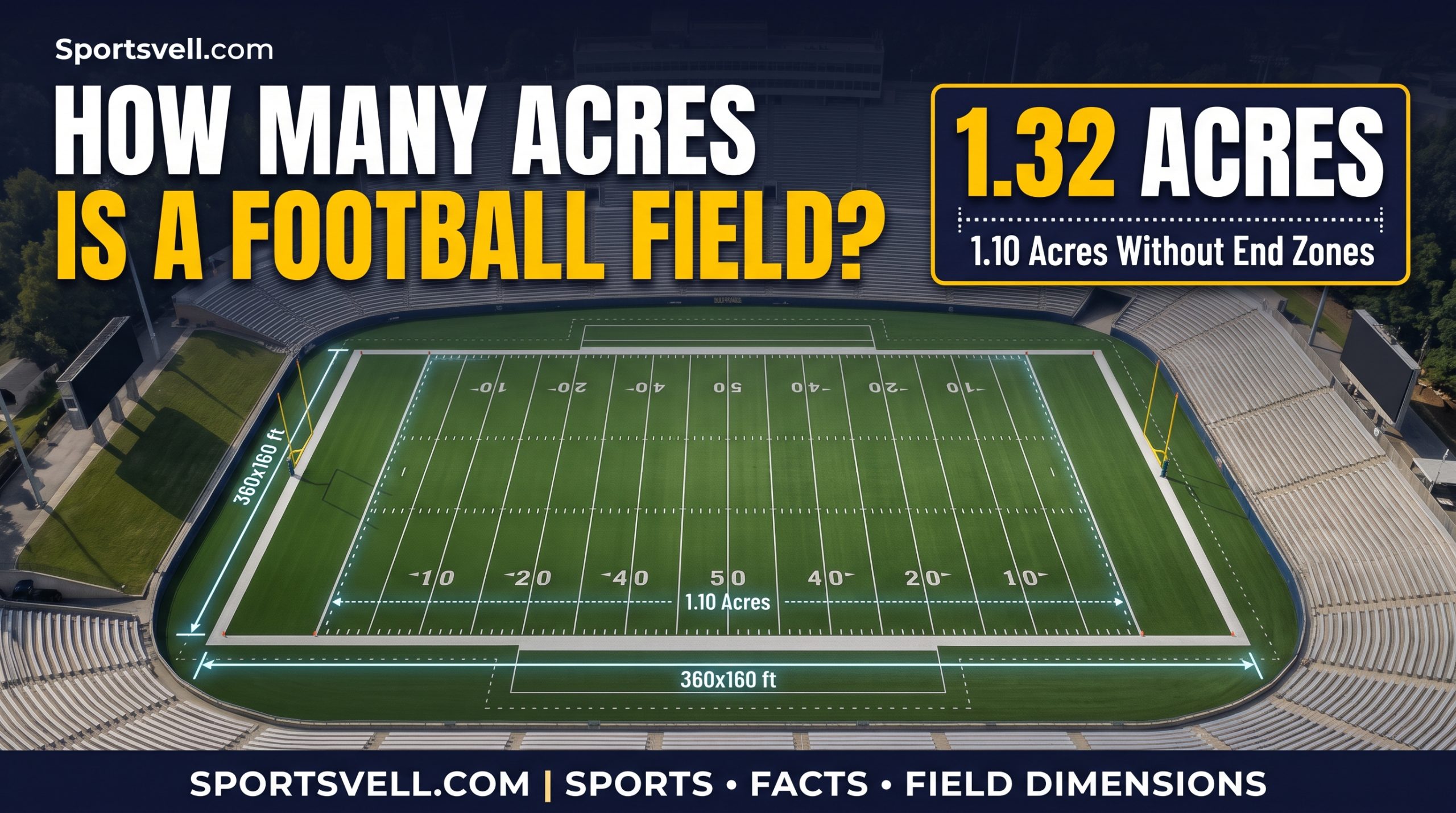
How many acres is a football field? A standard American football field is 1.32 acres including the end zones. It measures 120 yards long by 53 1/3 yards wide, which is 57,600 square feet. One acre is 43,560 square feet, so the field is about one third larger than a single acre.
Without the end zones, the field is 1.10 acres. The 100 yards between the goal lines cover 48,000 square feet. The two 10-yard end zones add the other 0.22 acres, with each end zone worth 0.11 acres.
This guide gives the full dimensions in feet, yards and meters, shows the math two ways so you can check it yourself, and compares the football field with soccer, Canadian, rugby and baseball fields. It also corrects the common mistakes that even top ranking pages get wrong.
The dimensions are the same in the NFL, NCAA college football and US high school football. Every level uses the same 120 by 53 1/3 yard field, so the 1.32 acre answer holds at every level of the American game.
The Quick Answer: 1.32 Acres With End Zones, 1.10 Without
A football field is 1.32 acres when you count the whole field, end zones included. That is the number to remember, and it is the answer most people are looking for. The field is 360 feet long and 160 feet wide.
A football field is 1.10 acres when you count only the 100 yards between the goal lines. That is the field of play, the part where most of the game happens. The end zones sit outside the goal lines, so they are easy to leave out by mistake.
One acre holds 0.76 football fields. Flip the question around and the answer is a fraction. An acre is about three quarters of a full field, or about 0.91 of the field without end zones. Memorize the pair together: 1 field equals 1.32 acres, and 1 acre equals 0.76 fields.
| What you measure | Length | Width | Square feet | Acres |
|---|---|---|---|---|
| Full field, with end zones | 360 feet | 160 feet | 57,600 | 1.32 |
| Field of play, no end zones | 300 feet | 160 feet | 48,000 | 1.10 |
| One end zone | 30 feet | 160 feet | 4,800 | 0.11 |
| One acre | 660 feet | 66 feet | 43,560 | 1.00 |
The table shows why the two answers exist. The end zones add 60 feet of length, which is 9,600 square feet, or 0.22 acres. If a source does not say whether it counts the end zones, its number will look wrong next to a source that does.
Most wrong answers online come from mixing the two field definitions. Some pages say the field is exactly one acre, which is wrong by 10 percent even without end zones. Others say one acre holds 1.3 football fields, which gets the fraction backwards. This guide keeps the two definitions apart so the numbers stay clean.
Three Numbers to Remember
1.32 acres is the full field. Use this number when someone asks how big a football field is, or when you compare land to a football field. It includes everything inside the boundary lines.
1.10 acres is the field of play. Use this number when you talk about the 100 yards between the goal lines, or when you compare playing areas across sports. It leaves out both end zones.
0.76 fields fit in one acre. Use this number when you flip the question, such as asking how much of a football field your land covers. An acre is about three quarters of a field.
Football Field Dimensions in Feet, Yards and Meters
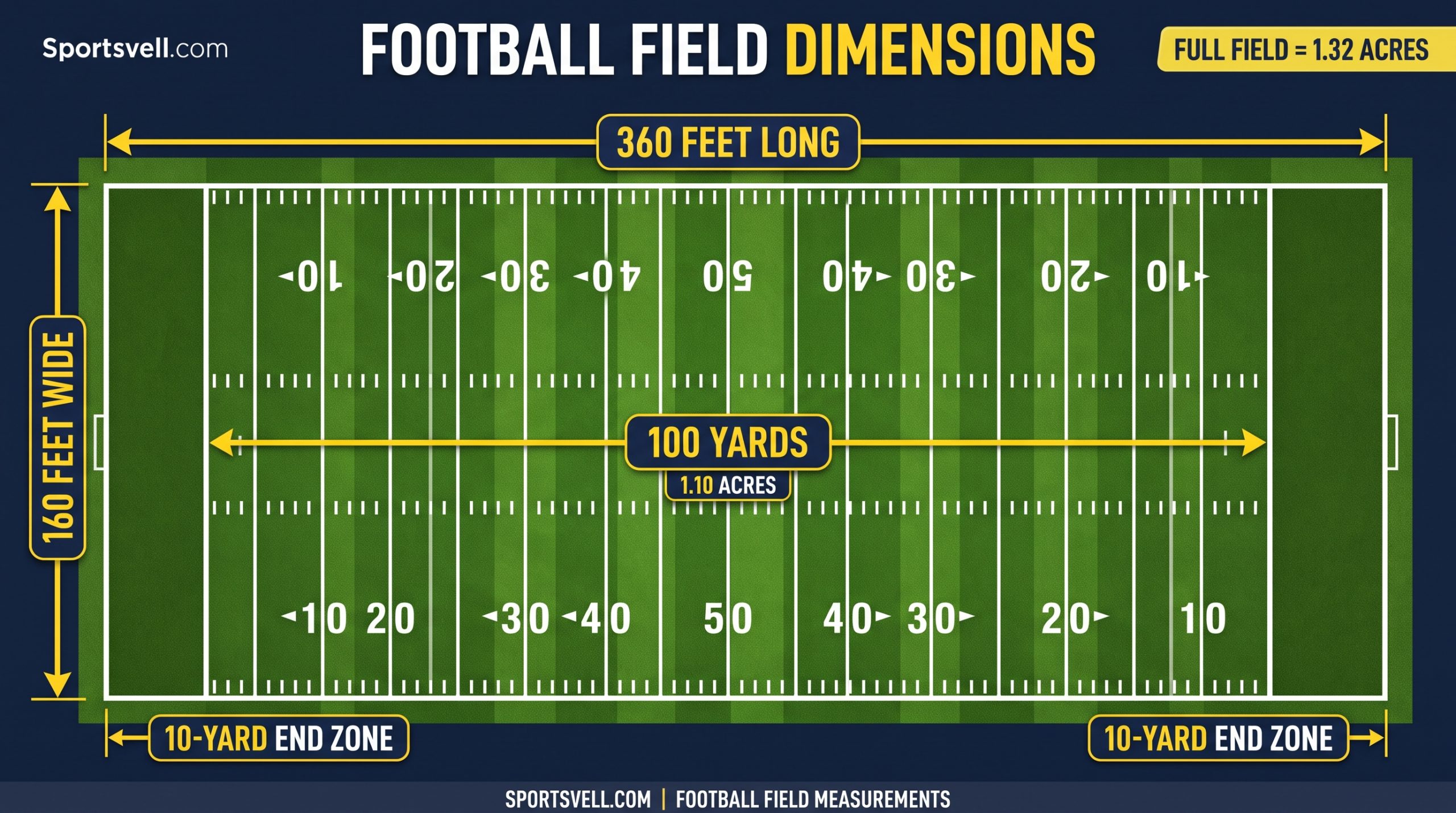
A football field is 120 yards long and 53 1/3 yards wide. In feet, that is 360 feet long and 160 feet wide. In meters, it is about 109.7 meters long and 48.8 meters wide. These numbers are fixed by the rulebooks, not by local choice. The SportsFoundation guide to American football field dimensions lists the same figures in yards, feet and meters.
The width is the odd number. Most people expect a round number, but the field is 53 1/3 yards wide because the width was set at 160 feet in the late 1800s and never changed. The length grew when end zones were added, but the width stayed the same.
Every Line on the Field, Measured
| Feature | Yards | Feet | Meters |
|---|---|---|---|
| Total length, with end zones | 120 | 360 | 109.7 |
| Field of play, goal line to goal line | 100 | 300 | 91.4 |
| Each end zone | 10 deep | 30 deep | 9.1 deep |
| Width | 53 1/3 | 160 | 48.8 |
| Yard lines | Every 5 | Every 15 | Every 4.6 |
| Numbers on the field | Every 10, up to the 50 | Every 30 | Every 9.1 |
| Total area | 6,400 sq yd | 57,600 sq ft | 5,351 sq m |
Yard lines cross the field every 5 yards and are numbered every 10 yards, counting up from each goal line to the 50-yard line at midfield. Short marks between the lines show each single yard, so players and officials can spot the ball precisely.
The goal line itself is part of the end zone. A ball that breaks the plane of the goal line while in a player’s possession counts as a touchdown. That is why the goal line matters more than any other line on the field.
The sidelines and end lines are out of bounds. A white border outlines the playing area, and extra space beyond the sidelines keeps players safely away from walls and seating. The team areas sit behind the sidelines, separated by a restraining line.
The Field in Meters and Hectares
The field is 109.7 meters long and 48.8 meters wide. Its total area is 5,351 square meters, which is 0.535 hectares. A hectare is 10,000 square meters, so the field covers just over half a hectare.
The field of play without end zones is 91.4 meters long. That is 4,800 square meters short of the full field, because each end zone is 9.1 meters deep and 48.8 meters wide. The metric numbers give the same 1.32 acre answer when converted back.
American football is one of the few sports still measured in yards and feet in the United States. Soccer and rugby use meters, which is why comparisons across sports need a conversion table instead of a single number.
The Math: How 57,600 Square Feet Becomes 1.32 Acres
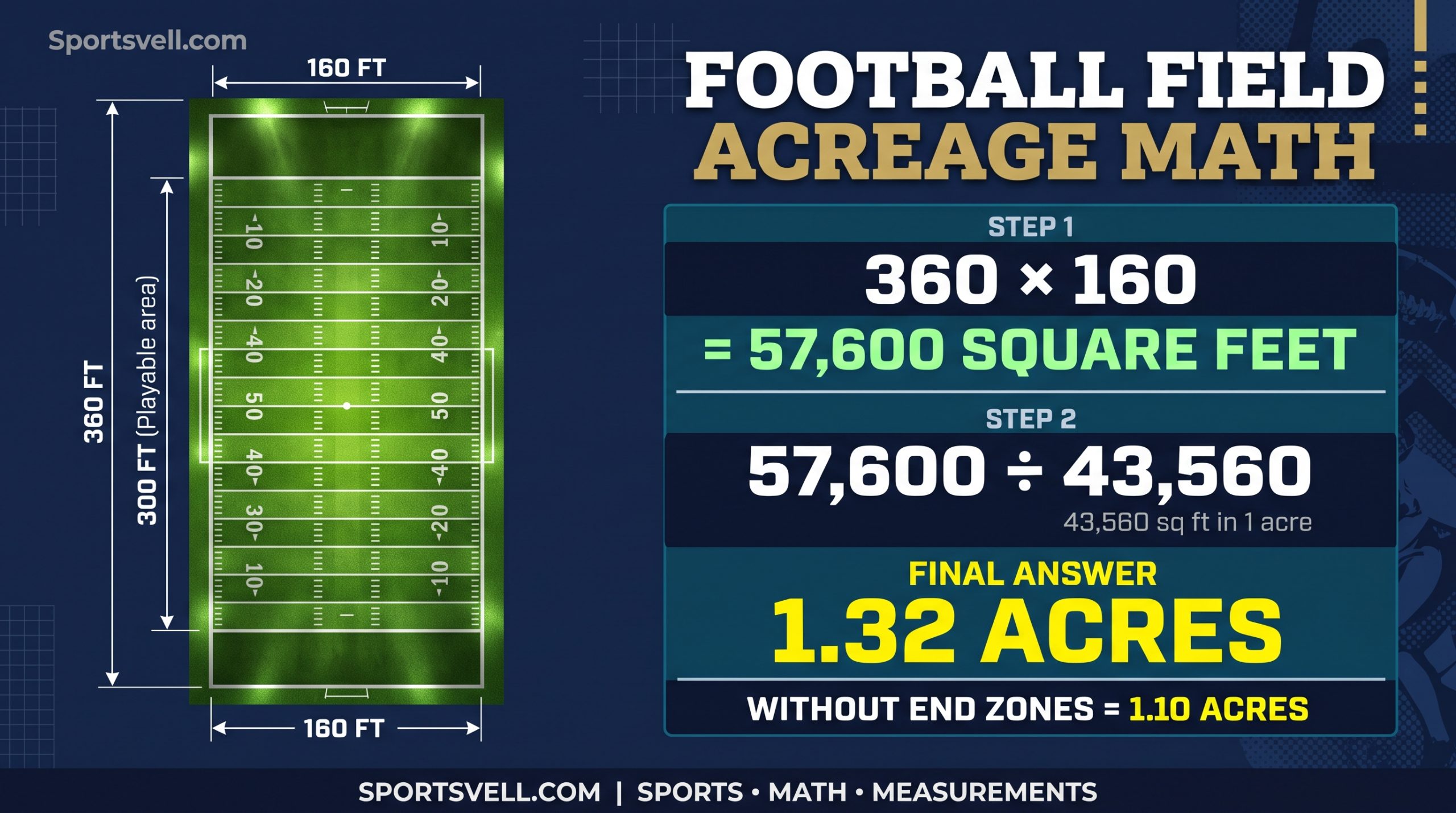
The math takes two steps and one division. First, multiply length by width to get the area in square feet. Then divide by 43,560, the number of square feet in one acre. That is the whole calculation.
Step 1: Length Times Width
Multiply 360 feet by 160 feet to get 57,600 square feet. The formula is the area of a rectangle: length times width. The field is a rectangle, so the formula fits exactly, with no curves or angles to adjust for.
Without end zones, multiply 300 feet by 160 feet to get 48,000 square feet. The width stays the same, and only the length changes. That is why the two acre figures differ by exactly the area of the two end zones.
Each end zone is 30 feet by 160 feet, which is 4,800 square feet. Two end zones together are 9,600 square feet. Add that to 48,000 and you get 57,600 again, which checks the first step.
Step 2: Divide by 43,560
| Step | Calculation | Result |
|---|---|---|
| 1. Area in square feet | 360 x 160 | 57,600 sq ft |
| 2. Convert to acres | 57,600 / 43,560 | 1.3223 acres |
| 3. Round to two decimals | 1.3223 | 1.32 acres |
Divide 57,600 by 43,560 to get 1.3223 acres. Rounded to two decimal places, that is 1.32 acres. The two inputs are both exact by definition, so the answer is exact too, not an estimate. The SportDA guide to football field acres shows the same two-step division and the square-yard cross-check.
Do the same division without end zones: 48,000 divided by 43,560 is 1.1019 acres. Rounded to two decimals, that is 1.10 acres. The end zones add 0.22 acres, which is the difference between the two figures.
Cross-Check: The Same Math in Square Yards
| Step | Calculation | Result |
|---|---|---|
| 1. Area in square yards | 120 x 53.33 | 6,400 sq yd |
| 2. Convert to acres | 6,400 / 4,840 | 1.3223 acres |
| 3. Round to two decimals | 1.3223 | 1.32 acres |
Football is measured in yards, so the square-yard check matters. The field is 120 yards by 53 1/3 yards, which is 6,400 square yards. One acre is 4,840 square yards, so 6,400 divided by 4,840 gives 1.3223 acres again.
Two different units give the same answer. That is the point of the cross-check. If the feet calculation and the yards calculation disagree, one of them has an error. Here they agree to four decimal places.
One acre is 4,840 square yards because one acre is 43,560 square feet and one square yard is 9 square feet. Divide 43,560 by 9 and you get 4,840. The two definitions of an acre are the same unit, just written in different measures.
Is a Football Field Exactly One Acre? No
No, a football field is not exactly one acre. A full field is 1.32 acres, which is 32 percent larger than a single acre. Even without end zones, the field is 1.10 acres, which is still 10 percent larger than an acre.
The myth is widespread but wrong. It survives because both units describe “a big open space” in everyday talk, and because 1.32 rounds down to 1 in casual speech. In real estate and land planning, that rounding error matters, because 0.32 acres is nearly 14,000 square feet.
One top-ranking page states the myth as fact, claiming the field without end zones is “exactly 1 acre”. It is not. The field of play is 48,000 square feet, and 48,000 divided by 43,560 is 1.10 acres, not 1.00. That page is wrong by 4,440 square feet.
Where the One-Acre Myth Comes From
People round 1.32 down to 1 when they talk casually. A football field feels like one unit of land, so the brain treats it as one acre. The number 1.32 is close enough to 1 that the error goes unnoticed in conversation.
Real estate listings make the myth worse. Agents often say a property is “the size of a football field” when they mean it is roughly one acre. The comparison is vivid, but it is off by a third of an acre, which is a large error on a small lot.
School projects spread the myth too. Students learn that an acre is about the size of a football field, and the “about” gets dropped when they repeat it. The field is a useful picture of an acre, but it is not an acre.
The 32 Percent Gap, in Plain Numbers
| Measure | One acre | Full football field | Difference |
|---|---|---|---|
| Square feet | 43,560 | 57,600 | 14,040 more |
| Square yards | 4,840 | 6,400 | 1,560 more |
| Square meters | 4,047 | 5,351 | 1,304 more |
| Percent larger | Base | 32 percent larger | 32 percent |
The field is 14,040 square feet larger than an acre. That gap is about the size of three typical house lots, or about a third of another football field. It is not a rounding error, and it is not close enough to ignore.
Without end zones, the gap is 4,440 square feet. The field of play is 48,000 square feet against an acre’s 43,560. That is still a 10 percent gap, which is about the size of a large house footprint.
Are NFL, College and High School Fields the Same Size?
Yes, the field dimensions are identical across the NFL, NCAA college football and US high school football. Every level uses a 120-yard field that is 53 1/3 yards wide, so every level covers 1.32 acres. The answer does not change with the level of play.
The sameness is unusual in sports. Most sports change field sizes between levels, but American football fixed its dimensions early and kept them. A high school field and an NFL field have the same acreage, even though the stadiums around them are very different sizes.
| Level | Length | Width | Area | Acres |
|---|---|---|---|---|
| NFL | 120 yards | 53 1/3 yards | 57,600 sq ft | 1.32 |
| NCAA college | 120 yards | 53 1/3 yards | 57,600 sq ft | 1.32 |
| High school (NFHS) | 120 yards | 53 1/3 yards | 57,600 sq ft | 1.32 |
The field dimensions are set by three rulebooks. The NFL Rulebook sets the professional field, the NCAA Football Rules set the college field, and the NFHS Football Rules set the high school field. All three agree on 120 yards by 53 1/3 yards.
What changes between levels is not the field size but the markings. The hash marks get wider as the level drops, and the goalposts get wider in high school. The field itself stays the same, which is why the acreage never changes.
Hash Marks by Level
| Level | Distance between hash marks | Effect on play |
|---|---|---|
| NFL | 18 feet 6 inches | Ball starts near the middle, so offenses can attack both sides |
| College | 40 feet | Wider short side and wider field side |
| High school | 53 feet 4 inches | Very pronounced short side and wide side |
Hash marks are the two rows of short lines near the middle of the field. If a play ends outside the hash marks or out of bounds, the ball is moved to the nearest hash mark for the next play. The width between the hashes decides how much of the field the offense can use. The Sportmentary guide to football field dimensions lists the hash mark and goalpost widths by level and explains how they shape strategy.
NFL hash marks are the narrowest, at 18 feet 6 inches apart. That is the same as the goalpost width. Narrow hashes put the ball near the center, which gives offenses balanced options and makes field goal angles more consistent.
High school hash marks split the field into thirds at 53 feet 4 inches apart. A ball placed on one hash leaves a short side with little room, so high school offenses often run plays toward the wide side. College hashes sit in the middle at 40 feet apart.
Goalposts by Level
| Level | Upright width | Crossbar height |
|---|---|---|
| NFL and college | 18 feet 6 inches | 10 feet |
| High school | 23 feet 4 inches | 10 feet |
Goalposts sit on the end line at the back of each end zone. The crossbar is 10 feet high at every level. The uprights extend well above the crossbar, and a kick must pass between the uprights and over the crossbar to count.
NFL and college uprights are 18 feet 6 inches apart. High school uprights are wider at 23 feet 4 inches, which makes kicks easier for younger players. The wider posts are one of the few size differences between levels.
A field goal from the opponent’s 20-yard line is really about a 37-yard kick. The kick travels 20 yards to the goal line, 10 yards through the end zone, and roughly 7 yards for the snap and hold. The end zone depth matters even for kicks.
After a touchdown, the extra point is snapped from the 15-yard line in the NFL and two-point tries come from the 2-yard line. College and high school use the 3-yard line for both. The try lines are part of the field markings, not part of the acreage.
How Many Football Fields Fit in an Acre?
About 0.76 football fields fit in one acre. Divide 43,560 by 57,600 and you get 0.756, which rounds to 0.76. An acre is about three quarters of a field, so it cannot hold a whole one.
Without end zones, about 0.91 fields fit in one acre. Divide 43,560 by 48,000 and you get 0.9075, which rounds to 0.91. An acre is almost a full field of play, but it still falls short by about 4,440 square feet.
One top-ranking page gets this flip backwards, claiming there are “1.3 football fields per acre”. That is wrong. There are 1.32 acres per field, which means 0.76 fields per acre. The two numbers are reciprocals, and swapping them is the most common error in this topic.
Conversion Table: Acres to Football Fields
| Acres | Football fields (full, with end zones) | Square feet |
|---|---|---|
| 1 | 0.76 | 43,560 |
| 1.32 | 1.00 | 57,600 |
| 2 | 1.52 | 87,120 |
| 5 | 3.79 | 217,800 |
| 10 | 7.58 | 435,600 |
| 20 | 15.15 | 871,200 |
| 40 | 30.30 | 1,742,400 |
| 50 | 37.88 | 2,178,000 |
| 100 | 75.76 | 4,356,000 |
| 640 (one square mile) | 484.85 | 27,878,400 |
To convert any acreage to football fields, divide by 1.32. A 40-acre farm holds about 30 football fields. A 100-acre parcel holds about 76 fields. A square mile, which is 640 acres, holds about 485 fields.
Another top-ranking page contradicts its own math here. Its headline claims 100 acres fits “5 to 6” football fields, while its own calculation shows 75.75 fields. The 75.76 figure is correct for the field alone. The 5 to 6 figure has no basis in the math.
The conversion table counts the field alone, not the stadium. A real stadium needs parking, seating, concourses and practice areas, so 100 acres of stadium land holds far fewer than 76 fields. The table is for the playing surface only.
Worked Examples
A 5-acre lot holds about 3.8 football fields. Divide 5 by 1.32 to get 3.79. That is enough land for three full fields with room left over, but not enough for four.
A 10-acre lot holds about 7.6 football fields. Divide 10 by 1.32 to get 7.58. A 10-acre school site could fit seven fields, but the eighth would not fit.
A 40-acre farm holds about 30 football fields. Divide 40 by 1.32 to get 30.30. The 40-acre parcel is a common farm size, and the football field comparison makes it easy to picture.
Half a football field is 0.66 acres. Divide 1.32 by 2 to get 0.66. A half field is 28,800 square feet, which is the size of the playing area without one end zone and half the field of play.
Football Field vs Soccer Field vs Canadian Field
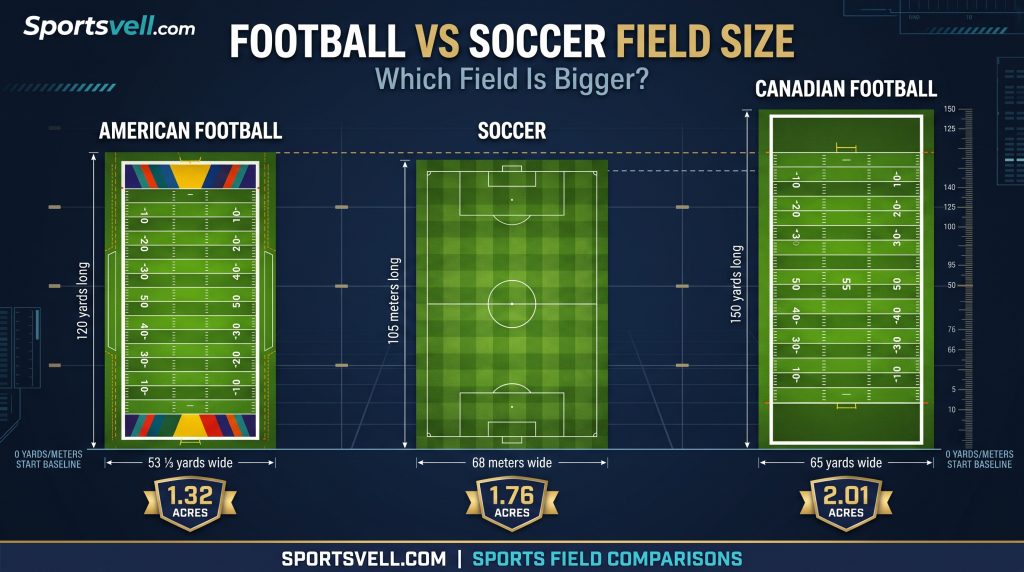
An American football field is smaller than most soccer fields and much smaller than a Canadian football field. The American field is fixed at 1.32 acres, while soccer fields vary by league and Canadian fields are fixed at a bigger size. The comparison table below uses verified figures.
| Field type | Length | Width | Square feet | Acres |
|---|---|---|---|---|
| American football (NFL, NCAA, high school) | 120 yards | 53 1/3 yards | 57,600 | 1.32 |
| American football, no end zones | 100 yards | 53 1/3 yards | 48,000 | 1.10 |
| Canadian football (CFL) | 150 yards | 65 yards | 87,750 | 2.01 |
| Soccer, FIFA maximum | 130 yards | 100 yards | 117,000 | 2.69 |
| Soccer, standard international (105 x 68 m) | 115 yards | 74 yards | 76,900 | 1.76 |
| Soccer, FIFA minimum | 100 yards | 50 yards | 45,000 | 1.03 |
| Arena / indoor football | 50 yards | 85 feet | 12,750 | 0.29 |
The Canadian field is 2.01 acres, not 1.75 acres. One top-ranking page lists the Canadian field as 131 yards long and 1.75 acres, which is wrong on both numbers. The real Canadian field is 110 yards between the goal lines plus two 20-yard end zones, which is 150 yards total, and 65 yards wide. Multiply 450 feet by 195 feet to get 87,750 square feet, and divide by 43,560 to get 2.01 acres.
The wider Canadian field favors passing and motion. At 65 yards wide with 20-yard end zones, Canadian receivers have more room to run before the snap, and the deeper end zones give quarterbacks a bigger target area. The extra 0.69 acres changes how the game is played.
Soccer Fields Vary, Football Fields Do Not
A soccer field is not one fixed size. The FIFA Laws of the Game allow 100 to 130 yards in length and 50 to 100 yards in width. That range covers 1.03 acres at the minimum and 2.69 acres at the maximum, so a soccer field can be smaller or much bigger than a football field.
A standard international soccer field is 105 by 68 meters, which is about 115 yards by 74 yards. That field covers about 76,900 square feet, or 1.76 acres. It is about one third larger than an American football field.
The FIFA maximum field is 2.69 acres, which is more than twice the size of an American football field. The FIFA minimum field is 1.03 acres, which is slightly smaller than the football field without end zones. The range is wide because soccer allows local choice.
American football allows no local choice. Every regulation field is 120 by 53 1/3 yards, so the acreage is always 1.32. That fixed size is why the football field works as a yardstick for land, while the soccer field does not.
Rugby, Baseball and Arena Football
Rugby fields are similar in total area to soccer fields, but their dimensions vary by competition. A rugby union field is about 100 meters long plus in-goal areas, and about 70 meters wide, which puts it near 1.7 to 2 acres. Exact figures depend on the competition, so check the current laws before quoting a number.
A baseball field has no fixed acreage. The infield is a 90-foot square, but the outfield has no set size, and the foul territory varies by ballpark. That is why baseball fields are never used as a land yardstick the way football fields are.
Arena and indoor football fields are much smaller, about 0.29 acres for the playing surface. They are 50 yards long and 85 feet wide, and they play inside hockey rinks and arenas. Some sources quote 0.6 acres, but that figure does not match the 50 by 85 foot dimensions. The small size makes the game faster and higher scoring, with more passing and less running room.
Youth, flag and 8-player football use smaller fields too. An 8-player field is commonly 80 yards long and 40 yards wide, which is 28,800 square feet, or 0.66 acres. Flag football fields vary by league and are often about half the size of a full field or smaller. Sizes vary by league, so check the local rules before building one.
How Big Is a Football Field Compared to Everyday Things?
A football field is easier to picture than an acre. Most people have stood on a football field, but few have measured an acre. That is why land is so often described in football fields, even in real estate listings and news reports.
Parking Spaces, Houses and City Blocks
| Comparison | Approximate size | Football fields |
|---|---|---|
| One acre | 43,560 sq ft | 0.76 fields |
| Standard parking space (9 x 18 ft) | 162 sq ft | About 355 spaces fit, with no driving lanes |
| Parking lot with driving lanes | About 300 sq ft per space | About 180 to 200 spaces |
| Typical new suburban house lot (0.2 acres) | About 8,700 sq ft | About 6.6 lots per field |
| City block (varies, often 2 to 5 acres) | About 87,000 to 218,000 sq ft | About 1.5 to 3.8 fields |
| One square mile (640 acres) | 27,878,400 sq ft | About 485 fields |
About 355 marked parking spaces fit on a football field if you pack them with no driving lanes. With driving lanes, the number falls to about 180 to 200 spaces. The driving lanes take up almost half the area, which is why real parking lots hold fewer cars than the raw math suggests.
About six or seven typical new suburban house lots fit on a football field. A 0.2-acre lot is about 8,700 square feet, and 57,600 divided by 8,700 is about 6.6. The field is bigger than most people think when they picture it as house lots.
City blocks vary widely, from about 2 to 5 acres in many American cities. A 2-acre block holds about 1.5 football fields, and a 5-acre block holds about 3.8 fields. The block comparison only works if you know the local block size.
A Football Stadium Is Much Bigger Than the Field
The field is 1.32 acres, but a full stadium site is often 10 to 20 acres. The extra land holds the seating bowl, concourses, locker rooms, press boxes, parking lots, practice fields and concession stands. The field is a small part of the whole site.
High school stadiums are smaller but still dwarf the field. A typical high school stadium site covers several acres, with bleachers on one or both sides, a track around the field, and a parking lot. The field is 1.32 acres, and the site is often 5 to 10 acres.
NFL stadiums sit on even larger sites. The stadium building alone covers several acres, and the parking and tailgating areas cover many more. When someone says a stadium is “100 acres”, they mean the whole site, not the playing field.
Practice fields add more land. An NFL team has multiple practice fields next to its stadium or training facility. Each one is another 1.32 acres, plus the space between fields for safety and access.
What Is an Acre? Where 43,560 Comes From
An acre is 43,560 square feet. It is defined as one chain by one furlong, which is 66 feet by 660 feet. Multiply 66 by 660 and you get 43,560. The definition is fixed, and it has been fixed since long before the football field existed. The Nest of Tools guide to football field acres traces the same chain-by-furlong history and the metric conversions.
A chain is 66 feet long. It was the surveyor’s measuring tool, made of 100 links. A furlong is 660 feet long, which is 10 chains. The acre was the area a team of oxen could plough in one day, measured as one chain wide and one furlong long.
The acre is an old English unit. It predates the United States, the NFL and the football field by centuries. The football field came later and borrowed the acre as its measuring partner, not the other way around.
International Acre vs US Survey Acre
| Acre type | Square meters | Square feet | Used where |
|---|---|---|---|
| International acre | 4,046.856 | 43,560 | Most of the world, and US real estate |
| US survey acre | 4,046.873 | 43,560.17 | US land surveys (historical) |
The international acre is 4,046.856 square meters. The US survey acre is 4,046.873 square meters, a difference of 0.017 square meters. The gap is tiny, and it does not change the 1.32 acre figure at two decimal places.
For football field math, use the international acre. The difference between the two acre definitions is less than one square foot per acre, so it never matters in a football field calculation. The 43,560 figure is the one to use.
An acre is not a square. It is a unit of area, not a shape. An acre can be a long thin strip, a square, or any other shape, as long as the area is 43,560 square feet. The football field is a rectangle, but the acre is not tied to any shape.
Building a Football Field: Grass, Turf and Cost
Football fields use either natural grass or artificial turf. Natural grass is softer, stays cooler in hot weather, and is preferred by many players. It needs significant maintenance and can wear out or become muddy with heavy use.
Artificial turf is made of synthetic fibers with a rubber or other infill. It holds up better to frequent use, performs consistently in wet weather, and is common at high schools and in many stadiums. Some venues use hybrid systems that combine natural grass with synthetic fibers.
The surface affects traction, speed and comfort. Players often choose different cleats for grass and turf. Research and debate continue about how different surfaces relate to certain injuries, and many leagues set standards for surface testing and maintenance.
Natural Grass vs Artificial Turf
| Factor | Natural grass | Artificial turf |
|---|---|---|
| Feel | Softer, cooler in heat | Firmer, hotter in sun |
| Maintenance | Mowing, watering, re-sodding | Brushing, infill top-ups, cleaning |
| Durability | Wears out with heavy use | Handles frequent use |
| Wet weather | Can become muddy | Performs consistently |
| Upfront cost | Lower to install | Higher to install |
| Long-term cost | Higher to maintain | Lower to maintain |
Costs vary widely by location, materials and labor. This guide does not state a single price for building a field, because prices change by region and year. Get a current quote from a local field builder before budgeting, and check the current price of turf by the square foot.
The field area drives the cost. Turf is priced by the square foot, so a 57,600 square foot field costs more than a 48,000 square foot field of play. The end zones add 9,600 square feet of turf, which is a real cost, not just a rounding difference.
To build a field, you need more than 1.32 acres. The field itself is 1.32 acres, but you also need room for sidelines, team areas, safety zones, drainage, access roads and parking. A realistic site for a single field with basic facilities is 3 to 5 acres or more.
FAQs
How many acres is a football field?
A football field is 1.32 acres including the end zones. It measures 120 yards by 53 1/3 yards, which is 57,600 square feet. Without the end zones, it is 1.10 acres.
Is a football field exactly one acre?
No, a football field is not exactly one acre. A full field is 1.32 acres, which is 32 percent larger than a single acre. Even without end zones, the field is 1.10 acres.
How many acres is a football field with end zones?
A football field with end zones is 1.32 acres. The field is 360 feet long and 160 feet wide, which is 57,600 square feet. Divide 57,600 by 43,560 to get 1.32 acres.
How many acres is a football field without end zones?
A football field without end zones is 1.10 acres. The 100 yards between the goal lines cover 300 feet by 160 feet, which is 48,000 square feet. Divide 48,000 by 43,560 to get 1.10 acres.
How many square feet is a football field?
A football field is 57,600 square feet including the end zones. Without the end zones, it is 48,000 square feet. Each end zone adds 4,800 square feet.
How many square yards is a football field?
A football field is 6,400 square yards including the end zones. Without the end zones, it is 5,333 square yards. One acre is 4,840 square yards.
How long is a football field in feet?
A football field is 360 feet long including the end zones. Without the end zones, it is 300 feet long. Each end zone is 30 feet deep.
How wide is a football field in yards?
A football field is 53 1/3 yards wide. That is 160 feet, or about 48.8 meters. The width is the same at every level of American football.
How many football fields fit in an acre?
About 0.76 football fields fit in one acre. An acre is about three quarters of a full field. Without end zones, about 0.91 fields fit in one acre.
How many football fields are in 10 acres?
About 7.6 football fields fit in 10 acres. Divide 10 by 1.32 to get 7.58. A 10-acre site could hold seven full fields, but not eight.
How many football fields are in 100 acres?
About 76 football fields fit in 100 acres. Divide 100 by 1.32 to get 75.76. That counts the playing surface only, not stadiums, parking or access roads.
How many acres is half a football field?
Half a football field is 0.66 acres. Divide 1.32 by 2 to get 0.66. A half field covers 28,800 square feet.
How many acres is a soccer field?
A soccer field is 1.03 to 2.69 acres, depending on its size. FIFA allows 100 to 130 yards in length and 50 to 100 yards in width. A standard international field of 105 by 68 meters is about 1.76 acres.
How many acres is a Canadian football field?
A Canadian football field is 2.01 acres. It is 150 yards long, including two 20-yard end zones, and 65 yards wide. That is 87,750 square feet, which is much bigger than the American field.
How many acres is a high school football field?
A high school football field is 1.32 acres. High school fields use the same 120 by 53 1/3 yard dimensions as the NFL and college, so the acreage is identical at every level.
How many acres is a college football field?
A college football field is 1.32 acres. NCAA fields use the same dimensions as NFL fields. The hash marks are wider in college, but the field size is the same.
Are NFL and college football fields the same size?
Yes, NFL and college football fields are the same size. Both are 120 yards long and 53 1/3 yards wide, covering 1.32 acres. The hash marks differ, but the field does not.
How many meters long is a football field?
A football field is about 109.7 meters long including the end zones. Without the end zones, it is about 91.4 meters long. The width is about 48.8 meters.
How many hectares is a football field?
A football field is 0.535 hectares. Its area is 5,351 square meters, and a hectare is 10,000 square meters. The field covers just over half a hectare.
How many square meters is a football field?
A football field is 5,351 square meters including the end zones. Without the end zones, it is about 4,459 square meters. Each end zone is about 446 square meters.
How big is an end zone in acres?
One end zone is 0.11 acres. It is 30 feet deep and 160 feet wide, which is 4,800 square feet. Two end zones together are 0.22 acres.
How many acres is a football stadium?
A football stadium site is often 10 to 20 acres. The field itself is only 1.32 acres. The rest holds seating, concourses, locker rooms, parking lots and practice fields.
How many parking spaces fit on a football field?
About 355 marked parking spaces fit on a football field with no driving lanes. With driving lanes, the number falls to about 180 to 200 spaces, because the lanes take up almost half the area.
How many acres is a youth football field?
Youth football fields are smaller than regulation fields, and sizes vary by league. An 8-player field is commonly 80 yards long and 40 yards wide, which is 0.66 acres. Flag football fields vary and are often about half the size of a full field or smaller.
What is an acre in square feet?
An acre is 43,560 square feet. It is defined as one chain (66 feet) by one furlong (660 feet). One acre is also 4,840 square yards and 4,047 square meters.
Conclusion
How many acres is a football field? A standard American football field is 1.32 acres including the end zones, and 1.10 acres without them. One acre holds 0.76 football fields. Those three numbers answer the question for every level of the game.
The math is simple and it checks out two ways. In feet, 360 times 160 is 57,600 square feet, and 57,600 divided by 43,560 is 1.32 acres. In yards, 120 times 53 1/3 is 6,400 square yards, and 6,400 divided by 4,840 is 1.32 acres again.
The field is not exactly one acre, and one acre does not hold 1.3 fields. Those two errors appear in top-ranking pages, and this guide corrects them with the verified figures. The field is 32 percent larger than an acre, and an acre is about three quarters of a field.
Use the football field as your land yardstick with confidence. A 40-acre farm holds about 30 fields, a 100-acre parcel holds about 76 fields, and a full stadium site is often 10 to 20 acres. The field is fixed, the math is exact, and the answer never changes.
For more football measurement guides on SportsVell, see our guide on how long a football game lasts and our who won Monday Night Football hub. For game coverage, see our Green Bay Packers vs Dallas Cowboys player stats page and our guide on where to watch Ohio State vs Indiana football. For scorecard hubs in other sports, see our India vs New Zealand match scorecard and our England vs India match scorecard.