
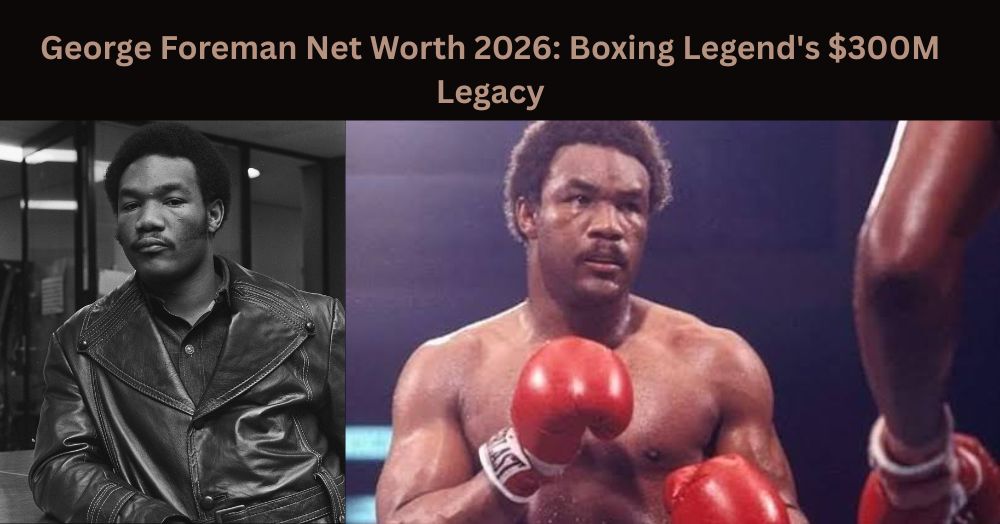
When you think about boxing champions and their earnings, George Foreman represents one of the most fascinating stories in sports history. This boxing legend transformed himself from a feared heavyweight into one of America’s most successful entrepreneur figures. Most people assume boxers build wealth through fighting, yet Foreman earned far more from a kitchen appliance than from his entire boxing career combined.
The George Foreman net worth sits at an estimated $300 million at the time of his death in March 2025. What makes this figure remarkable is that approximately $200 million came directly from the George Foreman Grill, while his professional boxing career generated only about $5 million over eight years. This contrast reveals how income diversification and smart business decisions can outpace athletic performance in creating lasting wealth building.
Quick Table
George Edward Foreman, known as “Big George,” was born on January 10, 1949, in Marshall, Texas. He became both a two-time heavyweight champion and an ordained minister who shaped pop culture through entrepreneurship. Key facts include his height of 6’3″, his marriage to Mary Joan Martelly for forty years, and twelve children across multiple marriages. His net worth growth accelerated dramatically after 1994, when he both reclaimed the heavyweight title and launched his iconic grill brand.
| Field | Details |
| Full Name | George Edward Foreman |
| Nickname | “Big George” |
| Date of Birth | January 10, 1949 |
| Date of Death | March 21, 2025 (age 76) |
| Birthplace | Marshall, Texas, U.S. |
| Nationality | American |
| Ethnicity | African American |
| Profession | Former professional boxer; entrepreneur; ordained minister; boxing analyst |
| Height | 6’3″ (191 cm) |
| Weight | 215–230 lbs (in his boxing prime) |
| Eye Color | Not publicly documented |
| Hair Color | Black |
| Relationship Status | Married five times; widow Mary Joan Martelly (m. 1985–2025) |
| Net Worth | Estimated $300 million at time of death |
| Career Start | 1969 (turned professional boxer) |
| Active Platforms | Instagram (managed by family/estate) |
Early Life and Background
Childhood and Family Origins
George Foreman grew up in Houston’s Fifth Ward during the 1950s and 1960s, one of the toughest neighborhoods in Texas at that time. His father was absent, and his mother struggled financially to support the family. Foreman himself admitted to being a “self-proclaimed thug” who dropped out of school in ninth grade and ran with street gangs across the city.
This challenging early life shaped his character and future determination. The poverty and instability forced young Foreman to find direction quickly or face a bleak future. His neighborhood offered limited opportunities, yet it also taught him resilience and hunger for improvement. These survival skills later translated into his professional success both inside and outside the boxing ring.
Early Interests and Training
The turning point arrived in 1965 when the federal Job Corps program gave Foreman structure and purpose. Inside the program, he met trainer Doc Broadus, who introduced him to boxing as a weight loss tool rather than a career path initially. Foreman began training to shed pounds and channel his aggression constructively rather than destructively on streets.
Boxing quickly became his passion and escape route from poverty. Career transition happened naturally as Foreman discovered his exceptional talent and power in the ring. His coaches recognized his potential immediately, helping him develop from an undisciplined street kid into a disciplined athlete. This transformation proved critical for his future success as both a boxing legend and later as a business owner.
Path to Professional Career
Foreman’s amateur career peaked at the 1968 Mexico City Olympics when he won the heavyweight gold medal at just nineteen years old. This victory validated his coaches’ faith and his own potential. He turned professional in 1969, quickly building an impressive record filled with knockout victories that caught the attention of boxing promoters nationwide.
His winning streak grew to thirty-seven consecutive victories, with thirty-five coming by knockout before his first heavyweight title opportunity. This dominance set the stage for major championship bouts. The combination of his size, strength, and improving skills made him a formidable opponent for any heavyweight competitor of that era.
Career Journey: From Champion to Comeback King
How It Started: First Championship
By 1972, George Foreman had compiled an outstanding thirty-seven-fight winning streak, with thirty-five victories by knockout. This record earned him a shot at the heavyweight title against the reigning champion. In January 1973, Foreman knocked out previously undefeated champion Joe Frazier in Jamaica in a dominant performance that shocked the boxing world.
The victory catapulted Foreman into mainstream fame overnight. Broadcaster Howard Cosell made his famous call “Down goes Frazier” which became iconic in sports broadcasting history. This championship win earned Foreman his first major paycheck and established his reputation as a devastating puncher. The achievement came at just twenty-three years old, promising a long reign as heavyweight champion.
Key Turning Points: Ali, Bankruptcy, Comeback
George Foreman’s reign lasted only nineteen months before facing Muhammad Ali in October 1974 in the legendary “Rumble in the Jungle” fight held in Zaire. Ali used his famous “rope-a-dope” strategy, letting Foreman punch himself tired before scoring a knockout in the eighth round. This devastating loss marked a turning point in Foreman’s boxing career, though he didn’t realize it immediately.
After losing to Jimmy Young in 1977, Foreman retired from boxing and became an ordained minister, seeking spiritual meaning beyond athletics. However, by 1987, severe financial difficulties forced his unexpected comeback despite being in his late thirties. This financial comeback became one of sports’ greatest stories. He faced bankruptcy after losing his earnings to bad investments and an extravagant lifestyle, pushing him back into the ring desperately seeking income.
Major Highlights: Championship Achievements
George Foreman’s career achievements spanned five decades of professional boxing and business. In 1968, he won Olympic gold in the heavyweight division at Mexico City. He defeated Joe Frazier in 1973 to claim his first world heavyweight title. He lost to Muhammad Ali in the legendary 1974 “Rumble in the Jungle” fight that captivated the world. His 1977 loss to Jimmy Young prompted his first retirement and spiritual awakening. Subsequently, his 1987 return launched his greatest comeback campaign at an age when most fighters had retired.
Most impressively, in 1994 he defeated Michael Moorer at age forty-five to become the oldest heavyweight champion in boxing history. This same year marked the launch of the George Foreman Grill, which would eventually eclipse all his boxing earnings combined. By 1999, he sold the naming rights to Salton Inc. for $138 million, creating wealth that boxing could never provide. His death in March 2025 ended a remarkable seven-decade journey from poverty to prosperity.
George Foreman Net Worth 2026: Complete Financial Analysis
Current Net Worth Estimate
George Foreman’s net worth 2026 remains estimated at $300 million according to Celebrity Net Worth, the standard reference point cited across financial media outlets. This figure represents his wealth at the time of his death in March 2025, remaining relevant as his estate continues settling through 2026. The vast majority of this fortune came from business ventures rather than boxing, a fact Foreman himself repeatedly emphasized throughout his later years.
The $300 million net worth reflects decades of accumulated wealth building through smart business decisions and brand monetization. His widow Mary Joan Martelly and his eleven surviving children are expected to inherit this estate, though official distribution details have not been publicly released. Understanding how Foreman built this fortune provides valuable lessons about diversifying income sources beyond primary career earnings and capitalizing on personal branding opportunities.
How Much Did George Foreman Earn?
George Foreman earned approximately $5 million during his initial eight-year boxing career spanning from 1969 to 1977. In today’s dollars, this amount equals roughly $20 million when adjusted for inflation. However, Foreman lost much of these earnings to poor investments, excessive spending, and an increasingly lavish lifestyle that consumed his resources faster than he could earn them.
By 1987, financial advisors estimated that Foreman was nearly bankrupt despite his previous earnings. This dire situation forced him into a comeback that ultimately saved his financial future. His post-1994 earnings from the George Foreman Grill exceeded $200 million in personal royalties alone. Foreman told AARP magazine in 2014 that grill royalties paid him “much more” than $200 million, with some months generating $8 million in passive income from product sales.
Net Worth Growth Timeline
Foreman’s financial journey shows dramatic fluctuations reflecting his career transitions and business success. By 1977, he had accumulated roughly $5 million through boxing but was living beyond his means. The years between 1977 and 1987 represent his financial decline and near bankruptcy period. His comeback in 1987 slowly restored his finances, but real transformation came in 1994 with his championship victory and grill launch.
By 1999, following the $138 million sale of naming rights to Salton Inc., Foreman’s net worth exceeded $150 million. This single business transaction generated more wealth than his entire boxing career. Subsequently, continued royalties from grill sales throughout the 2000s and 2010s steadily increased his fortune. By 2025, his wealth reached the estimated $300 million figure, with estate distribution expected among his surviving family members.
Read more:Heartbroken Stephanie Hurt: Charles Hurt Wife Story
Sources of Income: Where the Money Really Came From
The George Foreman Grill: The Ultimate Wealth Engine
The George Foreman Grill represents the most important income source in Foreman’s financial portfolio. Launched in 1994, this countertop cooking device revolutionized home grilling by offering a faster, easier alternative to traditional barbecues. The product sold over 100 million units worldwide, making it one of the best-selling kitchen appliances in history.
Foreman earned well over $200 million in personal royalties from grill sales before selling naming rights to Salton Inc. for $138 million in 1999. This $138 million sale created an immediate wealth surge that transformed his financial status permanently. Beyond the initial sale, Foreman continued receiving royalties from continued grill sales under his name. The grill’s popularity never diminished, generating consistent passive income for decades. This single product demonstrated how brand monetization could exceed athletic achievement in creating lasting wealth.
Boxing Career Earnings: Significant but Limited
George Foreman’s professional boxing earnings totaled approximately $5 million across his entire career from 1969 to 1977. While significant for that era, this amount pales in comparison to modern heavyweight champions who earn hundreds of millions. His comeback fight against Michael Moorer in 1994 added meaningful income later in life when he was in his mid-forties.
The boxing earnings, while substantial, were overshadowed by his business ventures. Foreman’s heavyweight championship status provided credibility and fame that later enabled the grill deal. Without his boxing legacy, he might never have become a recognizable spokesman and brand icon. Thus, boxing provided the foundation for business success even though it generated limited direct income. This income diversification strategy proved genius in retrospect.
Media Work and Endorsement Deals
After retiring from professional boxing in 1997, George Foreman pursued media opportunities including work as a boxing analyst for HBO. His distinctive voice and thoughtful commentary made him a sought-after sports commentator. Additionally, Foreman remained a highly valuable pitchman for various products beyond just the grill.
These media and endorsement opportunities supplemented his grill royalties significantly throughout the 2000s and 2010s. His warm personality and genuine likeability made him effective in television commercials and endorsement deals. Though these earnings never approached grill royalty figures, they provided additional income streams. His media presence kept him relevant and visible to consumers across multiple generations, strengthening his personal brand value continuously.
Real Estate and Business Investments
George Foreman owned and operated substantial real estate holdings throughout his wealth-building years. His signature property was an 11,000 square foot Texas ranch featuring five bedrooms, nine bathrooms, walking trails, a private pond, tennis courts, and a remarkable sixty-four-car garage. This property reflected his luxury lifestyle and passion for collecting classic vehicles.
Before his death due to declining health, Foreman sold this Texas ranch for approximately $9.5 million. Beyond this flagship property, he maintained various business ventures tied directly to his personal brand. His son George III, known as “Monk,” co-founded the EveryBodyFights gym chain, which represents continuing family business involvement. These diversified investments and holdings contributed meaningfully to his overall wealth portfolio and demonstrated sophisticated asset management.
Personal Life and Relationships: Family First
Family Background and Multiple Marriages
George Foreman was married five times throughout his life, demonstrating his commitment to finding lasting love despite initial failures. His wives included Adrienna Calhoun, Cynthia Lewis, Sharon Goodson, and Andrea Skeete before he married Mary Joan Martelly in 1985. This final marriage lasted forty years until his death in 2025, representing his most successful partnership.
Across his five marriages, Foreman fathered twelve children, making family his clear priority later in life. Interestingly, he named five of his sons “George Edward Foreman,” joking that the repetition helped him remember their names after years of boxing-related head trauma. He also adopted two daughters, Isabella and Courtney, demonstrating his commitment to expanding his family through non-biological means. This large family provided Foreman deep personal fulfillment beyond any business or athletic achievement.
Relationship Status and Family Legacy
At the time of his death in March 2025, George Foreman was survived by his wife Mary Joan Martelly and eleven of his twelve children. His daughter Freeda, who became a professional boxer herself, tragically died in 2019 at age forty-two. His son George III, known as “Monk,” boxed professionally before transitioning to business through the EveryBodyFights gym chain venture.
Foreman insisted that all of his children pursue college education regardless of athletic talent or boxing interest. This emphasis on education distinguished him from many athletes who pressure children into sports careers. His family remained tight-knit throughout his life, gathered primarily in the Houston area. The strong family bonds ensured smooth estate distribution expectations among his surviving family members following his 2025 death.
Physical Appearance: The Heavyweight Legend
George Foreman stood six feet three inches tall, towering over most opponents throughout his boxing career. His weight fluctuated between 215 and 230 pounds during his prime fighting years, all solid muscle and devastating power. His physical presence alone intimidated opponents before the bell even rang, giving him significant psychological advantage.
His black hair, powerful build, and imposing frame made him instantly recognizable across generations. Yet by his later years, Foreman cultivated a gentler public image as a grill salesman and television personality. This contrast between fierce young champion and approachable business icon fascinated fans and consumers alike. His physical transformation reflected his complete personal reinvention across multiple life chapters.
Lifestyle and Luxury: How George Foreman Lived
Real Estate Portfolio and Texas Ranch
George Foreman’s primary residence represented his wealth and success tangibly. The 11,000 square foot Texas ranch featured extensive amenities including five spacious bedrooms and nine luxurious bathrooms. Walking trails wound through the property, a private pond offered recreation, and tennis courts provided athletic pursuits on his own land.
The property’s most distinctive feature was the sixty-four-car garage, housing Foreman’s extensive automobile collection. This luxury property sold for approximately $9.5 million before his death, reflecting declining health and a desire to simplify. Beyond this flagship estate, Foreman owned other properties throughout his wealth-building years. Real estate represented safe, tangible investments that grew substantially during the decades he held them.
Automobile Collection: Passion for Vehicles
George Foreman maintained an impressive collection of vehicles that reached approximately fifty cars at its peak. His sixty-four-car garage housed vintage and classic automobiles that represented significant personal passion beyond necessity. The specific models remained undocumented publicly, yet collectors knew his taste ran toward quality classic vehicles.
This automobile collection demonstrated Foreman’s luxury lifestyle and disposable wealth throughout his most successful years. The cars represented emotional investments beyond financial value, tied to his personal interests and hobbies. Maintaining such a collection required dedicated staff and resources, reflecting his enormous wealth generation capacity through the grill business.
Travel and Lifestyle Choices
Early in his boxing career, George Foreman traveled extensively for championship fights and promotional appearances. His most famous international journey came in 1974 when he traveled to Zaire for the legendary “Rumble in the Jungle” fight against Muhammad Ali. Later years brought extensive travel tied to endorsement deals and grill promotion events.
By his later decades, Foreman substantially reduced public appearances and travel commitments. Instead, he focused on family life, ministry work, and personal pursuits centered around his Houston home base. This lifestyle shift reflected both his changing priorities and the reality that his wealth no longer required active earning. He had achieved financial security sufficient for multiple generations of his family.
Read more:Who Is Bryna Lublin? The Quiet Life of Daryl Hall’s First Wife
Social Media Presence and Fan Following
George Foreman maintained an active Instagram account that documented his later years and family life. Following his death on March 21, 2025, his family used the platform to announce his passing to millions of followers worldwide. The account provided insight into his personality and daily life beyond his public business persona.
The official George Foreman Grill brand channels continue operating independently, promoting the products that built his fortune. This dual social media presence keeps Foreman’s name and legacy visible to contemporary consumers. His grandiose following reflects his cultural impact across multiple generations who remember him as both athlete and entrepreneur.
Hobbies, Interests and Personality
George Foreman pursued numerous interests beyond boxing and business throughout his lifetime. His spiritual conversion in 1977 led him to become an ordained minister, making Christian preaching and ministry work central to his identity. Vintage car collecting satisfied his passion for automotive history and craftsmanship.
His personality transformed dramatically from the fierce young champion into one of America’s most beloved public figures. He joked about naming all five sons identically, claiming ring-related head trauma made it easier to remember. Foreman demonstrated genuine warmth toward fans, employees, and family members alike. His mentorship of younger boxers and his children showed his commitment to developing future talent and leaders.
Legacy and Estate Outlook
George Foreman’s estate remains pending full settlement as of 2026, with his $300 million fortune expected to divide among his widow Mary Joan Martelly and surviving children. Official will details have not been publicly released, protecting family privacy during the settlement process. His boxing legacy, particularly the record as oldest heavyweight champion, remains unbroken since his 1994 victory.
The George Foreman Grill brand continues generating substantial value tied directly to his name and likeness. Licensing agreements ensure ongoing royalties flow to his estate for years ahead. Additionally, his son George III’s EveryBodyFights gym chain represents continuation of the family entrepreneurial spirit. Foreman’s influence extends through boxing Hall of Fame honors and retrospectives celebrating his contributions to sport.
Conclusion
George Foreman’s $300 million net worth tells one of America’s most remarkable rags-to-riches stories combining athletic achievement with business success. Born into poverty in Houston’s toughest neighborhoods, he overcame tremendous odds to become an Olympic champion, heavyweight title holder, and eventually a billionaire entrepreneur. Yet his greatest wealth came not from knockout punches but from a kitchen appliance that revolutionized home cooking.
His journey through bankruptcy, comeback, and ultimate triumph demonstrates resilience and adaptability across multiple life chapters. The contrast between his modest $5 million boxing earnings and $200 million grill royalties reveals the power of personal branding and strategic partnerships. His family legacy, including twelve children and a tight-knit household, ensures his influence extends across generations. George Foreman transformed himself completely from feared champion into beloved businessman, proving that reinvention defines successful lives more than any single achievement.
Frequently Asked Questions
What was George Foreman’s net worth when he died?
George Foreman’s net worth reached approximately $300 million at his death in March 2025, according to Celebrity Net Worth sources. The vast majority came from grill royalties rather than boxing earnings accumulated over his career decades.
How did George Foreman make his money?
George Foreman earned most wealth from the George Foreman Grill, generating over $200 million in royalties before selling naming rights to Salton Inc. for $138 million in 1999. His professional boxing career contributed only $5 million total.
When did George Foreman die and how old was he?
George Foreman died on March 21, 2025, at age seventy-six, with his family announcing his passing peacefully on Instagram. His wife Mary Joan Martelly and eleven surviving children inherited his $300 million estate.
How many children did George Foreman have?
George Foreman fathered twelve children across five marriages, including five sons all named George Edward Foreman. His daughter Freeda died in 2019 at age forty-two, while his son George III co-founded EveryBodyFights gym.
Is George Foreman the oldest heavyweight boxing champion ever?
Yes, George Foreman became the oldest heavyweight champion in boxing history when he defeated Michael Moorer at age forty-five in 1994. This record remains unbroken as of 2026 in professional boxing.
