
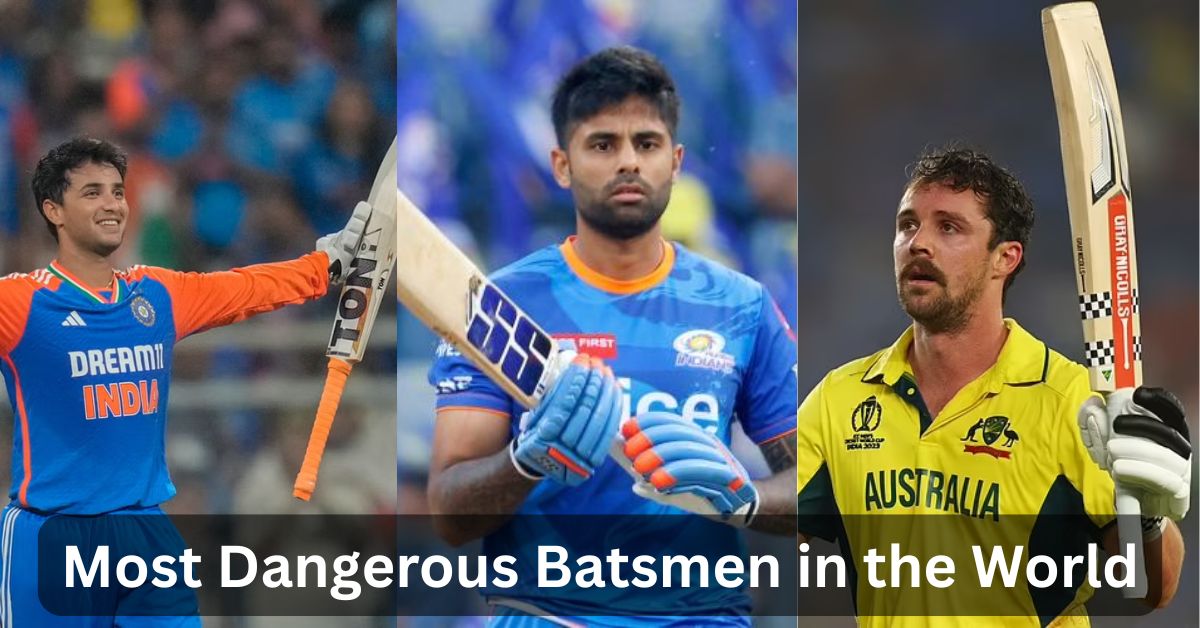
Picture this. Your team needs 60 runs off 30 balls. The crowd is on edge. The bowlers are locked in. And then one batsman walks to the crease — and everything changes. That’s the raw, electric power of the most dangerous batsman in the world. These aren’t just run-scorers. They’re match-wreckers. They’re the kind of players who don’t just read the game — they rewrite it, ball by ball, shot by shot.
Cricket in 2026 has evolved into a sport where a single batsman can dismantle a total that seemed untouchable just ten overs earlier. Power, precision, fearlessness, and the ability to improvise under pressure — these are the new benchmarks. This isn’t a participation list. Every name on here has genuinely kept bowlers awake at night.
What Makes a Batsman Dangerous 🔥
Not every big scorer is a dangerous batsman. That distinction matters enormously. Dangerous batsmen don’t simply accumulate runs — they destabilize bowling attacks, shift match momentum in minutes, and force captains into panic-mode field placements. The most dangerous batsman in the world in today’s era is evaluated on a combination of strike rate across formats, six-hitting ability, boundary percentage, performance under pressure, and consistency in crunch situations. A batter who scores 80 off 40 balls in a chase is considerably more threatening than someone who grinds out 120 off 140 in a comfortable setting.
Dangerous batsmen also possess the rare ability to convert starts into match-defining innings rather than getting out at 30. They thrive in high-pressure finals, knockout games, and difficult chasing conditions where ordinary batsmen crumble. Another key factor is adaptability — the ability to attack on tough pitches, against quality opposition, away from home, and in multiple formats without needing to shift gears too drastically. Power without technique is slogging. Technique without power is nudging. The truly dangerous batsman combines both into something bowlers simply cannot plan for.
Top 10 Most Dangerous Batsmen in the World 🏏

Here’s a list of the 2026 top 10 most dangerous batsmen in the world, ranked by strike rate, boundary power, consistency, and overall match impact.
| Rank | Player | Country | Best format(s) | Strike rate | Key strength |
|---|---|---|---|---|---|
| 1 | Travis Head | 🇦🇺Australia | All formats | ~80+ (Test) | Cross-format aggression, World Cup match-winner |
| 2 | Suryakumar Yadav | 🇮🇳India | T20I | 170+ | 360-degree play, unplayable shot range |
| 3 | Abhishek Sharma | 🇮🇳India | T20I | 197.21 | Highest T20I strike rate in history (20+ innings) |
| 4 | Yashasvi Jaiswal | 🇮🇳India | TestT20I | 164.31 (T20I) | Multi-format threat, IPL fastest 50 record (13 balls) |
| 5 | Harry Brook | 🇬🇧England | TestODI | ~80 (Test) | ICC Test rank #2 (846 pts), Bazball’s best weapon |
| 6 | Rohit Sharma | 🇮🇳India | ODI | ~90+ (ODI) | ICC ODI rank #1 (781 pts), 5 ODI double centuries |
| 7 | Heinrich Klaasen | 🇿🇦South Africa | T20IODI | 155+ | Best white-ball finisher, elite death-over destructor |
| 8 | Glenn Maxwell | 🇦🇺Australia | T20IODI | 154.0 (T20I) | Reverse sweep & switch-hit genius, 201* World Cup final |
| 9 | Andre Russell | 🇯🇲West Indies | T20 | 170+ | Highest six-to-ball ratio in franchise cricket history |
| 10 | Shubman Gill | 🇮🇳India | ODITest | ~95 (ODI) | ICC ODI rank #5, 1,764 ODI runs in 2025 season |
Sources: ICC Rankings 2026 · Strike rates reflect primary format performance · Rankings based on cross-format impact, consistency & ICC points
No. 1 — Travis Head (Australia) 🇦🇺
Travis Head is currently the most dangerous batsman in the world, and the numbers make an undeniable case. The left-handed Australian opener has consistently terrorized bowling attacks across all three formats, combining an attacking mindset with remarkable technical solidity that sets him apart from pure T20 sluggers. Head’s ability to go hard from ball one in Test cricket — an increasingly rare and prized trait — makes him a nightmare for any opposition captain trying to settle into a bowling rhythm.
His strike rate in Tests hovers around 75+, which is extraordinary by red-ball standards, while his white-ball numbers are even more electric. He was the defining batter in Australia’s 2023 World Cup campaign, smashing a match-winning century in the final when it mattered most. Head doesn’t wait for bad balls. He creates bad balls through aggressive intent and footwork, forcing bowlers to adjust their lengths and invariably giving up boundaries in the process. In 2026, his form across the Australian summer and the ongoing ICC cycle has only strengthened his claim to the top spot. He’s not reckless — he’s calculated aggression, which makes him the most difficult type of most dangerous batsman in the world to plan against.
| Format | Matches | Runs | Highest | Average | Strike Rate | 100s / 50s |
|---|---|---|---|---|---|---|
| Test | 65 | 4,592 | 175 | 44.15 | 77.5 | 12 / 20 |
| ODI | 79 | 3,007 | 154* | 44.22 | 95.2 | 7 / 16 |
| T20I | 53 | 1,335 | 80 | 28.40 | 151.0 | 0 / 8 |
No. 2 — Suryakumar Yadav (India) 🇮🇳
Ask any T20 bowler which batter they least want to face and “SKY” comes up time and again. Suryakumar Yadav has redefined what’s possible in the shortest format by essentially making every ball a scoring opportunity regardless of its line, length, or pace. His nickname — the 360-degree player — isn’t hype. It’s a clinical description of his ability to hit to all parts of the ground with equal effectiveness, neutralizing even the most brilliantly crafted bowling plans. With a T20I batting average consistently above 45 and a strike rate that routinely sits above 170, SKY operates at a level that simply isn’t normal.
His ability to hit scoops, ramps, and inside-out drives with the same composure he brings to straight drives and pull shots makes him genuinely unplayable on his day. What makes him especially dangerous is his mental clock — he never seems rattled, never seems to be in a hurry, yet the runs come at a relentless pace. In IPL 2025, he finished among the top scorers with 717 runs, and his India captaincy role in T20Is has only added authority to his already commanding batting presence. The most dangerous batsman in the world conversation in T20 cricket begins and ends with Suryakumar Yadav.
| Format | Matches | Runs | Highest | Average | Strike Rate | 100s / 50s |
|---|---|---|---|---|---|---|
| Test | 1 | 8 | 8 | 8.00 | 40.0 | 0 / 0 |
| ODI | 37 | 773 | 83 | 26.00 | 117.2 | 0 / 6 |
| T20I | 113 | 3,272 | 117 | 36.40 | 171.4 | 4 / 26 |
No. 3 — Abhishek Sharma (India) 🇮🇳
The most staggering individual stat in current world cricket belongs to this 24-year-old left-hander from Punjab. Abhishek Sharma holds the highest T20I strike rate in history among batters with a minimum of 20 innings — an almost incomprehensible 197.21. In just 21 T20I matches, he has already recorded 2 centuries and 3 fifties, establishing himself as the most explosive batting prospect the game has seen in years. What makes Sharma dangerous isn’t just his hitting power — it’s his exceptional bat speed, which allows him to play orthodox attacking shots at extraordinary pace without resorting to agricultural heaves.
He reads the ball early, gets into position quickly, and executes with a cleanness of strike that most senior batters take years to develop. His ICC T20I ranking currently sits at No. 1 with 908 points, the highest among any T20I batter in 2026, which is a remarkable achievement for someone still in the early stages of his international career. He’s not yet a multi-format threat at the highest level, but as a T20 weapon, Abhishek Sharma is already among the most dangerous batsmen the world has ever produced. Bowlers with no plan for him come away wicketless and wicket-depleted in terms of confidence.
| Format | Matches | Runs | Highest | Average | Strike Rate | 100s / 50s |
|---|---|---|---|---|---|---|
| ODI | 12 | 380 | 135 | 34.50 | 118.0 | 1 / 1 |
| T20I | 21 | 820 | 135 | 41.00 | 197.21 | 2 / 3 |
No. 4 — Yashasvi Jaiswal (India) 🇮🇳
Yashasvi Jaiswal is the rare batsman who can terrify opponents in both Test cricket and T20Is simultaneously — a combination that earns him an elite place on any list of the most dangerous batsman in the world. At the top of the Test order, he averages above 53 with a strike rate that routinely challenges traditional red-ball norms. His T20I strike rate sits at 164.31, which places him among the fastest scorers in the format.
Jaiswal’s rise has been meteoric. He holds the IPL record for the fastest fifty ever scored — 13 balls — which tells you everything you need to know about his boundary-hitting intent. In Test cricket, he combines the fearlessness of a T20 opener with the temperament of a classical batter, making him extraordinarily difficult to bowl to across sessions. He can occupy the crease when needed or accelerate brutally when the moment demands it. At just 23, he has already registered multiple Test centuries and match-winning IPL campaigns with Rajasthan Royals. The word “ceiling” feels irrelevant when describing his trajectory because he seems to consistently perform beyond whatever ceiling was previously assigned to him.
| Format | Matches | Runs | Highest | Average | Strike Rate | 100s / 50s |
|---|---|---|---|---|---|---|
| Test | 22 | 2,080 | 214* | 53.84 | 80.5 | 5 / 8 |
| ODI | 12 | 420 | 104 | 38.18 | 99.5 | 1 / 3 |
| T20I | 30 | 830 | 100* | 36.52 | 164.31 | 1 / 5 |
No. 5 — Harry Brook (England) 🇬🇧
Harry Brook is the human embodiment of England’s “Bazball” philosophy — and he might be its most potent expression. The Yorkshire batter currently sits second in the ICC Test rankings with 846 points, trailing only Joe Root, but in terms of pure destruction and entertainment value, Brook arguably surpasses his senior partner. His Test strike rate of around 80 would be considered exceptional even in white-ball cricket. Brook plays with a freedom and aggression that systematically dismantles bowling plans before they can be properly established.
He particularly devastates spin bowling, using his feet aggressively and hitting against the turn with a confidence that leaves experienced spinners searching for answers. His ODI and T20 batting is equally explosive, with a compact but powerful technique that allows him to clear boundaries without needing enormous backlift or physical effort. In the recent series cycles leading into 2026, Brook has delivered match-winning performances in challenging overseas conditions — South Africa, India, and New Zealand — proving his attacking instincts aren’t confined to friendly home pitches. He is unquestionably the most entertaining Test batsman currently playing and one of the most dangerous in world cricket across all formats.
| Format | Matches | Runs | Highest | Average | Strike Rate | 100s / 50s |
|---|---|---|---|---|---|---|
| Test | 38 | 3,200 | 317 | 52.45 | 84.3 | 10 / 9 |
| ODI | 38 | 1,354 | 136* | 40.42 | 112.1 | 3 / 6 |
| T20I | 63 | 1,303 | 88 | 30.30 | 148.0 | 0 / 9 |
No. 6 — Rohit Sharma (India) 🇮🇳
Rohit Sharma remains the benchmark for white-ball opening batting even in 2026, leading the ICC ODI batting rankings with 781 points — a position that reflects not just past greatness but sustained present-day dominance. When Rohit is in full flow, there is nothing more aesthetically pleasing or practically devastating in batting. His pulls and hooks off express pace are among the cleanest shots in the modern game, and his ability to convert good starts into enormous scores gives India an astronomical head start in every limited-overs match he plays.
Despite the natural evolution of his role — playing fewer T20Is now and focusing on Tests and ODIs — Rohit’s impact when available remains immense. His record of five ODI double centuries tells a story of a batsman who doesn’t just attack — he demolishes, with precision and command rather than brute force alone. What earns him a place among the most dangerous batsman in the world in 2026 specifically is his ODI form, his exceptional reading of match situations, and his unmatched ability to produce match-defining innings in ICC tournament cricket when the stakes are highest.
| Format | Matches | Runs | Highest | Average | Strike Rate | 100s / 50s |
|---|---|---|---|---|---|---|
| Test | 67 | 4,301 | 212 | 40.57 | 63.5 | 12 / 14 |
| ODI | 265 | 10,860 | 264 | 48.96 | 91.22 | 31 / 52 |
| T20I | 148 | 4,231 | 118 | 32.05 | 139.4 | 5 / 28 |
No. 7 — Heinrich Klaasen (South Africa) 🇿🇦
If you want a wicketkeeper-batter who can single-handedly dismantle a target that seemed out of reach, Heinrich Klaasen is your answer. The South African finisher has established himself as the most feared middle-order white-ball batter in international cricket, with the ability to hit boundaries to every part of the ground even off the best yorkers and slower balls that typically restrict most batters in the death overs.
His work for Sunrisers Hyderabad in the IPL has been breathtaking — consistently winning matches from impossible positions with an aggression that never tips into recklessness. Klaasen’s six-hitting range is exceptional, and his judgment of which balls to attack and which to respect is significantly more developed than his strike rate alone might suggest. In South Africa’s recent T20I and ODI campaigns, he has been the player the opposition specifically game-plans around, which is the clearest indicator of genuine danger at the crease. He averages above 40 in T20Is while maintaining a strike rate above 155, a combination that places him among the elite finishers in the history of the format.
| Format | Matches | Runs | Highest | Average | Strike Rate | 100s / 50s |
|---|---|---|---|---|---|---|
| Test | 4 | 112 | 43 | 18.66 | 48.0 | 0 / 0 |
| ODI | 60 | 2,141 | 174 | 47.57 | 117.05 | 5 / 11 |
| T20I | 58 | 1,690 | 119* | 38.40 | 155.8 | 2 / 12 |
No. 8 — Glenn Maxwell (Australia) 🇦🇺
Glenn Maxwell has been described as a batter who can win a World Cup final single-handedly — because he actually did exactly that. His extraordinary 201* off 128 balls in the 2023 ODI World Cup against Afghanistan, played through severe cramps while chasing a mammoth target, is the defining innings of modern white-ball batting. Maxwell’s T20I strike rate of 154.0 and his ODI strike rate of 125.44 place him among the most destructive batters in the game’s history.
What makes him uniquely dangerous is his ability to bat with equal effectiveness in any position — opener, middle-order, or emergency anchor — and his reverse sweep and switch-hit ability that renders entire field placements completely redundant. In 2026, Maxwell continues to produce explosive cameos for Australia and in franchise cricket globally, where his name consistently appears at the top of batting charts. He is unpredictable in the best possible way — a batsman opponents think they have figured out until he produces a shot that doesn’t exist in any coaching manual but somehow goes for six.
| Format | Matches | Runs | Highest | Average | Strike Rate | 100s / 50s |
|---|---|---|---|---|---|---|
| Test | 7 | 339 | 104 | 26.07 | 65.3 | 1 / 2 |
| ODI | 149 | 3,990 | 201* | 34.10 | 126.70 | 6 / 22 |
| T20I | 130 | 2,897 | 120* | 29.26 | 154.00 | 5 / 19 |
No. 9 — Andre Russell (West Indies) 🇯🇲
Andre Russell doesn’t approach batting — he attacks it. The Jamaican all-rounder has the highest six-to-ball ratio of any player who has batted extensively in T20 franchise cricket worldwide, and his ability to take a match away from a team in the space of a four-to-six-ball cameo is virtually unmatched. Russell’s combination of physical power — he is one of the strongest athletes in world cricket — and technically sound hand-eye coordination creates a batter who can hit good deliveries out of the ground with a frequency that defies conventional cricketing logic.
In the IPL, his record speaks emphatically: consistent performances for Kolkata Knight Riders over multiple seasons, regularly rescuing the team from trouble at astonishing strike rates above 170. His international appearances are now less frequent, but whenever Russell is at the crease in T20 cricket anywhere in the world, the game’s momentum can shift in a single over. Teams specifically design death bowling strategies around one goal: avoid giving Russell a sniff in the final four overs, because if he gets going, no total is safe.
| Format | Matches | Runs | Highest | Average | Strike Rate | 100s / 50s |
|---|---|---|---|---|---|---|
| ODI | 56 | 1,034 | 92* | 26.50 | 132.44 | 0 / 6 |
| T20I | 70 | 1,892 | 121* | 29.10 | 170.40 | 1 / 8 |
No. 10 — Shubman Gill (India) 🇮🇳
Shubman Gill is the most dangerous batsman in the world in ODI cricket by current ICC rankings, and his 2025 season numbers — 1,764 runs — provide the statistical foundation for that classification. Gill combines classical elegance with modern aggression in a way that very few batsmen of his generation manage with such apparent ease. His cover drives are textbook-perfect while his ability to step up and pull fast bowlers over midwicket reveals a fearlessness that belies his apparently composed demeanour at the crease.
What makes Gill particularly dangerous in 2026 is his consistency across conditions — he has performed well in the subcontinent, in the UK, in Australia, and in the Caribbean, which separates him from batsmen who only dominate in conditions that suit their style. He also leads the Indian ODI team, and the added responsibility has arguably sharpened rather than inhibited his batting. At 25, Gill is only entering the peak years of his career, and the cricketing world is genuinely curious about just how dominant he can become.
| Format | Matches | Runs | Highest | Average | Strike Rate | 100s / 50s |
|---|---|---|---|---|---|---|
| Test | 40 | 2,843 | 128 | 43.00 | 65.8 | 7 / 14 |
| ODI | 61 | 2,953 | 208 | 56.00 | 99.22 | 10 / 14 |
| T20I | 32 | 880 | 126* | 34.00 | 144.5 | 1 / 4 |
Rising Stars Who Could Enter This List Soon 🌟
No list of the world’s most dangerous batsmen would be complete without acknowledging the next wave threatening to break through and disrupt the established order. Vaibhav Suryavanshi, the 14-year-old Rajasthan Royals prodigy, has already turned heads with fearless strokeplay in IPL 2026 that cricket analysts have described as generationally rare. His maturity at the crease relative to his age is frankly disconcerting for any bowling side.
Tilak Varma of India is another name gathering momentum — his T20I performances have demonstrated that he can attack from the first ball in the middle order while also building an innings when the situation demands measured accumulation. Phil Salt of England, with his explosive opening partnerships in T20Is and IPIs, is consistently posting numbers that rival the senior names on this list. These are the players warming up in the wings, and watching them develop into complete match-winners over the next twelve to eighteen months is arguably as exciting as anything else happening in world cricket right now.
Read more related article: Which IPL Team Has Most Fans? Full Ranking List 2026
How Format Shapes Who the Most Dangerous Batsman Really Is 📊
One of the fascinating complexities in cricket’s modern era is that the answer to “who is the most dangerous batsman in the world” genuinely changes depending on which format you’re discussing. In Test cricket, Travis Head and Harry Brook cause the most damage because their aggressive scoring rates undermine the psychological patience-game that Test bowling is built upon. In ODIs, Rohit Sharma and Shubman Gill pose the greatest threat through their ability to build large partnerships at a scoring rate that leaves opposition totals looking inadequate before the 40th over.
In T20Is, Abhishek Sharma and Suryakumar Yadav occupy a different planet entirely — their strike rates and boundary percentages make conventional bowling plans almost irrelevant. Understanding this format-specific nature of batting danger is crucial context for evaluating this list fairly. A batter who is lethal at T20 but moderate in Tests isn’t less dangerous — they’re dangerous in a specific and highly relevant context. The truest measure of an all-time dangerous batsman is the rare ability to threaten meaningfully across all three formats, which is why Travis Head currently stands at the top of any cross-format assessment.
What Separates the Truly Dangerous From the Merely Very Good 🎯
There’s a meaningful and often underappreciated distinction between batsmen who are statistically excellent and those who are genuinely, viscerally dangerous. The difference comes down to fear — the kind that settles into a bowling attack when a specific batter walks to the crease. Truly dangerous batsmen change the atmosphere of a match through their presence alone, before they’ve even faced a ball. Captains reshuffle field placements preemptively. Bowlers adjust their plans. Wicketkeepers start conversations they wouldn’t otherwise have. This psychological dimension of batting danger is impossible to fully capture in spreadsheets but is entirely real and enormously impactful.
The most dangerous batsman in the world isn’t necessarily the one with the highest average — it’s the one who makes opponents feel as though no plan is quite good enough, no total entirely safe, and no lead entirely comfortable. Every player on this list carries that psychological weight. They don’t just score runs. They impose themselves on matches in ways that statistical summaries can only partially describe. That intangible — the dread factor — is what truly separates the names on this list from the hundreds of talented batters currently playing international cricket around the world.
Conclusion 🏆
Cricket in 2026 is richer, faster, and more competitive than at any point in its history — and the batsmen driving that evolution are genuinely extraordinary. From Travis Head’s cross-format dominance to Abhishek Sharma’s record-shattering T20I strike rate, from Suryakumar Yadav’s 360-degree genius to Yashasvi Jaiswal’s fearless brilliance across formats, the most dangerous batsman in the world conversation has never had more compelling candidates.
These aren’t just players to watch. They’re players who fundamentally reshape how you understand what batting in cricket can look like at its absolute peak. Whether you’re a lifelong fan or a newly converted cricket enthusiast trying to figure out who to keep your eye on through the rest of 2026, this list is your definitive starting point. Watch them closely. Because the next time one of these batsmen walks to the crease in a pressure match, something extraordinary is about to happen — and you’ll want to be paying attention.
Frequently Asked Questions ❓
Who is the most dangerous batsman in the world in 2026?
Travis Head of Australia is widely considered the most dangerous batsman in the world in 2026, owing to his aggressive cross-format performance, exceptional strike rates in both red and white-ball cricket, and his proven record in high-pressure ICC tournament matches.
Who is the most dangerous T20 batsman in 2026?
Abhishek Sharma of India holds the highest T20I strike rate in history at 197.21 among established players, making him the most statistically explosive T20 batsman alive. Suryakumar Yadav is a close second with his 360-degree batting mastery and consistency across multiple seasons.
Which country has the most dangerous batsmen currently?
India dominates the current rankings with Abhishek Sharma, Yashasvi Jaiswal, Suryakumar Yadav, Rohit Sharma, and Shubman Gill all featuring among the world’s elite. Australia follows closely with Travis Head and Glenn Maxwell.
Who is the most dangerous ODI batsman in 2026?
Shubman Gill currently leads the ICC ODI batting rankings and posted 1,764 ODI runs in 2025, making him the premier threat in 50-over cricket going into 2026. Rohit Sharma remains a close second with 781 ICC ODI ranking points.
What stats define a dangerous batsman?
Strike rate, six-hitting frequency, boundary percentage, average in pressure matches, and performance in knockout or final-stage games are the key metrics that define genuine batting danger beyond raw run totals.
Is Andre Russell still considered a dangerous batsman in 2026?
Absolutely. While his international appearances have reduced, Russell remains the most feared finisher in T20 franchise cricket globally, with a strike rate consistently above 170 and an unmatched ability to change a match’s outcome inside a single over.
