
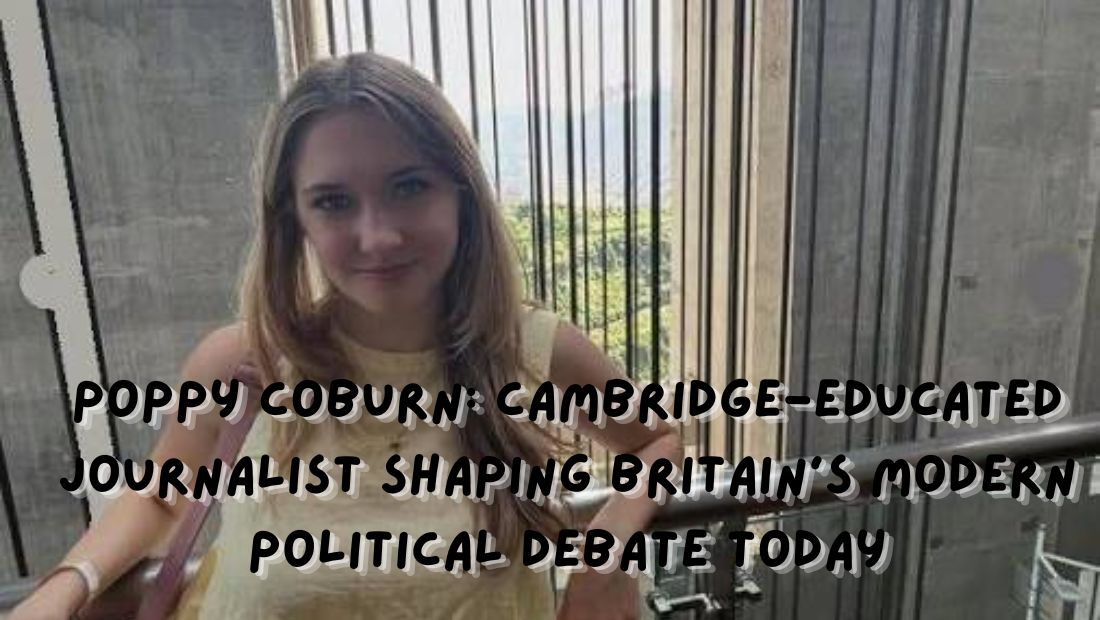
Poppy Coburn has built a notable career in British opinion journalism in only a few years. She is an Associate Comment Editor at The Daily Telegraph, where her work combines editing, writing, political commentary, and appearances across modern media formats.
Her background connects British politics, Cambridge University, UnHerd, GB News, and the Telegraph Comment desk. Her published work regularly examines immigration, free speech, class, meritocracy, universities, human-rights law, and political questions affecting younger generations.
Who Is Poppy Coburn?
Poppy Coburn is a British writer, editor, and political commentator associated with The Daily Telegraph. Current professional listings describe her as an Associate Comment Editor, while other profiles have used Assistant Comment Editor and Assistant US Opinion Editor.
Her responsibilities extend beyond writing individual columns. A comment editor works with opinion material, selects subjects, develops arguments, and edits contributions. Coburn has also appeared in podcasts, video programmes, and live debates, giving her career a broader role within modern opinion journalism.
Quick Table
| Detail | Information |
| Full Name | Poppy Coburn |
| Profession | Journalist, writer, editor, political commentator |
| Current Role | Associate Comment Editor at The Telegraph |
| Education | University of Cambridge |
| Degree | BA (Hons) in History and Politics |
| University Focus | Political thought, including Thomas Hobbes |
| Early Career | Editorial trainee at UnHerd |
| Previous Work | GB News producer and freelance writer |
| Known For | Political commentary, free speech, immigration, class, universities, and generational issues |
| Fellowship | 2024 Publius Fellow, Claremont Institute |
| Cambridge Role | Student representative on University Council |
| Public Speaking | Cambridge Union guest debater |
| Nationality | British |
| Age / Date of Birth | Not reliably confirmed in authoritative public sources |
| Parents | Not reliably documented publicly |
| Husband / Partner | Not reliably confirmed publicly |
| Children | No reliable public information found |
| Wikipedia | No dedicated English-language Wikipedia page confirmed |
Poppy Coburn’s Early Life and Family Background
Coburn has kept much of her private family life away from public attention. Her professional record instead provides clearer information about her education and career, including Colchester Royal Grammar School, University of Cambridge, and her later move into national journalism.
Her early public writing also provides useful context. At university, she became involved in political discussion and environmental activism before publishing a later account of leaving Extinction Rebellion. That experience became an important part of her early political outlook.
Poppy Coburn’s Parents
Coburn has publicly described her parents when discussing claims about media privilege and professional background. She has said her mother is a teacher who previously worked in social care, while her father worked as a clerk.

Those details help explain why discussions of her family background should remain grounded in her own statements. There is no need to attach unrelated people, private records, or unsupported family claims to the biography of a London journalist.
Is Poppy Coburn Related to Jo Coburn?
The names Poppy Coburn and Jo Coburn sometimes create confusion because both women have worked in political media. Jo Coburn is a well-known BBC political presenter, while Poppy Coburn works primarily in newspaper commentary and political journalism.
However, a shared surname does not establish a family connection. No credible public evidence identified for this profile establishes that the two journalists are relatives. They should therefore be treated as separate media professionals unless reliable evidence shows otherwise.
Poppy Coburn’s Age, Birth Date and Husband
Public professional records establish important stages of Coburn’s career, but they do not provide a reliable authoritative birth date. Her University of Cambridge education from 2018 to 2021 helps place her career timeline, although education dates cannot establish an exact age.
Her romantic life also remains largely outside her professional profile. Reliable sources reviewed for this article do not establish a husband, marriage, partner, or children. Keeping those details separate from verified journalism records provides a more accurate account of her public career.
Poppy Coburn’s Education and Cambridge Years
Coburn studied History and Politics at the University of Cambridge, graduating with a BA with honours. The Claremont Institute specifically notes her academic focus on political philosopher Thomas Hobbes, whose ideas include questions surrounding authority, government, order, and political obligation.
That academic background provides useful context for her later interests in state power, social order, rights, and government responsibility. Her career shows a continuing connection between historical political thought and contemporary arguments about institutions, law, citizenship, and public policy.
Poppy Coburn as a University Council Representative
During her Cambridge years, Coburn was elected as a student representative on the University Council. The Claremont Institute confirms that she served as a representative while studying at Cambridge, placing her in contact with university-level institutional decision-making.
This experience came before her national journalism career. It gave her practical exposure to institutional processes alongside her academic studies. Her involvement also shows that her interest in political and institutional questions existed before she became a professional opinion editor.
Poppy Coburn and Cambridge Union Debates
The Cambridge Union became another important part of Coburn’s early public speaking experience. The Claremont Institute records that she debated as a guest there, adding formal political debate to her university activities.
Cambridge Union debates can involve contested questions about politics, society, law, and public institutions. For Coburn, that environment complemented her studies in political thought and gave her opportunities to develop arguments before moving into professional political commentary.
Poppy Coburn’s Journalism Career
Coburn entered journalism through a combination of editorial training, freelance writing, broadcasting, and political commentary. Her career has included UnHerd, GB News, The Telegraph, The Express, CapX, The Critic, and other media projects.
This progression matters because her current role did not appear in isolation. Earlier assignments allowed her to write about universities, activism, technology, free speech, politics, and culture before she moved into a more senior editorial position.
Her Early Work at UnHerd
In 2021, Coburn worked as an editorial trainee at UnHerd. The publication’s author archive lists numerous pieces covering free speech, universities, feminism, online activism, technology companies, environmental activism, and social questions.
One particularly notable article was her 2021 essay about leaving Extinction Rebellion. She described her personal experience with the movement and questioned the effectiveness of disruptive activism. The piece became an early example of her willingness to reassess political movements she had previously supported.
How Poppy Coburn’s Political Outlook Developed
Coburn’s early writing shows an evolving relationship with political ideas. Her published work describes experiences with environmental activism and later criticism of protest strategies, while subsequent commentary has focused more strongly on meritocracy, institutions, immigration, and free expression.
That development should not be reduced to a simple political conversion story. Her writing includes criticism of positions associated with different sides of political debate. Her work is better understood through individual arguments and published evidence rather than a single fixed label.
Freelance Journalism and GB News
Before becoming a full-time Telegraph editor, Coburn developed experience through freelance journalism and broadcasting. Her writing appeared in The Telegraph, The Express, CapX, The Critic, and UnHerd, while she also worked as a producer at GB News.
The Claremont Institute describes her previous GB News work as a primetime producer. This production background added practical broadcast experience to her writing skills, allowing her career to span newspapers, television, digital publishing, and later podcast and debate formats.
Poppy Coburn’s Role at The Telegraph
Coburn joined The Telegraph in an editorial capacity in 2023 after earlier freelance work. Her title has appeared in several forms across professional sources, including Assistant Comment Editor and Associate Comment Editor, reflecting changes in responsibilities and profile descriptions.
Her Telegraph work covers subjects including British politics, immigration, culture, social class, younger generations, universities, and institutional power. She also writes under her own name, meaning her role combines editorial work with personal political commentary.
Poppy Coburn’s Political Views and Major Themes
Coburn’s published work covers a wide range of political and cultural questions. Common themes include immigration policy, human-rights law, meritocracy, class, free speech, institutional authority, and the economic pressures affecting younger adults.
These themes appear across different stages of her career. Her earlier work at UnHerd addressed activism and universities, while her later Telegraph writing has given those interests a larger national platform and connected them with current political debates.
Immigration and Human-Rights Law
Immigration is one of the most consistent subjects associated with Coburn’s political writing. Her commentary has addressed asylum, migration, national identity, labour supply, public services, and the legal framework surrounding immigration decisions.
Her interest also extends to human-rights law. A Cambridge Union biography reported that she was working on a book for Polity examining Britain’s human-rights framework and its effects on immigration policy. The project was reported publicly, although a final publication should only be treated as confirmed once formally released.
Meritocracy, Class and Young People
Coburn has publicly described herself as a “Meritocracy fan,” making meritocracy a recognizable theme in her public profile. Her commentary examines the relationship between effort, ability, opportunity, family background, and economic security.
Her writing about young people also focuses on practical pressures such as housing costs, wages, employment, and access to stable living conditions. Her discussion of class therefore goes beyond accents or education and considers material security, opportunity, and social mobility.
Free Speech and Institutional Power
Free speech remains another important subject in Coburn’s journalism. Her earlier UnHerd archive includes articles about free expression, universities, activism, and institutional culture, while later work continues to question how powerful organisations influence public debate.
She has also written about institutional power, including universities, broadcasters, charities, and legal bodies. Her arguments generally focus on accountability and the limits of institutional authority. Readers should distinguish those arguments from independently verified facts about the institutions themselves.
Poppy Coburn’s Fellowship and International Connections
In 2024, Coburn became the Jeff and Ryan Newman Publius Fellow at the Claremont Institute. The institute’s official biography confirms her Cambridge degree, focus on Thomas Hobbes, University Council experience, Cambridge Union participation, and previous work at GB News.
The Publius Fellowship brings together young professionals interested in journalism, politics, scholarship, and related fields. The programme focuses heavily on political philosophy and American constitutional government. Coburn’s fellowship therefore forms part of her broader connection with international political and intellectual networks.
Poppy Coburn’s Social Media Accounts
Coburn maintains a public presence on X, where the handle @kafkaswife has been associated with a biography describing her as a meritocracy supporter and Telegraph Associate Comment Editor. Her posts frequently extend conversations found in her published journalism.
She has also maintained Instagram and LinkedIn profiles connected with her professional identity. LinkedIn provides useful employment and education context, while social platforms can include humour, commentary, and personal material that should not automatically be treated as formal biography.
Does Poppy Coburn Have a Wikipedia Page?
A dedicated English-language Poppy Coburn Wikipedia biography has not been established as a reliable primary source for her career. That makes institutional and professional records particularly useful when checking information about her education, employment, fellowships, and public activities.
Readers can instead examine sources such as The Telegraph, UnHerd, professional profiles, fellowship biographies, and event listings. Those sources provide different pieces of her career history and are more useful than unattributed biography websites when verifying specific claims.
Final Thoughts on Poppy Coburn
Poppy Coburn’s career connects Cambridge education, student politics, editorial training, broadcasting, freelance writing, and national opinion journalism. Her progression includes UnHerd, GB News, freelance publications, and an editorial role at The Telegraph.
Her public work frequently returns to immigration, meritocracy, class, free speech, institutions, and political philosophy. At the same time, her private life remains comparatively limited in public documentation, making professional records the strongest basis for understanding her career.
FAQs About Poppy Coburn
Who Is Poppy Coburn?
Poppy Coburn is a British journalist and Associate Comment Editor at The Telegraph, known for political commentary covering immigration, free speech, class, institutions, and younger generations.
How Old Is Poppy Coburn?
Poppy Coburn studied at Cambridge from 2018 to 2021, but reliable authoritative sources do not establish her exact birth date or precise current age.
Who Are Poppy Coburn’s Parents?
Coburn has said her mother worked as a teacher and previously in social care, while her father worked as a clerk, without publicly naming them.
Is Poppy Coburn Married?
No reliable professional source confirms that Poppy Coburn is married or has a husband. She keeps her romantic and wider private life largely outside public journalism.
Does Poppy Coburn Have Any Siblings?
There are no reliable publicly verified details establishing Poppy Coburn’s siblings. Available professional biographies focus instead on her education, journalism career, and public activities.
Conclusion
Poppy Coburn’s career combines Cambridge education, political debate, journalism, broadcasting, and editorial work. Her path through UnHerd, GB News, freelance writing, and The Telegraph explains her growing public profile.
Her commentary repeatedly examines immigration, meritocracy, class, free speech, institutions, and political philosophy. Meanwhile, verified professional records provide stronger evidence than speculation about private matters or family relationships. For readers researching Poppy Coburn, her education, published work, editorial positions, and fellowship offer the clearest picture of her development as a British journalist and political commentator.
