
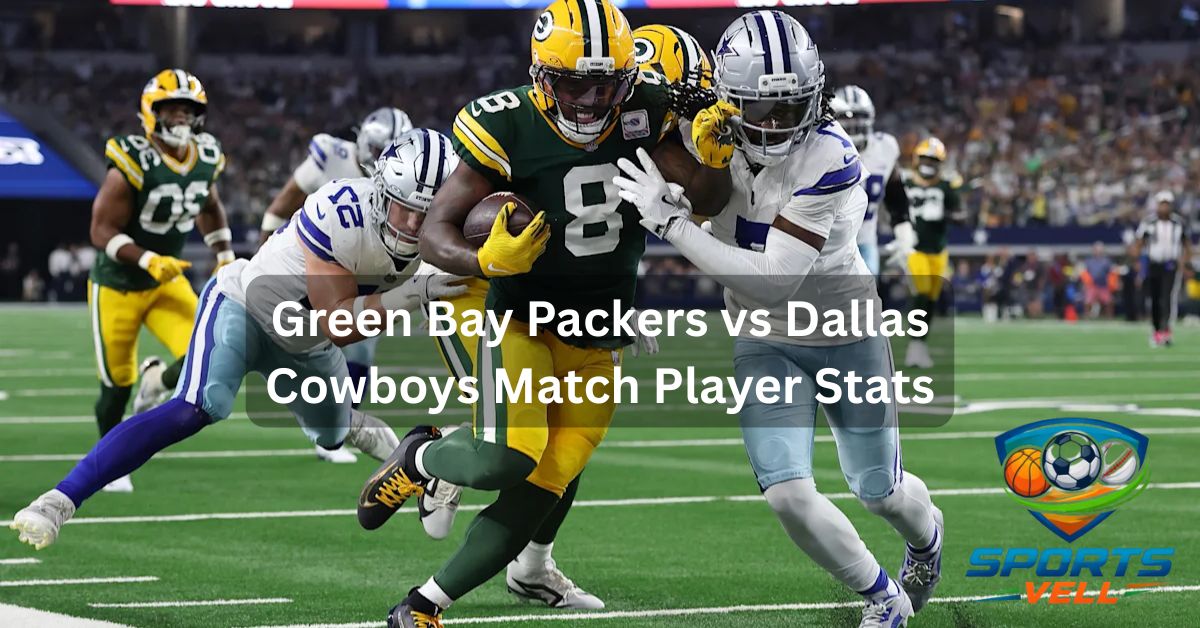
Some NFL games simply refuse to deliver a clean ending — and the Green Bay Packers vs Dallas Cowboys match player stats from September 28, 2025, tell the story of exactly one of those nights. Played under the open roof at AT&T Stadium in Arlington, Texas, this Week 4 Sunday Night Football showdown ended in a breathtaking 40-40 overtime tie — the second-highest scoring draw in professional football history. Neither team got the win it came for. Both teams, however, delivered a performance worth examining in forensic detail.
The narrative backdrop made this game extraordinary before a single snap was taken. Just one month earlier, Dallas had controversially traded All-Pro edge rusher Micah Parsons to Green Bay in a contract dispute that stunned the entire NFL world. Parsons was returning to face his former team, his former quarterback, and his former owner. The football itself then proceeded to match every ounce of that storyline with genuine, sustained drama from the first quarter through the final seconds of overtime.
This complete Green Bay Packers vs Dallas Cowboys match player stats breakdown covers every key performance — quarterback brilliance, ground game battles, defensive standouts, and the special teams moments that made this game truly unforgettable.
Match Biography Table
| Detail | Information |
|---|---|
| Match | Green Bay Packers vs Dallas Cowboys |
| Date | September 28, 2025 |
| Venue | AT&T Stadium, Arlington, Texas |
| Occasion | NFL Regular Season Week 4 |
| Broadcast | Sunday Night Football (NBC) |
| Final Score | Green Bay 40 – Dallas 40 (OT Tie) |
| Packers Record | 2-1-1 |
| Cowboys Record | 1-2-1 |
| Total Combined Points | 80 |
| Historical Note | 2nd highest-scoring tie in pro football history |
| Packers QB | Jordan Love |
| Cowboys QB | Dak Prescott |
| Game MVP (GB) | Josh Jacobs – 157 total yards, 2 TDs |
| Game MVP (DAL) | George Pickens – 8 rec, 134 yards, 2 TDs |
| Key Subplot | Micah Parsons’ return to Dallas |
Quarterback and Offensive Leadership Performance
The central storyline of the Green Bay Packers vs Dallas Cowboys match player stats was always going to be the quarterback duel — and Jordan Love and Dak Prescott delivered a performance that neither team’s coaching staff will fully forget. Both quarterbacks threw for three touchdowns each in regulation. Both were efficient, bold, and clutch under enormous pressure. And when the final whistle blew in overtime, neither had done quite enough to separate himself from the other.
Packers Quarterback Impact
Jordan Love produced one of the finest statistical performances of his young career on this particular Sunday night. His final line of 31 completions from 43 attempts for 337 passing yards and 3 touchdowns came with a passer rating of 118.1 — a genuinely outstanding number against a defence that was competing hard throughout.
What the raw passing stats do not fully capture is how Love managed the game’s dramatic momentum shifts with a composure that spoke volumes about his development as a franchise quarterback. When Green Bay trailed 16-13 at halftime — a deficit created partly by a chaotic sequence of events including a blocked PAT and a fumble — Love came out in the second half and systematically dismantled Dallas’s defensive scheme.
His 25-yard scramble in the fourth quarter on a crucial drive demonstrated the dual-threat dimension that makes him particularly difficult to defend. His third-down conversion rate of 71% for the team as a whole reflected Love’s ability to extend drives and find receivers in critical moments. The green zone efficiency was equally impressive — Green Bay converted 5 from 5 red zone trips into points, a reflection of Love’s precision and decision-making when the field compressed.
The only genuine blemish on his night was the second-quarter strip-sack by James Houston that gave Dallas the ball at the Green Bay 15 and directly led to the go-ahead score before halftime. It was a single costly error in an otherwise commanding performance. His final TD pass to Romeo Doubs with 1:45 remaining to take a 34-30 lead was the kind of clutch delivery that defines elite quarterbacks — and Love delivered it perfectly.
| Jordan Love – Passing Stats | Numbers |
|---|---|
| Completions/Attempts | 31/43 |
| Passing Yards | 337 |
| Touchdowns | 3 |
| Interceptions | 0 |
| Passer Rating | 118.1 |
| Longest Completion | 28 yards |
| Red Zone TD Drives | 5/5 |
Cowboys Quarterback Contribution
Dak Prescott matched Love play for play across a genuinely remarkable evening. His final line of 31 completions from 40 attempts for 319 yards with 3 passing touchdowns and a rushing score represented a total of 4 touchdowns on the night — and he did all of it without CeeDee Lamb, his number one receiver, who sat out with a high ankle sprain.
Prescott’s 124.9 passer rating — actually higher than Love’s — reflected an efficiency and accuracy that was remarkable given the personnel limitations he was operating under. His completion percentage of 77.5% told the story of a quarterback who was operating with exceptional precision, rarely wasting downs, and finding creative solutions to the absence of his most dangerous weapon.
The most visually impressive moment of Prescott’s night came in overtime when, under pressure from Micah Parsons, he escaped the pocket and launched a 34-yard completion to Jalen Tolbert — a throw made while moving away from the pass rush that just barely stayed inbounds. It was the kind of improvised brilliance that confirms his status as one of the NFL’s elite quarterbacks.
His rushing touchdown on a 2-yard quarterback draw late in the first half was a critical score that swung the momentum entirely in Dallas’s favour heading into the locker room. Prescott surpassed Troy Aikman during this game to claim the top spot on the Cowboys’ all-time passing completions list — a milestone that deserved considerably more attention than the chaotic scoreline allowed.
| Dak Prescott – Passing Stats | Numbers |
|---|---|
| Completions/Attempts | 31/40 |
| Passing Yards | 319 |
| Passing Touchdowns | 3 |
| Rushing Touchdowns | 1 |
| Total Touchdowns | 4 |
| Interceptions | 0 |
| Passer Rating | 124.9 |
| Completion Percentage | 77.5% |
Read more: San Francisco Giants vs New York Yankees Match Player Stats
Running Game and Receiving Stats Breakdown
Beyond the quarterback brilliance, the Green Bay Packers vs Dallas Cowboys match player stats reveal a ground game and receiving corps battle that was equally compelling and significantly underreported in the aftermath of such a high-scoring contest.
Ground Game Efficiency
Josh Jacobs was the single most complete offensive performer on either side of the field on this particular evening. His 22 carries for 83 rushing yards and 2 rushing touchdowns, combined with 4 receptions for 71 receiving yards, gave him a total of 157 yards from scrimmage — a dominant, relentless performance that controlled entire quarters of the game for Green Bay.
His second rushing touchdown in the fourth quarter — an 18-yard run where he broke multiple tackles and dragged defenders down the field — was the kind of physical, decisive play that temporarily gave Green Bay what looked like a comfortable lead. Pro Football Focus credited Jacobs with four missed tackles forced and an 80.4 game grade — reflecting not just the volume of his production but the genuine difficulty of bringing him down one-on-one.
Emanuel Wilson provided solid complementary work with 8 carries for 44 yards, giving the Packers a reliable secondary ball carrier when Jacobs needed rest. Green Bay finished with 164 total rushing yards compared to Dallas’s 117 — a meaningful advantage that reflected how consistently the Packers committed to establishing the run even when the scoreboard demanded urgency.
For Dallas, Javonte Williams stepped up in the absence of an established lead back, contributing 20 carries for 85 yards and a wildcat touchdown — the direct-snap score that gave the Cowboys a 30-27 lead with 4:50 remaining and briefly looked like the decisive play of the entire game.
| Rushing Stats Comparison | Green Bay | Dallas |
|---|---|---|
| Total Rushing Yards | 164 | 117 |
| Rush Attempts | 35 | 26 |
| Rush Average | 4.7 | 4.5 |
| Rushing Touchdowns | 2 (Jacobs x2) | 2 (Williams, Prescott) |
| Lead Rusher | Josh Jacobs – 83 yds | Javonte Williams – 85 yds |
Receiving Corps Performance
The receiving story of this game belongs almost entirely to two players — one on each side — who each delivered career-defining performances on the same extraordinary night.
Romeo Doubs was Jordan Love’s entire receiving universe when the game was on the line. His final line of 6 catches for 58 yards and all 3 of Love’s touchdown receptions made him the most clutch receiver on the field regardless of which team you were watching. Every single one of those touchdown catches came at a critical juncture of the game — the first establishing early Green Bay dominance, the second maintaining a lead under pressure, and the third on a crucial third-and-10 with 1:45 remaining to take a 34-30 lead that looked momentarily decisive.
George Pickens was the mirror image for Dallas. Playing his most important game as a Cowboy, Pickens delivered 8 receptions for 134 yards and 2 touchdowns — entirely absorbing the playmaking burden left by CeeDee Lamb’s absence. His 28-yard touchdown in the fourth quarter, where he spun off a defender and ran untouched down the sideline to pull Dallas level with 43 seconds remaining, was the individual play of the game. His air yards share of 61.1% and 4-of-7 completions on deep attempts showed a more vertical approach than Love’s offence, reflecting how aggressively Prescott was willing to attack downfield without his number one option.
Matthew Golden contributed 5 catches for 58 yards for Green Bay, providing crucial complementary production in the intermediate passing game. Tucker Kraft at tight end added 5 catches for 56 yards, giving Love a reliable security blanket at every down and distance.
For Dallas, Jalen Tolbert’s 4 catches for 61 yards — including that pivotal overtime reception — and Jake Ferguson’s 7 catches for 40 yards and a touchdown provided Prescott with diverse options that consistently kept Green Bay’s defence guessing.
| Key Receiving Performances | Rec | Yards | TDs |
|---|---|---|---|
| Romeo Doubs (GB) | 6 | 58 | 3 |
| George Pickens (DAL) | 8 | 134 | 2 |
| Josh Jacobs – receiving (GB) | 4 | 71 | 0 |
| Matthew Golden (GB) | 5 | 58 | 0 |
| Tucker Kraft (GB) | 5 | 56 | 0 |
| Jake Ferguson (DAL) | 7 | 40 | 1 |
| Jalen Tolbert (DAL) | 4 | 61 | 0 |
Defensive Stats and Game-Changing Plays
The defensive story of the Green Bay Packers vs Dallas Cowboys match player stats is perhaps the most nuanced element of the entire evening. Both defences gave up 40 points — which sounds like a defensive failure. But the deeper numbers tell a more complicated and more interesting story.
Packers Defensive Standouts
Micah Parsons was, in purely statistical terms, the most impactful defensive player on the field. Parsons led all defenders with 8 total pressures across 47 snaps — breaking down as 6 quarterback hurries, 1 quarterback hit, and 1 sack. His overtime sack of Prescott — catching him from behind as the quarterback tried to scramble toward the end zone — was the single most consequential defensive play of the entire game. It forced Dallas to settle for a field goal rather than a touchdown, which ultimately meant the Cowboys could not close out the victory they so desperately needed.
The Packers’ third-down defence was less effective — Dallas converted at a rate that kept their drives alive — but Green Bay did force enough punts in key moments to maintain parity throughout the contest. Edgerrin Cooper’s hit on Prescott on a third-down conversion attempt disrupted Dallas’s timing on one critical possession.
Cowboys Defensive Response
Juanyeh Thomas delivered the single most unusual and historically significant defensive play of the game when he blocked Brandon McManus’s PAT following Green Bay’s second touchdown. The Markquese Bell return of the blocked kick for a defensive two-point conversion was the first such play in Cowboys franchise history — and the three-point swing it created proved to be mathematically decisive in forcing McManus into his 53-yard equaliser at the end of regulation.
James Houston’s strip-sack of Jordan Love late in the second quarter was the other game-changing defensive moment. Dallas recovering the fumble at the Green Bay 15 directly led to Prescott’s rushing touchdown and then the Pickens touchdown pass — a ten-point swing in under a minute that completely reversed what had been a comfortable Green Bay lead.
| Key Defensive Plays | Player | Team | Impact |
|---|---|---|---|
| OT Sack | Micah Parsons | Green Bay | Forced FG, prevented TD |
| Blocked PAT + 2PT Return | Juanyeh Thomas / Markquese Bell | Dallas | 3-point swing, franchise first |
| Strip-Sack | James Houston | Dallas | Led to 10-point halftime swing |
| Total Pressures | Micah Parsons | Green Bay | 8 (6 hurries, 1 hit, 1 sack) |
Special Teams and Overall Team Impact
In a game this tight and this dramatic, special teams did not merely contribute — they determined the final result. The special teams statistics in the Green Bay Packers vs Dallas Cowboys match player stats deserve their own focused attention.
Brandon McManus was the unlikely hero of Green Bay’s night. His 53-yard field goal as time expired in regulation — converting with zero seconds remaining under maximum pressure — tied the game at 37-37 and prevented the Packers from leaving Arlington with a loss. He then added a 34-yard field goal in overtime that matched Dallas’s own extra-period score and produced the historic tie. Two clutch kicks under maximum pressure, both delivered without hesitation.
Brandon Aubrey responded for Dallas with a composed 22-yard field goal on Dallas’s first overtime possession that briefly gave the Cowboys a 40-37 lead — a score made possible partly by Prescott’s spectacular scramble pass to Tolbert.
The blocked PAT remains the most analytically significant special teams play of the entire contest. The three-point swing it created was, as multiple analysts noted, the precise mathematical margin that made McManus’s 53-yarder necessary rather than optional.
| Team Stats Comparison | Green Bay | Dallas |
|---|---|---|
| Total Yards | 489 | 436 |
| Total Plays | 79 | 67 |
| Yards Per Play | 6.2 | 6.5 |
| Passing Yards | 325 | 319 |
| Rushing Yards | 164 | 117 |
| Turnovers | 1 | 0 |
| Time of Possession | 35:33 | 34:27 |
| 3rd Down Conversion | 71% | 36% |
| Red Zone Scoring | 5/5 | 4/5 |
| Field Goals Made | 2 (McManus) | 2 (Aubrey) |
Green Bay’s third-down conversion rate of 71% against Dallas’s 36% tells the most important story about offensive efficiency on the night. The Packers were simply far more productive on the downs that matter most — and yet the final score still ended in a tie, largely due to the special teams blunder and Dallas’s superior red zone aggression when the game demanded big plays.
Conclusion
The complete Green Bay Packers vs Dallas Cowboys match player stats from September 28, 2025 paint the picture of one of the most extraordinary regular-season NFL games in recent memory. Two quarterbacks at the peak of their powers. Seven consecutive lead-changing touchdowns in the second half. A blocked PAT that rewrote Cowboys franchise history. A 53-yard game-tying field goal with zero seconds remaining. A Micah Parsons sack against his former team in overtime. And after all of it — a tie.
The Green Bay Packers vs Dallas Cowboys match player stats confirm several things about both teams heading forward from this contest. Jordan Love is a genuine franchise quarterback capable of performing under the most intense pressure. Josh Jacobs remains one of the most complete running backs in the NFL. Dak Prescott’s efficiency without CeeDee Lamb was quietly one of the most impressive aspects of the entire night. And George Pickens announced himself as a true number one receiver capable of carrying an offence when the moment demands it most.
Neither team got what it needed from this result. But everyone who watched it got something worth remembering for years.
FAQs
What was the final score of the Green Bay Packers vs Dallas Cowboys match?
The game ended in a 40-40 overtime tie on September 28, 2025 — the second-highest scoring draw in professional football history, behind only the 1964 AFL game between the Raiders and Boston Patriots.
What were Jordan Love’s stats in the Packers vs Cowboys game?
Jordan Love finished with 31 completions from 43 attempts for 337 yards, 3 touchdowns, 0 interceptions, and a 118.1 passer rating — one of the finest individual quarterback performances of his career to that point in the 2025 season.
How did Dak Prescott perform in the Cowboys vs Packers match?
Prescott delivered an outstanding night with 31 completions from 40 attempts for 319 yards, 3 passing touchdowns, 1 rushing touchdown, 0 interceptions, and a 124.9 passer rating — all without his number one receiver CeeDee Lamb available.
What was Micah Parsons’ impact in his return to Dallas?
Micah Parsons recorded 8 total pressures including 6 hurries, 1 quarterback hit, and 1 sack across 47 snaps. His overtime sack of Prescott was the most consequential defensive play of the game, forcing Dallas to settle for a field goal instead of a potential game-winning touchdown.
Who were the top receivers in the Green Bay Packers vs Dallas Cowboys match player stats?
George Pickens led all receivers with 8 catches for 134 yards and 2 touchdowns for Dallas. Romeo Doubs was the most impactful receiver for Green Bay with 6 catches for 58 yards and all 3 of Jordan Love’s touchdown receptions.
Why did the game end in a tie instead of a winner?
Both teams matched each other with field goals in overtime rather than touchdowns — a 22-yard Aubrey field goal for Dallas and a 34-yard McManus field goal for Green Bay — leaving both teams level when overtime expired. NFL rules at the time did not mandate a sudden-death winner beyond the overtime period in regular season play.
