
How Do NHL Standings Points Work in 2026–27?
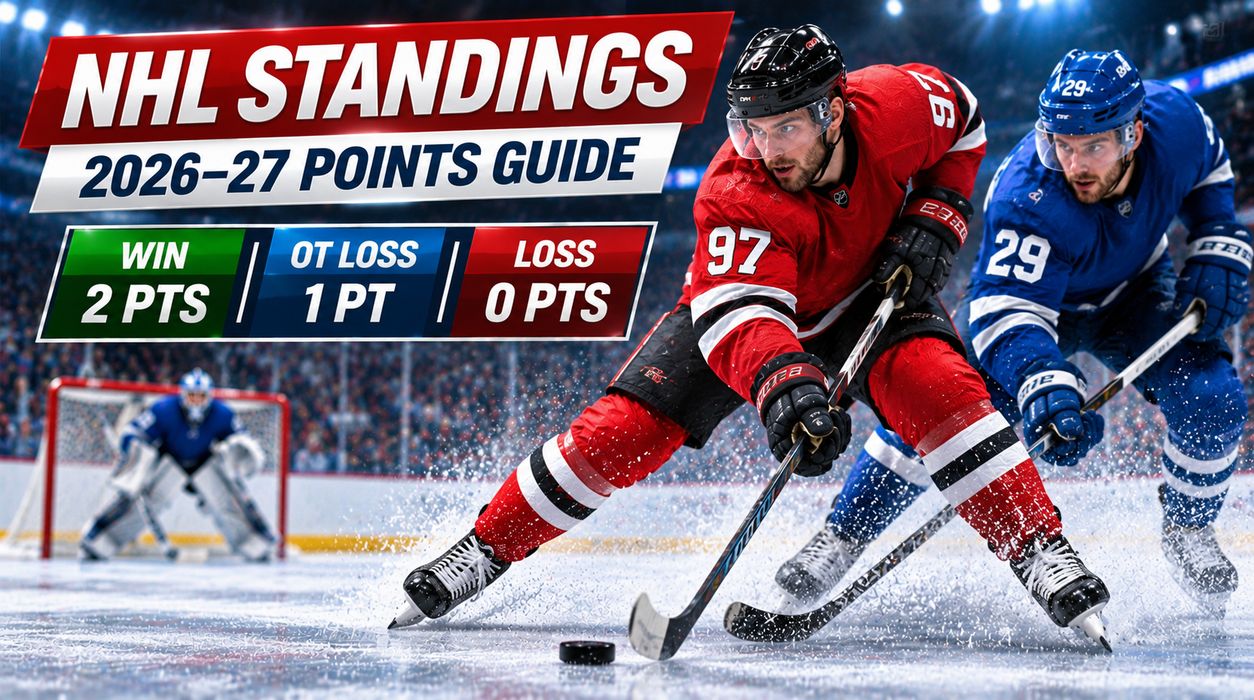
NHL standings points work by awarding two points for a win, one point for an overtime or shootout loss, and zero points for a regulation loss. During the 2026–27 season, each of the NHL’s 32 teams plays 84 regular-season games, making 168 the maximum possible points for one team.
The system sounds simple until you look at an NHL standings table. Why can a team lose a game and still earn a point? What is the difference between RW and ROW? Why can a team with fewer wins rank above another team? And how do these numbers determine which clubs qualify for the Stanley Cup Playoffs?
This guide explains how NHL standings points work, how to calculate them, what every major standings abbreviation means, and how the league breaks ties between teams.
NHL Standings Points: The Quick Answer
The NHL uses a two-point system for wins, regardless of whether the victory occurs in regulation, overtime, or a shootout.
| Game Result | Points Awarded |
|---|---|
| Regulation win | 2 |
| Overtime win | 2 |
| Shootout win | 2 |
| Regulation loss | 0 |
| Overtime loss | 1 |
| Shootout loss | 1 |
A team cannot earn more than two standings points from a single game.
However, an NHL game can distribute three total points between the two teams if it reaches overtime or a shootout.
For official standings and team records, visit the NHL standings page.
How Are NHL Standings Points Calculated?
The formula is straightforward:
NHL Standings Points = (Wins × 2) + Overtime/Shootout Losses
The number of regulation losses does not add any points.
Example 1: A Team With 20 Wins and 5 Overtime Losses
Imagine a team has the following record:
- 20 wins
- 10 regulation losses
- 5 overtime or shootout losses
Its points total is:
(20 × 2) + 5 = 45 points
The team has played 35 games and earned 45 standings points.
Example 2: A Team With More Losses but More Points
Now consider two fictional teams.
| Record | Team A | Team B |
|---|---|---|
| Wins | 20 | 19 |
| Regulation losses | 15 | 10 |
| OT/SO losses | 0 | 6 |
| Games played | 35 | 35 |
| Points | 40 | 44 |
Team A has more wins, but Team B has more standings points.
That happens because Team B earned six points from overtime or shootout losses.
This example demonstrates why looking only at the win column can be misleading.
Why Does the NHL Give One Point for an Overtime Loss?
The NHL rewards teams that finish regulation without losing.
When a game is tied after 60 minutes, both teams normally secure one standings point.
The winner of overtime or the shootout receives an additional point.
This means the winning team finishes with two points, while the losing team receives one.
Why the Rule Exists
The overtime-loss point became part of the NHL standings system in the 1999–2000 season.
At the time, the league wanted teams to have more incentive to pursue a victory during overtime instead of playing conservatively to protect a tie.
The shootout arrived in 2005–06, eliminating ties from regular-season games.
The modern system continues to reward teams for reaching overtime.
Is the Overtime-Loss Point Controversial?
Yes, some hockey fans and analysts debate whether the system is fair.
The main criticism is that an overtime game distributes three points, while a regulation game distributes only two.
That difference can affect the standings over a full season.
Supporters of the system argue that it recognizes teams that remain competitive through regulation.
Critics prefer systems that distribute the same number of total points in every game.
The NHL continues using its current system for the 2026–27 season.
What Is a Three-Point Game in the NHL?
A three-point game is an informal term for a regular-season matchup that reaches overtime or a shootout.
Consider a game between two fictional teams.
The score is tied 2–2 after regulation.
Team A wins 3–2 in overtime.
The standings points are distributed as follows:
| Team | Result | Points |
|---|---|---|
| Team A | Overtime win | 2 |
| Team B | Overtime loss | 1 |
| Total | 3 |
If Team A had won in regulation, Team B would receive zero points.
Only two points would be distributed.
Why Three-Point Games Matter
Suppose two teams are competing for the final playoff spot.
One team may benefit when a rival loses in regulation rather than overtime.
A regulation loss prevents that rival from earning any points.
An overtime loss still allows the rival to gain one point.
That single point can become important late in the season.
What Do GP, W, L, OT and PTS Mean in NHL Standings?
NHL standings tables use abbreviations to summarize each team’s performance.
Understanding these columns makes it easier to follow playoff races.
| Abbreviation | Meaning |
|---|---|
| GP | Games Played |
| W | Wins |
| L | Regulation Losses |
| OT | Overtime/Shootout Losses |
| PTS | Standings Points |
| P% | Points Percentage |
| RW | Regulation Wins |
| ROW | Regulation and Overtime Wins |
| GF | Goals For |
| GA | Goals Against |
| DIFF | Goal Differential |
| L10 | Record in Last 10 Games |
| STRK | Current Streak |
The most important columns for understanding a team’s position are PTS, GP, P%, RW, and ROW.
GP: Games Played
GP shows how many regular-season games a team has completed.
This number matters because teams do not always play the same number of games at the same point in the season.
W: Wins
W includes victories in regulation, overtime, and shootouts.
Every win contributes two standings points.
L: Regulation Losses
L counts games lost during the first 60 minutes.
These losses award zero points.
OT: Overtime and Shootout Losses
OT includes losses after regulation.
These normally award one standings point.
PTS: Total Standings Points
PTS determines the primary ranking of teams.
A higher points total generally means a higher position in the standings.
When teams are tied, the NHL applies its official tiebreaking procedure.
What Is the Difference Between RW and ROW in NHL Standings?
RW and ROW are among the most commonly misunderstood NHL abbreviations.
They are especially important because they can determine which team ranks higher when clubs have the same number of points.
RW Means Regulation Wins
RW counts only games won during the first 60 minutes.
Overtime and shootout victories are excluded.
For example, a team with 25 regulation wins has an RW total of 25.
ROW Means Regulation and Overtime Wins
ROW includes games won in regulation or overtime.
Shootout victories are excluded.
For example:
- 25 regulation wins
- 8 overtime wins
- 4 shootout wins
The team’s totals would be:
| Category | Total |
|---|---|
| W | 37 |
| RW | 25 |
| ROW | 33 |
Why RW Matters More Than ROW
Under the NHL’s official tiebreaking procedure, regulation wins are considered before regulation-plus-overtime wins.
That means a team with more RW can rank ahead of another team with the same standings points, even if the other team has more total victories.
This encourages teams to win during regulation rather than relying on overtime or shootouts.
How Does NHL Points Percentage Work?
Points percentage measures how many standings points a team has earned compared with the maximum available from its games played.
The formula is:
Points Percentage = Points Earned ÷ (Games Played × 2)
Example: 30 Points in 20 Games
A team has played 20 games.
The maximum available points are:
20 × 2 = 40
If the team has earned 30 points:
30 ÷ 40 = 0.750
Its points percentage is .750, or 75%.
Why Points Percentage Is Useful
Imagine two teams have played different numbers of games.
| Statistic | Team A | Team B |
|---|---|---|
| Games Played | 20 | 18 |
| Points | 26 | 25 |
| Maximum Points | 40 | 36 |
| Points Percentage | .650 | .694 |
Team A has more total points.
However, Team B has earned a higher percentage of its available points.
Points percentage helps compare teams that have played different numbers of games.
It also matters in the NHL’s official tiebreaking procedure when tied teams have played unequal numbers of games.
How Many Points Can an NHL Team Earn in 2026–27?
The 2026–27 NHL regular season includes 84 games per team.
Each victory is worth two points.
Therefore:
84 × 2 = 168
The maximum possible standings total for an NHL team in 2026–27 is 168 points.
That would require a team to win every regular-season game.
How Is This Different From Previous Seasons?
Under the former 82-game schedule, the maximum possible points total was 164.
The expanded 84-game season increases the theoretical maximum by four points.
| Season Format | Games | Maximum Points |
|---|---|---|
| 82-game season | 82 | 164 |
| 84-game season | 84 | 168 |
This difference is important when comparing team records across seasons.
A team earning 110 points in an 84-game season has a slightly different points percentage than a team earning 110 points in an 82-game season.
Points percentage provides useful context for those comparisons.
How Many Points Does an NHL Team Need to Make the Playoffs?
There is no fixed number of points that guarantees a Stanley Cup Playoff berth.
The required total changes depending on how teams perform within their divisions and conferences.
A team might qualify with fewer than 100 points in one season.
In another season, a club could reach 100 points and still face a difficult playoff race.
Why There Is No Automatic Qualification Number
The NHL awards playoff positions based on divisional rankings and wild-card standings.
A team’s playoff chances depend partly on how many points competing teams earn.
The number of overtime games across the league can also affect the distribution of standings points.
Is 100 Points Enough?
Reaching 100 points is often a strong indicator of a competitive season.
However, it is not an official playoff qualification threshold.
Fans should evaluate a team’s conference position, division ranking, remaining schedule, and points percentage rather than relying on one number.
How Do NHL Standings Determine the Stanley Cup Playoffs?
The NHL uses a 16-team playoff format.
Eight teams qualify from the Eastern Conference and eight from the Western Conference.
Step 1: Top Three Teams in Each Division
The top three teams in each of the NHL’s four divisions automatically qualify.
That accounts for 12 playoff positions.
Step 2: Two Wild Cards Per Conference
Each conference awards two additional playoff positions.
These go to the two highest-ranked remaining teams in the conference, regardless of division.
Step 3: First-Round Matchups
The two division winners with the best records in each conference face the wild-card teams.
The division winner with the better record faces the lower-ranked wild-card qualifier.
The second- and third-place teams in each division meet in the opening round.
This structure makes divisional performance especially important.
What Does Wild Card Mean in NHL Standings?
A wild-card team qualifies for the playoffs without finishing among the top three teams in its division.
For example, suppose a division has four strong teams.
The top three qualify through their divisional positions.
The fourth-place team may still qualify if it earns one of the conference’s two wild-card spots.
Can Both Wild Cards Come From the Same Division?
Yes.
The two wild-card teams in a conference can come from the same division.
They can also come from different divisions.
The deciding factor is their position among the remaining teams in the conference standings.
Why Wild-Card Races Are Competitive
Wild-card qualification creates competition between teams that may not play in the same division.
A club in the Atlantic Division may compete directly in the standings against a club from the Metropolitan Division.
The same applies to the Central and Pacific divisions in the Western Conference.
What Happens When Two NHL Teams Have the Same Points?
When two or more teams have equal standings points, the NHL uses a series of tiebreakers.
The official order is:
- Fewer games played
- More regulation wins (RW)
- More regulation and overtime wins (ROW)
- More total wins
- More points in head-to-head games, subject to the league’s uneven-game adjustments
- Better goal differential
- More goals scored
These rules are published in the NHL’s official playoff tiebreaking procedure.
Tiebreaker 1: Fewer Games Played
If two teams have equal points but one has played fewer games, the team with fewer games ranks higher.
This reflects a better points percentage.
At the end of a completed 84-game season, this tiebreaker normally has no effect because every team has played the same number of games.
Tiebreaker 2: Regulation Wins
The team with more regulation wins ranks higher.
For example:
| Statistic | Team A | Team B |
|---|---|---|
| Points | 98 | 98 |
| Games Played | 84 | 84 |
| Regulation Wins | 40 | 37 |
Team A wins the tiebreaker because it has more regulation victories.
Tiebreaker 3: Regulation and Overtime Wins
If regulation wins are equal, the NHL compares ROW.
This includes regulation and overtime victories but excludes shootout wins.
Tiebreaker 4: Total Wins
If RW and ROW are also equal, total victories become the next deciding factor.
This includes shootout wins.
Tiebreaker 5: Head-to-Head Results
The league compares points earned in games between the tied teams.
Special adjustments apply when teams have played an uneven number of head-to-head games.
The first game played in the city with the extra home game is excluded from the comparison.
Tiebreaker 6: Goal Differential
Goal differential is calculated by subtracting goals allowed from goals scored.
For example:
250 goals scored − 220 goals allowed = +30 goal differential.
The team with the better differential wins this tiebreaker.
Tiebreaker 7: Goals Scored
If teams remain tied after the previous comparisons, the NHL uses total goals scored.
The team with more goals ranks higher.
Why Are Regulation Wins Important in the NHL?
Regulation wins can become decisive during a close playoff race.
Two teams might have the same points total, but one may have earned more of its victories before overtime.
That team receives the advantage under the official tiebreaking procedure.
Example of a Late-Season Playoff Race
Imagine Team A and Team B finish with 96 points.
Team A has 38 regulation wins.
Team B has 35 regulation wins.
Assuming both teams played the same number of games, Team A ranks higher because it has more regulation victories.
This illustrates why a regulation win can carry additional competitive value even though it awards the same two standings points as an overtime victory.
Can an NHL Team Have More Losses Than Wins and Still Earn Many Points?
Yes.
Because overtime and shootout losses award one point, a team can accumulate a substantial points total even when its overall record includes many losses.
Consider a hypothetical 84-game record:
- 35 wins
- 30 regulation losses
- 19 overtime or shootout losses
The team earns:
(35 × 2) + 19 = 89 points
The team has 35 victories and 49 total losses, but it still earns 89 standings points.
That does not automatically make it a playoff team.
It simply demonstrates how the NHL points system works.
How Does the NHL Points System Compare With Other Sports?
Different professional sports use different methods to rank teams.
The NHL uses standings points.
The NFL generally ranks teams by win-loss-tie records and winning percentage.
Major League Baseball also uses win-loss records and winning percentage.
Soccer leagues commonly award three points for a victory and one point for a draw.
NHL vs. Soccer Points
| Result | NHL | Typical Soccer League |
|---|---|---|
| Win | 2 | 3 |
| Draw | Not allowed in NHL regular season | 1 |
| Regulation loss | 0 | 0 |
| Overtime/shootout loss | Usually 1 | Not a standard league result |
The comparison highlights how different competition formats create different incentives.
For more background on team structure in soccer, see SportsVell’s guide to how many players are on a soccer team.
Why NHL Standings Points Matter More Late in the Season
Every regular-season game contributes to the final standings.
However, the importance of individual results often becomes more visible during the final weeks.
A team competing for a playoff spot may need every available point.
Head-to-Head Games Become Crucial
When two teams competing for the same playoff position meet, the result directly affects both clubs.
A regulation win can be especially valuable because it gives the winner two points while preventing the opponent from earning any.
Games in Hand Matter
A team may trail another club in points but have played fewer games.
Those additional remaining games create opportunities to close the gap.
This is why analysts often discuss games in hand when evaluating playoff races.
Remaining Schedule Strength Matters
A team facing several strong opponents may have a more difficult path than a team facing struggling clubs.
However, standings points are earned through actual results, not predictions.
Unexpected victories and losses can quickly change playoff scenarios.
Does Overtime Change the Value of an NHL Game?
Overtime changes the total number of points distributed.
In regulation, the winner receives two points and the loser receives none.
In overtime or a shootout, the winner receives two points and the loser normally receives one.
The winning team does not receive an additional third point.
Instead, the extra point goes to the losing team.
Example: Two Different Outcomes
Game A: Regulation Finish
Team A defeats Team B 4–2.
- Team A: 2 points
- Team B: 0 points
- Combined: 2 points
Game B: Overtime Finish
Team C defeats Team D 4–3 in overtime.
- Team C: 2 points
- Team D: 1 point
- Combined: 3 points
This difference can influence the standings when teams compete closely over an 84-game season.
What Is the Presidents’ Trophy in the NHL?
The Presidents’ Trophy is awarded to the team that finishes the regular season with the most standings points.
It recognizes regular-season performance across the entire league.
However, winning the Presidents’ Trophy does not guarantee winning the Stanley Cup.
The Stanley Cup Playoffs are a separate postseason competition.
A team must win four best-of-seven playoff series to become the Stanley Cup champion.
Does the Presidents’ Trophy Guarantee Home-Ice Advantage?
The team with the league’s best regular-season record receives home-ice advantage throughout the playoffs if it advances.
That is a meaningful advantage, but it does not guarantee postseason success.
Teams still need to win their playoff matchups.
Why Points Percentage Is Better for Comparing Different NHL Seasons
The 2026–27 NHL season includes 84 games per team instead of the previous 82.
That makes raw points totals slightly less comparable across seasons.
For example:
| Season | Games | Points | Points Percentage |
|---|---|---|---|
| 82-game season | 82 | 100 | .610 |
| 84-game season | 84 | 100 | .595 |
Both teams earned 100 points.
However, the team playing 82 games earned a higher percentage of its available points.
Points percentage provides a more consistent measure when comparing seasons of different lengths.
It is still important to consider the competitive environment, team strength, and other factors before making historical comparisons.
How to Read an NHL Standings Table Like an Expert
When looking at an NHL standings table, start with the points column.
Then check how many games each team has played.
Next, compare points percentage.
Finally, review regulation wins and ROW if teams are close.
A Simple Five-Step Method
Step 1: Check PTS
Identify which teams have earned the most standings points.
Step 2: Compare GP
Determine whether teams have played the same number of games.
Step 3: Review P%
Use points percentage to compare teams with different numbers of games played.
Step 4: Look at RW and ROW
These numbers help explain potential tiebreakers.
Step 5: Check Division and Wild-Card Position
A team can have a strong record but still face competition for a playoff berth.
Understanding all five factors provides a clearer picture than looking only at total wins.
How Does the NHL Points System Affect Coaching Strategy?
The standings system can influence how coaches approach the final minutes of a tied game.
A team that reaches overtime normally secures one point.
However, winning in regulation prevents the opponent from earning that point.
This creates a strategic balance.
A team may want to attack for a regulation victory, but aggressive play also creates defensive risks.
Why Coaches Consider the Standings
Late in the season, coaches understand that one point can affect playoff positioning.
A team competing against a direct rival may place additional importance on winning in regulation.
However, teams still need to make decisions based on the game situation, available players, and defensive responsibilities.
The distinction between scheduled playing time and real-world game duration is also important across professional sports. SportsVell explains this in its article on how long a football game lasts.
Do NHL Playoff Games Award Standings Points?
No.
The NHL standings points system applies to the regular season.
Stanley Cup Playoff games are part of a separate elimination competition.
Teams advance by winning playoff series rather than accumulating regular-season standings points.
Each playoff series is best-of-seven.
The first team to win four games advances to the next round.
This means a playoff victory contributes to winning the series, not to the regular-season points total.
Are NHL Standings Points the Same as Player Points?
No.
This is another common source of confusion.
NHL standings points measure team results.
Player points measure individual offensive production.
A player earns one statistical point for a goal or an assist.
For example, a player with 25 goals and 40 assists has 65 individual points.
Those points are completely different from the standings points awarded to the player’s team.
Team Points vs. Player Points
| Category | Team Standings Points | Player Points |
|---|---|---|
| Purpose | Rank teams | Measure offensive production |
| Awarded for | Wins and OT/SO losses | Goals and assists |
| Maximum per game | 2 | No fixed maximum |
| Used for playoff qualification | Yes | No |
Understanding the distinction helps avoid confusion when reading NHL news, statistics, and player profiles.
SportsVell also publishes guides about player participation and roster structures in other sports, including how many players are on a football team.
Common NHL Standings Mistakes to Avoid
Mistake 1: Assuming Every Loss Is Worth Zero Points
Overtime and shootout losses normally award one standings point.
Only regulation losses automatically result in zero points.
Mistake 2: Assuming Every NHL Game Distributes Two Points
Games decided after regulation normally distribute three total points.
Mistake 3: Confusing RW With ROW
RW includes only regulation wins.
ROW includes regulation and overtime wins but excludes shootout victories.
Mistake 4: Assuming 100 Points Guarantees a Playoff Spot
There is no fixed playoff qualification threshold.
Teams qualify based on divisional and conference standings.
Mistake 5: Ignoring Games Played
Two teams with similar points totals may have played different numbers of games.
Points percentage helps provide context.
Mistake 6: Comparing 82-Game and 84-Game Seasons Without Adjustments
The expanded 2026–27 schedule increases the maximum available points.
Historical comparisons should consider points percentage.
Frequently Asked Questions About NHL Standings Points
How many points is an NHL win worth?
An NHL win is worth two standings points, whether the victory occurs in regulation, overtime, or a shootout.
How many points do NHL teams get for an overtime loss?
Teams normally receive one point for losing in overtime or a shootout.
How many points is a regulation loss worth?
A regulation loss is worth zero points.
What does PTS mean in NHL standings?
PTS stands for standings points. It is the total number of points earned from wins and overtime or shootout losses.
What does OT mean in NHL standings?
OT represents overtime and shootout losses.
What does RW mean in NHL standings?
RW means regulation wins, counting only victories completed during the first 60 minutes.
What does ROW mean in NHL standings?
ROW means regulation and overtime wins. Shootout victories are excluded.
What is NHL points percentage?
Points percentage is calculated by dividing points earned by the maximum points available from games played.
How many points can an NHL team earn in 2026–27?
An NHL team can earn a maximum of 168 points across 84 regular-season games.
Why do NHL teams get a point for losing in overtime?
The NHL rewards teams that reach the end of regulation without losing.
What happens if two NHL teams have the same points?
The league applies official tiebreakers, beginning with fewer games played, followed by regulation wins and other criteria.
How many NHL teams make the playoffs?
Sixteen teams qualify: eight from the Eastern Conference and eight from the Western Conference.
How many wild-card teams make the NHL playoffs?
Four wild-card teams qualify, with two from each conference.
Is 100 points enough to make the NHL playoffs?
It can be enough, but it is not guaranteed. Qualification depends on the standings of other teams.
Do NHL playoff wins count toward regular-season standings points?
No. Playoff games determine which teams advance in the postseason.
Are NHL player points and team standings points the same?
No. Player points come from goals and assists, while team standings points come from game results.
Final Thoughts
Understanding how NHL standings points work makes it much easier to follow the 2026–27 season.
Every win is worth two points, overtime and shootout losses normally earn one point, and regulation losses earn zero.
The expanded 84-game schedule means each team can earn up to 168 points.
However, total points are only part of the story.
Regulation wins, ROW, points percentage, divisional rankings, and official tiebreakers can all influence the playoff race.
For fans following their favorite teams, the most useful approach is to monitor points, games played, regulation wins, and wild-card positioning together.
The key takeaway: NHL standings are based primarily on points earned, but how teams earn those points can determine their final ranking and playoff qualification.
For additional sports explanations and current coverage, visit SportsVell and explore its football field dimensions guide for another example of how official sports measurements and rules are calculated.

Washim is a passionate sports writer and editor at SportsVell.com, covering the latest sports news, match updates, player performances, and expert analysis. He focuses on football, cricket, basketball, NFL, NBA, UFC, and other major sports. His goal is to provide sports fans with accurate, engaging, and easy-to-understand content from around the world.