
How Many Players on a Football Team? (2026 Guide)

How many players on a football team? An American football team fields 11 players on the field at a time, so 22 players are on the field during every play. The full team is much bigger than 11, though, because the roster, the bench, and the practice squad all hold more players.
The question has three answers, not one. The number on the field is 11, the number dressed for a game is 46 in the NFL, and the number on the roster is 53 in the NFL and 105 in college football. Each number answers a different version of the question.
Football also means two different sports. In the United States, football means American football, with its 53-man NFL rosters and its 105-player college rosters. In most of the rest of the world, football means soccer, which also fields 11 players per side but uses very different roster rules.
This guide gives every number, by level and by format. It covers the NFL, college football, high school football, the CFL, arena football, 8-man football, 6-man football, and flag football, plus the positions, the substitution rules, and the history of why the number is 11.
The Short Answer: 11 on the Field, 53 on an NFL Roster, 105 in College
The short answer is 11 players on the field per team. Eleven play offense, eleven play defense, and eleven play special teams, but only one unit is on the field at a time. The other units wait on the sideline until their turn comes.
The roster is the bigger number behind the 11. An NFL team carries 53 players on its active roster during the regular season, plus up to 16 more on the practice squad. A college team at a school that opted into the House settlement carries up to 105 players.
High school rosters vary the most. Small schools may carry 25 to 30 players, while large schools may carry 70 to 80. Many high school players play both offense and defense because the roster is too small to specialize.
| Level | Players on the field | Players dressed for a game | Total roster |
|---|---|---|---|
| NFL | 11 | 46 (48 with 8 offensive linemen) | 53 active + 16 practice squad |
| College (FBS/FCS, opt-in schools) | 11 | About 70 to 74 travel, varies by conference | 105 |
| High school | 11 | Whole roster dresses | 25 to 80 |
| CFL | 12 | 45 | 45 dressed |
| Arena football | 8 | Whole roster dresses | About 20 |
| 8-man football | 8 | Whole roster dresses | 15 to 25 |
| 6-man football | 6 | Whole roster dresses | 12 to 18 |
| Flag football | 5 or 7 | Whole roster dresses | 8 to 14 |
| Soccer (for comparison) | 11 | 20 to 26 | 23 to 26 (World Cup 26) |
The table shows why the question confuses people. The on-field number is almost always 11, but the roster number changes with the level, the league, and the format. A fan who hears “53-man roster” and a fan who hears “105-player roster” are both right, about different levels.
American Football vs Soccer: Which “Football” Do You Mean?
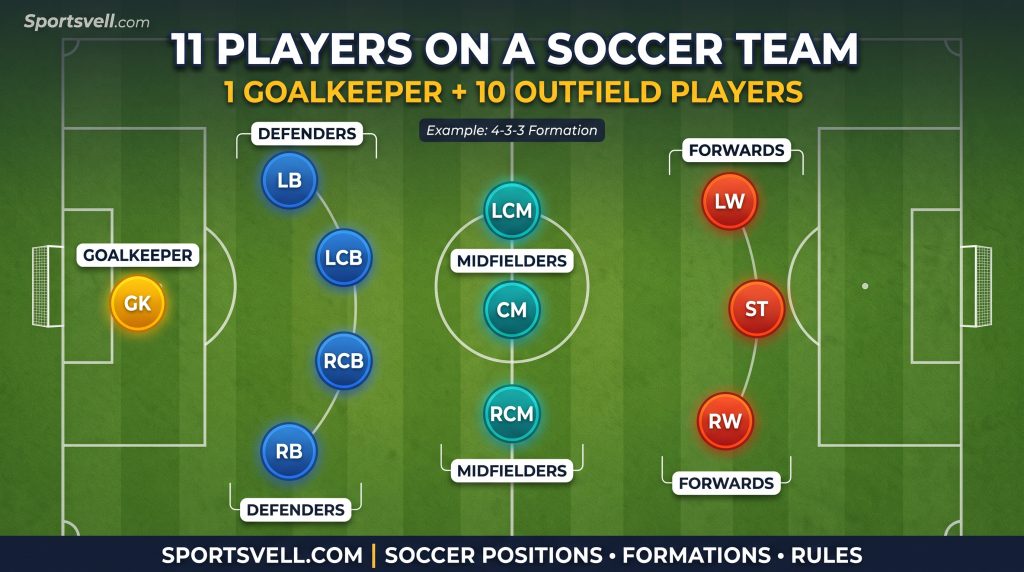
In the United States, football means American football. It is played with an oval ball, on a 100-yard field, with four downs to gain ten yards. The NFL is the professional league, college football is the amateur level below it, and high school football feeds both.
In most other countries, football means soccer. It is played with a round ball, on a larger field, with continuous play and no downs. The sport is governed by IFAB, which writes the Laws of the Game, and FIFA applies those laws in its competitions.
Both sports field 11 players per team, which is why search results mix them up. A search for how many players are on a football team returns soccer pages first, because most of the world calls soccer “football.” The number is the same, but everything behind it is different.
The roster rules are where the two sports split. A soccer team names 11 starters and a handful of substitutes, and a World Cup squad has 26 players with 15 named substitutes. An NFL team carries 53 players, dresses 46, and rotates three separate units through the game.
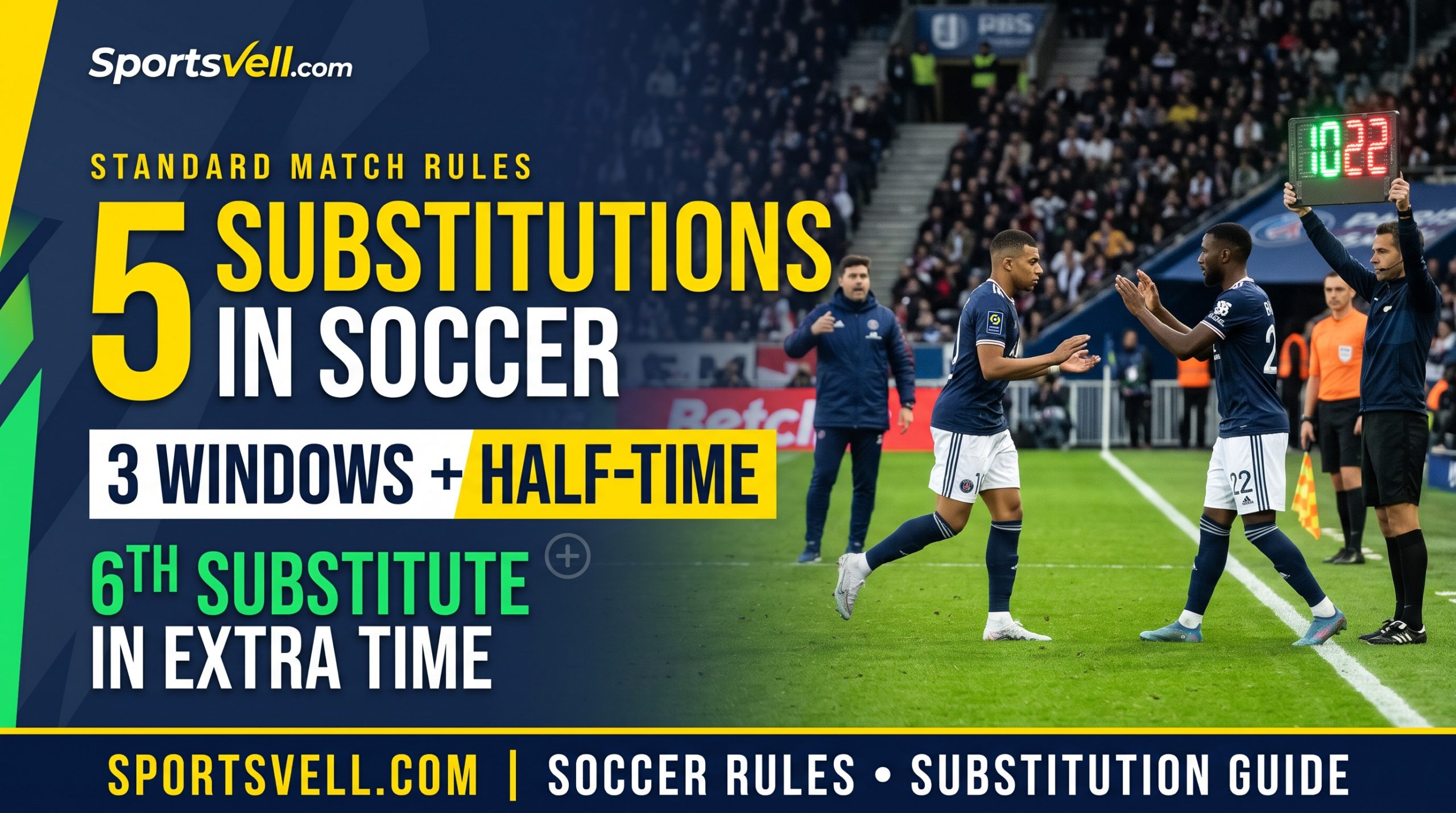
Substitutions work differently too. Soccer allows 5 substitutions in 3 windows plus half-time, and a substituted player cannot return. American football allows unlimited substitutions between plays, and players rotate in and out freely all game.
This guide is about American football, with soccer noted only for comparison. When it says football, it means the American game, unless it says soccer explicitly. The soccer numbers are included so readers who meant soccer still get their answer.
How Many Players Are on an NFL Team?
An NFL team carries 53 players on its active roster during the regular season. The number is set by the league’s collective bargaining agreement with the players union, and it applies to all 32 teams. No team may carry more than 53 on its active roster once the season starts.
Only 46 of the 53 dress for a game. The other seven are declared inactive before kickoff, usually because of injury, matchup decisions, or depth at their position. The inactive players sit on the sideline in street clothes and cannot play.
Eleven of the 46 are on the field at a time. The offense sends out 11 players, then the defense sends out 11, then the special teams unit sends out 11. The same 46 players fill all three units, so most players play on at least two of them.
The total number of players under contract is about 69. That is 53 on the active roster plus up to 16 on the practice squad. Injured players on reserve lists sit outside the 53, so the real number of people attached to a team is higher still.
The 53-Man Active Roster
The 53-man roster is the core of the team. It holds the starters, the backups, and the specialists, and it is the group the coaches manage all season. Every player on it is eligible to be activated for a game, subject to the 46-player game-day limit.
The roster breaks down by position group. A typical NFL roster carries 2 to 3 quarterbacks, 3 to 4 running backs, 5 to 7 wide receivers, 2 to 3 tight ends, 8 to 9 offensive linemen, 8 to 9 defensive linemen, 5 to 6 linebackers, 9 to 10 defensive backs, and 3 specialists. The exact split varies by team and by scheme.
| Position group | Typical players on a 53-man roster | Role |
|---|---|---|
| Quarterback | 2 to 3 | Throws and hands off; runs the offense |
| Running back | 3 to 4 | Carries the ball; catches passes out of the backfield |
| Wide receiver | 5 to 7 | Catches passes; stretches the defense |
| Tight end | 2 to 3 | Blocks and catches passes |
| Offensive line | 8 to 9 | Protects the quarterback; opens running lanes |
| Defensive line | 8 to 9 | Rushes the passer; stops the run |
| Linebacker | 5 to 6 | Defends runs and short passes; calls adjustments |
| Defensive back | 9 to 10 | Covers receivers; defends deep passes |
| Specialists | 3 | Kicker, punter, long snapper |
| Total | 53 | Starters, backups, and specialists |
The roster is not fixed during the season. Teams sign and release players every week because of injuries, trades, and performance. The number stays at 53, but the names on it change constantly, especially at the bottom of the depth chart.
Roster size is set by the collective bargaining agreement. The 53-man limit has been the standard for decades, and it is the number every fan learns first. The NFL Operations site publishes the league’s roster rules, and the NFL rulebook carries the game-day details.
Game-Day Actives: 46 Players, or 48 With 8 Offensive Linemen
Only 46 players may dress for a regular-season game. The team declares seven of its 53 inactive about 90 minutes before kickoff, and those seven cannot play. The rule forces coaches to choose which backups they need most for that opponent.
The number rises to 48 if the team dresses at least 8 offensive linemen. The rule changed in 2021, and it exists because offensive line injuries can leave a team with no healthy linemen. A team that dresses eight linemen gets two extra active spots, bringing the total to 48.
Some pages state the number as 48 flat, which is an oversimplification. The 48 figure is conditional, not automatic, and a team that dresses only seven offensive linemen is capped at 46. The condition matters, because it changes how many backups a coach can use.
The inactive list is a tactical decision, not just an injury list. Coaches deactivate healthy players when the matchup does not need them, such as a third quarterback against a run-heavy opponent. The seven inactive spots are part of game planning, not just a medical report.
Our Monday Night Football hub tracks the biggest weekly game, where 46 players dress per team. The latest result there is the Bears beating the Seahawks 34-17 on November 2, 2026, a game in which both teams used their full active rosters across offense, defense, and special teams.
The Practice Squad: 16 Players Plus One
An NFL team may carry up to 16 players on its practice squad. Practice squad players train with the team all week, run the opponent’s plays on the scout team, and prepare the starters for Sunday. They do not count against the 53-man roster, and they do not dress for games unless promoted.
A 17th spot exists for the International Player Pathway program. The extra spot is reserved for a player from outside the United States, and it does not count against the 16. The program has brought players from rugby, soccer, and other sports into the league.
Up to six practice squad players may be veterans. The old rule limited the squad to young players, but the current rules let teams keep experienced backups there. The change made the practice squad a real depth pool instead of a developmental roster only.
Teams may elevate two practice squad players per week. An elevation lets a practice squad player dress for one game without being signed to the 53-man roster. Each player may be elevated at most three times in a season, and after the third elevation the team must sign him to the active roster to use him again.
Teams protect four practice squad players every Tuesday. A protected player cannot be signed by another team that week, which stops rivals from poaching a team’s best developmental players. The protection list changes weekly, and it is a quiet part of roster management.
Injured Reserve and the PUP List
Injured Reserve, or IR, removes a hurt player from the 53-man roster. The team gains a roster spot for a healthy replacement, and the injured player rehabs without counting against the limit. The player must miss at least four games before he can return, under the rule in force since 2022.
One source reports a three-game minimum, which is out of date. The minimum was three games under an earlier version of the rule, and it rose to four games in 2022. The four-game figure is the current rule, and it is the one to use.
Teams may bring back up to eight players from IR in a season. The limit stops teams from cycling unlimited players through IR, and it forces coaches to choose which injuries are worth a return designation. A player who is not designated cannot return that season.
The PUP list, physically unable to perform, covers players hurt before training camp. A player on PUP does not count against the 53-man roster, and he may return after the first four weeks of the regular season. The list exists so a player recovering from an offseason injury does not cost the team a roster spot in September.
Reserve lists are why the real number of players attached to a team exceeds 53. A team with five players on IR, two on PUP, and 16 on the practice squad has more than 70 players under contract, even though only 53 count against the active roster limit.
The 90-Man Offseason Roster
During the offseason and preseason, teams may carry up to 90 players. The extra 37 spots let coaches evaluate rookies, undrafted free agents, and tryout players through training camp and the preseason games. The roster is at its largest in July and August.
The NFL Draft feeds the 90-man roster every spring. Each year, 32 teams select new players over seven rounds, adding about 260 rookies to the league. The drafted players compete with undrafted free agents and veterans for the 53 spots that survive cut-down day.
Cut-down day is the hardest day on the NFL calendar. After the final preseason game, every team must reduce its roster from 90 to 53 before the first regular-season game. About 1,180 players across the league lose their jobs in a single week, and many of them land on practice squads.
The 90-man roster is also where undrafted players make the team. Every year, several undrafted free agents beat out drafted players for a roster spot, because the coaches care about training camp performance, not draft position. The 90-man limit makes that competition possible.
How Roster Size Changes Through the Season
Roster size follows a calendar, not a single number. It is 90 in the offseason and preseason, 53 in the regular season, 46 or 48 dressed on game day, and 16 on the practice squad all year. A fan who asks how many players are on a team needs to know which week it is.
The playoffs use the same 53-man roster and the same game-day limits. There is no roster expansion for the postseason, and the same 46 or 48 players dress for a playoff game. The only change is that practice squad elevations become more valuable, because injuries accumulate late in the year.
Trades and signings keep the roster at 53 all season. When a team signs a free agent, it must release or place another player on IR to make room. The number never rises above 53, and the churn at the bottom of the roster is constant from September to January.
How Many Players Are on a College Football Team?
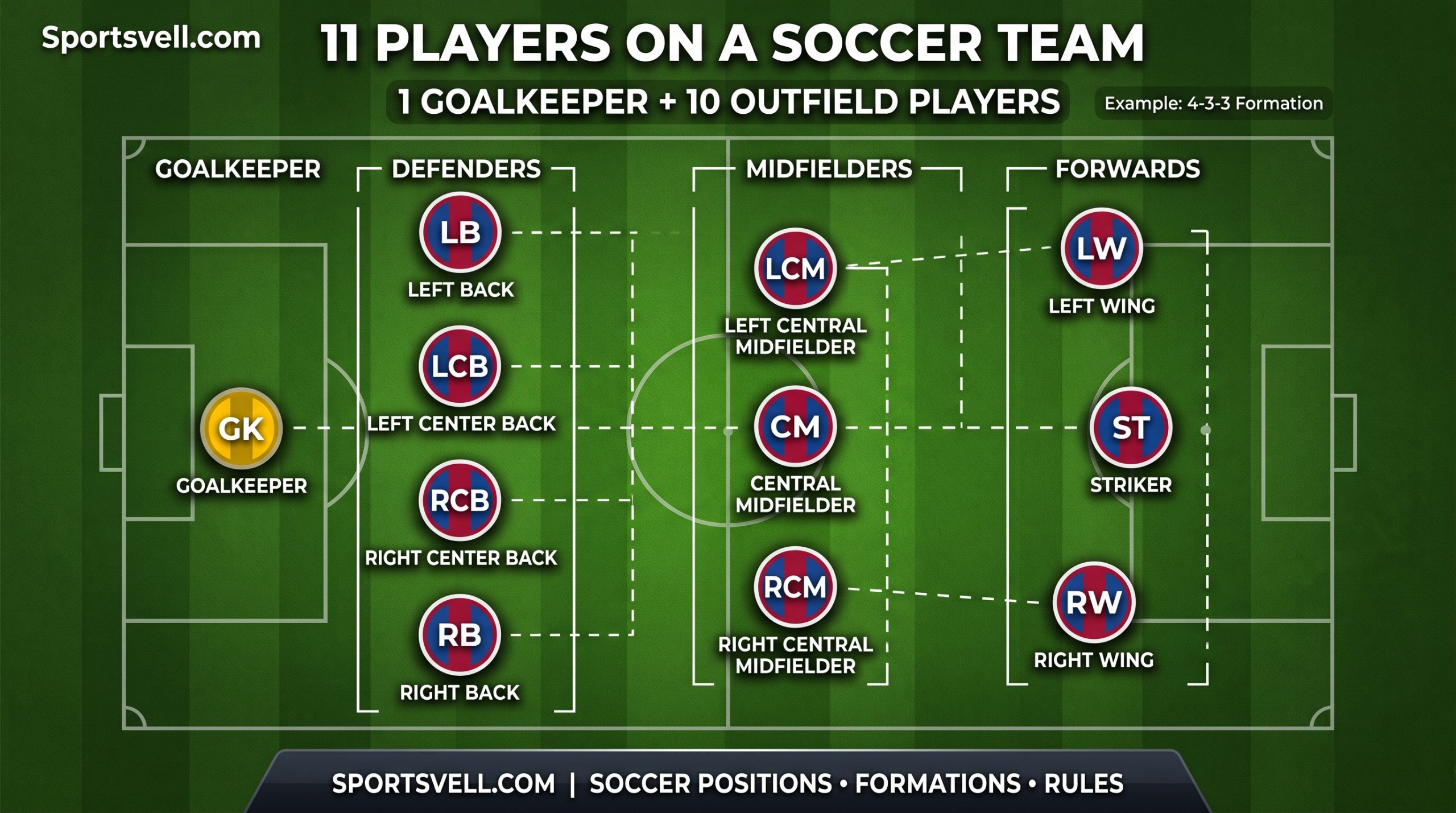
College football teams at schools that opted into the House settlement carry up to 105 players. The 105-player roster limit took effect on July 1, 2025, and it replaced the old system of scholarship caps with unlimited walk-ons. The change is the biggest roster rewrite in college football history.
The old system capped scholarships, not players. FBS programs, the top tier of Division I, could give 85 full scholarships, and FCS programs could split 63 scholarship equivalencies across more players. Walk-ons paid their own way and did not count against the cap, so rosters routinely carried 120 to 130 players.
The new system caps players, not scholarships. Every player on the 105-man roster can receive athletic aid, in full or in part, and the school decides how much aid to fund. The old 85-scholarship cap is gone at opt-in schools, and the roster limit is the only number that matters.
Only 11 players are on the field at a time, just like the NFL. The college game uses the same on-field number, the same four downs, and the same basic positions. The difference is the roster behind the 11, which is twice as large in college because the sport is developmental.
The 105-Player Roster Limit
The 105-player limit comes from the House v. NCAA settlement. The settlement, approved in June 2025, let schools share revenue directly with athletes, and it replaced sport-by-sport scholarship limits with roster limits. The NCAA adopted the roster limit rules on June 23, 2025, and they took effect on July 1, 2025.
The limit applies to schools that opted into the settlement. Schools in the defendant conferences and other schools that chose to opt in use the 105-player roster limit. Schools that did not opt in are still capped at the value of the old limits, 85 for FBS and 63 for FCS, counted in equivalencies.
The cap covers both FBS and FCS programs. FBS went from 85 scholarships to a 105-player roster, and FCS went from 63 equivalencies to the same 105-player roster. The two subdivisions now share one roster number, which is a first in college football history.
The NCAA is named here as the source for the settlement rules. Its website returned an error to our check on November 6, 2026, so it is named in plain text only, not linked. The settlement facts are reported consistently across multiple independent guides, including the NCAA’s own published Q and A as cited by those guides.
What Happened to the 85 Scholarships
The 85-scholarship cap no longer exists at opt-in schools. A school can now give aid to all 105 rostered players, in full or in part, and it can split scholarships in football for the first time. The old rule, in which a player was either on a full ride or on no aid at all, is gone.
Removing the cap did not mean every school funds 105 full scholarships. Each athletic department decides how much aid to put into football, and the revenue-sharing cap of about 20.5 million dollars per school in 2025-26 is shared across all sports. Most schools fund fewer than 105 full rides.
Some pages still carry the old framing, which is now stale. One competitor page says college teams “can carry as many players as they want beyond the 85 scholarship limit” and that “some programs have 120 or more total athletes,” in the same article that correctly reports the 105-player cap. The 120-plus roster is history, not current practice.
The transition year was 2025, and the SEC moved first on funding. SEC presidents voted to fund the full 105 starting in 2026, after holding at 85 for the transition year. Other conferences are funding different numbers, and the funding level is a budget decision, not an NCAA rule.
Walk-Ons Now Count Toward 105
Walk-ons are players who join the team without scholarship money. They pay their own way through school while competing for playing time, and they provide practice competition and depth. Under the old system, walk-ons were unlimited and sat outside the 85-scholarship cap.
Under the new system, every walk-on occupies one of the 105 spots. A non-scholarship player now uses a roster spot that the school could fund, which makes walk-on spots scarce. The change is the hardest part of the new rule for players, because the old path onto a roster through walking on has narrowed.
Designated student-athletes are the exception. Athletes who were on rosters when the limits took effect were designated as exceptions, and they do not count toward the 105 for the rest of their eligibility. The grandfather clause protects the players who were caught by the change.
Spread over five classes, a 105-player roster leaves room for about 20 new players a year. That includes freshmen and transfers, and it means recruiting classes are smaller and more selective than they were under the old 120-plus rosters. The transfer portal now competes with high school recruiting for those 20 spots.
FBS vs FCS: Same Cap, Different History
FBS is the Football Bowl Subdivision, the top tier of Division I. Its teams play in conferences and bowl games and compete for the College Football Playoff. There are 138 FBS schools in the 2026 season, up from 136 in 2025 and 134 in 2024.
FCS is the Football Championship Subdivision, the other half of Division I. Its teams play a playoff bracket instead of bowl games, and there were 129 FCS schools in 2025. FCS programs are generally smaller, with smaller budgets and smaller stadiums.
Both subdivisions now share the 105-player roster limit. The change is bigger for FCS, because the old 63-equivalency cap meant FCS teams split aid across more players, while FBS teams gave 85 full rides. FCS teams gained up to 42 more roster spots that can carry aid, where the school opts in and funds them.
| Rule | Before July 2025 | Now (opt-in schools) |
|---|---|---|
| FBS scholarship limit | 85 full scholarships | No limit; every rostered player can receive aid |
| FCS scholarship limit | 63 equivalencies, split across up to 85 players | No limit; every rostered player can receive aid |
| Roster size | No cap; many teams carried 120 or more | 105 players maximum |
| Walk-ons | Unlimited, outside the scholarship cap | Count toward the 105 |
| Partial scholarships in football | Not allowed at FBS level | Allowed; aid can be split |
| Effective date | Old rules through June 30, 2025 | July 1, 2025 |
The table is the fastest way to understand the change. The old system limited aid and not bodies, and the new system limits bodies and not aid. That single sentence explains the whole House settlement roster rewrite.
Division II, Division III, NAIA, and JUCO
Division II programs split a smaller pool of scholarship money. Scholarship guides report 36 equivalency scholarships for Division II football, with average team sizes around 126 players under the old system. Division II did not adopt the 105-player roster limit, so its rules are different from Division I.
Division III schools do not offer athletic scholarships at all. Their rosters are built on walk-ons and need-based aid, and the teams are often large because any student can try out. The on-field number is still 11, but the roster is a student body, not a scholarship list.
NAIA programs report 24 scholarships, with average team sizes around 107 players. The NAIA is a separate association from the NCAA, and its football programs are mostly at smaller colleges. The 24-scholarship figure comes from scholarship guides, not from the NAIA itself, so treat it as reported.
Junior colleges, or JUCO programs, report up to 85 scholarships on smaller rosters. The JUCO figure matches the old FBS cap, packed onto rosters of about 76 players. Junior college football is a two-year path, and its players often transfer to Division I programs.
For away games, colleges typically travel with 60 to 70 players. The travel squad is smaller than the full roster because of cost, and only the players likely to see action make the trip. The figure comes from competitor reporting, so it is a guide, not a rule.
How Many Players Are on a High School Football Team?
High school football teams vary more in size than any other level. Small rural schools might field teams with just 25 to 30 players total, while large suburban and urban schools can have 70 to 80 athletes. The range is the widest in the sport, because school size drives roster size.
The National Federation of State High School Associations, the NFHS, governs high school football. It writes the rules used in most states, and it sets the on-field limit at 11 players per team. The NFHS publishes the football rules book, and it also tracks participation data for the smaller formats of the game.
High school football has no strict roster cap. The NFHS does not impose a maximum roster size, so a school can carry as many players as it can equip and coach. The practical limit is the number of students who try out, not a rulebook number.
No Roster Cap, but Real Limits
The absence of a cap does not mean rosters are unlimited. A school needs helmets, pads, coaches, and practice field space for every player, and those resources cap the roster in practice. A program with 40 players and a program with 80 players face very different logistical problems.
One competitor claims rosters max out at 99 players because of jersey numbering. That claim is unverified, and it is almost certainly wrong, because jersey numbers can repeat across offense and defense and across varsity and junior varsity. Do not use the 99-player figure.
Two players on the same team cannot wear the same jersey number on the field at the same time. That is a real rule, and it is about officials identifying players, not about roster size. The rule limits who can play together, not how many players a team can carry.
Typical Roster Sizes by School Size
Small schools carry 25 to 30 players. These programs struggle to fill every position, and they often require athletes to play both offense and defense plus special teams. A single player might be a wide receiver on offense, a cornerback on defense, and a kick returner on special teams.
Mid-size schools carry 40 to 50 players. That is the most common high school roster size, and it is enough for separate offensive and defensive units with a few backups. Players still play both ways at some positions, but specialization begins.
Large schools carry 70 to 80 players. These programs function more like college teams, with separate offensive and defensive units and plenty of backups. Players specialize in specific roles rather than playing multiple positions, and the junior varsity team is a real developmental squad.
Roster numbers are falling at some schools. One Massachusetts report from November 2026 notes football participation down 18.1 percent in the state since 2015-16, with several small schools forfeiting games for lack of players. The decline is why 8-man football is growing as an alternative.
Two-Way Players: When One Athlete Plays Both Sides
A two-way player plays on both offense and defense. The term describes the high school reality that small rosters force, and it is rare in college and almost unknown in the NFL. A two-way player might play 100 snaps in a game, while an NFL starter plays about 60.
Two-way play is a necessity, not a strategy, at small schools. A team with 25 players cannot field 22 separate starters, so the best athletes play both ways. The coach’s job is to manage their stamina, because a tired two-way player makes mistakes late in the game.
Large schools avoid two-way play when they can. Specialization lets players rest between series, learn one position deeply, and stay healthier. The difference between a 25-player roster and an 80-player roster is the difference between survival and strategy.
Other Formats: CFL, Arena, 8-Man, 6-Man, and Flag Football
Not every version of football uses 11 players. The Canadian game uses 12, arena football uses 8, small-school football uses 8 or 6, and flag football uses 5 or 7. The format changes the game, and the team size is the first thing that changes.
The field changes with the format too. A standard American football field is 100 yards long and 53 and one third yards wide, covering about 1.32 acres including the end zones. Our guide on how many acres a football field covers gives the exact math, including the Canadian field, which is bigger in every dimension.
| Format | Players per team | Total on field | Field size | Downs |
|---|---|---|---|---|
| NFL / college / high school | 11 | 22 | 100 x 53.3 yards | 4 |
| CFL | 12 | 24 | 110 x 65 yards | 3 |
| Arena football | 8 | 16 | 50 yards, indoor | 4 |
| 8-man football | 8 | 16 | 80 x 40 yards | 4 |
| 6-man football | 6 | 12 | 80 x 40 yards | 4 |
| Flag football (5v5) | 5 | 10 | Smaller field, varies | 4 |
| Flag football (7v7) | 7 | 14 | Smaller field, varies | 4 |
| Soccer (comparison) | 11 | 22 | 100-130 x 50-100 yards | None |
CFL: 12 Players on the Field
The Canadian Football League fields 12 players per team, not 11. The extra player is usually an additional receiver or defensive back, and it makes the Canadian game faster and more pass-heavy. The CFL publishes its rule book, and the 12-player format is the first difference every guide lists.
The CFL field is bigger in every dimension. It is 110 yards long between the goal lines, with 20-yard end zones, and 65 yards wide. The NFL field is 100 yards long with 10-yard end zones and 53 and one third yards wide, so the Canadian field is about 50 percent larger.
CFL teams get three downs to gain ten yards, not four. The missing down forces more aggressive play, and the extra player gives the offense more passing options. The combination is why CFL scores are often higher than NFL scores.
CFL teams dress 45 players for a game. The dressed roster must include at least 21 Canadian players, called national players, and teams must start at least 7 nationals. No more than 19 international players, mostly American, may dress. One rules guide reports a 46-man active roster, so the 45 dressed figure is the safer one to use.
The CFL plays an 18-game regular season with 9 teams. The championship is the Grey Cup, and the 113th Grey Cup kicks off on November 15, 2026, at McMahon Stadium in Calgary. The league also uses a 35-second play clock, dropping to 20 seconds inside the final three minutes of each half under a rule new for 2026.
Arena Football: 8 Players
Arena football fields 8 players per team, for 16 total on the field. The game is played indoors on a 50-yard field with walls, and the ball stays in play off the walls. The format is built for speed and scoring, and the roster is about 20 players.
The arena offense is compact by design. It typically includes two offensive linemen, one running back, three receivers, and a quarterback, with a similarly compact defensive setup. The small field and the walls make every play a scoring threat.
Arena football is the indoor cousin of the outdoor game. It keeps the four-down structure and the touchdown scoring, but it shrinks everything else. The 8-player format is why arena games routinely produce combined scores above 100 points.
8-Man Football
8-man football fields 8 players per team, for 16 total on the field. It is played by high schools and smaller colleges that do not have enough players for the 11-man game. The format is growing because roster numbers are falling at small schools.
More than 21,000 players take part in 8-man football in the United States, per NFHS data. The game is played in 30 mostly rural states, and Nebraska has 115 teams, nearly as many as it has for 11-man. Maine and New York are the only nearby states in the Northeast playing 8-man public school football.
The field is 80 yards long and 40 yards wide. The offense must have five players on the line of scrimmage at the snap, with three down linemen who are not eligible to receive a pass. The game uses four 12-minute quarters with a 15-minute halftime, and teams get three timeouts per half.
The game must start with eight eligible players on each team. Once the game has started, a team may continue with seven players, and the opponent is not required to match the number. Anything less than six players is a forfeit in most youth and school leagues that use the format.
6-Man Football
6-man football fields 6 players per team, for 12 total on the field. It is played in 8 states, and Texas has more than 300 teams, more than any other state. The format exists for the smallest rural schools, where even 8-man football needs too many players.
The six players are two guards and four backs: a center, a quarterback, a running back, and a wingback. The game emphasizes passing, because it allows five eligible receivers instead of the usual four in the 11-man game. The field is the same 80 by 40 yard size as 8-man football.
6-man football is a Texas institution. The state’s small rural schools have played it for generations, and the state championship games draw crowds that surprise outsiders. The format proves that football works at any size, as long as the rules fit the roster.
Flag Football: 5v5 and 7v7
Flag football is the non-contact version of the game, and it uses 5 or 7 players per team. The most common formats are 5v5 and 7v7, and the roster is usually 8 to 14 players. Defenders pull a flag from the ball carrier’s belt instead of tackling, so the game is safe for players of all ages.
Youth flag football is growing faster than youth tackle football. Parents choose it for safety, schools choose it for cost, and the NFL promotes it as an entry point to the sport. The NFHS is writing new flag football playing rules, effective starting with the 2025-26 season.
Flag football will be an Olympic sport at Los Angeles 2028. The Olympic debut is the biggest moment in the format’s history, and it is pushing more schools and leagues to adopt it. The team size stays small, but the stage is getting bigger.
The 11 Players on the Field: Positions by Unit
The 11 players on the field split into three units, but only one unit plays at a time. The offense has the ball, the defense tries to stop it, and the special teams unit handles kicks. Each unit has 11 players, and most players belong to one unit, with some crossing over.
Substitution is unlimited between plays in American football. A team may change all 11 players between one play and the next, and it does so constantly. The offense leaves, the defense enters, and the special teams unit enters for kicks, all within seconds.
Offense: 11 Players
The offense fields 11 players: 5 offensive linemen, 1 quarterback, and 5 skill players. The linemen are the center, two guards, and two tackles, and they protect the quarterback and open running lanes. The skill players are the running backs, wide receivers, and tight ends, and they carry and catch the ball.
The quarterback is the most important player on the field. He calls the plays, distributes the ball, and makes decisions in seconds. Elite quarterbacks can carry average teams to championships, and the position is why teams spend the most draft capital and salary cap space on one player.
The standard offensive set is 1 quarterback, 1 running back, 3 wide receivers, 1 tight end, and 5 linemen. That grouping is called 11 personnel, because it has 1 running back and 1 tight end. Coaches change the personnel by formation, adding a second tight end or a second running back when they want to run the ball.
At least 7 offensive players must line up on the line of scrimmage. The 5 linemen plus 2 ends, usually a tight end and a wide receiver, form the line, and only the ends are eligible to catch a pass. The rule is why linemen wear numbers 50 to 79 and cannot catch passes.
Defense: 11 Players
The defense fields 11 players: 4 defensive linemen, 3 linebackers, and 4 defensive backs in the standard 4-3 set. The linemen rush the passer and stop the run, the linebackers defend runs and short passes, and the defensive backs cover receivers. The 4-3 is the base defense, and the 3-4 is the main alternative.
The 3-4 defense uses 3 defensive linemen, 4 linebackers, and 4 defensive backs. It trades a lineman for a linebacker, which gives the defense more speed and more blitz options. The choice between 4-3 and 3-4 shapes the whole roster, because the two schemes need different body types.
Linebackers are the quarterbacks of the defense. They call adjustments, read the offense, and defend against both runs and passes. The middle linebacker usually wears the green dot helmet, which carries the radio receiver for the coach’s play calls.
Defensive backs split into cornerbacks and safeties. Cornerbacks cover wide receivers one on one, and safeties defend deep passes and support the run. A typical NFL roster carries 9 to 10 defensive backs, because the modern game demands five or six of them on the field at once.
Special Teams: 11 Players
Special teams fields 11 players for every kick, punt, and return. The unit includes the kicker, the punter, the long snapper, the holder, and the coverage and return players. Most of the coverage players are backups from offense and defense, so special teams is where roster depth shows.
The three specialists are the kicker, the punter, and the long snapper. Each team carries exactly one of each on the 53-man roster, and they are the only players whose job is a single kick. A long snapper’s entire career is snapping the ball 7 to 15 yards accurately, under pressure, hundreds of times a season.
Return specialists handle kickoffs and punts. The role is often filled by a backup wide receiver or cornerback, because the job needs speed and open-field running. A good returner changes field position by 10 to 20 yards, which is worth a first down.
Special teams is one third of the game, and coaches say it decides close games. A blocked punt, a missed field goal, or a long return swings a game faster than any offensive drive. The 11 players on special teams are the least famous and the most likely to decide the result.
What Happens With 12 Players on the Field
A team with 12 players on the field is penalized for too many men on the field. The penalty is 5 yards for illegal substitution, and it is one of the most common penalties in football. The extra player usually comes from a substitution that was too slow, not from a deliberate attempt to cheat.
The offense is penalized if 12 players are in the huddle or on the field at the snap. The defense is penalized if 12 players are on the field when the ball is snapped. The officials count the players before every snap, and the penalty is automatic when the count is wrong.
The penalty is 5 yards and a repeat of the down. It is a minor penalty, but it can kill a drive by turning a second and 5 into a second and 10. Coaches drill substitutions precisely because the penalty is so avoidable and so costly.
Player stats from a real game show how many players actually contribute. Our Green Bay Packers vs Dallas Cowboys match player stats page lists the players who touched the ball, made tackles, and kicked, and the list is far longer than 11 names on either side.
Can a Football Team Play With Fewer Than 11 Players?
Yes, a football team can play short-handed, and it happens more often than fans think. Injuries, ejections, and illness can leave a team with fewer than 11 players on the field, and the game continues. The rules do not stop the game the way soccer’s 7-player minimum does.
American football has no soccer-style minimum to continue a game. Soccer abandons a match if a team falls below 7 players, but the NFL rulebook has no equivalent forfeit threshold. A team plays with whoever is healthy, even if that means 10 players on the field.
The most famous case is the 2020 Denver Broncos game against the New Orleans Saints. All four of the Broncos’ quarterbacks were ruled out as close contacts under COVID-19 protocols, and the team had no quarterback available. Practice squad wide receiver Kendall Hinton played quarterback, completing 1 of 9 passes for 13 yards with 2 interceptions, and the Broncos lost 31-3.
The Broncos game is the proof that the NFL has no minimum quarterback rule. The league did not postpone the game, and it did not let Denver sign an emergency quarterback. The team played with the players it had, and the result was one of the most lopsided quarterback performances in league history.
Injuries and Short-Handed Play
Injuries during a game can leave a team short at a position. If both healthy running backs are hurt, a wide receiver takes handoffs. If the offensive line is depleted, a tight end lines up as a tackle. Coaches cross-train players for exactly this reason, and the depth chart lists emergency options at every position.
Ejections also thin a team mid-game. A player ejected for targeting or fighting leaves the team short-handed for the rest of the game, and there is no replacement beyond the players already dressed. The 46 dressed players are the whole pool, and the pool shrinks with every ejection.
High school games are forfeited when a team cannot field enough players. The threshold varies by state and by league, and several small schools forfeited games in 2026 for lack of players. The forfeit is a school decision, not an NFHS rule, and it reflects safety as much as numbers.
Why 11 Players? A Short History
The 11-player format was settled in American football in 1880, under Walter Camp. The early game, codified in 1876, used 15 players per side, and the field was crowded and chaotic. Camp, the Yale captain who became known as the father of American football, reduced the number to 11 and introduced the line of scrimmage and the system of downs.
Eleven works because the field is 53 and one third yards wide. Five linemen fill the line, two ends stretch the edges, and four backs fill the space behind. Fewer players would leave the field too open, and more players would crowd it, so 11 is the balance point the game settled on.
The number has not changed in more than 140 years. Substitutions, roster sizes, and formations have all changed, but the on-field number has stayed at 11 since 1880. The stability is the reason the question has a simple answer, and the reason the rest of the answer is about everything around the 11.
Soccer settled on 11 independently, in England in the 1860s. The two sports arrived at the same number for the same reason: a full-size field needs 11 players to balance attack and defense. The shared number is a coincidence of geometry, not a shared rulebook.
A football game lasts about three hours, and the 11 players rotate through it constantly. Our guide on how long a football game lasts breaks down the time by level, from the NFL’s three-hour broadcasts to the shorter high school games, and it explains where the time goes.
FAQs About How Many Players Are on a Football Team
How many players on a football team?
An American football team fields 11 players on the field at a time. The full team is bigger: 53 players on an NFL active roster, up to 105 on a college roster, and 25 to 80 on a high school roster. The on-field number is 11 at every level.
How many players are on the field in American football?
Twenty-two players are on the field during a play, 11 per team. Eleven play offense and eleven play defense, and special teams sends out 11 for kicks. Add the officials, and there are about 29 people on the field during a play.
How many players on an NFL team?
An NFL team has 53 players on its active roster during the regular season. Only 46 dress for a game, or 48 if the team dresses at least 8 offensive linemen. Up to 16 more players sit on the practice squad.
How many players on an NFL team roster?
The active roster is 53 players, and the total under contract is about 69. The 69 counts the 53 active players plus the 16 practice squad players. Injured players on reserve lists sit outside the 53, so the real total is higher.
How many players dress for an NFL game?
Forty-six players dress for a regular-season game, or 48 with 8 active offensive linemen. The team declares seven of its 53 inactive before kickoff. The inactive players cannot play, even if an injury leaves the team short.
How many players are on an NFL practice squad?
Up to 16 players, plus a 17th spot for the International Player Pathway program. Practice squad players train with the team but do not dress for games unless elevated. Up to six of the 16 may be veterans.
How many players on a college football team?
Up to 105 players at schools that opted into the House settlement. The 105-player roster limit took effect on July 1, 2025, replacing the old 85-scholarship cap for FBS and the 63-equivalency cap for FCS. Schools that did not opt in use the old limits.
How many players on a college football roster in 2025?
The limit is 105 players at opt-in schools, down from rosters that routinely carried 120 to 130. Walk-ons now count toward the 105, and every rostered player can receive aid. Designated student-athletes from before the change are exempt.
How many scholarships does a college football team get?
There is no scholarship cap at opt-in Division I schools anymore. The old caps were 85 full scholarships for FBS and 63 equivalencies for FCS. Now every player on the 105-man roster can receive aid, in full or in part, subject to the school’s budget.
How many players on a high school football team?
High school rosters range from 25 to 80 players, with 40 to 50 the most common size. Small schools carry 25 to 30, and large schools carry 70 to 80. The NFHS sets the on-field limit at 11 but imposes no roster cap.
How many players on a youth football team?
Youth tackle teams usually carry 15 to 35 players, depending on the league and the source. One guide reports 15 to 20 players per team, and another reports 25 to 35. The range reflects different leagues, ages, and formats, so check the local league’s rules.
How many players on a flag football team?
Flag football uses 5 or 7 players per team on the field, with rosters of 8 to 14 players. The 5v5 format is the most common for youth leagues, and 7v7 is common for older players and school programs. Flag football debuts at the Olympics in Los Angeles in 2028.
How many players on a CFL team?
A CFL team fields 12 players per side, for 24 total on the field. The team dresses 45 players for a game, including at least 21 Canadian players, and must start at least 7 Canadians. The extra player is usually an additional receiver or defensive back.
How many players on an arena football team?
Eight players per team, for 16 total on the field. The arena offense typically has two offensive linemen, one running back, three receivers, and a quarterback. The roster is about 20 players.
How many players are on an 8-man football team?
Eight players per team on the field, with rosters of 15 to 25 players. The field is 80 yards long and 40 yards wide, and the offense must have five players on the line of scrimmage. More than 21,000 players take part in the United States, per NFHS data.
How many players are on a 6-man football team?
Six players per team on the field, with rosters of 12 to 18 players. The six are two guards and four backs: a center, a quarterback, a running back, and a wingback. The format is played in 8 states, and Texas has more than 300 teams.
Can a football team play with fewer than 11 players?
Yes, and the game continues. American football has no soccer-style minimum to continue a game, so a team plays with whoever is healthy. The most famous case is the 2020 Broncos, who played without a quarterback and used a practice squad wide receiver at the position.
What happens if a football team has 12 players on the field?
The team is penalized 5 yards for illegal substitution, also called too many men on the field. The penalty applies to the offense or the defense, and the down is repeated. The extra player usually comes from a substitution that was too slow.
What is the 12 men on the field penalty?
It is a 5-yard penalty for having 12 players on the field at the snap. The officials count the players before every snap, and the penalty is automatic when the count is wrong. It is one of the most common and most avoidable penalties in football.
How many players are on offense in football?
Eleven players: 5 offensive linemen, 1 quarterback, and 5 skill players. The standard set is 1 running back, 3 wide receivers, and 1 tight end, plus the 5 linemen. At least 7 players must line up on the line of scrimmage.
How many players are on defense in football?
Eleven players: 4 defensive linemen, 3 linebackers, and 4 defensive backs in the 4-3 defense. The 3-4 defense uses 3 linemen, 4 linebackers, and 4 defensive backs. Both add to 11, and the choice shapes the roster.
How many players are on special teams?
Eleven players for every kick, punt, and return. The unit includes the kicker, the punter, the long snapper, the holder, and the coverage and return players. Most coverage players are backups from offense and defense.
How many offensive linemen are on a football team?
Five linemen are on the field: a center, two guards, and two tackles. An NFL roster carries 8 to 9 offensive linemen, so there are 3 to 4 backups. Dressing at least 8 linemen lets a team activate 48 players instead of 46.
How many players can be on an NFL roster during the offseason?
Up to 90 players during the offseason and preseason. The roster is cut from 90 to 53 after the final preseason game, on cut-down day. The extra 37 spots let coaches evaluate rookies and undrafted free agents.
Why are there 11 players on a football team?
Walter Camp set the number at 11 in 1880, reducing it from 15. Eleven fills a 53 and one third yard wide field with five linemen, two ends, and four backs, balancing attack and defense. Soccer settled on 11 independently in the 1860s, for the same geometric reason.
Conclusion
How many players on a football team? Eleven on the field, 22 total during a play, 53 on an NFL roster, and 105 on a college roster. The on-field number never changes, but the roster number depends on the level, the league, and the format.
The three numbers are the whole answer. Eleven is the number that plays, 46 is the number that dresses in the NFL, and 53 is the number on the roster. College football adds a fourth number, 105, which is the new roster limit from the House settlement. High school adds a range, 25 to 80, because school size drives everything.
The formats add their own numbers. The CFL fields 12, arena football fields 8, 8-man football fields 8, 6-man football fields 6, and flag football fields 5 or 7. Each format fits its field, its roster, and its players, and each one is a real version of the sport.
The rules keep changing, so check the current edition. The 105-player college limit arrived in July 2025, the 48-player game-day rule arrived in 2021, and the 4-game injured reserve minimum arrived in 2022. The NFL Operations site, the NFL rulebook, the NFHS, and the CFL rule book carry the current text, and Pro Football Reference carries the roster and game data behind the numbers.
Football is the most watched entertainment in America, and the roster is part of the show. The 53-man roster, the practice squad, the draft, and cut-down day are a year-round story, and they are why fans follow the sport between games. The cost of following it is part of the picture too, and our guide to how much entertainment costs per month puts the streaming, cable, and ticket spending in context. For the language of the sport itself, from the word entertainment to its 65 synonyms, see another word for entertainment.
Keep the count in mind the next time you watch. Eleven on the field, seven inactive on the sideline, sixteen on the practice squad, and ninety in August. The number is simple, and the system behind it is the deepest in American sports.