
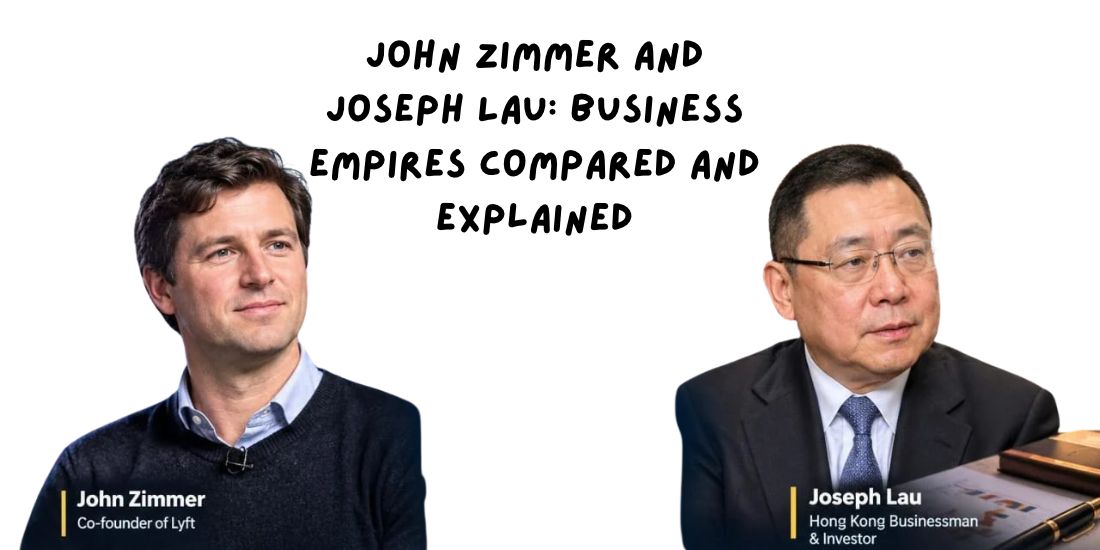
Two businessmen, two continents, and two completely different fortunes. John Zimmer and Joseph Lau share nothing except a search bar. Yet this unlikely pairing reveals something fascinating about how modern wealth gets built today across industries.
This article gives you the straight facts on both men, without speculation. You will learn their backgrounds, companies, strategies, and fortunes in plain language. Therefore, read on for the complete verified comparison of two self-made winners.
| Detail | John Zimmer | Joseph Lau |
|---|---|---|
| Full name | John Zimmer | Joseph Lau Luen-hung |
| Born | 1984, United States (widely reported) | 1951, Hong Kong (widely reported) |
| Age in 2026 | 42 | 75 |
| Nationality | American | Hong Kong Chinese |
| Known for | Co-founding Lyft | Chinese Estates Holdings, property empire |
| Company | Lyft (co-founded 2012) | Chinese Estates Holdings |
| Education | Cornell, Hotel Administration (2006) | University of Windsor, BSc |
| Career start | Lehman Brothers → Zimride → Lyft | Evergo manufacturing (1978) → property |
| Reported net worth | Hundreds of millions (published estimates; tied to Lyft stock) | Multi-billion (rich-list estimates; tied to property) |
| Base | United States | Hong Kong |
John Zimmer and Joseph Lau at a Glance
John Zimmer and Joseph Lau come from different generations and entirely different business environments. Zimmer co-founded Lyft with Logan Green, building an American ride-hailing giant. Lau built his name in Hong Kong property and investments.
Zimmer’s story belongs to the smartphone era and the age of platform economics. Lau’s story stretches back decades through manufacturing, corporate finance, and deal-making. Their professional paths differ fundamentally in tools, timing, and temperament completely.
Despite the vast distance between their worlds, both men reached the very top of their games. Each spotted hidden value where others saw only routine business. That shared instinct makes their comparison genuinely instructive for readers.
Getting to Know John Zimmer
John Zimmer is an American businessman and entrepreneur recognized worldwide for developing Lyft. He graduated from Cornell University‘s School of Hotel Administration in 2006. His unusual hospitality education shaped his entire entrepreneurial outlook from day one.
According to Cornell, a class on green cities changed his thinking forever. It pushed him to consider transportation efficiency, population growth, and urban infrastructure. He began questioning why cities surrender so much space to cars and parking.
Rather than seeing transport as mere movement from points A to B, Zimmer saw interconnected systems. He studied how vehicles and cities waste enormous capacity every single day. That systems-level curiosity eventually pulled him toward ridesharing.
John Zimmer’s Education and Early Professional Years
After graduating from Cornell, Zimmer joined Lehman Brothers in the high-pressure finance world. The role exposed him to major corporate dealings and sharp analytical thinking. His deeper interests, however, kept drifting toward entrepreneurship and transportation.
Zimmer eventually connected with Logan Green, who shared his deep transportation obsession. Together they built Zimride, a clever platform for sharing longer-distance car journeys. Cornell reports they later sold Zimride to Enterprise Holdings in 2013.
The Zimride experience gave both founders crucial real-world lessons. They learned how travelers behave, what trust requires, and where platforms break down. That hard-won knowledge became the foundation for their far bigger transportation venture ahead.
How John Zimmer Built Lyft
Zimmer and Green co-founded Lyft in 2012 with a bold, simple idea. The platform let passengers request on-demand rides from nearby drivers through a smartphone app. Lyft helped accelerate America’s massive shift toward app-based transportation.
Zimmer’s vision stretched far beyond building just another taxi alternative. He spoke constantly about transportation efficiency, sustainability, and shared mobility. His ultimate goal was redesigning cities around people instead of private automobiles and endless traffic.
Cornell has highlighted his striking belief about the future of urban space. Fewer cars could let cities reclaim vast parking lots for parks, housing, and gathering places. That people-first urban dream still defines his public message today.
The Business Philosophy of John Zimmer
Hospitality training gave Zimmer an unusual edge in the technology world. While rivals studied code and engineering, he studied customer experience and service. He later poured those service principles directly into transportation design and operations.
Zimmer has described cities as enormous hospitality environments serving millions of guests. In that view, transportation networks should ease daily life and widen accessibility. Every single ride becomes part of a larger urban guest experience.
This philosophy clearly separated him from typical Silicon Valley tech founders. He discussed the human experience of moving through cities, not just algorithms and growth charts. Experience-first thinking became his signature entrepreneurial advantage for years.
Getting to Know Joseph Lau
Joseph Lau Luen-hung is a Hong Kong businessman synonymous with real estate and investments. Unlike Zimmer’s tech-era rise, Lau built his career in traditional industries. His name carries serious weight across Asian business circles today.
Lau attended the University of Windsor in Canada. A Chinese Estates corporate document confirms his Bachelor of Science degree. It also credits him with decades of experience in corporate finance, manufacturing, and property investment and development.
Those decades transformed him into one of Hong Kong’s best-known property figures. His career shows how patience and sharp deal-making compound over time. Lau’s empire grew building by building, never download by download like Zimmer’s.
Joseph Lau’s Early Years in Business
Lau began his business career in manufacturing, not property development. He established Evergo Industrial Enterprise in 1978 from scratch. The company initially focused on manufacturing goods before his attention shifted toward investment and deal-making instead.
Evergo became publicly listed in Hong Kong during the booming 1980s. Lau gradually expanded from that base into property-related businesses. This strategic transition proved absolutely crucial to his entire career trajectory for decades to come.
Rather than remaining a manufacturer forever, Lau spotted far bigger opportunities ahead. Property investment, development, and corporate acquisitions offered much greater upside. A Hong Kong government report confirms he steered the group toward real estate.
Joseph Lau’s Role at Chinese Estates Holdings
Chinese Estates Holdings became the company most strongly associated with Joseph Lau. Through Evergo, he acquired a major interest during the 1980s. He then took deep personal involvement in the company’s strategic direction and growth.
Chinese Estates grew into property investment, development, management, and securities investment activities. Lau’s talent for spotting undervalued assets drove that expansion. His sharp deal-execution skills built his formidable business reputation across Asia over decades of winning.
His strategy differed greatly from Zimmer’s technology-driven business model. Zimmer scaled rapidly through software and digital networks, while Lau accumulated tangible assets. Both men created enormous value, but through opposite philosophies and methods of wealth creation.
Inside Joseph Lau’s Investment Activities
Lau’s financial interests stretched far beyond traditional property development alone. He and his family-controlled businesses made major investments across Hong Kong and mainland China. His portfolio reflected a truly continental investment vision and appetite for growth.
One particularly notable relationship involved China Evergrande Group. The South China Morning Post reported numerous significant transactions between Lau’s Chinese Estates and Evergrande. These major deals followed the property developer’s 2009 Hong Kong listing closely.
Lau also gained fame as a collector of high-value assets. His renowned collections of art and fine wine made headlines. These passions reinforced his image as a businessman operating far beyond ordinary property deals and investments.
Are John Zimmer and Joseph Lau Business Partners?
The direct answer is no. No widely documented evidence shows that John Zimmer and Joseph Lau are business partners. Zimmer’s professional identity belongs entirely to Lyft and American transportation technology innovation and startups in Silicon Valley.
Lau’s career centers on Hong Kong real estate, corporate investments, and Chinese Estates Holdings. Their documented business histories occupy separate industries and geographic markets. Nothing connects their boardrooms, balance sheets, or business networks anywhere on record.
Readers should demand solid proof before believing any partnership claims. Credible corporate filings, company announcements, or established news organizations would document such a tie. Without those sources, treat the idea as pure speculation and nothing more.
Are John Zimmer and Joseph Lau Family?
No established evidence shows the two men are relatives in any way. They come from different family backgrounds and entirely different parts of the world. Their shared search results prove absolutely nothing about bloodlines or heritage.
Search engines routinely combine unrelated names for purely mechanical reasons. User queries, pages containing both terms, and algorithmic associations all contribute. A search phrase alone never demonstrates a real-world connection between people in business or life.
This distinction protects curious readers from embarrassing false conclusions. Famous names appearing together deserve verification, never blind assumption. Always separate algorithmic coincidence from documented human relationships before sharing claims online on social media.
John Zimmer vs Joseph Lau: A Side-by-Side Comparison
Despite wildly different careers, the two men share striking similarities. Both identified hidden inefficiencies inside established, everyday industries. Each man saw what millions of others overlooked completely for years. That pattern recognition separates great entrepreneurs from the crowd.
For Zimmer, urban transportation hid massive waste in plain sight. Privately owned cars sat idle for hours while cities paved endless parking. Smart technology could connect passengers with available drivers far more efficiently than ever before.
For Lau, property and investment markets offered similar hidden openings. He acquired undervalued assets, restructured businesses, and joined large-scale developments. Both men recognized commercial opportunity brilliantly, though their methods differed substantially in every way that matters.
Technology Wealth vs Real Estate Wealth
The clearest difference between them lies in how each fortune was actually built. Zimmer represents modern technology entrepreneurship operating at global scale. Lau represents the classic asset-focused business model perfected over decades of deal-making.
Here is the deeper economic truth most comparisons miss. Both men practiced the same ancient trade: idle-asset arbitrage. Zimmer monetized idle cars; Lau monetized idle buildings. One used code, the other used capital, but the profit engine was identical.
Zimmer’s industry expands rapidly through digital networks and powerful network effects. Property businesses instead need substantial capital and physical assets. Both approaches create enormous value, but they demand completely different skills and risk appetites from founders.
Business Lessons From Their Leadership
Their careers teach powerful lessons about entrepreneurship and vision. The first lesson: major opportunities hide inside industries people use every day. Transportation and real estate both existed long before these men arrived on the scene.
Neither man invented his industry from nothing at all. Zimmer changed how passengers and drivers connect through smart technology. Lau won by reading property markets, corporate structures, and valuable assets better than his rivals consistently.
The second lesson is adaptability under changing market pressure. Zimmer moved from hospitality and banking into transport technology. Lau evolved from manufacturing into property and investment. Neither man’s peak identity was obvious at the start.
Why the Public Searches John Zimmer and Joseph Lau Together
Searchers landing on this keyword usually expect a direct relationship. The reality proves more interesting than any rumor could be. Their individual careers matter far more than the supposed connection between them today for investors.
Zimmer’s story belongs to modern ridesharing and technology-driven urban transportation. Lau’s story belongs to Hong Kong’s dynamic property and investment landscape. Together they contrast two great wealth-building traditions worth studying closely by every entrepreneur today.
For researchers, separating verified facts from assumptions remains absolutely essential. Curiosity about the pairing is healthy and completely natural. Just let evidence, not algorithms, decide what the connection really is between them in the end.
FAQs About John Zimmer and Joseph Lau
Are John Zimmer and Joseph Lau business partners?
No. No widely documented evidence shows any business partnership between them. Their careers sit in separate industries and separate parts of the world.
Are John Zimmer and Joseph Lau related?
No established evidence suggests a family relationship. They come from different backgrounds and different regions, and search co-occurrence proves nothing.
Who is John Zimmer?
An American entrepreneur best known as the Lyft co-founder. He studied hospitality at Cornell, worked at Lehman Brothers, built Zimride, then launched Lyft in 2012.
Who is Joseph Lau?
A Hong Kong businessman associated with Chinese Estates Holdings. He moved from manufacturing into property investment, corporate finance, and major deals including Evergrande transactions.
What is the real connection between them?
There is no verified partnership or family tie. Their true connection is thematic: two entrepreneurs who built wealth through opposite strategies, technology platforms versus tangible assets.
Conclusion
John Zimmer and Joseph Lau are accomplished businessmen from very different industries and eras. Zimmer co-founded Lyft and reshaped urban transportation through technology. Lau built his standing through manufacturing, real estate, and Chinese Estates Holdings.
Zimmer’s journey ran from Cornell and Lehman Brothers through Zimride to Lyft. Hospitality thinking, shared mobility, and efficient cities shaped his remarkable career. Lau’s path ran from factories to property portfolios and landmark corporate deals.
No public evidence shows they are relatives or direct business partners. Their real connection is the comparison itself, and it is illuminating. Both prove that spotting opportunities, adapting fast, and executing clear strategy build lasting wealth.
