
What Are Capital One Entertainment Purchases? The 8%, 5X, and 3% Rules Explained
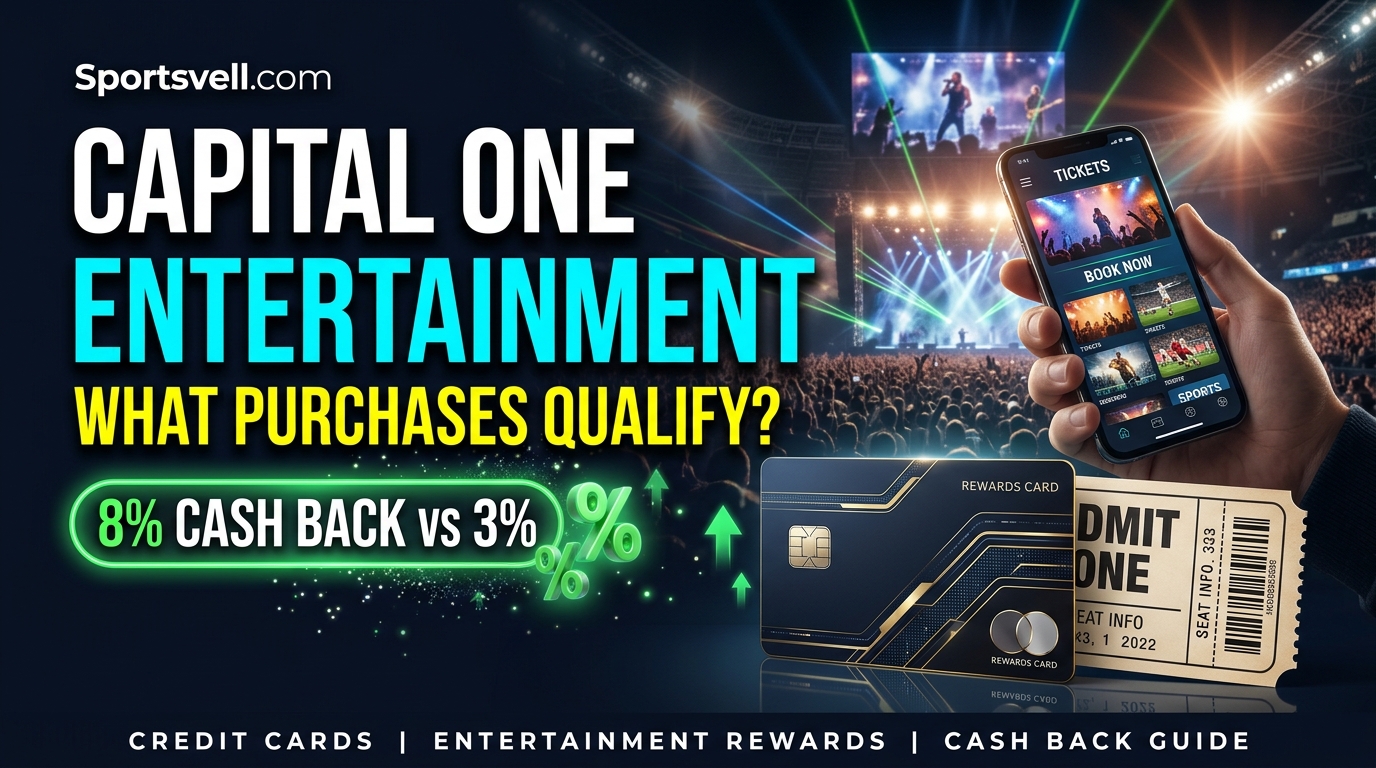
What are Capital One entertainment purchases? The phrase means two different things, and the rate earned depends on which one applies.
Capital One Entertainment is a ticketing platform where cardholders buy tickets to concerts, sports, theater, and dining events.
Entertainment purchases are also a general rewards category, decided by merchant category code, that pays 3% back with the Savor card.
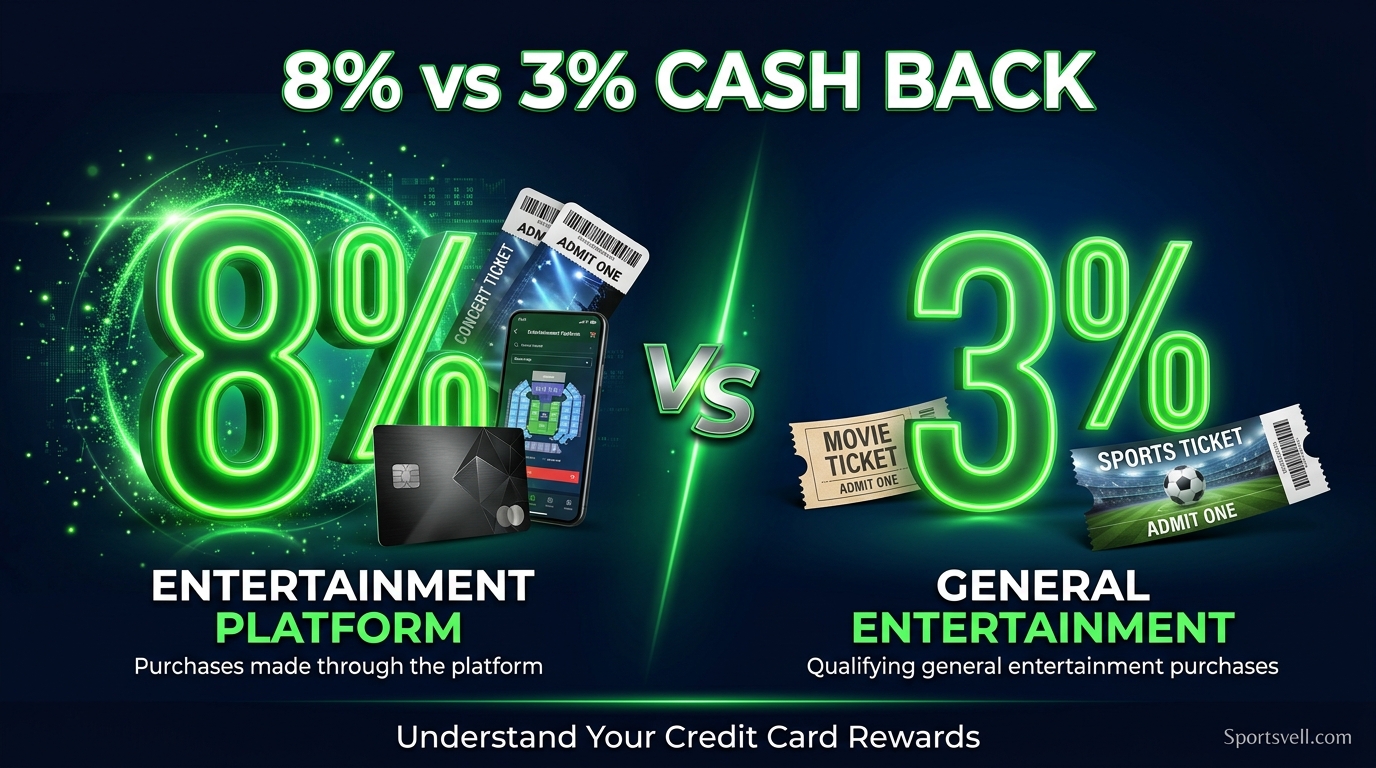
The platform rate is 8% cash back with Savor cards and 5X miles with Venture family cards, far above the 3% general rate.
Presale tickets and tickets bought through Capital One Hall or Capital One Arena do not earn the platform rate, a trap that costs people money.
Below is the full qualifying list, the full exclusions list, the merchant codes, the refund rules, and a worked example.
Rates were checked in November 2026 and must be re-verified on Capital One’s own site before applying for any card.
General information only follows here, not financial advice, and card terms change, so the issuer’s own pages control.
The Short Answer: Two Different Meanings
Meaning one is a platform purchase, a ticket bought on the Capital One Entertainment ticketing platform itself.
Meaning two is a general entertainment purchase, a ticket bought at a qualifying entertainment merchant anywhere else.
Savor cards earn 8% cash back on platform purchases and 3% cash back on general entertainment purchases.
Venture family cards earn 5X miles on platform purchases and the standard 2X miles on most other spending.
Quicksilver earns 5% cash back on platform purchases, per Capital One’s published rates, and 1.5% flat everywhere else.
Where the ticket is bought decides the rate, not what the ticket is for, and that single fact explains most confusion.
A concert ticket bought on the platform earns 8% with Savor, while the same concert ticket bought on a third-party site may earn only 1%.
A presale ticket bought through Capital One’s separate presale page earns the general rate, not the platform rate.
| Where you buy | Savor earns | Venture X earns | Quicksilver earns |
|---|---|---|---|
| Capital One Entertainment platform | 8% cash back | 5X miles | 5% cash back |
| Qualifying entertainment merchant | 3% cash back | 2X miles | 1.5% cash back |
| Cardholder presale (capitalone.com/pre-sales) | 3% if qualifying, else 1% | 2X miles | 1.5% cash back |
| Capital One Hall or Arena direct | 3% if qualifying, else 1% | 2X miles | 1.5% cash back |
| Third-party ticket site | 1% cash back | 2X miles | 1.5% cash back |
| Non-qualifying merchant (golf, college sports) | 1% cash back | 2X miles | 1.5% cash back |
TPG values the 5X miles on the platform at a 9.25% return, per its September 2026 valuations, which is TPG’s own estimate, not a guarantee.
Entertainment is a broad word, and the card industry gives it a narrow technical meaning based on merchant codes.
The another word for entertainment guide lists 65 synonyms and examples, which shows how wide the everyday word is.
What Is Capital One Entertainment?
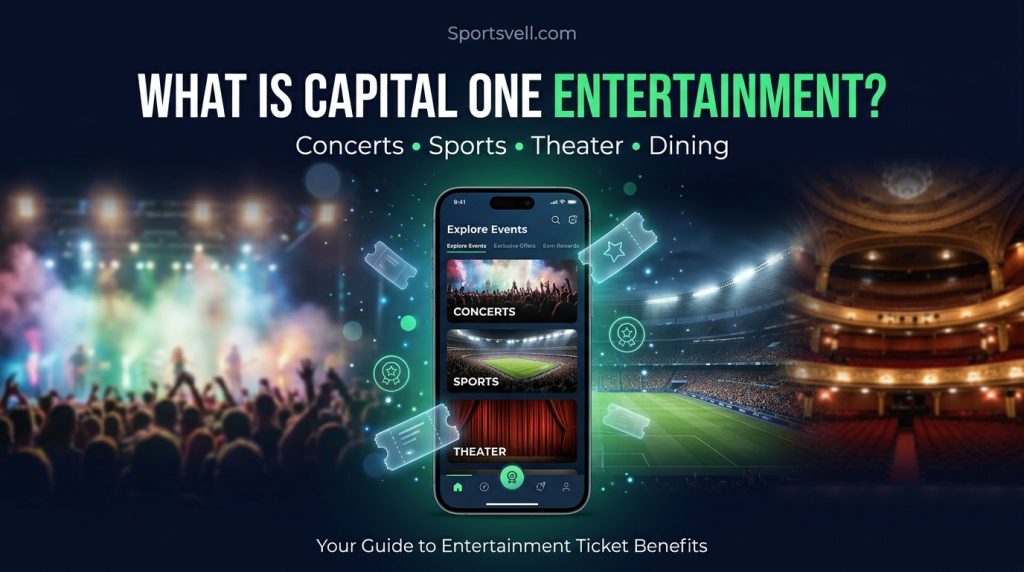
Capital One Entertainment is the bank’s ticketing and experiences platform, where eligible cardholders buy tickets to live events.
Vivid Seats powers the platform, supplying inventory for more than 500,000 events across sports, music, comedy, theater, and dining.
Access runs through the Capital One mobile app or the Capital One website, at the platform’s own benefits page.
The platform is published by Capital One Entertainment, which describes it as access to entertainment experiences.
Eligible cards include US-issued, Capital One branded rewards consumer and small-business credit cards in good standing, for holders age 18 and over.
Discover by Capital One branded rewards cards are also eligible, following the Discover acquisition.
Debit cards, private-label retail cards, and co-brand partner cards are not eligible to use the platform itself.
Cardholders can pay three ways: redeem rewards, charge the eligible Capital One card, or split the cost between rewards and card.
Most inventory is fixed-price and powered by Vivid Seats, where the cardholder picks the event, chooses seats, and checks out.
Vivid Seats prices are set by independent resellers and can run above or below face value, so the same seat may cost more than the box office price.
Categories on the platform cover cardholder exclusives, sports, music, comedy and theater, and dining experiences.
Capital One is the official bank partner of the NCAA and Major League Baseball, which feeds the platform’s marquee access.
Why a bank sells concert tickets at all is a marketing story, and live events are one of the strongest loyalty tools in banking.
The sports and entertainment marketing guide explains how a live event turns into appointment viewing and brand loyalty.
Cardholder Exclusives
Exclusives are the real draw of the platform, beyond the everyday inventory of half a million events.
Music exclusives include concert tickets, premium seats, exclusive sound checks, and artist meet-and-greets, including iHeartRadio festival access.
Sports exclusives include tickets and VIP packages, with marquee access like the World Series, the College Football National Championship, and the Capital One Orange Bowl.
Dining exclusives include cardholder-only dinners with Michelin-starred and James Beard chefs, plus access at top food festivals.
Theater exclusives include presale access to Broadway performances, which often sell out before the general public.
Money-can’t-buy packages rotate in and out, including private orchestra receptions and curated golf trips, per platform guides.
At sponsored events, cardholders have bought access to the Capital One Lounge at Club LIV during the Orange Bowl.
Fan Fest has given cardholders front-of-stage access and a 10% discount on stadium merchandise, food, and beverages.
As reported in September 2026, cardholders could redeem 5,000 miles for premium MLB seats at any of the 30 stadiums.
Playoff tickets were listed at 18,750 miles for the wild card round in the same report, which came from The Points Daily, citing M2M.
That report also warned to avoid tickets marked “Powered by Vivid Seats,” which carry lower value and extra fees.
What Earns 8% Cash Back
Savor cards earn 8% cash back on purchases made through the Capital One Entertainment ticketing platform.
Two Savor cards exist: Savor Cash Rewards, with a $0 annual fee, and Savor Rewards, with a $95 annual fee.
Savor Cash Rewards was called SavorOne until October 2024, when Capital One renamed it, so older articles still use the old name.
Qualifying purchases include tickets purchased on the platform only, paid for with an eligible Capital One rewards card.
Rewards post to the account within 1 to 2 billing cycles, per the official account terms published by Capital One.
Tickets bought through cardholder-exclusive presales are excluded from the 8% rate, even though Capital One runs those presales too.
Tickets bought directly through the Capital One Hall or Capital One Arena ticketing services are also excluded from the 8% rate.
That exclusion is the single most valuable fact here, because it surprises even experienced cardholders.
Savor’s other rates are 5% cash back on hotels, vacation rentals, and rental cars booked through Capital One Travel.
Savor also earns 3% cash back on dining, qualified entertainment purchases, popular streaming services, and grocery stores.
Everything else earns 1% cash back, which is the rate that applies when a purchase falls outside every bonus category.
Capital One’s official Savor page lists the 8% platform rate first, and it is published by Capital One Savor.
Capital One allows a maximum of two personal Capital One branded cards at a time, per The Points Guy.
New cards are also restricted to about one every six months, per the same source, which matters for application planning.
What Earns 5X Miles
Venture family cards earn 5X miles on all purchases made through the Capital One Entertainment platform.
Eligible cards are Venture X, Venture X Business, Venture, Venture Business, and Spark 2X Miles cards.
Standard earning on Venture cards is 2X miles on most purchases, so the platform rate is two and a half times the base rate.
The Points Guy values 5 miles per dollar on the platform at a 9.25% return, per its September 2026 valuations.
That valuation is TPG’s own estimate of what a mile is worth, not a guaranteed return, and valuations change over time.
Miles redeem for tickets on the platform at 0.8 cents per mile, which means a $100 ticket costs 12,500 miles.
Cash back redeems at 1 cent per point, which means $100 in rewards buys a $100 ticket with no loss.
Miles are worth less than cash back on the platform, so a Savor cardholder gets more value per dollar than a Venture cardholder here.
Venture X still wins for travelers, because its miles transfer to airline and hotel partners, where they can be worth more.
Quicksilver earns 5% cash back on platform purchases, per Capital One’s published rates, which beats its 1.5% flat rate.
That 5% rate makes Quicksilver a quiet second choice for platform buyers who do not want a category card.
Best cards for entertainment spending are ranked by The Points Guy, with Capital One’s platform rate near the top.
What Earns 3% Cash Back
General entertainment purchases earn 3% cash back with Savor, and the definition comes from Capital One itself.
Capital One’s FAQ states the rule plainly: ticket purchases at qualifying entertainment merchants count, and the merchant’s code decides.
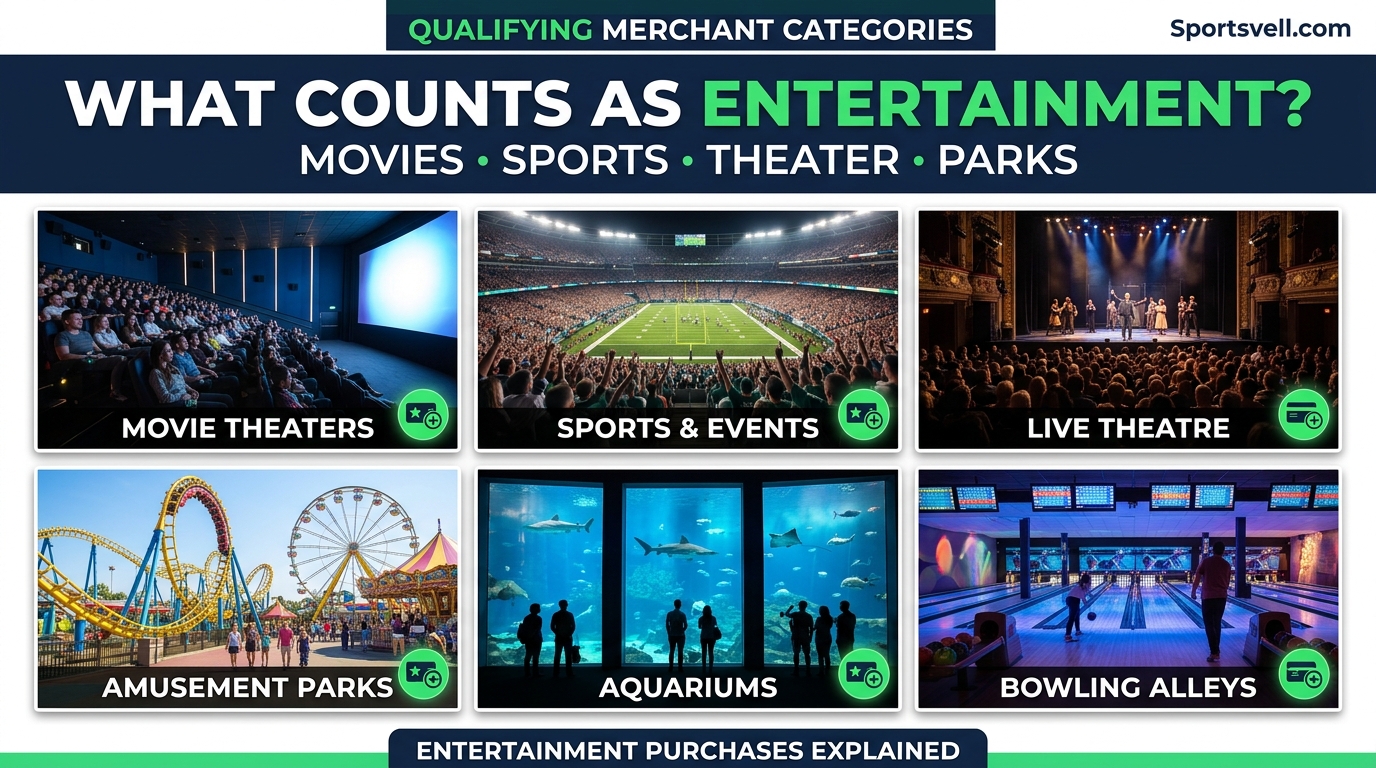
Movie theaters qualify, which covers the most common entertainment purchase most cardholders make.
Sports promoters qualify for professional and semi-professional live sporting events, which covers most pro games.
Theatrical promoters qualify, which covers plays, musicals, and Broadway shows bought from the promoter.
Amusement parks qualify when tickets are bought directly, which covers theme parks and carnivals.
Tourist attractions qualify, which covers tours, exhibits, and landmarks that sell tickets.
Aquariums and zoos qualify, which covers family outings that many cardholders do not realize earn a bonus.
Dance halls qualify, along with record stores, pool halls, and bowling alleys, per the official definition.
Video rental locations also qualify in the account terms, excluding digital streaming and subscription services.
How much entertainment costs each month shapes whether the 3% rate matters, and the average is higher than most people guess.
The how much does entertainment cost per month guide breaks down the 2026 data by category.
| Merchant type | Examples | Savor rate |
|---|---|---|
| Movie theaters | AMC, Regal, local cinemas | 3% |
| Sports promoters | Pro and semi-pro live events | 3% |
| Theatrical promoters | Plays, musicals, Broadway | 3% |
| Amusement parks | Theme parks, carnivals | 3% |
| Tourist attractions | Tours, exhibits, landmarks | 3% |
| Aquariums | Public aquariums | 3% |
| Zoos | Zoos, petting zoos | 3% |
| Dance halls | Dance venues | 3% |
| Record stores | Vinyl and music shops | 3% |
| Pool halls | Billiard establishments | 3% |
| Bowling alleys | Bowling centers | 3% |
| Video rental locations | Physical rental shops | 3% |
Buying tickets to a big college football game is a common entertainment purchase, and the venue matters for the rate.
Tickets to games like Alabama vs Georgia and Ohio State vs Indiana are sold by promoters and venues, not by Capital One.
For the full watch guide to those games, the Alabama vs Georgia watch guide and the Ohio State vs Indiana watch guide both lead with the result and the replay options.
Merchant Category Codes
Merchant category codes, or MCCs, are the mechanism that decides the 3% rate, and every merchant has one.
Every purchase is assigned a code by the merchant, and Capital One uses that code to decide how much cash back is earned.
Capital One states plainly that it is not responsible for the codes merchants use, which is why a purchase can surprise the cardholder.
MCC 7941 covers athletic fields, commercial sports, professional sports clubs, and sports promoters.
MCC 7996 covers amusement parks and carnivals, and MCC 7998 covers aquariums and zoos.
MCC 7991 covers tourist attractions and exhibits more broadly, and MCC 7933 covers bowling alleys.
MCC 7932 covers pool and billiard halls, and MCC 7994 covers video game arcades.
Knowing the code is the only way to predict the rate, and the code is set by the merchant, not by the cardholder.
| MCC code | What it covers |
|---|---|
| 7941 | Sports promoters, athletic fields, professional sports clubs |
| 7996 | Amusement parks and carnivals |
| 7998 | Aquariums and zoos |
| 7991 | Tourist attractions and exhibits |
| 7933 | Bowling alleys |
| 7932 | Pool and billiard halls |
| 7994 | Video game arcades |
What Does Not Count as Entertainment
Exclusions matter as much as the qualifying list, because the excluded purchases earn only 1% with Savor.
Golf courses are excluded, along with country clubs, including membership fees, per the official account terms.
Collegiate sporting events categorized as universities are excluded, which surprises college sports fans.
College football tickets bought through a university box office often code as a university, not as a sports promoter.
Charitable organizations that provide live entertainment are excluded, even when the event itself is a concert or show.
Amusement park tickets purchased on third-party sites are excluded, even when the park itself qualifies.
Entertainment and resort packages categorized as travel or hotel are excluded, because they code as travel instead.
Cable, digital streaming, and membership services are excluded from entertainment, because streaming is a separate category.
Third-party purchases generally earn 1% when the vendor does not categorize under a qualifying entertainment merchant code.
College sports money works differently from pro sports money, and the rules around who gets paid shape the whole system.
The do college football players get paid guide covers the four pay streams and the House settlement cap.
| Excluded purchase | Why it is excluded | Savor rate |
|---|---|---|
| Golf courses | Explicitly excluded in the terms | 1% |
| Country clubs (incl. membership fees) | Explicitly excluded in the terms | 1% |
| Collegiate sporting events | Categorized as universities | 1% |
| Charity live entertainment | Charitable organization code | 1% |
| Amusement park tickets on third-party sites | Third-party seller code | 1% |
| Entertainment and resort packages | Categorized as travel or hotel | 1% |
| Cable and digital streaming | Separate streaming category | 3% as streaming |
| Membership services | Non-industry merchant code | 1% |
Resort packages are the sneakiest exclusion, because a vacation that includes show tickets codes as travel, not entertainment.
Third-party sites are the most common exclusion, because a ticket bought on a resale site carries the reseller’s code.
Charity galas with live music are the most surprising exclusion, because the event feels like entertainment but codes as charity.
Streaming Is a Separate Category
Streaming is a separate 3% category with Savor, and it is not part of the entertainment definition.
Eligible streaming includes purchases from music and video streaming services, including Netflix, Hulu, Disney+, Spotify, and Apple Music.
HBO Max is also named in some guides as an eligible video streaming service for the 3% rate.
Verizon FIOS On Demand is excluded from the streaming category, per the official account terms.
Audiobook subscriptions are excluded, and fitness programming is excluded too, per the same terms.
Cable and satellite providers are excluded from both entertainment and streaming, and they earn the 1% base rate.
People confuse streaming with entertainment because both involve watching things, but Capital One separates them on purpose.
A Netflix subscription earns 3% as streaming, while a movie theater ticket earns 3% as entertainment, and the rates match by coincidence.
Entertainment add-ons from other providers work differently, and the Spectrum add-on is one example worth comparing.
The what is Spectrum Entertainment View guide explains the TV add-on, its channels, and its price.
How to Buy Tickets on the Platform
Buying tickets on the Capital One Entertainment platform takes five steps, and the rewards post within 1 to 2 billing cycles.
Step 1. Check Eligibility
Confirm the card is a US-issued, Capital One branded rewards credit card in good standing.
Debit cards, private-label retail cards, and co-brand partner cards cannot use the platform, so check the card type first.
Step 2. Open the Platform
Open the Capital One mobile app or go to the Capital One website and find the Entertainment section.
Sign in with the Capital One account tied to the eligible card, and confirm the account is in good standing.
Step 3. Find the Event
Search by artist, team, venue, or date across the platform’s 500,000-plus events, powered by Vivid Seats.
Filter by category: sports, music, comedy and theater, dining, or cardholder exclusives only.
Check whether the listing is a cardholder exclusive or a standard Vivid Seats listing, because the resale rules differ.
Step 4. Choose Seats and Payment
Pick seats and review the total, including fees, before checkout, since Vivid Seats prices can run above face value.
Choose one of three payment methods: redeem rewards, charge the eligible Capital One card, or split the cost between the two.
Remember that miles redeem at 0.8 cents per mile, while cash back redeems at 1 cent per point, so cash back stretches further.
Step 5. Confirm and Save the Order
Confirm the order knowing it is final, non-refundable, and non-cancelable, except when the event provider cancels.
Save the order confirmation and the ticket delivery details, since the tickets arrive by email or through the app.
Check the rewards posting within 1 to 2 billing cycles, and confirm the 8% or 5X rate actually applied.
If the rate looks wrong, check whether the purchase went through the platform or through a presale page instead.
Refunds, Postponements, and Resale
Orders on the Capital One Entertainment platform are final, non-refundable, and non-cancelable once placed.
Cancelled events are the exception, and the cardholder is refunded to the original payment method when the provider cancels.
Split orders are refunded proportionally, with the rewards portion returned as rewards and the card portion returned to the card.
Postponed events are not refunded, and the tickets stay valid for the new date, per the platform’s own rules.
That distinction matters, because a postponed concert is not a cancelled concert, and the refund rules treat them differently.
Cardholder-exclusive tickets cannot be resold, which is a condition of buying an exclusive in the first place.
Other Vivid Seats tickets may be transferred or resold through Vivid Seats, which runs the resale marketplace.
Resale steps are simple: create a Vivid Seats account, list the tickets with the event, date, and seat location, set a price, and wait for a buyer.
After a sale, the tickets transfer to the buyer’s Vivid Seats account, and Vivid Seats releases the funds within a few days.
Vivid Seats offers a 100% Buyer Guarantee, which covers the safety and authenticity of transactions on its marketplace.
Fees on Vivid Seats can vary from 0% to 15%, per a November 2026 resale guide, so the seller’s net depends on the event.
Ticket scalping is banned in 15 US states and can lead to large fines or jail, per the same guide, so check local law before reselling.
| Situation | What happens |
|---|---|
| Event cancelled by provider | Refund to original payment; split orders refunded proportionally |
| Event postponed | No refund; tickets valid for the new date |
| Buyer changes mind | No refund; order is final and non-cancelable |
| Cardholder-exclusive ticket | Cannot be resold |
| Standard Vivid Seats ticket | Can be transferred or resold through Vivid Seats |
Why Did My Purchase Only Earn 1%?
One percent is the base rate, and it is what a purchase earns when it falls outside every bonus category.
Third-party seller is the most common cause, because a ticket bought on a resale site carries the reseller’s merchant code.
Wrong merchant code is the second cause, because Capital One relies on the code the merchant assigns, not on what was bought.
Presale purchase is the third cause, because presale tickets do not earn the 8% platform rate even though Capital One runs the presale.
Hall or Arena direct purchase is the fourth cause, because those venues’ own ticketing services are excluded from the platform rate.
College sports is the fifth cause, because collegiate events categorized as universities code as education, not entertainment.
Golf and country clubs are the sixth cause, because they are explicitly excluded from the entertainment definition.
Charity events are the seventh cause, because charitable organizations carry a charity code, not an entertainment code.
Travel packages are the eighth cause, because a resort package with show tickets codes as travel or hotel.
Check the statement first, then check where the ticket was bought, then check the merchant’s code, in that order.
| Symptom | Likely cause | Fix |
|---|---|---|
| Earned 1% on a concert ticket | Bought on a third-party site | Buy on the platform or direct from the promoter next time |
| Earned 3% instead of 8% | Bought through a presale page | Buy on the platform itself, not the presale page |
| Earned 1% on a college game | University merchant code | No fix; college sports are excluded |
| Earned 1% on a golf outing | Golf is excluded | No fix; golf is excluded |
| Earned 1% on a charity gala | Charity merchant code | No fix; charity events are excluded |
Which Capital One Card Earns the Most?
Savor earns the most cash back on entertainment, at 8% on the platform and 3% at qualifying merchants.
Venture X earns the most miles on entertainment, at 5X miles on the platform, with travel perks on top.
Quicksilver earns the least attention but a solid return, at 5% on the platform and 1.5% flat everywhere else.
Annual fees change the math: Savor Cash Rewards costs $0 a year, Savor Rewards costs $95, and Quicksilver costs $0.
Quicksilver’s welcome offer is a $200 cash bonus after $500 in purchases within 3 months, per Bankrate and NerdWallet in October 2026.
Quicksilver’s intro APR is 0% for 15 months on purchases and balance transfers, then 18.74% to 28.74% variable, per Bankrate.
Bankrate’s Quicksilver review is published by Bankrate, with the full rates and terms.
| Card | Platform rate | General entertainment | Other key rates | Annual fee |
|---|---|---|---|---|
| Savor Cash Rewards | 8% cash back | 3% cash back | 5% Capital One Travel; 3% dining, streaming, groceries; 1% else | $0 |
| Savor Rewards | 8% cash back | 3% cash back | Same as Savor Cash Rewards | $95 |
| Venture X | 5X miles | 2X miles | Travel perks and lounge access | Not stated here; verify on capitalone.com |
| Venture | 5X miles | 2X miles | 2X miles on most purchases | Not stated here; verify on capitalone.com |
| Quicksilver | 5% cash back | 1.5% cash back | 5% Capital One Travel; 1.5% flat; $200 bonus after $500 in 3 months | $0 |
Venture X annual fee is not stated here because no in-session source verified it, so check Capital One’s own page.
Best card depends on the goal: cash back favors Savor, miles favor Venture X, and simplicity favors Quicksilver.
Two-card rule limits the strategy, since Capital One allows two personal branded cards at a time and about one new card every six months.
A Worked Example: One $200 Ticket, Three Ways
One ticket can earn three different rewards, depending only on where it is bought, and the gap is large.
Platform with Savor earns 8% cash back on a $200 ticket, which is $16 back, the best cash return available.
Merchant with Savor earns 3% cash back on a $200 ticket, which is $6 back, less than half the platform return.
Presale with Savor earns 1% cash back on a $200 ticket, which is $2 back, because the presale does not qualify for the platform rate.
Platform with Venture X earns 5X miles on a $200 ticket, which is 1,000 miles, valued by TPG at about $18.50 at its September 2026 valuations.
Redeeming miles for a ticket costs 12,500 miles for $100, so the 1,000 miles from one ticket cover $8 of a future ticket.
Platform with Quicksilver earns 5% cash back on a $200 ticket, which is $10 back, between the Savor merchant rate and the platform rate.
Twelve tickets a year at $200 each cost $2,400, and the platform with Savor returns $192, while the presale returns $24.
That $168 gap is the cost of buying in the wrong place, and it is the reason the platform matters.
| How the ticket is bought | Card | Rate | Reward on $200 |
|---|---|---|---|
| Platform | Savor | 8% cash back | $16.00 |
| Platform | Venture X | 5X miles | 1,000 miles |
| Platform | Quicksilver | 5% cash back | $10.00 |
| Qualifying merchant | Savor | 3% cash back | $6.00 |
| Presale page | Savor | 1% cash back | $2.00 |
| Third-party site | Savor | 1% cash back | $2.00 |
Capital One Entertainment vs Ticketmaster and StubHub
Capital One Entertainment is not Ticketmaster, and the difference decides where a ticket should be bought.
Ticketmaster is the primary seller for many concerts and sports events, selling tickets at face value plus fees.
Vivid Seats is a resale marketplace, where independent resellers set the price, which can run above or below face value.
Capital One Entertainment uses Vivid Seats inventory, so its prices follow the resale market, not the box office.
StubHub works the same way as Vivid Seats, as a resale marketplace with seller-set prices and buyer guarantees.
Primary inventory is Ticketmaster’s strength, because it sells the first run of tickets directly from the venue.
Exclusives are the platform’s strength, because meet-and-greets, sound checks, and chef dinners are not sold on Ticketmaster.
Fees differ by marketplace, and Vivid Seats fees can vary from 0% to 15%, per a November 2026 resale guide.
Refunds work the same way in both worlds: a cancelled event means a refund, and a postponed event means the tickets stay valid.
Eight percent back does not always beat a lower price, and the math is worth doing before checkout.
A $200 face-value ticket on Ticketmaster with Savor earns 3%, which is $6 back, for a net cost of $194.
A $220 resale ticket on the platform with Savor earns 8%, which is $17.60 back, for a net cost of $202.40.
Ticketmaster wins that comparison by $8.40, even though the platform rate is more than twice as high.
Check both places before buying, compare the total after rewards, and buy the exclusive only on the platform.
Frequently Asked Questions
1. What are Capital One entertainment purchases?
Two things share the name: tickets bought on the Capital One Entertainment platform, and tickets bought at qualifying entertainment merchants.
Platform purchases earn 8% back with Savor or 5X miles with Venture cards, while general entertainment purchases earn 3% back with Savor.
2. What counts as an entertainment purchase for Capital One?
Ticket purchases at movie theaters, sports promoters, theatrical promoters, amusement parks, tourist attractions, aquariums, zoos, dance halls, record stores, pool halls, and bowling alleys.
The merchant’s category code decides, not the name of the event, so a ticket can qualify or fail on the code alone.
3. What is Capital One Entertainment?
Capital One Entertainment is the bank’s ticketing platform, powered by Vivid Seats, with more than 500,000 events across sports, music, comedy, theater, and dining.
Cardholders can pay with rewards, their card, or a mix of both, and the platform also offers cardholder-exclusive events.
4. How do I earn 8% cash back on Capital One Entertainment?
Buy tickets on the Capital One Entertainment platform with a Savor card, and the 8% rate applies to platform purchases only.
Presale tickets and tickets bought directly through Capital One Hall or Capital One Arena do not earn the 8% rate.
5. Which cards earn 8% on Capital One Entertainment?
Savor-branded cards earn 8%: Savor Cash Rewards with a $0 annual fee, and Savor Rewards with a $95 annual fee.
Savor Cash Rewards was called SavorOne until October 2024, when Capital One renamed it.
6. Which cards earn 5X miles on Capital One Entertainment?
Venture X, Venture X Business, Venture, Venture Business, and Spark 2X Miles cards earn 5X miles on platform purchases.
Quicksilver earns 5% cash back on platform purchases, per Capital One’s published rates.
7. Do presale tickets earn 8% cash back?
No. Tickets bought through cardholder-exclusive presales at capitalone.com/pre-sales do not earn the 8% platform rate.
Presales are an access perk, not a platform purchase, and the tickets are bought on the regular ticket seller’s site.
8. Do Capital One Hall tickets earn 8%?
No. Tickets bought directly through Capital One Hall ticketing services are excluded from the platform rate.
Those tickets may still earn the general 3% entertainment rate if the merchant code qualifies.
9. Do Capital One Arena tickets earn 8%?
No. Tickets bought directly through Capital One Arena ticketing services are excluded from the platform rate.
Those tickets may still earn the general 3% entertainment rate if the merchant code qualifies.
10. What is the difference between Capital One Entertainment and entertainment purchases?
Capital One Entertainment is the ticketing platform, which pays 8% with Savor or 5X miles with Venture cards.
Entertainment purchases are the general category, decided by merchant code, which pays 3% with Savor.
11. Do concert tickets count as entertainment on Capital One?
Yes, if bought from a concert promoter or on the platform, where they earn 8% with Savor.
Tickets bought on a third-party site may earn only 1%, because the reseller’s merchant code does not qualify.
12. Do movie tickets count as entertainment on Capital One?
Yes. Movie theaters are named first in Capital One’s official entertainment definition.
A movie ticket bought at the theater earns 3% with Savor, while the same film streamed at home earns 3% as streaming.
13. Do sports tickets count as entertainment on Capital One?
Yes for professional and semi-professional live events bought from a sports promoter.
Collegiate sporting events categorized as universities do not count, so college game tickets often earn only 1%.
14. Do amusement park tickets count as entertainment?
Yes, when bought directly from the park, which earns 3% with Savor.
Amusement park tickets bought on third-party sites do not count, and they earn only 1%.
15. Does golf count as entertainment on Capital One?
No. Golf courses and country clubs, including membership fees, are explicitly excluded from the entertainment definition.
A golf outing earns the 1% base rate with Savor, no matter how it is booked.
16. Do college sports tickets count as entertainment?
No. Collegiate sporting events categorized as universities are excluded from the entertainment category.
College game tickets bought through a university box office often carry a university merchant code.
17. Does streaming count as entertainment on Capital One?
No. Streaming is a separate 3% category with Savor, covering Netflix, Hulu, Disney+, Spotify, and Apple Music.
Verizon FIOS On Demand, audiobook subscriptions, and fitness programming are excluded from the streaming category too.
18. What is a merchant category code?
A merchant category code, or MCC, is a code the merchant assigns to each purchase that tells the issuer what category it falls in.
Capital One uses these codes to decide the reward rate, and it states it is not responsible for the codes merchants use.
19. What MCC codes count as entertainment for Capital One?
MCC 7941 covers sports promoters, MCC 7996 covers amusement parks, MCC 7998 covers aquariums and zoos, and MCC 7991 covers tourist attractions.
MCC 7933 covers bowling alleys, MCC 7932 covers pool halls, and MCC 7994 covers video game arcades.
20. Why did my entertainment purchase only earn 1%?
Third-party seller, wrong merchant code, presale purchase, Hall or Arena purchase, college sports, golf, charity, or a travel package are the usual causes.
Check the statement first, then check where the ticket was bought, then check the merchant’s code, in that order.
21. Can I use Capital One miles for concert tickets?
Yes, on the Capital One Entertainment platform, where miles redeem at 0.8 cents per mile.
A $100 ticket costs 12,500 miles, while the same ticket costs $100 in cash-back rewards at 1 cent per point.
22. Can I use cash back for Capital One Entertainment tickets?
Yes. Cash back redeems at 1 cent per point on the platform, so $100 in rewards buys a $100 ticket.
Cash back stretches further than miles on the platform, because miles redeem at only 0.8 cents each.
23. Can I split payment between rewards and my card?
Yes. The platform lets cardholders pay with rewards, their eligible Capital One card, or a mix of both.
Split orders are refunded proportionally if the event provider cancels, with each part returned the way it was paid.
24. Are Capital One Entertainment tickets refundable?
No. Orders are final, non-refundable, and non-cancelable once placed, except when the event provider cancels.
Postponed events are not refunded either, and the tickets stay valid for the new date.
25. Can I resell Capital One Entertainment tickets?
Cardholder-exclusive tickets cannot be resold, while other Vivid Seats tickets can be transferred or resold through Vivid Seats.
Resale runs through a Vivid Seats account, and Vivid Seats offers a 100% Buyer Guarantee on its marketplace.
Conclusion
What are Capital One entertainment purchases? They are two things: platform tickets that pay 8% with Savor or 5X miles with Venture cards, and merchant tickets that pay 3% with Savor.
Where the ticket is bought decides the rate, not what the ticket is for, and the platform is where the best rate lives.
Presale tickets and tickets bought through Capital One Hall or Capital One Arena do not earn the platform rate, and that trap is worth remembering.
Golf, college sports, charity events, and third-party tickets earn only 1% with Savor, and no card fixes that.
Streaming is a separate 3% category, with its own list and its own exclusions, so a Netflix bill is not an entertainment purchase.
Orders are final and non-refundable, postponed events are not refunded, and only standard Vivid Seats tickets can be resold.
Check the platform before buying tickets anywhere else, and confirm the rate posted within 1 to 2 billing cycles.
Verify every rate on Capital One’s own site before applying for a card, because rates and terms change.
Start with the platform for the next concert, game, or show, and let the 8% or 5X rate do the work.