What Is a Two-Way Contract in the NBA? 2026–27 Salary and Roster Rules Explained
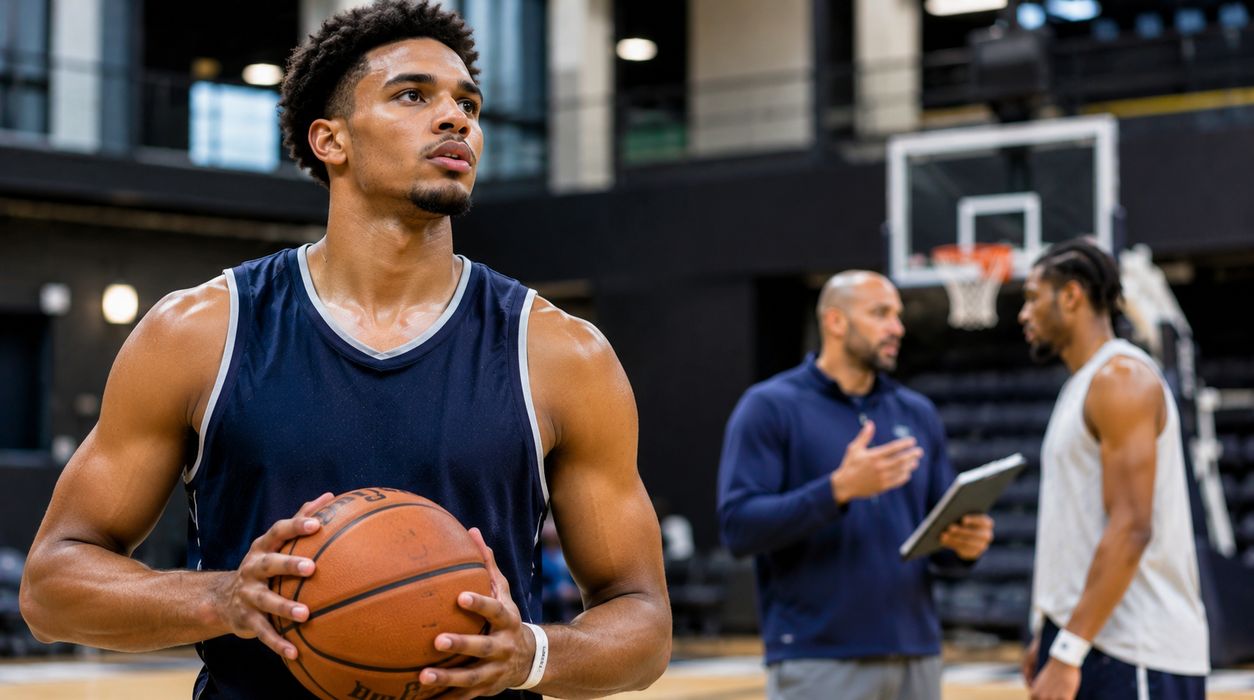
Every NBA season, talented young basketball players compete for a limited number of roster spots. Some are first-round draft picks with guaranteed contracts. Others are undrafted prospects hoping to prove they belong in the league.
For many of those developing players, an NBA two-way contract offers an important opportunity.
A two-way contract allows an eligible player to spend time with an NBA team and its NBA G League affiliate while remaining under one agreement.
During the 2026–27 season, a full-season two-way contract pays approximately $678,882. Each NBA team can carry up to three two-way players in addition to its standard roster.
However, these contracts come with important restrictions involving playing time, eligibility, postseason participation, and salary guarantees.
Here’s everything basketball fans should know about how NBA two-way contracts work in 2026–27.
What Is a Two-Way Contract in the NBA?
An NBA two-way contract is a special player agreement that allows a basketball player to provide services to both an NBA franchise and its affiliated G League team.
The system gives developing players access to NBA coaching, training facilities, and regular-season opportunities without requiring teams to use a standard roster position.
For example, a young guard might spend several weeks playing for a G League affiliate before joining the parent NBA team when additional backcourt depth is needed.
After that assignment, the player may return to the G League for more consistent playing time.
Unlike an ordinary G League contract, a two-way agreement places the player under the control of the NBA organization.
The player receives one contract covering both levels of competition.
The NBA introduced two-way contracts in 2017 to create a stronger development pathway between its two leagues.
The system originally provided two additional roster positions per team. Under the 2023 collective bargaining agreement, that number increased to three.
The official NBA G League two-way contract guide explains the system’s purpose and basic eligibility requirements.
How Much Do NBA Two-Way Players Make in 2026–27?
The full-season NBA two-way contract salary for 2026–27 is approximately $678,882.
That figure is calculated using a specific formula.
A two-way player’s annual salary equals 50% of the NBA minimum salary for a player with zero years of NBA service.
For 2026–27, the applicable rookie minimum is approximately $1,357,763.
Half of that amount is $678,881.50, rounded to $678,882.
This represents an increase from the 2025–26 two-way salary of $636,435.
Importantly, a player does not receive separate salaries from the NBA team and its G League affiliate.
The two-way salary covers services at both levels.
A player who spends more time in the NBA does not automatically receive additional base salary simply because of those appearances.
However, the full-season figure does not mean every two-way player is guaranteed the entire amount.
Contract protection and signing dates can affect actual earnings.
Are NBA Two-Way Contracts Fully Guaranteed?
Not necessarily.
Two-way contracts may include partial salary guarantees rather than guaranteeing the entire season’s compensation immediately.
The amount protected depends on the contract’s terms and the applicable collective bargaining rules.
For example, a player might sign a two-way agreement with limited guaranteed compensation.
If the team waives him before additional salary becomes protected, he may receive less than the full-season amount.
A contract can also contain provisions that increase salary protection if the player remains with the team through an agreed date.
Players signing during the regular season receive prorated compensation based on the remaining days.
Therefore, the advertised $678,882 salary should be understood as the full-season rate, not an unconditional payment to everyone who signs a two-way contract.
These financial differences are important for young players deciding between NBA opportunities, overseas contracts, and other professional basketball arrangements.
How Many Two-Way Players Can an NBA Team Have?
Each NBA team can carry up to three players on two-way contracts.
These positions are separate from the standard roster.
A team may have up to 15 players on standard NBA contracts, plus three additional two-way players.
That creates a maximum of 18 players across those two contract categories.
However, two-way players do not receive all the same roster privileges as standard NBA players.
They have specific limitations on regular-season availability and postseason eligibility.
The additional roster positions help organizations develop young talent without immediately committing standard contracts.
Across the league’s 30 teams, the system creates as many as 90 two-way contract positions.
Not every team must keep all three positions filled at every moment.
Organizations can leave a spot open while evaluating available prospects.
What Is the NBA Two-Way Contract 50-Game Limit?
One of the most important rules is the 50-game limit.
A two-way player generally cannot appear on his NBA team’s Active List for more than 50 regular-season games.
The distinction between being active and actually playing is important.
A player does not necessarily need to enter a game for it to count toward the limit.
If he is on the team’s Active List for that game, it generally counts.
For example, imagine a rookie guard joins an NBA team’s Active List for 20 games.
He plays in only 12 of those contests.
The relevant count is generally 20 active-list games, not 12 appearances.
This prevents teams from keeping two-way players available for an unlimited number of games while using them only occasionally.
The rule encourages teams to decide whether a developing player should remain on a two-way contract or receive a standard NBA agreement.
Does the 50-Game Limit Reset After a Trade?
The 50-game limitation is not intended to provide unlimited additional NBA availability through transactions.
Teams must follow the collective bargaining agreement when acquiring or signing two-way players.
A player cannot simply assume that changing organizations provides another unrestricted 50-game allowance.
Contract dates, prior active-list usage, and the applicable roster rules must be considered.
For a player signed during the regular season, the permitted number of active-list games is prorated according to the time remaining.
This means a player who signs in February cannot automatically receive the same full-season allowance as someone who signed before opening night.
The rule helps maintain a distinction between developmental contracts and ordinary NBA roster positions.
Who Is Eligible for an NBA Two-Way Contract?
Two-way contracts are primarily designed for players early in their NBA careers.
Under the current system, players generally must have three or fewer years of NBA service to qualify.
There is a narrow exception for certain players with four years of service who meet additional conditions involving a season spent on an NBA roster without appearing in games.
Eligibility is based on NBA service rather than a player’s age alone.
A 27-year-old international player with limited NBA experience may qualify.
Meanwhile, a younger player who has accumulated too much NBA service may be ineligible.
Teams must also consider restrictions on how long a player can remain on two-way contracts with the same franchise.
The agreement cannot keep a player under two-way contracts with one organization for portions of more than three salary-cap years.
These rules prevent teams from using two-way contracts indefinitely for established players.
Can Undrafted Players Sign Two-Way Contracts?
Yes.
Undrafted players are among the most common candidates for two-way agreements.
Not every talented college basketball player is selected in the NBA Draft.
Some prospects go undrafted because of concerns about shooting, defensive ability, physical development, or positional fit.
However, going undrafted does not prevent a player from reaching the NBA.
A strong Summer League performance or impressive training camp can lead to a two-way opportunity.
For example, an undrafted college guard might demonstrate excellent perimeter defense during preseason games.
An NBA team could decide that he has long-term potential but needs additional experience.
A two-way contract allows the organization to develop him through the G League while providing occasional NBA opportunities.
For the player, the agreement offers financial compensation and direct access to an NBA development system.
How Long Can an NBA Two-Way Contract Last?
A two-way contract can last one or two seasons.
The exact length depends on the agreement negotiated between the player and the team.
A two-year contract can provide additional continuity for a developing prospect.
However, two-way contracts cannot contain an option year.
This differs from certain standard NBA contracts that may include team options or player options.
A two-way player can also be converted to a standard NBA contract if the team wants to provide a permanent roster opportunity.
The organization must comply with the relevant roster and salary-cap requirements.
A conversion can become particularly important when a player performs well enough to contribute during the postseason.
Can NBA Two-Way Players Play in the Playoffs?
Not while remaining on a two-way contract.
Two-way players may travel and practice with their NBA teams during the play-in tournament and playoffs, but they are not eligible to participate on the postseason roster under their two-way status.
A team that wants to use a two-way player during the postseason must convert him to a standard NBA contract before the applicable deadline.
Under the governing rules, the conversion must occur before the start of the team’s final regular-season game for the player to become eligible for that team’s postseason roster.
This creates important decisions late in the season.
Imagine a two-way guard becomes a reliable defender during March.
His team expects to face several strong offensive guards in the playoffs.
The organization might decide that his defensive skills justify converting his contract.
However, that conversion requires a standard roster spot and changes the team’s financial commitments.
What Happens When a Two-Way Player Reaches 50 Games?
A player who reaches the applicable active-list limit cannot continue being active for additional regular-season games under the same two-way status.
The team must decide how to proceed.
One option is keeping the player on the two-way contract while assigning him to the G League.
Another is converting him to a standard NBA contract, provided the club has the necessary roster flexibility.
A standard contract removes the two-way active-game limitation.
For a player who has become a regular contributor, conversion may be the logical next step.
However, teams must consider salary-cap implications, roster openings, and the player’s projected role.
Reaching 50 games does not automatically guarantee a promotion.
It simply means the organization cannot continue using the player on its NBA Active List under the ordinary two-way allowance.
What Is the NBA Under-15 Rule?
The NBA also has a team-wide restriction involving two-way players when a club carries fewer than 15 standard-contract players.
These are known as Under-Fifteen Games.
During such games, the team is limited to 90 aggregate active-list uses of its two-way players across the season.
For example, if a team has 14 standard-contract players and activates two two-way players for a game, that counts as two Under-Fifteen Games toward the aggregate limit.
If three two-way players are active, the count increases by three.
This rule prevents teams from relying excessively on two-way players while leaving standard roster positions unfilled.
It is separate from each individual player’s 50-game limit.
A club must therefore monitor both restrictions when deciding which players to activate.
How Is a Two-Way Contract Different From a Standard NBA Contract?
The differences extend beyond salary.
| Feature | Two-Way Contract | Standard NBA Contract |
|---|---|---|
| Roster position | One of three additional spots | Standard roster |
| Salary | Special two-way salary formula | Applicable NBA contract salary |
| NBA availability | Limited active-list games | No two-way 50-game restriction |
| G League assignments | Built into development arrangement | Subject to assignment rules |
| Playoff eligibility | Requires conversion | Eligible if postseason roster rules are met |
| Contract length | One or two seasons | Depends on contract type |
Standard contracts generally provide greater earning potential and fewer restrictions on NBA availability.
Two-way agreements offer a pathway for players who are not yet ready for permanent standard roster positions.
Both arrangements serve important purposes.
Can Two-Way Players Move Between the NBA and G League?
Yes. That flexibility is the defining feature of the contract.
A two-way player may practice with the NBA team, participate in eligible games, and spend time with its G League affiliate.
For example, a center might play several games in the G League to improve his rebounding and defensive positioning.
If the NBA team experiences injuries, he may be brought into the active rotation.
After the injured players return, the center could resume his developmental assignment.
This arrangement helps teams evaluate prospects in different competitive environments.
It also gives players opportunities to gain experience without immediately occupying a permanent NBA roster spot.
However, movement between teams remains subject to league scheduling, assignment procedures, and active-list restrictions.
Do Two-Way Contracts Count Against the NBA Salary Cap?
Two-way compensation is generally excluded from a team’s salary-cap calculations.
That makes these contracts particularly valuable for organizations managing expensive rosters.
The NBA’s salary cap for 2026–27 is $164.961 million.
Teams must also consider luxury-tax thresholds and additional restrictions associated with the first and second salary-cap aprons.
A two-way contract allows a franchise to develop another player without using a standard roster position or adding the player’s two-way compensation to its team salary.
However, converting the player to a standard contract changes the financial treatment.
The club must then evaluate the new agreement under the applicable salary-cap rules.
This is one reason teams carefully manage their two-way roster spots throughout the season.
Why Do NBA Teams Use Two-Way Contracts?
Teams use two-way contracts to balance immediate competition with long-term player development.
Developing young talent
A player may have strong physical tools but need additional experience reading NBA defenses.
The G League provides regular opportunities to improve.
Maintaining roster flexibility
Teams can evaluate prospects without immediately using standard roster positions.
Responding to injuries
Eligible two-way players can provide temporary depth when standard-roster players are unavailable.
Identifying future contributors
A two-way player who performs consistently well may earn a standard contract.
This development approach benefits both rebuilding organizations and championship contenders.
For teams with expensive veteran rosters, finding productive young players through lower-cost development agreements can be especially valuable.
Are NBA Two-Way Contracts Worth It for Players?
For many prospects, a two-way contract represents an excellent opportunity.
The full-season salary is substantially higher than ordinary G League compensation.
Players also receive exposure to NBA coaches, professional development resources, and high-level competition.
However, the arrangement has disadvantages.
The salary may not be fully guaranteed.
The player faces restrictions on NBA availability and cannot participate in postseason games without conversion.
He may also experience frequent changes between NBA and G League assignments.
For an established international player with a lucrative overseas offer, the financial comparison may be more complicated.
For an undrafted rookie hoping to establish an NBA career, the opportunity can be extremely attractive.
Ultimately, the value depends on the player’s circumstances and long-term goals.
Can a Two-Way Player Become a Full-Time NBA Starter?
Yes.
A two-way contract does not permanently define a player’s career.
Some players use the arrangement to demonstrate that they can contribute at the highest level.
Strong performances can lead to standard NBA contracts, larger roles, and greater financial security.
Development is rarely predictable.
A player who initially struggles with NBA defensive schemes may improve through regular G League minutes.
Another may become valuable because of specialized shooting, rebounding, or defensive skills.
Teams are constantly searching for players who can outperform expectations.
The two-way system gives them another way to identify that talent.
How Can Fans Track NBA Two-Way Players?
The NBA G League maintains an official tracker showing players signed to two-way contracts.
It includes their NBA organizations and affiliated G League teams.
Because roster transactions occur throughout the season, the list can change frequently.
Fans should use current information rather than assuming preseason contracts remain unchanged.
SportsVell also provides broader sports coverage through its NBA category.
Readers interested in how professional athletes are compensated can explore how much college football players get paid.
For comparisons with another professional sports league, the MLB qualifying offer explanation discusses how baseball teams handle certain free-agent contracts.
SportsVell’s Banana Ball player salary guide also examines compensation in an alternative professional baseball environment.
Fans who enjoy comparing sports formats can read how long a football game lasts.
Frequently Asked Questions
How much is an NBA two-way contract worth in 2026–27?
A full-season two-way contract pays approximately $678,882 before applicable deductions. Actual guaranteed compensation may differ.
How many two-way players can an NBA team have?
Each NBA team can have up to three two-way players in addition to its standard roster.
Can a two-way player play all 82 NBA games?
No. A two-way player generally has a 50-game NBA Active List limit, with prorated limits for certain in-season signings.
Does sitting on the bench count toward the 50-game limit?
Yes, if the player is on the NBA team’s Active List for that game. Actual playing minutes are not required.
Can two-way players participate in the NBA playoffs?
Not unless they are converted to standard NBA contracts in time to satisfy postseason eligibility requirements.
Can an undrafted player receive a two-way contract?
Yes. Undrafted players frequently receive two-way opportunities.
How long does a two-way contract last?
A two-way contract can last one or two seasons.
Can a team convert a two-way contract into a standard contract?
Yes, subject to the applicable roster, salary-cap, and transaction rules.
Do two-way players receive separate NBA and G League salaries?
No. They receive one salary covering services with both teams.
Can an NBA veteran sign a two-way contract?
Generally, eligibility is limited to players with three or fewer years of NBA service, subject to a narrow exception.
Final Thoughts
NBA two-way contracts provide an important connection between the NBA and its developmental league.
During the 2026–27 season, eligible players can earn approximately $678,882 on a full-season agreement while receiving opportunities with both an NBA franchise and its G League affiliate.
Each team can carry up to three two-way players, and those players generally face a 50-game NBA Active List limit.
The contracts also have restrictions involving eligibility, salary guarantees, and postseason participation.
For young players, the system offers a chance to develop their skills and compete for permanent NBA positions.
For teams, it creates valuable roster flexibility and another way to discover future contributors.
Understanding these rules makes NBA roster moves, player promotions, and G League assignments much easier to follow throughout the season.