How Do UFC Judges Score Takedowns and Control Time? 2026 MMA Scoring Rules Explained
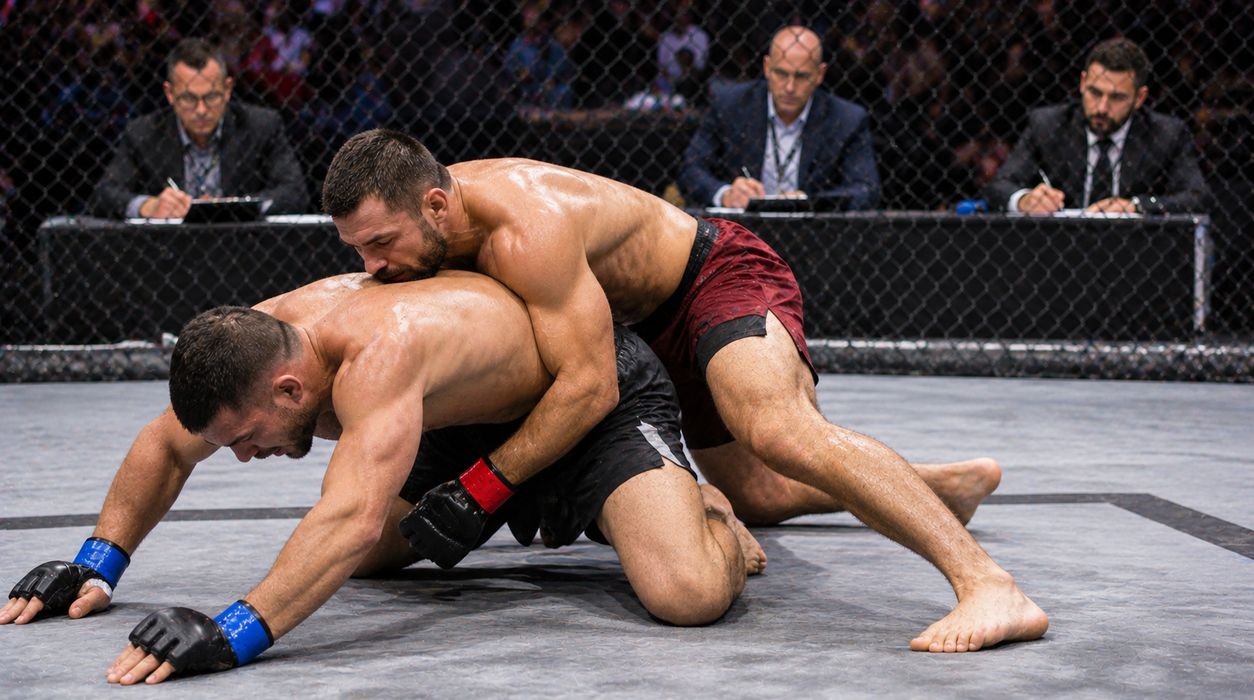
A UFC fighter lands four takedowns, controls their opponent against the cage, and spends nearly three minutes in top position. Their opponent lands the cleaner punches, threatens a submission, and finishes the round with a damaging elbow.
Who wins the round?
Many fans assume the fighter with more takedowns and longer control time deserves the victory. But that is not how modern MMA judging works.
Under the Unified Rules of Mixed Martial Arts used in 2026, judges prioritize effective striking and effective grappling. Takedowns and control time matter primarily because of what a fighter accomplishes with them, not simply because they occur.
A takedown that creates an immediate submission threat can be more valuable than several takedowns that lead to no meaningful offense. Similarly, holding an opponent against the fence does not automatically outweigh damaging strikes.
This guide explains UFC takedown scoring rules, control time, effective grappling, the 10-point must system, and why judges sometimes award a round to the fighter who spent more time on their back.
How Do UFC Judges Score Takedowns in 2026?
UFC judges evaluate takedowns as part of effective grappling.
However, there is no fixed number of points awarded for completing a takedown.
A fighter does not automatically receive one point for a single-leg takedown, two points for a double-leg takedown, or three points for a slam.
Instead, judges consider the effectiveness of the action.
A takedown becomes particularly meaningful when it creates an opportunity for damaging strikes, a submission attempt, or another effective offensive action.
The official ABC MMA Officials Handbook explains that judging focuses on the impact of techniques rather than simply counting actions.
Quick Guide to UFC Takedown Scoring
| Action | How Judges Evaluate It |
|---|---|
| Takedown followed by damaging punches | Strong effective grappling and striking |
| Takedown leading to a dangerous submission | Meaningful effective grappling |
| Takedown with immediate opponent escape | Limited value without effective follow-up |
| Holding top position without offense | Not automatically round-winning |
| Repeated unsuccessful takedown attempts | No automatic scoring credit |
| Successful reversal followed by attacks | Potentially valuable effective grappling |
| Cage pressure without meaningful offense | Primarily a lower-priority consideration |
The central question is what the action actually accomplished.
Does a Takedown Count as a Point in UFC?
No.
UFC scoring is not the same as amateur wrestling scoring.
In wrestling, specific takedowns and positional achievements may earn numerical points under that sport’s rules.
In UFC competition, judges score the overall round using the 10-point must system.
Individual techniques do not have fixed point values.
A takedown is evaluated within the broader category of effective grappling.
Example: One Takedown vs. Three Takedowns
Imagine Fighter A completes three takedowns.
Each time, Fighter B immediately stands up.
Fighter A does not land meaningful strikes or establish a dangerous submission attempt.
Fighter B lands several clean, damaging punches during the standing exchanges.
Fighter B may win the round despite being taken down three times.
Now consider a different situation.
Fighter A completes one takedown, advances to mount, lands damaging elbows, and nearly finishes a submission.
That single takedown sequence may have a much greater impact on the score.
The difference is effectiveness.
What Is Control Time in UFC?
Control time measures how long a fighter maintains a recognized controlling position during a bout.
It may include time spent controlling an opponent on the ground or in certain clinch positions.
Broadcast statistics can help viewers understand the flow of a fight.
However, the number displayed on television is not a separate scoring category that automatically awards points.
A fighter who controls an opponent for three minutes does not automatically win over a fighter who controls for one minute.
The judges must evaluate the effectiveness of the actions during those periods.
Does More Control Time Mean Winning?
Not necessarily.
Control time can reflect dominance, but it does not prove that the controlling fighter delivered the more effective offense.
A fighter may hold an opponent against the fence while doing very little damage.
Meanwhile, the opponent may land the round’s most significant strikes.
The judging criteria prioritize effective striking and grappling.
Control of the fighting area is a lower-priority criterion.
What Are the Official UFC Judging Criteria?
The Unified Rules establish a hierarchy for evaluating MMA rounds.
Judges consider three principal categories in order.
1. Effective Striking and Effective Grappling
This is the primary scoring criterion.
Judges assess the meaningful results of legal strikes and grappling actions.
Effective striking includes legal blows that produce immediate or cumulative impact.
Effective grappling includes successful takedowns, submission attempts, reversals, and advantageous positions that create meaningful offensive results.
2. Effective Aggressiveness
This is considered only when effective striking and grappling are assessed as equal.
It concerns meaningful attempts to finish the fight.
Simply moving forward or throwing ineffective attacks does not automatically demonstrate effective aggressiveness.
3. Fighting Area Control
This is considered only when the first two criteria are equal.
It involves determining which fighter dictates the pace, place, and position of the contest.
The 2025 Unified Rules document hosted by IMMAF describes this scoring hierarchy, which remains the relevant framework for this 2026 guide.
What Counts as Effective Grappling?
Effective grappling involves more than maintaining physical contact or preventing an opponent from moving.
Judges look for actions that produce meaningful results.
Examples include successful offensive takedowns, threatening submission attempts, effective reversals, and positional advances that lead to attacks.
Takedowns
A takedown can be valuable when it establishes an offensive opportunity.
A fighter who brings an opponent down and immediately lands damaging punches has accomplished more than simply changing the position.
Submission Attempts
A submission attempt can carry substantial scoring value when it creates a real threat.
For example, a deep rear-naked choke that forces an opponent to defend urgently may be highly significant.
A loosely applied hold that creates no meaningful danger is less persuasive.
Reversals
A reversal can be important when a fighter escapes a disadvantageous position and establishes effective offense.
However, merely reversing position without producing meaningful attacks does not automatically determine the round.
Positional Advancement
Moving from guard to side control or mount can create opportunities for offense.
The position becomes particularly important when the fighter uses it to threaten submissions or land effective strikes.
Does Ground-and-Pound Score More Than Control Time?
Ground-and-pound can be highly significant because it combines grappling control with effective striking.
For example, Fighter A secures top position and lands repeated legal punches and elbows.
If those strikes produce meaningful impact, judges consider them under effective striking.
The top position also creates the opportunity for that offense.
Compare that with a fighter who maintains the same position but throws almost no meaningful strikes.
The first fighter has a stronger scoring argument.
Are All Ground Strikes Equal?
No.
Judges assess the effectiveness of strikes.
A clean elbow that visibly affects an opponent may carry more weight than several light punches that cause little impact.
Immediate effects are particularly important under the ABC judging guidance.
However, cumulative impact can also matter.
The judges evaluate the round as a whole rather than applying a fixed points-per-strike formula.
Can a Fighter Win a Round From Bottom Position?
Yes.
A fighter can win a round while spending much of it underneath an opponent.
That may surprise viewers who associate top position with winning.
However, position alone is not the primary scoring criterion.
Imagine Fighter A controls Fighter B from inside the guard.
Fighter A maintains top position but delivers very little effective offense.
Fighter B attacks from the bottom with damaging elbows and a serious submission attempt.
If Fighter B produces the more effective offense, the judges may award the round to Fighter B.
Does Being on Your Back Mean You Are Losing?
No.
A fighter’s position is important tactically, but judges must assess what happens from that position.
A skilled grappler can threaten submissions and land strikes from the bottom.
A fighter on top may struggle to generate meaningful attacks.
The scoring criteria distinguish between controlling a position and effectively using it.
How Does Cage Control Affect UFC Scoring?
Cage control refers to a fighter’s ability to influence where the contest takes place.
For example, one fighter may repeatedly push an opponent toward the fence.
Another may control the center of the Octagon.
However, fighting area control is not the first consideration in scoring.
Judges use it only when effective striking and grappling, followed by effective aggressiveness, do not separate the fighters.
Does Walking Forward Win Rounds?
Not automatically.
A fighter may pressure an opponent for an entire round without landing effective strikes.
The opponent may move backward while landing clean counters.
Under the judging criteria, effective offense takes priority over forward movement alone.
Pressure becomes more valuable when it creates meaningful offensive results.
Does Holding Someone Against the Cage Count?
It can matter, but holding an opponent against the cage without effective attacks is not automatically enough to win the round.
If the clinch produces damaging knees, punches, or successful grappling attacks, those actions receive greater consideration.
The distinction is between control that creates effective offense and control that merely occupies time.
How Does the 10-Point Must System Work?
UFC judges generally score rounds using the 10-point must system.
Three judges independently evaluate each round.
The winner normally receives 10 points.
The opponent receives nine or fewer points depending on the margin.
A 10–10 round is possible but rare.
Common UFC Round Scores
| Score | General Meaning |
|---|---|
| 10–9 | One fighter wins by a relatively close margin |
| 10–8 | One fighter wins by a large margin |
| 10–7 | Extremely dominant round |
| 10–10 | No discernible advantage; very rare |
The ABC’s official Unified Rules page provides access to the governing rules and scoring documents.
When Does a Takedown Help Produce a 10–8 Round?
A 10–8 round requires a large margin in effective performance.
A fighter may earn that score through significant damage, dominance, and duration.
For example, Fighter A completes an early takedown.
They advance to a dominant position and spend much of the round landing damaging strikes while threatening submissions.
Fighter B offers little effective offense.
That sequence may support a 10–8 score.
However, simply holding an opponent on the ground for most of the round does not automatically justify 10–8.
The quality and impact of the offense remain important.
Can a Grappling-Heavy Round Be 10–8?
Yes.
A fighter does not need to dominate through punches alone.
Effective grappling can produce a wide scoring margin.
A series of dangerous submission attempts, impactful takedowns, positional attacks, and effective ground strikes may support a 10–8 round.
The judges must assess the actual performance.
Can Control Time Help Produce a 10–7 Round?
A 10–7 round is extremely rare.
It reflects an exceptionally one-sided round involving overwhelming effectiveness.
Control time alone does not justify such a score.
For example, holding top position for nearly five minutes without meaningful offense would not automatically produce a 10–7.
The judging criteria require an extraordinary level of effective dominance.
A fighter who repeatedly damages an opponent and creates near-fight-ending situations may present a different case.
Even then, judges must apply the official criteria carefully.
Why Do UFC Judges Sometimes Disagree?
Judges watch the same contest from different positions around the fighting area.
They may perceive the effectiveness of strikes and grappling exchanges differently.
A punch that appears powerful from one angle may look less significant from another.
A submission attempt may appear close to completion to one judge but less threatening to another.
The criteria are standardized, but evaluating live action still involves judgment.
What Is a Split Decision?
A split decision occurs when two judges award the fight to one competitor and the third judge awards it to the opponent.
A unanimous decision occurs when all three judges select the same winner.
A majority decision occurs when two judges select one winner and the third scores the contest a draw.
These outcomes are based on the judges’ round-by-round scorecards.
Do UFC Judges Use Takedown Statistics?
Judges are expected to score what they observe during the contest.
Broadcast statistics are not a replacement for the official judging criteria.
A television graphic might show five takedowns for Fighter A and one for Fighter B.
That does not automatically establish who won.
The judges must consider the effectiveness of those takedowns and the other offense produced during the round.
Why Can Statistics Be Misleading?
Statistics provide useful context, but they cannot fully describe the impact of an exchange.
Two fighters might each land twenty strikes.
One fighter’s strikes may be significantly more damaging.
Likewise, two takedowns may produce very different results.
One may lead to an immediate escape.
The other may create a dangerous submission attempt.
The numbers alone do not capture that distinction.
Does Defending a Takedown Score Points?
Successful defense is valuable tactically.
A fighter who stops takedowns can keep the contest in a preferred position.
However, defending a takedown does not automatically earn a fixed number of scoring points.
Judges primarily assess effective offense.
A successful defensive action becomes particularly important when it leads to a meaningful counterattack.
For example, Fighter A attempts a takedown.
Fighter B sprawls, prevents the takedown, and lands effective strikes.
Those strikes contribute to the scoring assessment.
The defensive action helps create the opportunity.
How Do Submission Attempts Compare With Takedowns?
Submission attempts can be more significant than takedowns when they create an immediate threat of ending the fight.
Imagine Fighter A completes three takedowns but produces little offense afterward.
Fighter B attempts a deep armbar that forces Fighter A into an urgent escape.
The judges must evaluate the effectiveness of those actions rather than simply counting them.
A genuine near-finish can be highly influential.
However, not every submission attempt is equally valuable.
A loose guillotine attempt that never threatens the opponent should not be treated the same as a fully developed choke.
How Do UFC Grounded Opponent Rules Affect Scoring?
The grounded opponent rule determines whether certain strikes are legal.
It does not create a separate scoring category.
Under the updated Unified Rules, a fighter is grounded when a body part other than the hands or feet touches the canvas.
Knees and kicks to the head of a genuinely grounded opponent remain prohibited.
A legal knee delivered during a takedown defense may contribute to effective striking.
An illegal knee does not become a scoring advantage simply because it lands.
The referee handles fouls under the applicable regulations.
This distinction matters because a legal counterattack during a grappling exchange can influence the round.
Do Illegal Elbows Count Toward UFC Scoring?
No.
Judges evaluate legal offense.
An illegal strike does not receive ordinary scoring credit.
The former prohibition on straight downward 12–6 elbows was removed from the updated Unified Rules, but strikes to prohibited target areas remain illegal.
For example, a legal downward elbow delivered from top position can contribute to effective striking.
An elbow directed at the back of the head remains prohibited.
Referees may apply penalties for fouls, including point deductions.
How Can a Point Deduction Change a Decision?
Point deductions can affect the final score even when one fighter appears to have won more rounds.
Suppose Fighter A wins a round 10–9 but receives a one-point deduction.
The score for that round may become 9–9.
If the contest is close, that deduction can change the final outcome.
An accidental eye poke, illegal strike, or another foul may lead to a penalty depending on the circumstances.
The scoring effect of a foul is separate from the ordinary evaluation of effective striking and grappling.
For comparison with another combat sport, SportsVell explains unusual outcomes in No Contest in Boxing: NC vs. DQ vs. Technical Draw.
Boxing has its own procedures, so the rules should not be treated as identical.
How Is UFC Scoring Different From Boxing Scoring?
UFC and professional boxing both use versions of the 10-point must system.
However, the permitted techniques differ significantly.
Boxing judges evaluate punching exchanges under boxing’s scoring criteria.
UFC judges must evaluate both striking and grappling.
That includes takedowns, submission attempts, reversals, and effective ground offense.
The sports also use different standard round lengths.
SportsVell’s guide to how many rounds are in a boxing match explains common professional boxing formats.
A UFC fighter can win a round through effective grappling without landing the most punches.
A professional boxer cannot use takedowns or submissions as legal scoring techniques.
Does Fighter Weight Affect UFC Judging?
No.
The scoring criteria do not award extra credit simply because a fighter is heavier.
UFC weight divisions exist to organize competition between athletes within approved weight limits.
Judges evaluate the action in the cage.
A fighter’s size, reputation, or championship status does not automatically determine the score.
Weight arrangements may change which athletes can compete against one another, but they do not create a different takedown scoring formula.
For a related explanation of weight agreements in combat sports, read SportsVell’s catchweight boxing guide.
Why Do Wrestlers Sometimes Lose Despite More Takedowns?
A wrestling-oriented fighter may complete several takedowns but fail to generate effective offense.
The opponent may land more damaging strikes during standing exchanges or threaten meaningful submissions from the bottom.
Under the scoring criteria, effective striking and grappling take priority over raw takedown totals.
That does not mean wrestling is undervalued.
A successful takedown followed by damaging offense or a serious submission attempt can be extremely influential.
The important distinction is between a technique that creates meaningful impact and one that produces little beyond a change in position.
How Do Fighters Adjust Their Strategies to the Rules?
Successful MMA fighters must balance offense, defense, positioning, and energy management.
A grappler who relies entirely on holding top position may struggle to win close rounds against an opponent who lands cleaner strikes.
A striker who ignores takedown defense may allow an opponent to create repeated offensive opportunities.
The best approach depends on the matchup.
For Wrestling Specialists
Effective follow-up attacks can make takedowns more valuable.
For Striking Specialists
Maintaining distance and landing clean strikes can offset an opponent’s positional control.
For Submission Specialists
Creating credible submission threats can influence the judging assessment.
For All Fighters
Understanding the criteria helps athletes recognize when they need to increase effective offense rather than simply maintain position.
Conor McGregor’s career illustrates how striking can shape an MMA athlete’s competitive identity. SportsVell’s Roger Federer and Conor McGregor feature examines his broader influence alongside another individual-sport icon.
How Is UFC Competition Different From Team Sports?
MMA scoring focuses on two athletes competing directly in a regulated contest.
Team sports use different scoring systems and tactical structures.
In American football, for example, teams rotate offensive and defensive units, and points are awarded for specific scoring plays.
SportsVell explains the team structure in How Many Players Are on a Football Team?.
UFC judges do not award fixed points for each takedown or strike in the way football awards points for touchdowns.
Instead, judges evaluate the relative effectiveness of each fighter over the round.
That difference is fundamental to understanding MMA decisions.
Common Mistakes About UFC Takedown Scoring
Mistake 1: Every takedown earns two points.
UFC does not use a fixed points-per-takedown system.
Mistake 2: The fighter with more control time always wins.
Control time alone does not determine the score.
Mistake 3: Top position automatically beats bottom position.
The effectiveness of offense matters more than position alone.
Mistake 4: Moving forward always wins close rounds.
Effective aggressiveness is a secondary criterion.
Mistake 5: Judges count all strikes equally.
The impact of legal strikes matters.
Mistake 6: A fighter needs multiple takedowns to earn a 10–8.
A dominant grappling sequence can support a wide score without a high takedown count.
Mistake 7: Broadcast statistics determine the official result.
Judges apply the scoring criteria based on the action they observe.
Frequently Asked Questions
How do UFC judges score takedowns in 2026?
Judges evaluate takedowns as part of effective grappling, emphasizing meaningful offensive results rather than awarding fixed points for each takedown.
How many points is a takedown worth in UFC?
There is no fixed numerical value for an individual takedown.
Does control time count in UFC scoring?
Yes, but its significance depends on the effectiveness of the actions and the judging hierarchy. Control time alone does not automatically win a round.
Can a fighter win a round from bottom position?
Yes. A fighter on the bottom can win through more effective striking or grappling.
Is a submission attempt worth more than a takedown?
A dangerous submission attempt may carry greater significance than an ineffective takedown, depending on the circumstances.
Do failed takedown attempts score points?
No automatic scoring credit is awarded for unsuccessful attempts.
Can cage control win a UFC round?
It can become relevant when effective striking and grappling, followed by effective aggressiveness, are equal.
Can a grappling-heavy round be scored 10–8?
Yes. A large margin in effective grappling, supported by the applicable criteria, can justify a 10–8 score.
Do UFC judges use the 10-point must system?
Yes. Three judges generally score each round using the 10-point must system.
Why can a fighter with fewer takedowns win?
Because effective striking and grappling matter more than raw takedown totals.
Are UFC judging rules identical in every jurisdiction?
Not necessarily. Athletic commissions may adopt different versions of the rules, so the regulations governing the particular event should be checked.
Final Thoughts
UFC takedown scoring rules in 2026 are based on effectiveness, not simply statistics.
A takedown is valuable because of the offense it creates. Control time matters most when it reflects meaningful attacking success.
Judges prioritize effective striking and grappling.
Effective aggressiveness and fighting area control are lower-priority criteria used only when the higher-priority assessments are equal.
That means a fighter can win despite having fewer takedowns or less control time.
A clean, damaging strike or dangerous submission attempt may outweigh extended periods of ineffective positional control.
Understanding these rules helps explain why UFC scorecards sometimes surprise viewers.
It also shows why MMA is more complex than counting punches, takedowns, or minutes spent on the ground.
The central question remains the same throughout the fight: Which athlete produced the more effective offense during the round?
For fans, fighters, and coaches, that principle is the foundation of modern MMA judging.