What Counts as a Grounded Opponent in UFC? 2026 Knee and Kick Rules Explained
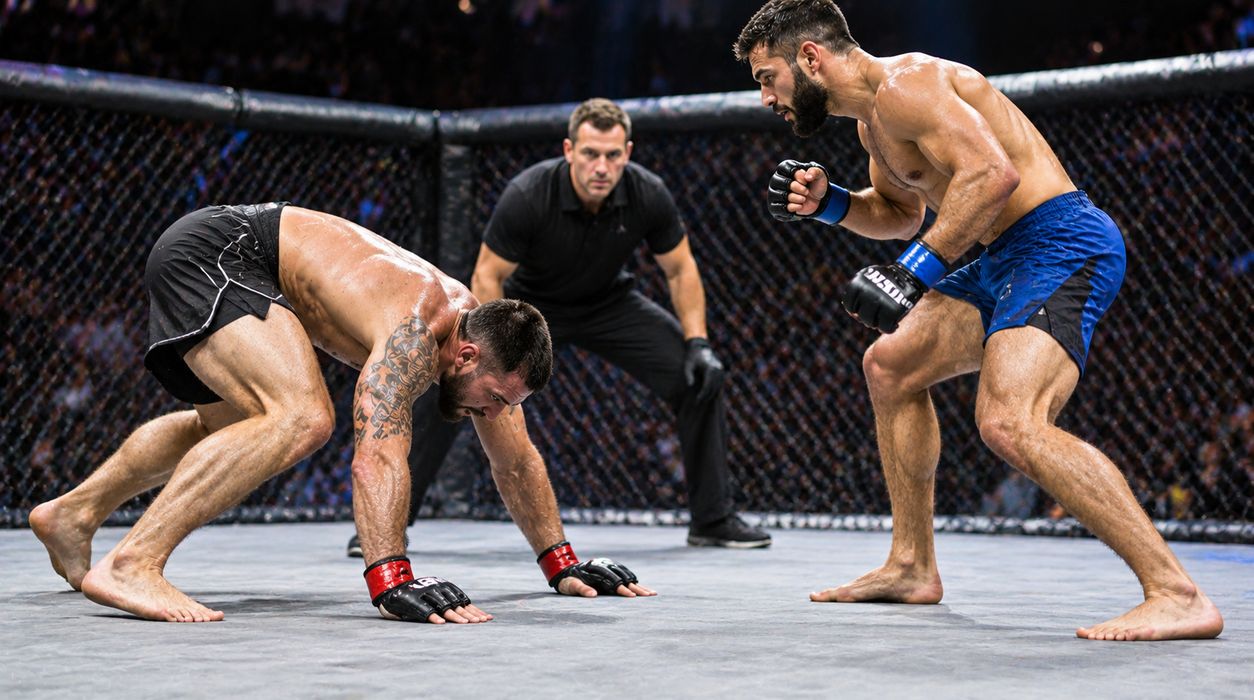
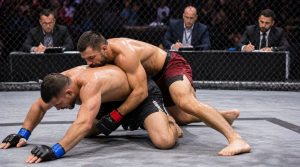
A fighter is defending a takedown against the cage. They bend forward, place one hand on the canvas, and try to avoid a knee to the head.
A few years ago, that hand position could have changed which strikes were legal.
In 2026, the rule is different.
Under the updated Unified Rules of Mixed Martial Arts, a fighter is grounded when any body part other than the hands or feet touches the canvas. Simply placing one or both hands on the ground no longer provides protection against knees or kicks to the head.
That change matters during takedown attempts, clinches, scrambles, and exchanges near the cage.
However, knees and kicks to the head remain illegal when an opponent is genuinely grounded. Fighters must also follow other restrictions, including the prohibition on stomping a grounded opponent.
Understanding the difference can help fans recognize legal strikes, controversial fouls, and referee decisions.
This guide explains the UFC grounded opponent rule in 2026, why it changed, how it affects knees and kicks, and what happens when a fighter commits an illegal strike.
What Counts as a Grounded Opponent in UFC in 2026?
Under the updated Unified Rules of MMA, a fighter is grounded when a body part other than the hands or feet is touching the fighting surface.
Examples include:
- One knee touching the canvas.
- Both knees on the canvas.
- A hip or buttock touching the ground.
- An elbow touching the canvas.
- A forearm or other part of the arm touching the ground.
- The torso touching the canvas.
By contrast, a fighter is not grounded merely because one or both hands touch the floor.
The official Unified Rules of MMA published by IMMAF include the updated definition.
Quick Guide: Grounded or Not Grounded?
| Fighter’s Position | Grounded? | Knee or Kick to Head |
|---|---|---|
| Standing on both feet | No | Generally legal |
| One hand touching canvas | No | Generally legal |
| Both hands touching canvas | No | Generally legal |
| One knee touching canvas | Yes | Illegal |
| Both knees touching canvas | Yes | Illegal |
| Sitting on canvas | Yes | Illegal |
| Elbow touching canvas | Yes | Illegal |
| Forearm touching canvas | Yes | Illegal |
| Lying on back | Yes | Illegal |
| Hands and feet only on canvas | No | Generally legal |
These examples assume the strike does not violate another MMA rule.
When Did the UFC Grounded Opponent Rule Change?
The Association of Boxing Commissions and Combative Sports approved the revised grounded opponent definition in July 2024.
The change became effective on November 1, 2024, in jurisdictions adopting the updated rules.
The UFC began using the changes at UFC Edmonton in November 2024.
The revised definition remains relevant to UFC competition in 2026.
Previously, the grounded fighter rule included circumstances where a fighter could protect themselves by placing a hand on the canvas.
The updated rule removed that protection for hand contact alone.
New York’s athletic commission formally adopted the revised wording, as documented in its official 2024 Unified Rules update.
Why Was the Rule Changed?
The old rule created situations where fighters deliberately placed a hand on the ground to avoid certain strikes.
A fighter defending a takedown could briefly touch the canvas while remaining otherwise upright.
That hand placement changed the legality of knees and kicks to the head.
Critics argued that this created an artificial defensive tactic.
The revised rule makes the distinction clearer.
A fighter must have another body part touching the canvas to be considered grounded.
Is One Hand on the Ground Still Considered Grounded?
No.
Under the updated rules, one hand touching the canvas does not make a fighter grounded.
This is one of the most important changes for UFC fans to understand.
Imagine Fighter A is defending a takedown.
Fighter A bends forward and places one palm on the canvas while keeping both feet on the ground.
Fighter B throws a knee toward Fighter A’s head.
Under the updated grounded opponent definition, Fighter A is not grounded solely because of that hand placement.
The knee may therefore be legal, assuming it does not violate another rule.
What If Both Hands Touch the Canvas?
The answer is the same.
A fighter touching the canvas with both hands and both feet is not automatically grounded.
This can surprise viewers who remember the older rules.
The relevant question is whether another body part, such as a knee, elbow, or torso, is touching the canvas.
What If Only the Fingertips Touch?
Fingertip contact does not establish grounded status.
The current definition excludes the hands.
Whether the fighter touches the floor with fingertips, a palm, or a closed fist, hand contact alone does not create the protection.
Is a Fighter Grounded When One Knee Touches the Canvas?
Yes.
One knee touching the canvas is enough to make a fighter grounded.
The fighter does not need to have both knees down.
For example, imagine a fighter defending a takedown near the fence.
Their right foot remains planted, but their left knee touches the canvas.
The fighter is grounded.
An opponent cannot legally knee or kick that fighter in the head while the grounded condition exists.
What Happens When the Knee Comes Off the Canvas?
Grounded status depends on the fighter’s position at the relevant moment.
If the knee leaves the canvas and no other body part besides the hands or feet remains in contact, the fighter is no longer grounded under the definition.
This can create difficult situations during fast exchanges.
A fighter may move from kneeling to standing in a fraction of a second.
The referee must evaluate the position and the strike under the applicable rules.
Can You Knee a Grounded Opponent in UFC?
No.
Kneeing the head of a grounded opponent remains a foul under the Unified Rules of MMA.
The 2024 amendment changed the definition of grounded status.
It did not remove the prohibition on knees to the head of genuinely grounded fighters.
Legal Knee Example
Fighter A stands with both feet on the canvas.
Fighter B controls Fighter A’s head during a clinch.
Fighter B throws a knee to the head.
Because Fighter A is standing and not grounded, the strike may be legal.
Illegal Knee Example
Fighter A attempts a takedown and drops one knee to the canvas.
Fighter B delivers a knee to Fighter A’s head while that knee remains down.
That is an illegal strike.
What About Knees to the Body?
The grounded opponent rule specifically prohibits knees and kicks to the head.
It does not impose a blanket ban on every knee strike against a grounded opponent.
Knees to the body may be legal, provided the strike does not violate another rule.
Target selection is therefore essential.
A knee directed toward the ribs is not evaluated in the same way as a knee directed toward the head.
Can You Kick a Grounded Opponent in the Head?
No.
Kicking the head of a grounded opponent is prohibited under the Unified Rules.
This restriction applies whether the fighter is sitting, kneeling, or lying on the canvas.
For example, a fighter who falls onto their back cannot legally be kicked in the head while grounded.
However, kicks to other permitted target areas may be allowed.
Are Body Kicks Against Grounded Fighters Legal?
Generally, kicks to the body of a grounded opponent can be legal under the Unified Rules.
The striker must still avoid prohibited techniques and target areas.
The rule against kicking a grounded opponent’s head should not be confused with a prohibition on all kicks against grounded fighters.
Are Soccer Kicks Legal in UFC?
A soccer kick generally refers to a kicking motion directed at an opponent, often while that opponent is on the ground.
A soccer-style kick to the head of a grounded opponent is illegal under the Unified Rules.
The legality of a kick depends on the target, the opponent’s position, and the technique used.
Fans should not assume every kick thrown near a grounded fighter is automatically a foul.
Are Stomps Legal Against Grounded Opponents?
Stomping a grounded opponent is prohibited.
The Unified Rules define stomping by the striking action.
A stomp involves lifting the leg, bending at the knee, and initiating a strike with the bottom of the foot or heel.
The prohibition is separate from the rule against knees and kicks to the head.
Are Foot Stomps in the Clinch Legal?
Standing foot stomps are not automatically prohibited by the grounded-opponent stomping rule.
For example, fighters sometimes attack an opponent’s foot while both athletes are standing in a clinch.
That technique is different from stomping a grounded opponent.
The rules distinguish the action and the opponent’s position.
Are Axe Kicks Considered Stomps?
The updated Unified Rules specifically distinguish axe kicks from stomping.
An axe kick is not automatically classified as a prohibited stomp.
However, the strike must still comply with the rules governing target areas and grounded opponents.
An axe kick aimed at the head of a grounded fighter would still raise the prohibition on kicking a grounded opponent’s head.
Can You Punch a Grounded Opponent in UFC?
Yes.
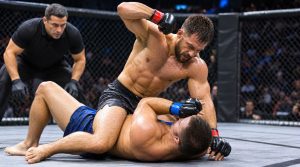
Punches are generally permitted against grounded opponents, provided they land on legal target areas and comply with the other rules.
This is why ground-and-pound is an important part of MMA.
A fighter may secure top position and deliver punches to an opponent who is on the canvas.
However, strikes to prohibited areas, including the back of the head and spine, remain illegal.
Are Elbows Legal on the Ground?
Many elbow strikes are permitted during ground fighting.
The Unified Rules no longer prohibit the traditional 12–6 elbow motion.
That change was approved alongside the revised grounded opponent definition.
However, the removal of the 12–6 elbow prohibition does not make every elbow strike legal.
Elbows directed toward prohibited target areas remain fouls.
For example, striking the back of an opponent’s head is still prohibited.
What Is the Difference Between a Grounded Fighter and a Downed Fighter?
Fans sometimes use the terms grounded and downed interchangeably.
However, grounded is the term used in the Unified Rules definition relevant to knees and kicks to the head.
A fighter does not have to be lying flat on the canvas to be grounded.
One knee touching the ground is enough.
Likewise, a fighter can have both hands on the canvas without being grounded under the updated definition.
The legal status depends on actual body contact, not simply whether the fighter looks unstable or is defending a takedown.
How Does the Rule Affect Takedown Defense?
The grounded opponent rule has significant implications for wrestlers and grapplers.
Before the revision, fighters could sometimes use hand placement to establish grounded status while defending takedowns.
Under the updated definition, that tactic no longer works.
A fighter defending a takedown must consider the possibility of legal knees to the head while only the hands and feet touch the canvas.
Example: Defending a Single-Leg Takedown
Fighter A attempts to grab Fighter B’s leg.
Fighter A bends forward and places one hand on the canvas.
Fighter B maintains balance and prepares a knee.
If Fighter A has only hands and feet touching the canvas, Fighter A is not grounded.
The knee may be legal.
However, if Fighter A drops a knee to the canvas before the strike lands, the legal situation changes.
Example: Defending a Double-Leg Takedown
Fighter A drives toward Fighter B’s hips.
Fighter B sprawls and applies downward pressure.
Fighter A remains on hands and feet.
Under the updated definition, Fighter A is not grounded merely because both hands touch the canvas.
If Fighter A’s knee or another qualifying body part touches the ground, grounded status applies.
This distinction makes timing important during scrambles.
How Does the Rule Affect Fighting Against the Cage?
The cage creates many situations where grounded status becomes important.
Fighters often use the fence to defend takedowns, regain balance, or stand up from the canvas.
During these exchanges, body position can change rapidly.
Example: One Hand Against the Cage, One Hand on the Floor
A fighter braces against the fence while placing one hand on the canvas.
Both feet remain on the ground.
That fighter is not grounded solely because of hand contact.
Example: Sitting Against the Fence
A fighter sits on the canvas with their back against the cage.
The fighter is grounded.
Knees and kicks to the head are prohibited.
Example: Rising From a Kneeling Position
A fighter begins with one knee on the canvas.
They push upward and lift that knee.
Once no body part other than the hands or feet touches the canvas, the grounded classification no longer applies.
These transitions can happen quickly, making referee observation especially important.
What Happens If a UFC Fighter Throws an Illegal Knee?
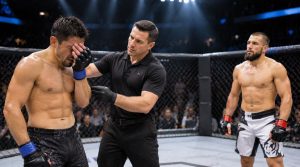
The referee determines whether a foul occurred and applies the relevant procedures.
The consequences depend on the circumstances, including whether the foul was intentional or accidental and whether the affected fighter can continue.
Possible outcomes include a warning, point deduction, disqualification, or another official result under the applicable rules.
An illegal knee does not automatically produce the same penalty in every situation.
What If the Fighter Can Continue?
The referee may stop the action to assess the foul and the fighter’s condition.
If the contest can safely continue, the referee applies any appropriate penalty and resumes the fight according to the rules.
What If the Fighter Cannot Continue?
If an illegal strike prevents the opponent from continuing, the result depends on the foul’s classification and the applicable stoppage rules.
An intentional foul can lead to disqualification.
An accidental foul may result in a no contest or technical decision, depending on the circumstances and how much of the bout has been completed.
These outcomes are not interchangeable.
For a comparison with another combat sport, SportsVell explains the distinctions in What Is a No Contest in Boxing?.
Boxing and MMA have different regulations, so boxing’s specific round thresholds should not be applied automatically to UFC fights.
Who Decides Whether a Fighter Is Grounded?
The referee is responsible for enforcing the rules during the bout.
That includes determining whether an opponent is grounded when a potentially illegal knee or kick occurs.
The referee must consider the fighter’s position and the timing of the strike.
A television replay may make a situation look obvious afterward, but the referee often has to make the initial judgment in real time.
Can Video Replay Change the Result?
Replay procedures depend on the supervising commission’s regulations.
Some jurisdictions permit video review in specified circumstances.
Others impose different limits on when and how replay may be used.
Fans should not assume that every UFC event follows an identical replay procedure.
The applicable athletic commission and event regulations determine the official process.
Does Every MMA Organization Use the Same Grounded Opponent Rule?
No.
Different MMA promotions and jurisdictions may operate under different approved rulesets.
The Unified Rules provide a widely used framework, but not every organization follows the same regulations.
Some international promotions permit techniques that are prohibited under the UFC’s usual Unified Rules framework.
Therefore, a strike that is legal in one competition may be illegal in another.
The safest approach is to check the rules governing the specific event.
Why Does Jurisdiction Matter?
Professional MMA events are regulated by athletic commissions or equivalent authorities.
Those authorities approve the rules used for sanctioned bouts.
Even when a promotion generally follows the Unified Rules, local adoption and regulatory procedures matter.
That is why an official commission document is more reliable than assuming a social media explanation applies everywhere.
How Do UFC Rules Compare With Boxing?
MMA and boxing both regulate striking, but the sports have different permitted techniques.
Boxing focuses on punches and prohibits kicks, knees, and elbows.
MMA combines striking and grappling.
Fighters can transition between standing exchanges, clinches, takedowns, and ground fighting.
The grounded opponent rule exists because MMA permits a wider range of techniques.
In boxing, a fighter who is knocked down is subject to the referee’s count rather than continued ground fighting.
SportsVell’s guide to How Many Rounds Are in a Boxing Match? explains how boxing’s structure differs from MMA.
Weight divisions are another shared feature of combat sports.
For more context about negotiated weight limits, read What Is a Catchweight Fight in Boxing?.
Although boxing and MMA share some terminology, their rules must be evaluated separately.
Why Is the Grounded Opponent Rule Important for Fighter Safety?
The rule helps establish boundaries around potentially dangerous strikes.
A grounded fighter may have limited mobility or fewer options for avoiding a kick or knee to the head.
The prohibition protects fighters in positions where those techniques are not permitted.
At the same time, the revised definition reduces the ability to gain protection merely by touching the canvas with a hand.
The change attempts to establish a clearer distinction between standing and grounded positions.
However, no rule eliminates the risks associated with combat sports.
Referees, medical professionals, athletic commissions, and fighters all have responsibilities related to safety.
How Do Fighters Train for the Updated Rule?
The revised definition changes the decisions fighters must make during certain grappling exchanges.
A fighter defending a takedown can no longer assume that placing a hand on the canvas makes knees to the head illegal.
Coaches may therefore emphasize better positioning, controlled transitions, and awareness of when a knee or elbow touches the ground.
Defensive Awareness
Fighters must recognize when they are genuinely grounded and when they remain vulnerable to legal head strikes.
Takedown Entries
Wrestlers may need to pay closer attention to head position when shooting for takedowns.
Cage Scrambles
Fighters working back to their feet must understand how quickly their legal status can change.
Referee Instructions
Athletes should follow the referee’s directions rather than rely on assumptions about a position.
Successful adaptation requires understanding both the rules and the physical demands of MMA.
What Do Fans Often Get Wrong About Grounded Opponents?
The most common mistake is assuming that one hand on the canvas still makes a fighter grounded.
That was relevant under older interpretations, but it does not reflect the updated definition.
Another mistake is assuming that all strikes against grounded opponents are prohibited.
Punches and many other legal techniques remain permitted.
The restriction specifically addresses knees and kicks to the head, along with the separate prohibition on stomping a grounded opponent.
Fans also sometimes confuse a legal strike with an intentional foul because the opponent changes position during the exchange.
Timing matters.
A fighter may be standing when a strike begins and grounded when it lands.
The referee must evaluate the actual circumstances.
For a broader look at how different sports depend on specialized rules and athlete preparation, SportsVell’s Roger Federer and Conor McGregor feature explores the contrasting demands of tennis and MMA.
Sports such as American football also have detailed rules governing contact and player positions. SportsVell’s guide to How Many Players Are on a Football Team? provides a useful comparison of how another contact sport organizes its participants.
Frequently Asked Questions
What counts as a grounded opponent in UFC in 2026?
A fighter is grounded when any body part other than the hands or feet touches the canvas.
Is one hand on the ground considered grounded in UFC?
No. One hand touching the canvas does not make a fighter grounded under the updated rules.
Are two hands on the ground considered grounded?
No. A fighter touching the canvas only with hands and feet is not grounded under the revised definition.
Can you knee a fighter with one hand on the ground?
Generally, yes, provided no other body part besides the hands or feet touches the canvas and the strike does not violate another rule.
Can you knee a fighter who has one knee down?
No. A fighter with one knee touching the canvas is grounded, so knees to the head are prohibited.
Can you kick a grounded opponent in the head?
No. Kicking the head of a grounded opponent is illegal under the Unified Rules.
Are body kicks legal against grounded opponents?
Generally, yes, if the strike targets a permitted area and does not violate another rule.
Are foot stomps legal in UFC?
Standing foot stomps are not automatically prohibited. Stomping a grounded opponent is prohibited.
Are 12–6 elbows legal in UFC in 2026?
Yes. The former prohibition on the 12–6 elbow motion was removed from the updated Unified Rules. Strikes to prohibited target areas remain illegal.
When did the grounded opponent rule change?
The revised definition became effective in adopting jurisdictions on November 1, 2024, and remains relevant in 2026.
Can an illegal knee cause disqualification?
Yes. Depending on the circumstances, an illegal knee can result in disqualification or another penalty under the applicable rules.
Does every MMA promotion use the same grounded fighter definition?
No. Rules can differ between organizations and jurisdictions.
Final Thoughts
The UFC grounded opponent rule in 2026 is easier to understand once you know the updated definition.
A fighter is grounded when any body part other than the hands or feet touches the canvas.
One hand on the ground is not enough.
Two hands on the ground are not enough.
However, a knee, elbow, hip, or another qualifying body part touching the canvas makes the fighter grounded.
Knees and kicks to the head remain illegal against grounded opponents.
Punches and other permitted techniques may still be used, provided they comply with the remaining rules.
The change has important implications for takedown defense, cage fighting, and transitions between standing and grounded positions.
For fighters, understanding the rule is essential for making safe and legal decisions.
For fans, it helps explain why a knee that would once have been controversial may now be legal.
Ultimately, the updated rule does not remove protection for grounded fighters. It changes the conditions that determine when that protection applies.
Understanding those conditions makes UFC fights easier to follow and referee decisions easier to interpret.