
What Happens If a UFC Fighter Misses Weight? 2026 Weigh-In Rules Explained
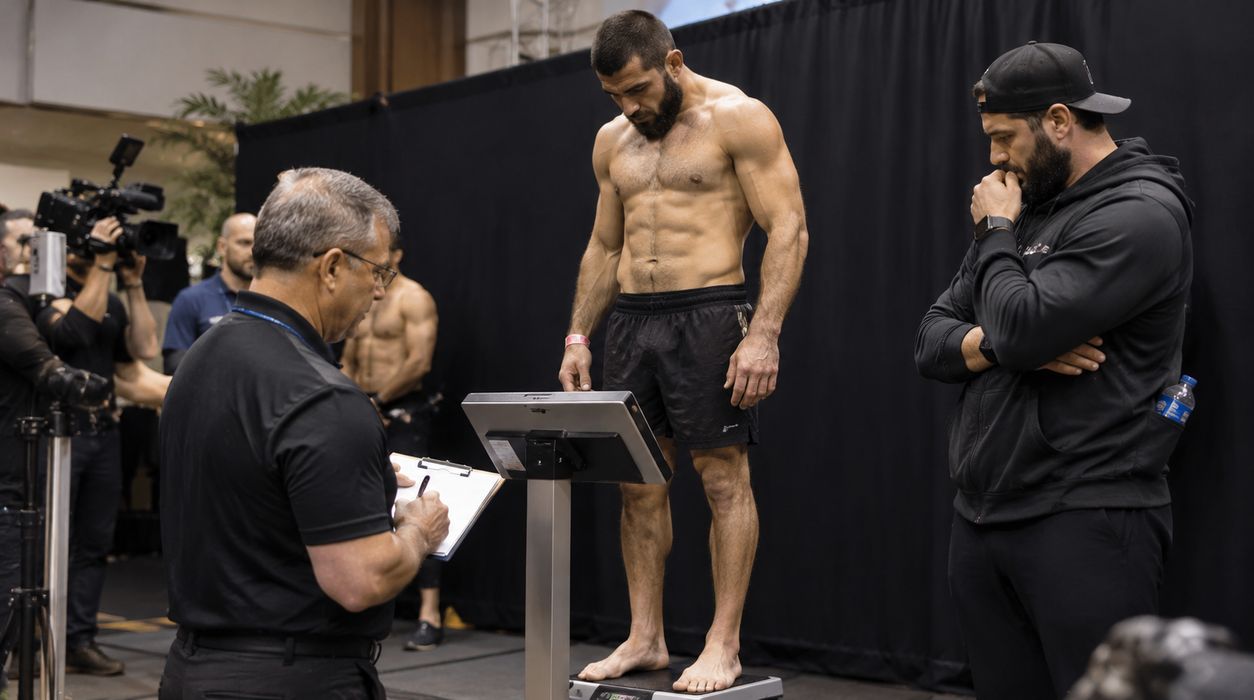
A UFC fighter steps onto the scale the morning before a major event. The official announces a weight slightly above the division’s limit. The fighter looks disappointed, their coach starts making phone calls, and fans immediately wonder whether the fight will happen.
Missing weight can change an entire UFC event.
If a UFC fighter misses weight in 2026, the fight may still proceed, but the athlete can lose a percentage of their purse, compete under a revised agreement, or face cancellation. Championship fights have additional consequences because the fighter who misses weight generally becomes ineligible to win the title.
The outcome is not automatic. It depends on the amount of weight missed, the opponent’s willingness to continue, the athletic commission’s approval, and the terms of the bout agreement.
Some fighters miss by only half a pound. Others arrive several pounds above the permitted limit.
Those situations may lead to very different decisions.
This guide explains UFC weigh-in rules, the one-pound allowance, purse forfeitures, catchweight fights, title eligibility, and real examples of fighters who failed to make weight.
What Happens If a UFC Fighter Misses Weight?
When a fighter exceeds the permitted weight, several outcomes are possible.
The athlete may receive another opportunity to weigh in if the commission allows it. If the fighter still cannot make weight, the promotion and relevant parties determine whether the bout can continue.
The opponent may agree to compete despite the difference.
The commission must also approve the contest.
If the bout proceeds, the overweight fighter commonly forfeits part of their purse to the opponent.
If the difference is considered unacceptable or an agreement cannot be reached, the fight may be canceled.
Quick Summary of UFC Missed Weight Rules
| Situation | Possible Outcome |
|---|---|
| Non-title fighter weighs one pound over division limit | Usually within allowance |
| Fighter exceeds permitted non-title limit | Official weight miss |
| Fighter misses championship weight | Cannot normally win the title |
| Opponent agrees to continue | Bout may proceed with approval |
| Opponent refuses revised terms | Bout may be canceled |
| Fighter forfeits purse percentage | Money generally goes to opponent |
| Fighter receives another weigh-in attempt | Depends on commission rules |
| Large weight difference creates safety concerns | Commission may reject bout |
These outcomes reflect the UFC’s published guide to weight classes and weigh-ins.
What Is the UFC One-Pound Weight Allowance?
Most UFC non-title fights allow competitors to weigh up to one pound above the division’s standard limit.
For example, the lightweight division has a normal limit of 155 pounds.
In a non-title lightweight bout, a fighter can generally weigh 156 pounds.
That is not considered missing weight when the allowance applies.
However, weighing 156.5 pounds would exceed the permitted limit.
UFC Weight Classes and Non-Title Allowances
| Division | Standard Limit | Typical Non-Title Maximum |
|---|---|---|
| Strawweight | 115 lb | 116 lb |
| Flyweight | 125 lb | 126 lb |
| Bantamweight | 135 lb | 136 lb |
| Featherweight | 145 lb | 146 lb |
| Lightweight | 155 lb | 156 lb |
| Welterweight | 170 lb | 171 lb |
| Middleweight | 185 lb | 186 lb |
| Light heavyweight | 205 lb | 206 lb |
| Heavyweight | 265 lb | 266 lb |
Not every division is offered for both men and women, and the UFC does not regularly stage every possible weight class.
The one-pound allowance is a standard UFC practice for non-title bouts, not a universal entitlement across all MMA organizations.
The governing commission and bout contract remain important.
Do UFC Title Fights Have a One-Pound Allowance?
No.
UFC championship fights require competitors to make the exact championship limit or weigh below it.
For example, a fighter competing for the lightweight title must weigh no more than 155 pounds.
A reading of 155.5 pounds is a weight miss, even though it would be acceptable in a typical non-title lightweight contest.
This distinction makes championship weigh-ins particularly important.
A fighter can miss the title limit by a very small amount and still face serious consequences.
Example: Lightweight Title Fight
Fighter A weighs 155 pounds.
Fighter B weighs 155.5 pounds.
Fighter A has made championship weight.
Fighter B has missed.
The fight may still happen, but Fighter B generally cannot win the championship under the revised title conditions.
The precise handling of an existing championship or vacant title depends on the circumstances.
Can a UFC Fight Continue After a Fighter Misses Weight?
Yes.
A UFC fight can continue after a weight miss if the necessary parties agree and the athletic commission approves it.
The opponent’s willingness to accept the fight is important.
The commission must consider whether the contest remains appropriate and safe.
A small difference may be easier to accommodate than a substantial one.
However, no specific weight difference guarantees approval.
Example: A Fighter Misses by Two Pounds
Imagine a non-title featherweight contest.
The usual maximum is 146 pounds.
Fighter A weighs 148 pounds.
Fighter B weighs 145.5 pounds.
Fighter A has missed the permitted limit.
The promotion may propose proceeding under revised terms, potentially including a purse forfeiture.
Fighter B may agree or decline.
The commission must approve the final arrangement.
If those conditions are satisfied, the fight can proceed.
How Much Money Does a UFC Fighter Lose for Missing Weight?
There is no single purse-forfeiture percentage that applies to every UFC weight miss.
A fighter might forfeit 20%, 25%, 30%, or another amount depending on the circumstances and applicable agreement.
The percentage can vary by event and jurisdiction.
For example, official UFC weigh-in results from 2026 documented fighters forfeiting 20% or 25% of their purses after missing weight.
Other historical cases have involved 30%.
Example of a 20% Purse Forfeiture
Suppose a fighter has a contractual purse of $100,000.
If the applicable agreement requires a 20% forfeiture:
$100,000 × 20% = $20,000.
The fighter would forfeit $20,000, generally for the benefit of the opponent.
This is a simplified illustration.
Actual UFC compensation arrangements can include separate components, and the calculation depends on the applicable terms.
Does the Opponent Receive the Money?
Typically, the forfeited percentage is paid to the opponent who made weight.
That compensates the opponent for accepting a fight under altered conditions.
However, the precise financial treatment depends on the approved agreement.
What Is a Catchweight Fight in UFC?
A catchweight bout is a fight contested under a specially agreed weight arrangement rather than the original division limit.
Catchweight agreements may be established before an event.
They can also become relevant when a fighter misses weight.
For example, two fighters originally scheduled for a 155-pound lightweight contest might agree to compete under revised terms after one fighter weighs 158 pounds.
The commission must approve the bout.
A catchweight agreement does not automatically eliminate a financial penalty.
The parties may still negotiate purse forfeiture or other conditions.
Is Catchweight the Same as a Weight Allowance?
No.
A weight allowance permits a small amount above a division’s standard limit under the applicable rules.
A catchweight is a separately agreed contest weight or revised arrangement.
The distinction also exists in boxing.
SportsVell explains the broader concept in What Is a Catchweight Fight in Boxing?.
Although the sports share the terminology, their contractual and regulatory procedures can differ.
Can the Opponent Refuse to Fight After a Weight Miss?
Yes.
An opponent may decline a proposed bout after the other fighter misses weight.
The original agreement was made with a particular weight limit in mind.
A significant weight difference may affect the opponent’s assessment of fairness and safety.
However, the decision does not belong exclusively to the fighters.
The promotion, athletic commission, and contractual arrangements also matter.
Why Would an Opponent Accept?
An opponent may still want to compete because of preparation costs, career opportunities, or the chance to earn their contracted compensation.
A purse forfeiture can also make the revised arrangement more attractive.
Why Would an Opponent Decline?
The fighter may believe the weight difference creates an unacceptable competitive disadvantage.
A larger opponent may have advantages in strength, size, or grappling exchanges.
The athlete may also have medical or safety concerns.
Neither choice guarantees that the fight will proceed.
Can a UFC Fighter Get Another Weigh-In Attempt?
Sometimes.
Depending on the commission and the circumstances, a fighter who misses on the first attempt may be granted additional time to make weight.
The UFC’s general weigh-in guidance describes the possibility of up to an additional hour in certain situations.
However, that is not guaranteed at every event.
The commission controls the official process.
A fighter who misses weight should not assume they automatically receive another hour.
What Happens During the Additional Time?
The athlete may attempt to reach the required weight before returning to the scale.
However, further rapid weight cutting can create health risks.
The commission and medical personnel may intervene if there are concerns about the fighter’s condition.
An additional attempt is not permission to disregard medical safety.
What Happens If a UFC Champion Misses Weight?
A champion missing the championship limit creates a particularly complicated situation.
The athlete may lose eligibility to retain or win the title under the applicable championship arrangements.
The fight may still proceed, but the belt might be available only to the opponent who made weight.
The specific result depends on whether the championship was held or vacant and how the UFC handles the situation.
Charles Oliveira at UFC 274
One of the best-known examples occurred in May 2022.
Charles Oliveira weighed 155.5 pounds before his lightweight title fight against Justin Gaethje.
That was half a pound above the championship limit.
The UFC announced that Oliveira would forfeit a percentage of his purse and vacate the title when the fight began.
Gaethje remained eligible to win the championship.
Oliveira won the fight, but he did not retain the belt.
The UFC documented the decision in its official UFC 274 announcement.
The case shows how a small weight miss can have major championship consequences.
What Happens If a Challenger Misses Championship Weight?
A challenger who misses weight generally cannot win the title.
The fight may still proceed if approved, but the championship stakes are adjusted.
For example, a champion who makes weight may still defend the title against an overweight challenger under an approved arrangement.
If the challenger wins, the challenger would not receive the championship.
The exact terms should be confirmed for the particular event.
Yoel Romero at UFC 221
In February 2018, Yoel Romero missed weight for an interim middleweight title fight against Luke Rockhold.
The bout proceeded.
However, only Rockhold was eligible to win the interim championship.
Romero won the contest but did not receive the belt.
The case demonstrates why winning the fight and winning the championship are not always the same outcome.
Can a UFC Fight Be Canceled Because of a Weight Miss?
Yes.
A weight miss can lead to cancellation.
This may happen if the opponent declines the revised bout, the commission does not approve the matchup, or the parties cannot reach acceptable terms.
A substantial weight difference may create additional concerns.
However, cancellation is not automatic.
What Happens to the Event Card?
The UFC may proceed with the remaining scheduled fights.
In some circumstances, the promotion might explore a replacement opponent or another scheduling adjustment.
Those possibilities depend on timing, medical clearance, and regulatory approval.
A late cancellation can be difficult to replace because the event is already close.
Why Do UFC Fighters Miss Weight?
There is no single explanation.
Some fighters struggle with the final stages of their weight cut.
Others may have difficulty managing weight throughout training camp.
Illness, injury, travel, or other complications can also affect preparation.
A fighter may simply underestimate how difficult it will be to reach the contracted limit.
Does Missing Weight Always Mean Poor Preparation?
No.
Poor planning can contribute to a weight miss, but it is not the only possible cause.
Medical issues and unexpected circumstances can affect an athlete’s ability to make weight.
The circumstances should be evaluated individually rather than assumed from the scale reading alone.
How Does Weight Cutting Work in MMA?
Professional MMA fighters often compete at a lower official weigh-in weight than their normal training weight.
They may gradually reduce body mass during camp.
Some also use short-term fluid manipulation near weigh-in day.
After the official weigh-in, fighters typically attempt to restore fluids and nutrition before competition.
However, aggressive dehydration can be dangerous.
It may affect cardiovascular function, concentration, physical performance, and overall health.
Weight cutting should never be treated as a harmless shortcut.
Athletic commissions and medical professionals have an important role in monitoring fighter safety.
Does a Weight Miss Give a Fighter an Advantage?
Potentially, but not always.
A fighter who weighs more than the contracted limit may enter the contest with a size or strength advantage.
However, the effect depends on the actual athletes, the amount of weight missed, and the circumstances.
An unsuccessful weight cut may also leave a fighter physically depleted.
That can reduce performance rather than improve it.
The important point is that weight limits exist to promote fair and reasonably matched competition.
A weight miss changes the conditions under which the original bout was agreed.
Are UFC Weigh-In Rules the Same in Every State?
Not necessarily.
UFC events are subject to the relevant athletic commission or other regulatory authority.
The Association of Boxing Commissions and Combative Sports provides a widely used framework, but jurisdictions retain authority over their sanctioned events.
The ABC’s official committee guidance on MMA weight classes explains that non-title allowances and catchweight approvals depend on applicable regulations and agreements.
Therefore, fighters should follow the specific commission’s requirements rather than assume every event uses identical procedures.
How Is Missing Weight Different From Breaking a Fight Rule?
Missing weight is a pre-fight regulatory and contractual issue.
An illegal strike is a violation that occurs during competition.
The consequences are different.
A fighter who misses weight may lose part of their purse or have the bout canceled.
A fighter who commits a serious foul during a contest may face a point deduction or disqualification.
For comparison, SportsVell’s No Contest in Boxing guide explains how unusual fight outcomes differ from ordinary wins and losses.
The precise rules differ between boxing and MMA.
Does Missing Weight Change the Number of UFC Rounds?
Not automatically.
A weight miss does not, by itself, create a new round structure.
The scheduled bout format generally remains subject to the approved contest arrangements.
UFC non-title fights are usually scheduled for three five-minute rounds.
Championship fights are generally scheduled for five five-minute rounds.
Certain non-title main events also use five rounds.
A revised weight agreement does not automatically shorten the fight.
For comparison with another combat sport, SportsVell explains how many rounds are in a boxing match.
Does Missing Weight Affect a Fighter’s Career?
It can.
Repeated weight misses may damage a fighter’s reputation for reliability.
Promoters and opponents may become less willing to accept certain matchups.
A fighter may also be encouraged to compete in a higher division.
However, the consequences vary.
A single weight miss does not automatically end a UFC career.
The athlete’s overall performance, medical circumstances, and future preparation all matter.
Successful fighters often work with experienced teams to manage training, nutrition, and competition schedules.
That broader preparation is one reason MMA athletes such as Conor McGregor attract interest beyond their results. SportsVell explores his sporting influence in Roger Federer and Conor McGregor: Two Icons Who Transformed Sport.
How Are UFC Rosters Different From Team Sports?
UFC fighters compete individually, even though they train with coaches and teammates.
Unlike American football, there is no large active roster from which a replacement can simply enter the same contest.
A late MMA cancellation can therefore be particularly difficult to resolve.
In the NFL, teams organize dozens of players across offensive, defensive, and special-teams units.
SportsVell’s guide to how many players are on a football team explains that roster structure.
MMA events depend on individually approved matchups, making the availability and condition of each fighter especially important.
Common Misunderstandings About UFC Weight Misses
Mistake 1: Missing weight always cancels the fight.
The bout may continue under revised terms with commission approval.
Mistake 2: Every UFC fighter receives a one-pound allowance.
Championship fights require the exact weight limit.
Mistake 3: Every overweight fighter loses 20% of their purse.
The percentage varies.
Mistake 4: A fighter who misses championship weight can still win the belt.
Generally, the overweight fighter becomes ineligible for the title.
Mistake 5: Catchweight automatically removes penalties.
A revised weight arrangement may still include financial consequences.
Mistake 6: Every athletic commission has identical weigh-in procedures.
Local regulations and approved agreements can differ.
Frequently Asked Questions
What happens if a UFC fighter misses weight in 2026?
The fighter may forfeit part of their purse, compete under revised terms, receive another weigh-in opportunity if allowed, or have the bout canceled.
How much can a UFC fighter weigh over the limit?
Most non-title bouts allow one pound above the division’s standard limit. Championship fights generally have no such allowance.
How much money does a UFC fighter lose for missing weight?
There is no universal percentage. Official UFC examples include 20%, 25%, and 30% purse forfeitures.
Can a UFC fighter still fight after missing weight?
Yes, if the relevant parties agree and the commission approves the contest.
Can an overweight UFC fighter win the championship?
Generally, no. A fighter who misses championship weight becomes ineligible to win the title under the adjusted conditions.
Can a UFC champion lose the belt before fighting?
Yes. Charles Oliveira’s UFC 274 situation is a well-known example of a championship being vacated because of a weight miss.
Does the opponent receive the forfeited purse money?
Typically, yes, subject to the approved agreement.
Can a UFC fighter weigh in again?
Sometimes. An additional attempt depends on the commission and the circumstances.
What is a catchweight fight?
A catchweight fight is contested under a specially agreed weight arrangement rather than the original division limit.
Can the opponent refuse a fight after a weight miss?
Yes. The opponent may decline the proposed revised arrangement, and the commission must approve any bout that proceeds.
Final Thoughts
Missing weight in the UFC can have consequences far beyond the number displayed on the scale.
A fighter may lose money, compete under altered terms, become ineligible for a championship, or see the fight canceled entirely.
However, a weight miss does not automatically mean the contest is over.
The final outcome depends on the amount missed, the opponent’s agreement, the athletic commission’s approval, and the bout’s contractual conditions.
The one-pound allowance is another important distinction.
It generally applies to non-title UFC fights, but championship contests require the exact division limit.
Real examples involving Charles Oliveira and Yoel Romero show how weight misses can change championship eligibility even when the fight continues.
For fans, understanding these rules makes official weigh-in results easier to interpret.
For fighters, making weight remains an essential part of professional preparation.
And for everyone involved, the underlying goal is to balance fair competition with athlete safety.