Are 12–6 Elbows Legal in UFC? 2026 MMA Elbow Rules Explained
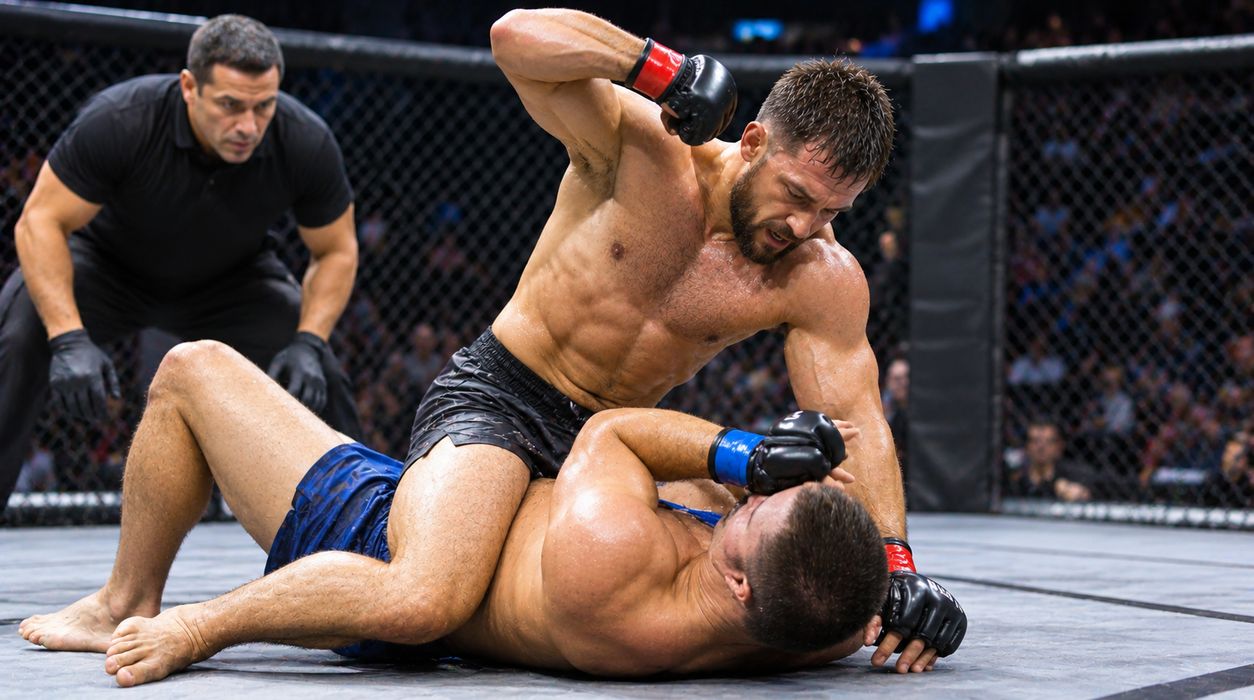
A fighter gains top position inside the UFC Octagon. Their opponent is pinned against the canvas, defending punches while looking for an opportunity to escape.
The fighter on top raises an elbow and brings it straight downward.
For years, that movement could result in a foul.
But the rules have changed.
Yes, 12–6 elbows are legal in UFC in 2026. The Association of Boxing Commissions and Combative Sports (ABC) removed the long-standing prohibition on straight downward elbow strikes from the Unified Rules of Mixed Martial Arts in 2024.
The change became effective in adopting jurisdictions on November 1, 2024.
However, removing the ban does not mean every elbow strike is legal. Fighters still cannot strike prohibited target areas, including the back of the head and spine.
Understanding the distinction is important because the legality of an elbow depends on more than its direction.
This guide explains what a 12–6 elbow is, why it was previously banned, what changed in the rules, how the new regulations affect UFC fights, and which elbow strikes remain illegal.
Are 12–6 Elbows Legal in UFC in 2026?
Yes. Under the current Unified Rules of MMA, the straight downward elbow motion commonly called a 12–6 elbow is no longer a prohibited technique.
The ABC approved the change on July 23, 2024.
The recommended implementation date was November 1, 2024.
The revised rules were subsequently adopted by athletic commissions, including the New York State Athletic Commission.
The change removed the prohibition on the elbow’s direction.
It did not eliminate restrictions on illegal target areas or other fouls.
According to the official ABC Unified Rules of MMA, the 12–6 elbow is no longer listed among prohibited strikes.
Quick Summary of UFC Elbow Rules
| Elbow Strike | Legal in 2026? |
|---|---|
| Straight downward 12–6 elbow to a legal target | Yes |
| Diagonal downward elbow to a legal target | Yes |
| Horizontal elbow to a legal target | Yes |
| Upward elbow to a legal target | Yes |
| Spinning elbow to a legal target | Yes |
| Elbow to the back of the head | No |
| Elbow to the spine | No |
| Elbow to the throat | No |
| Elbow after the referee stops the fight | No |
The most important distinction is between the motion of the elbow and the location where it lands.
What Is a 12–6 Elbow in MMA?
A 12–6 elbow is a strike delivered in a straight downward motion.
The name comes from the hands of a clock.
Imagine the number 12 at the top of a clock face and the number 6 at the bottom.
A fighter raises the elbow and drives it downward along that vertical path.
That movement is commonly described as a 12–6 elbow.
How Is It Different From Other Elbow Strikes?
MMA fighters use elbows from several directions.
A horizontal elbow travels across the opponent.
A diagonal elbow moves downward at an angle.
An upward elbow rises toward the target.
A spinning elbow involves rotation of the body before impact.
The 12–6 elbow is distinguished by its direct downward motion.
Under the previous rules, that particular direction was prohibited even though many other elbow angles were permitted.
The revised regulations removed that distinction.
When Was the 12–6 Elbow Ban Removed?
The ABC voted to remove the 12–6 elbow prohibition in July 2024.
The revised rules were recommended for implementation beginning November 1, 2024.
UFC Edmonton, held on November 2, 2024, was among the first UFC events to operate under the updated rules.
The changes included both the removal of the 12–6 elbow ban and a revised definition of a grounded opponent.
The New York State Athletic Commission’s official bulletin documents the regulatory change.
Why Did the Rule Change?
The previous prohibition had long been controversial.
Critics questioned why a perfectly vertical elbow was prohibited while a slightly angled downward elbow was allowed.
The distinction could be difficult for officials to apply during fast exchanges.
A small change in angle could determine whether a strike was considered legal.
The ABC ultimately removed the prohibition, simplifying the rules governing elbow direction.
The updated approach still protects prohibited target areas.
Why Were 12–6 Elbows Originally Illegal?
The original Unified Rules included a prohibition on straight downward elbow strikes.
The ban was associated with concerns about the potential danger of that particular striking motion.
However, the distinction between a vertical elbow and other elbow angles became controversial.
A diagonal elbow could be legal while a nearly identical straight downward elbow was prohibited.
That created difficult judgments for referees.
For example, imagine two fighters delivering downward elbows from top position.
One elbow travels at a slight diagonal angle.
The other moves almost vertically.
Under the old rules, the difference in direction could determine whether a foul occurred.
The revised rules eliminate that specific problem.
Does Legal Mean Safe?
No.
A technique being legal does not mean it is risk-free.
Elbow strikes can cause cuts, swelling, and other injuries.
The Unified Rules establish which techniques are permitted in sanctioned competition.
They do not guarantee that permitted techniques are harmless.
Referees and ringside medical professionals remain responsible for protecting fighters under the applicable regulations.
What Happened in Jon Jones vs. Matt Hamill?
One of the most famous examples of the old 12–6 elbow rule occurred during Jon Jones’ fight against Matt Hamill at The Ultimate Fighter 10 Finale in December 2009.
Jones controlled much of the action.
During a ground-fighting exchange, he delivered downward elbows that were ruled illegal under the regulations in effect at the time.
The referee disqualified Jones.
Hamill was awarded the victory by disqualification.
The result became one of the most frequently discussed officiating decisions in UFC history.
Did the New Rule Change Jon Jones’ Record?
No.
Removing the 12–6 elbow prohibition did not automatically reverse historical fight results.
The Jones-Hamill contest was officiated under the rules in force in 2009.
A later regulatory change does not, by itself, invalidate a previous disqualification.
Official records remain subject to the appropriate athletic commission’s authority.
The case illustrates why fans distinguish between the rules that applied when a fight occurred and those used today.
Are 12–6 Elbows Legal on the Ground?
Yes.
The removal of the prohibition applies to the elbow motion, including during ground fighting.
A fighter in top position may deliver a straight downward elbow to a legal target.
For example, a fighter controlling an opponent from mount may use downward elbows while maintaining position.
However, the fighter must avoid prohibited areas.
An elbow landing on the back of the head remains illegal even if the motion itself is permitted.
Can a Fighter Use 12–6 Elbows From Guard?
The direction of the elbow is no longer prohibited simply because it is vertical.
A fighter working from guard may use legal elbow strikes, subject to the other rules.
The exact technique depends on positioning and available space.
Fighters must still avoid striking prohibited targets.
What About Elbows From Side Control?
Elbows from side control can be legal.
The same restrictions apply.
A downward elbow directed toward a legal target is not prohibited merely because it follows a 12–6 path.
However, an elbow aimed at the spine or back of the head remains a foul.
Can You Throw a 12–6 Elbow While Standing?
Yes.
The updated rules do not restrict the legality of the 12–6 motion to ground fighting.
A straight downward elbow can be legal during standing exchanges or clinches if it lands on a permitted target and does not violate another rule.
For example, a fighter may create an opening during a clinch and deliver a downward elbow toward a legal area.
The strike’s legality depends on the circumstances.
The movement alone is no longer a foul.
Are Standing Elbows Different From Ground Elbows?
The same general restrictions on elbow direction and prohibited targets apply.
However, standing and ground exchanges create different positioning challenges.
A standing fighter may have more room to rotate or move.
A fighter on the ground may be working from a constrained position.
Those tactical differences do not create a separate ban on 12–6 elbows.
Which Elbow Strikes Are Still Illegal in UFC?
Although the 12–6 elbow prohibition was removed, several restrictions remain.
The Unified Rules prohibit strikes to certain target areas.
Elbows to the Back of the Head
Striking the back of an opponent’s head is prohibited.
The rule applies regardless of whether the strike is delivered with a fist, elbow, or another permitted striking surface.
Elbows to the Spine
Strikes directed at the spine are illegal.
A fighter cannot use the removal of the 12–6 ban to justify an elbow aimed at the spinal area.
Elbows to the Throat
Throat strikes are prohibited.
A fighter must avoid intentionally targeting the throat during striking exchanges.
Elbows After the Bell
A strike delivered after the round has ended is prohibited.
The legality of the technique during active competition does not permit attacks after the bell.
Elbows Against an Opponent Under Referee Protection
A fighter cannot continue attacking after the referee has stopped the contest.
The referee’s intervention takes priority over the legality of the individual striking technique.
Does the Grounded Opponent Rule Affect Elbows?
The grounded opponent rule primarily determines when knees and kicks to the head are prohibited.
It does not establish a general ban on elbow strikes against grounded fighters.
Under the updated definition, a fighter is grounded when a body part other than the hands or feet touches the canvas.
A fighter touching the ground only with the hands and feet is not grounded under that definition.
However, the legality of an elbow still depends on the target area and other applicable rules.
For more details, read SportsVell’s UFC & MMA guide on the grounded opponent rule once that article has been published.
The grounded-opponent definition and the removal of the 12–6 elbow ban were approved during the same period, but they address different techniques.
What Happens If a Fighter Lands an Illegal Elbow?
The referee determines whether a foul occurred.
Possible consequences depend on the circumstances and the applicable regulations.
A referee may issue a warning, deduct points, or stop the contest.
Serious intentional fouls can lead to disqualification.
If an accidental foul prevents a fighter from continuing, the official result may depend on the stage of the fight and the governing commission’s rules.
Does Every Illegal Elbow Cause Disqualification?
No.
Not every foul automatically results in disqualification.
Officials consider the nature of the violation and its consequences under the applicable regulations.
For example, an accidental illegal strike that does not prevent the opponent from continuing may be handled differently from a deliberate foul that causes a serious injury.
Can an Illegal Elbow Result in a No Contest?
Yes, depending on the circumstances.
An accidental foul that ends a fight may lead to a no contest or technical decision under the applicable rules.
These outcomes differ from disqualification.
For a comparison with another combat sport, SportsVell explains the distinctions in No Contest in Boxing: NC vs. DQ vs. Technical Draw.
Boxing and MMA have different regulations, so the specific procedures should not be treated as identical.
Does Every MMA Promotion Allow 12–6 Elbows?
Not necessarily.
The ABC Unified Rules provide a widely used regulatory framework.
However, individual athletic commissions and MMA organizations may adopt different rules.
The 2024 change did not automatically rewrite every organization’s regulations worldwide.
A technique permitted in a UFC bout under the updated Unified Rules may be treated differently in a competition using another ruleset.
This is especially important when comparing American MMA events with international promotions.
Fans should verify the rules governing the specific event.
How Do Referees Judge a Downward Elbow?
Referees evaluate the action under the applicable rules.
Since the 12–6 motion is no longer prohibited, the referee does not need to penalize an otherwise legal elbow solely because it travels vertically.
However, officials still must evaluate the target.
A downward elbow landing on a legal part of the opponent’s body may be permitted.
An elbow landing on the back of the head remains prohibited.
Timing also matters.
A strike delivered after the referee calls a stoppage is not permitted.
The referee must consider the actual circumstances rather than simply the elbow’s direction.
Can Elbows Cause a Fight to Be Stopped?
Yes.
Legal elbow strikes can cause injuries that lead to a stoppage.
For example, an elbow may open a cut that prevents a fighter from safely continuing.
A ringside physician may examine the injury.
The referee ultimately applies the appropriate stoppage procedure under the governing rules.
A fight can end by technical knockout when a fighter cannot safely continue because of legal strikes.
However, the official result depends on the circumstances.
A stoppage caused by an illegal elbow may be classified differently.
Why Are Elbows Important in MMA?
Elbows are a distinctive part of MMA striking.
Unlike boxing, MMA permits a wider variety of striking techniques.
Fighters can use punches, kicks, knees, and elbows, subject to the rules.
Elbows are particularly useful in close-range exchanges.
They can be delivered from clinches, against the cage, and during ground fighting.
Their effectiveness depends on positioning, timing, and control.
Elbows in the Clinch
A fighter may use short elbows while controlling an opponent at close range.
Elbows During Ground-and-Pound
A fighter in top position may use elbows while maintaining grappling control.
Elbows Against the Cage
The cage can create opportunities for short-range strikes.
However, fighters must avoid illegal target areas and comply with referee instructions.
How Do UFC Elbow Rules Compare With Boxing?
Elbows are prohibited in professional boxing.
Boxers are generally permitted to strike with the knuckle portion of a closed glove.
MMA allows a broader range of techniques, including elbows.
That difference affects fighting styles and defensive strategies.
For example, a boxer defending at close range does not need to anticipate legal elbow strikes.
An MMA fighter must account for them.
SportsVell’s guide to how many rounds are in a boxing match explains another important difference between the sports.
Boxing contests commonly use three-minute rounds for men, while professional MMA rounds under the Unified Rules are generally five minutes.
These differences influence pacing and preparation.
Does the 12–6 Elbow Rule Affect MMA Scoring?
The removal of the prohibition does not create a special scoring category for 12–6 elbows.
Judges evaluate effective striking and grappling under the applicable scoring criteria.
A legal downward elbow may contribute to effective striking.
However, the technique does not automatically earn extra points because of its direction.
Judges consider the effect of the action.
A clean, effective elbow can be significant.
A missed or ineffective elbow does not receive credit merely because it is legal.
The scoring system remains based on the approved judging criteria.
Can a 12–6 Elbow End a UFC Fight?
Yes.
A legal 12–6 elbow can contribute to a knockout or technical knockout.
The result depends on the effect of the strike and the referee’s assessment.
However, not every downward elbow is powerful or decisive.
Some strikes are blocked.
Others land without significantly affecting the opponent.
A fighter’s positioning and the opponent’s defense influence the outcome.
A legal technique does not guarantee a successful attack.
Why Did the 12–6 Elbow Ban Become So Controversial?
The old rule drew criticism because it focused on a narrow distinction in elbow direction.
Fans questioned why a straight downward strike was prohibited while a slightly angled version could be legal.
Fighters and coaches also had to account for that distinction during fast exchanges.
Referees faced the challenge of deciding whether a particular elbow followed a prohibited path.
The Jon Jones-Matt Hamill disqualification kept the issue visible for years.
The 2024 change removed the specific prohibition while retaining protections against illegal targets.
That made the rule easier to explain.
How Does the Rule Affect Fighter Preparation?
Fighters and coaches must understand which techniques are permitted under the event’s rules.
The removal of the 12–6 ban expands the range of legal elbow motions.
However, it does not eliminate the need for careful target selection.
Training must still account for prohibited areas and referee instructions.
Fighters also need to understand how elbow strikes fit into their overall strategy.
A technique may be legal without being the best tactical choice in every situation.
For example, using an elbow from top position may create an opening for an opponent to escape.
Successful MMA requires balancing striking opportunities with positional control.
Common Mistakes About 12–6 Elbows
Mistake 1: 12–6 elbows are still banned in UFC.
The prohibition was removed from the updated Unified Rules.
Mistake 2: Every downward elbow is legal.
Elbows to prohibited target areas remain illegal.
Mistake 3: The rule changed in 2026.
The change was approved in 2024 and remains relevant in 2026.
Mistake 4: The new rule automatically reversed Jon Jones’ disqualification.
The historical result was not automatically changed.
Mistake 5: The grounded opponent rule bans elbows on the ground.
The grounded opponent rule primarily restricts knees and kicks to the head.
Mistake 6: Every MMA organization uses identical elbow rules.
Rules may differ between commissions and promotions.
Frequently Asked Questions
Are 12–6 elbows legal in UFC in 2026?
Yes. Straight downward 12–6 elbows are legal under the updated Unified Rules when directed at permitted targets.
When did UFC legalize 12–6 elbows?
The ABC approved removing the ban in July 2024, with implementation recommended for November 1, 2024.
Why were 12–6 elbows banned?
The original rules prohibited the straight downward motion amid concerns about the technique. The distinction later became controversial because other downward elbow angles were permitted.
Can you use 12–6 elbows on the ground?
Yes, provided the strike lands on a legal target and follows the other applicable rules.
Are elbows to the back of the head legal?
No. Strikes to the back of the head remain prohibited.
Can you elbow the spine in UFC?
No. Strikes to the spine are illegal.
Did the rule change erase Jon Jones’ loss to Matt Hamill?
No. The rule change did not automatically reverse the 2009 disqualification.
Can a 12–6 elbow cause a knockout?
Yes. A legal downward elbow can contribute to a knockout or technical knockout.
Are 12–6 elbows legal in every MMA organization?
Not necessarily. The rules depend on the promotion and supervising regulatory authority.
Can a referee deduct points for an illegal elbow?
Yes. Depending on the circumstances, illegal strikes may result in warnings, point deductions, or other penalties.
Final Thoughts
The answer to whether 12–6 elbows are legal in UFC in 2026 is clear.
Yes. The straight downward elbow motion is permitted under the updated Unified Rules of MMA.
The ABC removed the long-standing prohibition in 2024, and the change remains part of the current rules.
However, the legality of an elbow still depends on where it lands and when it is delivered.
Strikes to the back of the head, spine, throat, and other prohibited areas remain illegal.
Fighters also cannot continue striking after the referee stops the action.
The rule change simplifies one of MMA’s most debated technical restrictions.
It also demonstrates why fans should distinguish between a prohibited striking motion and a prohibited target.
For fighters, the updated rule provides additional options during standing exchanges, clinches, and ground fighting.
For fans, it makes controversial elbow exchanges easier to understand.
The key principle is simple: the 12–6 motion is legal, but illegal targets remain illegal.
For more explanations of combat sports rules, weight classes, and fight results, explore SportsVell’s catchweight boxing guide and other articles in the UFC & MMA category.