
What Happens When a Tennis Match Is Too Hot? ATP Heat Rules Explained (2026)
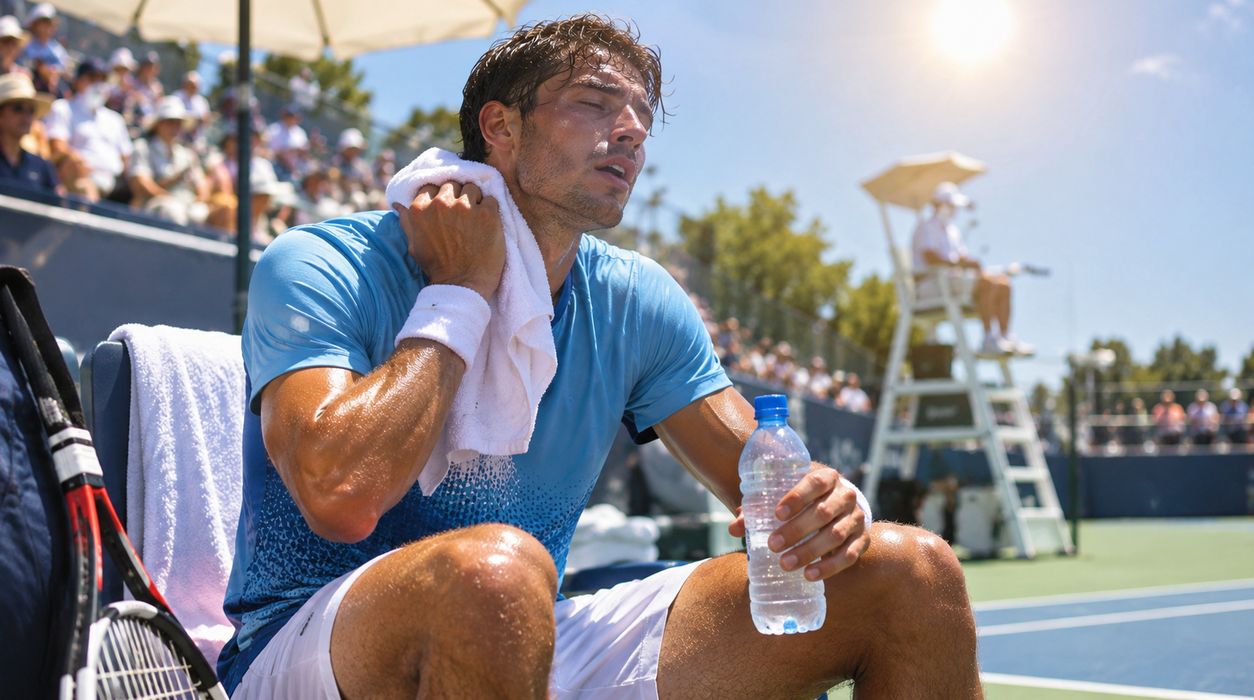
A tennis player walks toward the bench after another exhausting rally. Their shirt is soaked, the court is radiating heat, and even the spectators are searching for shade. The player grabs a towel, drinks water, and looks toward the chair umpire.
Can the match be stopped because it is too hot?
Yes. Under the ATP heat rule introduced for the 2026 season, players can receive a 10-minute cooling break in qualifying best-of-three singles matches, and outdoor play must be suspended when dangerous heat conditions meet the official threshold.
The policy uses Wet Bulb Globe Temperature (WBGT), a measurement that accounts for several environmental factors rather than relying only on the temperature shown by a weather app.
A cooling break becomes available when WBGT reaches 30.1°C or higher before the third set. Mandatory outdoor suspension is triggered when WBGT remains at or above 32.2°C for 15 consecutive minutes.
These protections are particularly important during tournaments held in hot and humid climates.
Here is how the 2026 ATP heat policy works, what players can do during cooling breaks, when matches stop, and how officials decide that conditions are safe enough to resume.
What Is the ATP Heat Rule in 2026?
The ATP heat rule is a formal safety policy designed to protect players and other people involved in professional tennis during extreme heat.
The ATP Board approved the regulation in December 2025, with implementation beginning in the 2026 season.
It applies across the ATP Tour and ATP Challenger Tour, including outdoor competition and qualifying retractable-roof courts.
The policy establishes specific heat-risk categories, cooling procedures, and suspension requirements.
According to the ATP’s official announcement of the new heat rule, the changes were introduced to strengthen player protection and align the men’s tour more closely with existing heat-safety practices in women’s tennis.
ATP Heat Rule 2026: Quick Summary
| WBGT Reading | Heat Category | Main Action |
|---|---|---|
| Below 29.0°C | Normal | Standard match procedures |
| 29.0–30.0°C | Heat Advisory | Increased heat awareness |
| 30.1°C or higher | Extreme Heat Level 1 | Eligible singles cooling break |
| 32.2°C or higher for 15 minutes | Extreme Heat Level 2 | Outdoor play suspended |
| Below 30.5°C for 20 minutes | Resumption condition | Play may resume |
The figures are WBGT readings, not ordinary air temperatures.
That distinction matters because a relatively modest air temperature combined with strong sunlight and high humidity can still create substantial heat stress.
What Is Wet Bulb Globe Temperature in Tennis?
Wet Bulb Globe Temperature, commonly abbreviated WBGT, is a measurement used to evaluate environmental heat stress.
Unlike ordinary air temperature, WBGT considers several factors that influence how effectively the human body can release heat.
These include air temperature, humidity, radiant heat from sunlight, and wind conditions.
For tennis players, those factors can make a major difference.
A sunny outdoor hard court may feel much hotter than the temperature displayed on a nearby weather station.
High humidity also makes sweating less effective because moisture evaporates more slowly.
The ATP uses on-court WBGT measurements, taken or confirmed by ATP medical personnel in coordination with the tournament physician.
Why Doesn’t ATP Use Ordinary Temperature?
Imagine two tennis tournaments with identical air temperatures of 90°F.
One takes place in dry conditions with a breeze.
The other takes place in humid conditions under intense sunlight.
Although the air temperature is the same, the physical stress experienced by players can differ considerably.
WBGT provides a more useful basis for deciding when additional safety measures are necessary.
It also gives tournament officials measurable thresholds rather than relying entirely on subjective impressions.
When Do Tennis Players Get a 10-Minute Cooling Break?
Under the 2026 ATP rules, a 10-minute cooling break is available in best-of-three singles matches when WBGT reaches at least 30.1°C before the third set.
Either player can request the break.
Once requested, the cooling break applies to both players.
It takes place between the second and third sets.
For example, imagine a singles match tied at one set each.
The WBGT reaches 30.4°C during the second set.
After the second set ends, either player may request the cooling break.
Both players then receive the same 10-minute period before the deciding set begins.
Can a Player Request the Break During a Set?
The formal cooling break does not interrupt an ordinary game or rally.
It is scheduled between the second and third sets.
Players may still receive appropriate medical attention under the applicable medical rules when necessary.
However, the heat-policy cooling break is a separate procedure with specific eligibility and timing requirements.
What If Neither Player Requests a Break?
The cooling break is optional at Extreme Heat Level 1.
If neither player requests it, the match can continue, provided conditions have not reached the mandatory suspension threshold.
A player does not have to request the break simply because the WBGT has reached 30.1°C.
What Can Players Do During the Cooling Break?
The 10-minute period allows players to take practical steps to reduce heat stress.
Under the ATP rules, permitted activities include:
- Drinking water and appropriate hydration fluids.
- Using cooling towels, ice, and other cooling measures.
- Changing clothing.
- Taking a shower.
- Receiving coaching consistent with ATP regulations.
- Recovering under ATP medical supervision.
ATP medical personnel supervise player recovery and hydration.
The purpose is not simply to provide additional rest.
It is to reduce the physical strain associated with prolonged exposure to extreme conditions.
Can Players Talk to Their Coaches?
Yes.
The ATP’s 2026 heat policy permits coaching during the cooling break, consistent with ATP coaching rules.
That is an important distinction because coaching permissions can differ between competitions and historical rulebooks.
Players and coaches must still follow the applicable regulations.
What If a Player Returns Late?
The cooling break lasts 10 minutes, measured from the end of the second set to the start of the third.
A player who returns late may receive time violations.
The ATP rulebook provides for consecutive time penalties when a player fails to resume promptly.
The cooling break is therefore a controlled safety measure rather than an unlimited interruption.
When Does ATP Suspend a Tennis Match Because of Heat?
Mandatory outdoor suspension occurs when WBGT reaches at least 32.2°C for 15 consecutive minutes.
This is the detailed trigger specified in the 2026 ATP Rulebook.
The tournament supervisor must suspend play on outdoor courts when that condition is met.
The policy also requires outdoor practice sessions to stop.
Players are directed to designated cooling areas or locker rooms, with medical monitoring available as needed.
Does the Match Stop Immediately During a Rally?
No.
The suspension procedure allows the current game or tiebreak to be completed.
For example, imagine a match reaching the suspension threshold while the score is 30–30.
Officials do not ordinarily interrupt the rally at that instant.
The current game is completed before players leave the court.
If a tiebreak is underway, it is completed before suspension.
This approach creates a defined stopping point while still prioritizing safety.
Who Makes the Suspension Decision?
The tournament supervisor is responsible for implementing the suspension procedure under the ATP policy.
The chair umpire communicates the relevant instructions to players.
ATP medical personnel and the tournament physician are involved in monitoring conditions.
The decision is based on official measurements and the policy’s requirements, not simply on a player’s personal preference.
When Can a Tennis Match Resume After Extreme Heat?
Under the 2026 ATP policy, outdoor play may resume once WBGT remains below 30.5°C for 20 consecutive minutes.
This is different from the suspension threshold.
A single brief drop in the reading is not enough.
Officials must confirm that conditions have remained below the required level for the specified period.
The tournament supervisor then issues a restart notice.
For example, suppose play is suspended when WBGT remains at 32.4°C.
Later, conditions improve.
The WBGT falls to 30.3°C and stays below 30.5°C for 20 consecutive minutes.
The supervisor may authorize play to resume.
This system reduces the risk of restarting matches during a temporary improvement followed immediately by another dangerous increase.
What Happens on Tennis Courts With Retractable Roofs?
The ATP heat policy includes special procedures for courts equipped with retractable roofs.
Under the 2026 rulebook, roof closure is triggered when either:
- WBGT reaches at least 32.0°C.
- The court-surface temperature reaches at least 45°C.
The roof is closed at the next changeover or end of a set.
The closure is treated as a suspension of play.
Once closed, the roof remains closed for the remainder of that match.
Why Does Court-Surface Temperature Matter?
A tennis court can become extremely hot after hours of direct sunlight.
The surface absorbs and radiates heat, increasing the thermal load experienced by players.
Hard courts can be particularly uncomfortable during intense sunshine.
The separate surface-temperature trigger recognizes that dangerous conditions can develop even when the WBGT reading has not reached the outdoor suspension threshold.
Roof closure can reduce direct solar exposure and help officials manage the playing environment.
Does the ATP Heat Rule Apply to Doubles Matches?
Yes, but the cooling procedures differ.
The 2026 ATP policy does not provide the same formal 10-minute cooling break for doubles matches.
Instead, when WBGT reaches at least 31.0°C, the chair umpire may authorize a 90-second hydration extension at set breaks for both teams.
This is an important exception.
A doubles player cannot automatically claim the singles cooling-break procedure.
The applicable doubles provision offers additional hydration time while recognizing the different match format.
Mandatory outdoor suspension measures still apply when the required extreme-heat threshold is reached.
Why Did ATP Introduce the Heat Rule in 2026?
Extreme heat has become a major concern at professional tennis tournaments.
Players compete for long periods, often with limited shade and demanding physical workloads.
Hot and humid conditions can increase fatigue, affect concentration, and create serious health risks.
During the 2025 Shanghai Masters, several players experienced difficult conditions.
The tournament generated renewed discussion about whether men’s professional tennis needed a clearer, standardized heat policy.
The ATP subsequently announced the new rule in December 2025.
The objective was to establish consistent, medically supported procedures rather than leaving every heat-related decision to a less clearly defined process.
How Does Heat Affect Tennis Performance?
Heat can influence several aspects of a match.
Players may experience increased cardiovascular strain, faster fatigue, and difficulty maintaining their usual intensity.
Long rallies become more demanding.
Footwork can deteriorate as exhaustion develops.
Decision-making may also suffer when players are struggling physically.
Severe heat illness is a medical emergency.
The ATP policy is designed to reduce exposure to dangerous conditions, but it does not eliminate every health risk.
Players who experience concerning symptoms still require appropriate medical assessment.
Is the ATP Heat Rule the Same as the Grand Slam Heat Rule?
Not necessarily.
Grand Slam tournaments operate under their own competition regulations.
Although several major tournaments use WBGT-based heat measures, their procedures are not identical to the ATP Tour policy.
For example, Wimbledon introduced a heat rule for its 2026 Championships.
That policy allows cooling breaks in qualifying singles matches, including a 10-minute break in best-of-three matches and a break between the third and fourth sets in best-of-five matches.
Wheelchair events have different break provisions.
Wimbledon’s policy also contains specific rules for covered courts.
The official Wimbledon Heat Rule explains those tournament-specific requirements.
Fans should therefore avoid assuming that every tennis event uses exactly the same cooling-break timing or suspension procedure.
How Is the ATP Heat Policy Different From Other Sports?
Tennis presents a distinctive heat-management challenge.
A player may compete alone on an exposed court for several hours.
Unlike many team sports, there are no ordinary player substitutions during a singles match.
The athlete must repeatedly serve, return, sprint, recover, and change direction.
In soccer, teams can replace tired players through substitutions.
SportsVell explains the team structure in how many players are on a soccer team.
American football uses an even more flexible personnel system, with players rotating between offensive, defensive, and special-teams situations.
For comparison, see SportsVell’s guide to how many players are on a football team.
Tennis players cannot rely on that kind of rotation.
Consequently, environmental monitoring and structured recovery periods are particularly important.
How Can Tennis Players Prepare for Hot Conditions?
Professional players often work with coaches, trainers, and medical personnel to prepare for demanding conditions.
Their preparation may include heat acclimatization, hydration planning, appropriate clothing, and recovery strategies.
However, individual preparation does not replace tournament safety procedures.
Hydration Planning
Players need to replace fluids lost through sweating.
Their requirements vary depending on body size, intensity, environmental conditions, and individual sweat rates.
A qualified sports medicine professional can help develop an appropriate hydration plan.
Cooling Strategies
Cold towels, shade, cooling equipment, and other approved measures can help players manage heat exposure.
During an authorized ATP cooling break, players can use these measures under medical supervision.
Clothing and Equipment
Breathable clothing may improve comfort.
Players may also change sweat-soaked clothing during permitted breaks.
Recognizing Warning Signs
Dizziness, confusion, collapse, and other concerning symptoms require prompt attention.
Players should not assume that continuing through severe symptoms demonstrates toughness.
Medical staff should assess possible heat illness.
The ATP heat policy provides a formal framework, but immediate medical judgment remains essential.
How Does Heat Affect Match Scheduling?
Extreme heat can create significant scheduling challenges.
Tournament organizers must consider court availability, match duration, television arrangements, and weather conditions.
A suspension can delay several matches simultaneously.
If outdoor courts become unavailable, organizers may need to move matches or adjust the following day’s schedule.
Retractable-roof courts can provide additional flexibility.
However, not every venue has a roof.
A prolonged suspension may affect players waiting for their next match, especially during tournaments with tightly packed schedules.
The ATP’s structured thresholds help officials make consistent decisions while managing these logistical challenges.
Can a Player Refuse to Continue Because of Heat?
A player experiencing a medical problem should seek assistance from the chair umpire and tournament medical personnel.
The ATP heat policy establishes procedures for cooling breaks and suspension.
However, a player cannot automatically demand that an entire tournament stop simply because they personally feel uncomfortable.
Officials must apply the relevant heat thresholds and medical rules.
A player who cannot continue may retire from the match.
That is different from a tournament-wide heat suspension.
Medical personnel are responsible for evaluating health concerns, while tournament officials administer the competition rules.
Common Misunderstandings About the ATP Heat Rule
Mistake 1: The 30.1°C threshold refers to ordinary air temperature.
It refers to Wet Bulb Globe Temperature, which measures environmental heat stress.
Mistake 2: Every match stops when WBGT reaches 30.1°C.
That threshold activates cooling-break eligibility in qualifying singles matches, not mandatory suspension.
Mistake 3: Play stops immediately at a single 32.2°C reading.
The detailed ATP policy requires WBGT of at least 32.2°C for 15 consecutive minutes.
Mistake 4: Doubles players receive the same 10-minute break.
The formal singles cooling break does not apply to doubles. A separate hydration extension may be authorized.
Mistake 5: Players can take unlimited cooling breaks.
The formal cooling break has specific eligibility, timing, and duration requirements.
Mistake 6: All Grand Slam tournaments use identical ATP rules.
Grand Slam events have their own regulations, which may differ.
Frequently Asked Questions
What is the ATP heat rule for 2026?
The ATP heat rule uses WBGT measurements to determine cooling-break eligibility, mandatory outdoor suspension, and resumption procedures during extreme heat.
At what temperature do tennis matches stop?
Under the 2026 ATP policy, outdoor play is suspended when WBGT reaches at least 32.2°C for 15 consecutive minutes.
When can ATP players take a cooling break?
In best-of-three singles matches, either player can request a 10-minute cooling break between the second and third sets if WBGT reaches at least 30.1°C before the third set.
Can both players use the cooling break?
Yes. Once either player requests an eligible cooling break, it applies to both players.
Can players receive coaching during the cooling break?
Yes, consistent with ATP coaching regulations.
Does the ATP heat rule apply to doubles?
The heat policy applies, but doubles does not receive the formal 10-minute singles cooling break. A 90-second hydration extension may be authorized at set breaks when WBGT reaches at least 31.0°C.
When can play resume after a heat suspension?
Play may resume once WBGT remains below 30.5°C for 20 consecutive minutes and the supervisor authorizes the restart.
Does the ATP heat policy apply to Challenger tournaments?
Yes. The policy covers the ATP Tour and ATP Challenger Tour under the applicable competition regulations.
Can a tennis stadium close its roof because of heat?
Yes. Under the ATP policy, retractable-roof closure is triggered by specified WBGT or court-surface temperature thresholds.
Is the ATP heat rule the same as Wimbledon’s?
No. Wimbledon operates under its own heat policy, including different provisions for best-of-five singles and wheelchair events.
Final Thoughts
The ATP heat rule introduced in 2026 represents an important step toward protecting professional tennis players during extreme weather.
The policy establishes clear WBGT thresholds rather than relying only on ordinary temperature readings.
At 30.1°C WBGT, eligible singles players can request a 10-minute cooling break between the second and third sets.
At 32.2°C WBGT sustained for 15 consecutive minutes, outdoor play must be suspended.
Matches may resume once conditions remain below the required recovery threshold for 20 minutes.
The policy also addresses doubles hydration, retractable-roof closure, and medical supervision.
For players, these measures provide structured opportunities to recover and reduce exposure to dangerous conditions.
For fans, they explain why a match may pause even when the weather appears manageable from the stands.
And for tournament organizers, the rules establish a more consistent framework for making difficult decisions.
Tennis will always demand physical endurance, but player safety must remain a priority when environmental conditions become dangerous.
For more tennis stories, player analysis, and sports explanations, visit SportsVell.
You can also read SportsVell’s feature on Roger Federer and Conor McGregor for a comparison of two athletes whose careers required different forms of physical preparation and competitive endurance.