
What Happens If Tennis Players Serve From the Wrong End During a Tiebreak? (2026 Rules Explained)
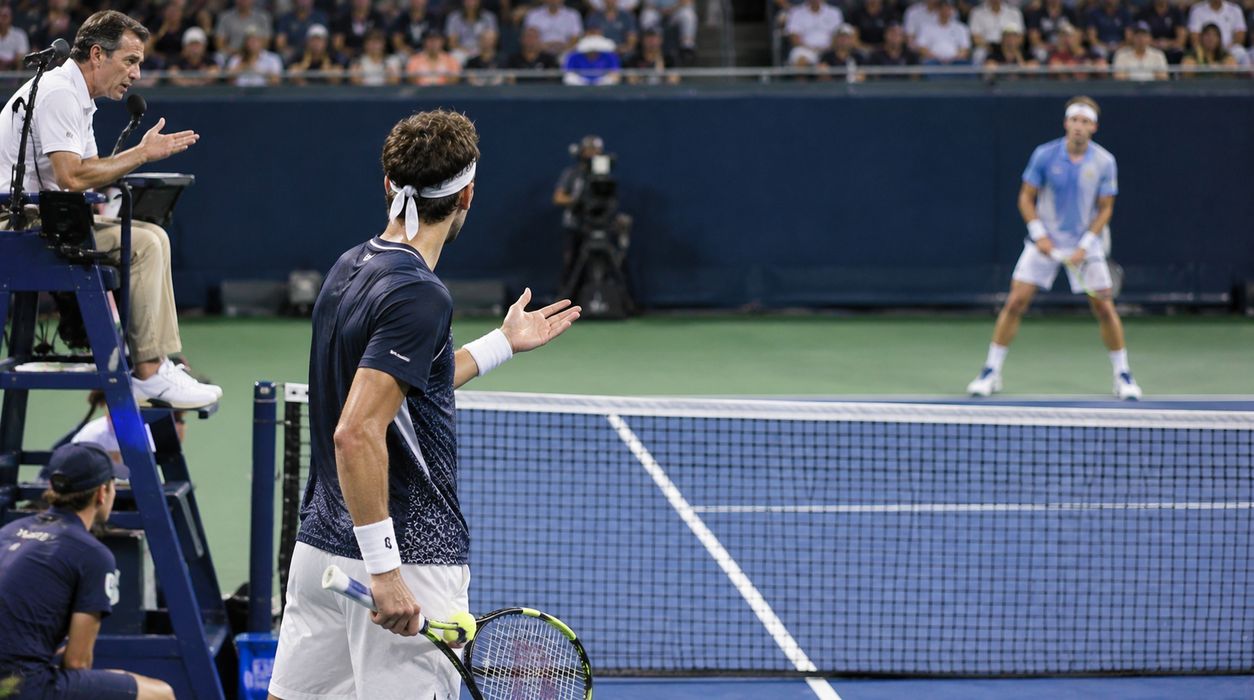
The score is 5–5 in a tense tennis tiebreak. Both players are focused on winning the next point, but neither notices that they forgot to change ends earlier.
One player serves, wins the rally, and prepares for the next point. Suddenly, the chair umpire realizes the players are standing at the wrong ends of the court.
Does the previous point count? Do they have to replay it? And what happens if the server has already hit a fault?
Under the 2026 International Tennis Federation (ITF) Rules of Tennis, players who serve from the wrong end during a tiebreak must correct their positions as soon as the mistake is discovered. All completed points remain valid.
The rules also distinguish between serving from the wrong end, serving from the wrong half of the court, and serving out of turn.
These situations sound similar, but they have different correction procedures.
Most importantly, the 2026 rules clarify that a service fault made before discovering a wrong-end error does not stand.
Here is how ITF Rule 27 works, with practical scoring examples, tiebreak serving rotations, doubles situations, and common mistakes.
What Happens If You Serve From the Wrong End in a Tennis Tiebreak?
If players are positioned at the wrong ends of the court during a tiebreak, the mistake must be corrected immediately after it is discovered.
The server then serves from the correct end according to the score.
The points already completed remain unchanged.
For example, imagine Player A and Player B are playing a standard seven-point tiebreak.
After six points, they should change ends.
However, both players forget and continue playing.
Player A wins the seventh point before the mistake is noticed.
The score is now 4–3.
The players must change to their correct ends before the eighth point.
The seventh point still counts.
Neither player receives an automatic penalty, and the tiebreak does not restart.
This follows ITF Rule 27: Correcting Errors.
Quick Summary of the 2026 Tiebreak Correction Rules
| Situation | Official Correction |
|---|---|
| Players serve from the wrong end | Correct ends immediately |
| Completed points before discovery | Remain valid |
| First-service fault before discovering wrong ends | Does not stand |
| Serve from the wrong half of the court | Correct immediately |
| Fault before discovering wrong service half | Stands |
| Wrong player serves in tiebreak; even number of points completed | Correct service order immediately |
| Wrong player serves in tiebreak; odd number completed | Keep altered service order |
| Doubles receiving order mistake | Keep altered order until tiebreak ends |
The difference between a wrong end and a wrong service half is especially important.
What Does ITF Rule 27 Say About Wrong-End Errors?
ITF Rule 27 governs errors discovered during tennis matches.
Its central principle is straightforward: completed points generally remain valid even when an error in applying the rules is discovered.
The rule then explains how officials should correct different mistakes.
Rule 27(b) specifically addresses players standing at the wrong ends during a standard game or tiebreak.
The correction is immediate.
The server must continue from the correct end according to the score.
The 2026 edition also clarifies that a fault served before the wrong-end mistake is discovered does not stand.
This distinction can matter when an error is noticed between a first and second serve.
Why Doesn’t the Umpire Replay Every Point?
Replaying completed points could create more confusion than the original mistake.
Imagine a tiebreak reaching 8–8 before anyone notices an incorrect change of ends.
If every point played from the wrong end were canceled, the players might have to replay a substantial portion of the tiebreak.
Instead, Rule 27 protects the results of completed points.
The players correct their positions and continue from the existing score.
This approach keeps matches fair, practical, and manageable.
What Changed in the 2026 Tennis Rules?
The 2026 ITF amendments clarified how service faults are treated when players discover that they are at the wrong ends of the court.
Under Rule 27(b), a fault served before the error is discovered does not stand.
For example, suppose a player serves from the wrong end and hits a first serve into the net.
Before the second serve, the chair umpire realizes the players should have changed ends.
The players move to their correct ends.
The earlier fault is canceled, so the server begins with a first serve from the correct end.
This is different from serving from the wrong half of the court.
Under Rule 27(a), a fault served before discovering a wrong-half error still counts.
The distinction is confirmed in the official ATP 2026 Rulebook, which reproduces the ITF correction rules.
How Often Do Players Change Ends During a Tiebreak?
In a standard tiebreak, players change ends after every six points.
The change occurs after six completed points, then twelve, eighteen, and so on.
For example:
- After point 6: Change ends.
- After point 12: Change ends.
- After point 18: Change ends.
- After point 24: Change ends.
The change is based on the total number of points played, not the individual score of either player.
Example: A Tiebreak at 4–2
The score is 4–2.
Six points have been completed.
The players change ends before the seventh point.
Example: A Tiebreak at 6–6
The score is 6–6.
Twelve points have been completed.
The players change ends before the thirteenth point.
Example: A Tiebreak at 7–6
Thirteen points have been completed.
The players do not change ends merely because one player has reached seven points.
The next scheduled change is after eighteen completed points, assuming the tiebreak continues that long.
The total point count determines the changeover.
How Does Serving Order Work in a Tennis Tiebreak?
The serving order is different from a standard tennis game.
In a standard tiebreak, the player whose turn it is to serve begins with one point.
The opponent then serves the next two points.
After that, players alternate serving two consecutive points until the tiebreak ends.
For example, suppose Player A serves first.
| Point Number | Server | Service Court |
|---|---|---|
| 1 | Player A | Deuce |
| 2 | Player B | Ad |
| 3 | Player B | Deuce |
| 4 | Player A | Ad |
| 5 | Player A | Deuce |
| 6 | Player B | Ad |
| 7 | Player B | Deuce |
| 8 | Player A | Ad |
| 9 | Player A | Deuce |
| 10 | Player B | Ad |
This rotation continues until one player wins the tiebreak.
The players change ends after the sixth point, but the service order continues normally.
A change of ends does not automatically mean a change of server.
What Happens If Players Forget to Change Ends?
Forgetting to change ends is a common mistake in recreational tennis.
Players may be concentrating on the score, discussing a close call, or preparing for the next serve.
When the error is discovered, the players should correct it immediately.
They do not replay completed points.
Example: Forgetting the First Changeover
Player A and Player B begin a tiebreak.
After six points, the score is 3–3.
They should change ends but forget.
Player B serves the seventh point and wins it.
The score becomes 4–3.
The chair umpire notices the error.
The players move to the correct ends.
The next point begins with Player A serving from the ad court, following the established service sequence.
The seventh point remains valid.
What If the Error Is Discovered Several Points Later?
The same principle applies.
Suppose the players forget to change ends after six points and continue until the score reaches 6–5.
They have completed eleven points.
The mistake is discovered before the twelfth point.
The players correct their ends immediately.
The score remains 6–5.
They then follow the normal serving order.
After the twelfth point, they must also observe the scheduled change-of-ends requirement according to the correct sequence.
What Happens If a Player Serves From the Wrong Half of the Court?
Serving from the wrong half is different from serving from the wrong end.
The wrong half refers to the deuce court or ad court.
For example, a player might serve from the deuce court when the score requires service from the ad court.
Under ITF Rule 27(a), the mistake must be corrected immediately.
The player serves from the correct half according to the score.
Completed points remain valid.
However, a service fault made before discovering the error still counts.
Example: Wrong Service Half
Player A should serve from the ad court.
Instead, Player A serves from the deuce court and hits the first serve into the net.
The chair umpire notices the mistake.
Player A moves to the ad court.
The first-service fault remains.
Player A must now hit a second serve from the correct half.
This is different from a wrong-end mistake, where the fault is canceled under the 2026 wording.
Wrong End vs. Wrong Half: What’s the Difference?
The two errors involve different parts of the court.
A wrong-end error means the players are positioned on the incorrect sides of the net.
A wrong-half error means the server is using the incorrect deuce or ad service court.
| Feature | Wrong End | Wrong Half |
|---|---|---|
| Error | Players at incorrect ends | Server on incorrect deuce/ad side |
| Correction | Change ends immediately | Move to correct service half |
| Completed points | Stand | Stand |
| Earlier service fault | Does not stand | Stands |
| Governing provision | ITF Rule 27(b) | ITF Rule 27(a) |
Understanding this distinction prevents incorrect rulings during competitive and recreational matches.
What Happens If the Wrong Player Serves During a Tiebreak?
A serving-order mistake follows a different rule.
Under ITF Rule 27(d), the correction depends on whether an even or odd number of points have been completed when the error is discovered.
If the mistake is discovered after an even number of completed points, the correct service order is restored immediately.
If discovered after an odd number of completed points, the altered service order remains in effect.
This is one of the most unusual correction rules in tennis.
Example: Error Discovered After an Even Number of Points
Suppose Player A serves when Player B should have served.
The mistake is discovered after eight completed points.
Because eight is an even number, the correct service order is restored immediately.
All eight completed points remain valid.
Example: Error Discovered After an Odd Number of Points
Now imagine the error is discovered after nine completed points.
Because nine is odd, the altered service order remains in effect.
The players continue using that altered order.
Completed points still stand.
The purpose is to maintain a workable service rotation without invalidating completed play.
What Happens to a Fault When the Wrong Player Serves?
Under Rule 27(d), a fault served by the opponent before discovering a service-order mistake does not stand.
In doubles, however, a fault served by the wrong partner on the same team does stand.
This distinction is important.
For example, if the opposing player incorrectly serves and hits a fault before the error is noticed, the correction can remove that fault.
But if the mistake involves two doubles partners serving in the wrong order, the earlier fault remains.
Players should not apply the same fault-correction rule to every serving mistake.
The relevant part of Rule 27 determines the result.
How Do Wrong-End Rules Work in Doubles Tiebreaks?
The basic wrong-end rule applies to doubles as well as singles.
If both doubles teams are positioned at the wrong ends, they must correct the mistake immediately.
Completed points remain valid.
However, doubles introduces additional complexity because four players participate.
Teams must track both the service order and receiving order.
Example: Doubles Teams Forget to Change Ends
Team A consists of Players A1 and A2.
Team B consists of Players B1 and B2.
After six completed points, both teams forget to change ends.
They play two additional points.
The score becomes 5–3.
The mistake is discovered.
Both teams move to the correct ends.
The score remains 5–3.
The established serving sequence continues.
What If Doubles Partners Receive in the Wrong Order?
Under Rule 27(e), an incorrect receiving order remains as altered until the end of the tiebreak.
The players then restore the original receiving order for the next game in which their team receives during that set.
This differs from wrong-end corrections, which take place immediately.
Can a Player Request That Completed Points Be Replayed?
Generally, no.
ITF Rule 27 establishes that completed points stand when these errors are discovered.
A player cannot demand that several completed points be replayed merely because the competitors were standing at the wrong ends.
For example, suppose a player loses two points while serving into bright sunlight because the players forgot to change ends.
The player may believe the incorrect position created a disadvantage.
However, the completed points remain valid.
The players correct their positions and continue.
The rule prevents disputes about hypothetical outcomes.
No one can know whether the results would have been different from the correct ends.
Does Serving From the Wrong End Automatically Cause a Penalty?
No.
An accidental wrong-end mistake does not automatically result in a point penalty or disqualification.
The correction procedure is designed to restore the proper playing conditions.
Completed points remain valid.
The players move to the correct ends.
The match continues.
However, deliberate misconduct or refusal to follow the umpire’s instructions could raise separate issues under the competition’s code of conduct.
That is different from an ordinary mistake in changing ends.
How Do Tiebreak Rules Differ From Regular Games?
A standard tennis game uses the familiar scoring sequence of love, 15, 30, 40, and game.
A tiebreak uses numerical point scoring.
A standard seven-point tiebreak is won by the first player to reach at least seven points with a two-point advantage.
For example, a tiebreak may finish 7–4, 8–6, or 10–8.
If the score reaches 6–6, play continues until one player leads by two points.
Why Is the Serving Rotation Different?
A normal game uses one server throughout.
In a tiebreak, the serve rotates after the opening point and then after every two points.
This creates a more balanced distribution of serving opportunities.
Players must track both the score and the serving sequence.
That makes errors more likely, especially during long tiebreaks.
Do Ten-Point Match Tiebreaks Follow the Same Correction Rules?
Yes, the general ITF correction principles apply to match tiebreaks.
A ten-point match tiebreak is won by the first player or team to reach at least ten points with a two-point margin.
The serving sequence and change-of-ends procedure follow the applicable tiebreak format.
If players serve from the wrong end, they correct the mistake immediately.
Completed points stand.
If the wrong player serves, the even-versus-odd completed-point rule determines how the service order is corrected.
The competition’s approved match format still controls.
How Can Players Avoid Tiebreak Serving Mistakes?
Tiebreak errors often happen because players focus on winning points rather than tracking the sequence.
A few simple habits can help.
Count Completed Points
Add both players’ scores together.
If the total is a multiple of six, a change of ends is due.
Remember the First Server
The player who serves the first point also receives in the first game of the following set.
Remembering this helps maintain the correct service rotation.
Track the Two-Point Pattern
After the opening point, each player serves two consecutive points.
This pattern continues throughout the tiebreak.
Communicate Clearly
In recreational matches without a chair umpire, players should confirm the score and serving order when uncertain.
Correct Mistakes Promptly
If an error is discovered, apply Rule 27 immediately rather than continuing and hoping the situation resolves itself.
The official USTA explanation of serving from the wrong end provides a useful practical example.
Why Do Tiebreak Mistakes Matter in Professional Tennis?
Tiebreaks often decide closely contested sets.
One point can determine whether a player wins a set or must continue playing.
That creates significant pressure.
Players must manage serving strategy, return positioning, concentration, and physical fatigue.
A procedural mistake can become an unnecessary distraction.
Professional officials help track the score, service order, and changeovers.
However, the correction rules remain important because even experienced players and officials can make mistakes.
Tennis demands concentration in ways that differ from many team sports.
SportsVell’s feature on Roger Federer and Conor McGregor explores the preparation and competitive focus required in two individual sports.
How Is Tennis Scoring Different From Other Sports?
Tennis uses games, sets, and tiebreaks rather than a continuous running clock.
In soccer, matches are organized around two halves and stoppage time.
SportsVell’s guide to how many players are on a soccer team explains the structure of that team sport.
American football uses timed quarters and a game clock.
You can compare its timing system in SportsVell’s article about how long a football game lasts.
Boxing uses scheduled rounds rather than games or sets.
SportsVell explains those formats in how many rounds are in a boxing match.
These differences illustrate why tennis requires its own detailed rules for serving rotations and correcting scoring-related errors.
For another comparison of how sports organize participants, see how many players are on a football team.
Common Mistakes About Tiebreak Serving Rules
Mistake 1: A wrong-end mistake cancels all previous points.
Completed points remain valid.
Mistake 2: Players can wait until the next scheduled changeover.
Wrong-end mistakes should be corrected immediately after discovery.
Mistake 3: A service fault always stands.
Under the 2026 rule, a fault made before discovering a wrong-end error does not stand.
Mistake 4: Wrong-end and wrong-half mistakes have identical rules.
They have different fault-correction provisions.
Mistake 5: The wrong server always takes over immediately.
During a tiebreak, the correction depends on whether an even or odd number of points have been completed.
Mistake 6: Players change ends after every six games during a tiebreak.
They change ends after every six points in a standard tiebreak.
Frequently Asked Questions
What happens if you serve from the wrong end in a tennis tiebreak?
Players must move to the correct ends as soon as the mistake is discovered. Completed points remain valid.
Do you replay points played from the wrong end?
No. Under ITF Rule 27, completed points stand.
Does a first-serve fault count if you served from the wrong end?
No. Under the 2026 wording, a fault served before discovering the wrong-end mistake does not stand.
What if you serve from the wrong deuce or ad court?
Correct the service half immediately. A fault served before discovering that particular error still counts.
What happens if the wrong player serves during a tiebreak?
After an even number of completed points, restore the correct order immediately. After an odd number, retain the altered service order.
When do players change ends during a tiebreak?
In a standard tiebreak, players change ends after every six completed points.
Who serves first after a tiebreak ends?
The player or team that received the first point of the tiebreak serves first in the next set.
Do the same rules apply in doubles?
Yes, the wrong-end correction applies in doubles. Additional rules govern incorrect service and receiving orders.
Can a player be disqualified for accidentally serving from the wrong end?
An ordinary accidental mistake does not automatically cause disqualification. The appropriate correction is applied under Rule 27.
Does Rule 27 apply to ten-point match tiebreaks?
Yes. The general correction provisions apply, subject to the approved match format.
Final Thoughts
Serving from the wrong end during a tennis tiebreak can be confusing, but the 2026 ITF rules provide a clear solution.
Correct the ends immediately, keep the completed points, and continue from the existing score.
The 2026 clarification also establishes that a fault served before discovering a wrong-end mistake does not stand.
That differs from serving from the wrong deuce or ad court, where an earlier fault remains valid.
If the wrong player serves during a tiebreak, the correction depends on whether an even or odd number of points have been completed.
These distinctions matter because applying the wrong correction could unfairly affect a close match.
For players, learning the serving rotation and changeover sequence helps prevent confusion.
For coaches and officials, understanding Rule 27 ensures that mistakes are corrected consistently.
And for fans, knowing the rules makes tense tiebreak situations easier to understand.
The most important lesson is simple: a procedural mistake does not automatically erase the tennis already played.
For more tennis rules, match explanations, and sports guides, visit SportsVell.