
Can You Serve Outside the Singles Sideline in Doubles Tennis? 2026 Foot Fault Rules Explained
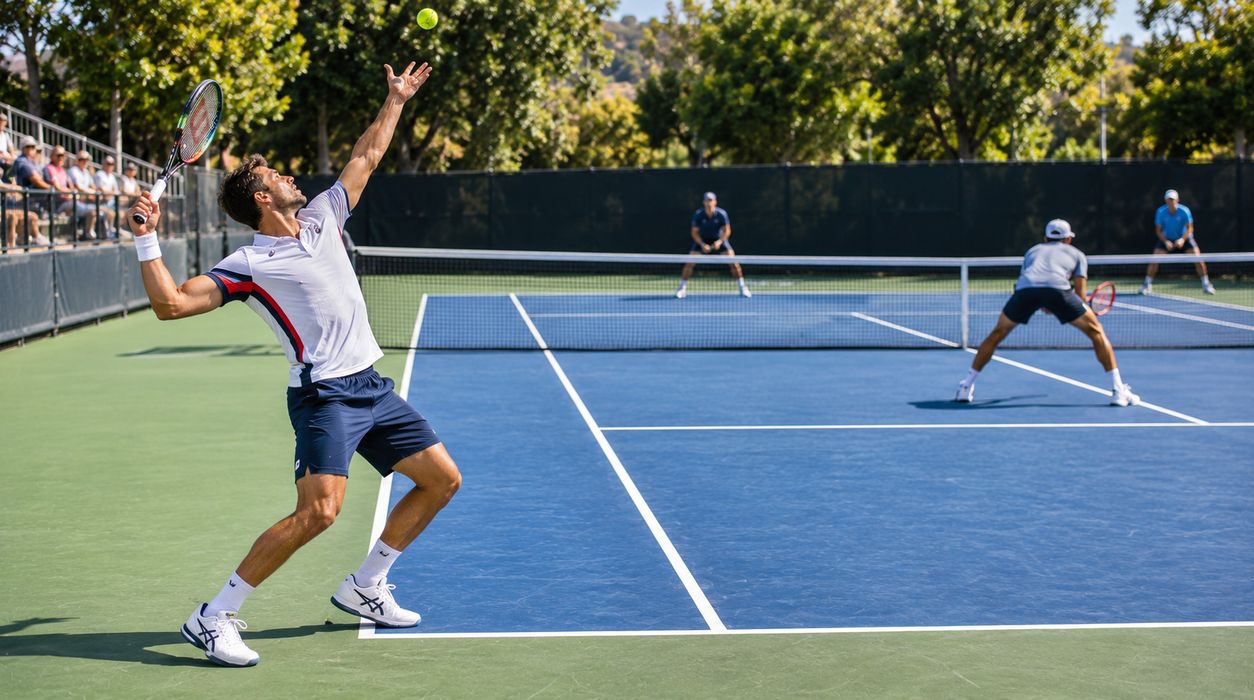
You’re playing doubles tennis, and your partner is standing near the net. You move farther toward the outside of the court to serve, positioning yourself behind the doubles alley. Your opponent suddenly questions whether you’re allowed to stand there.
Is serving outside the singles sideline a foot fault?
Yes, you can legally serve from behind the area between the singles sideline and doubles sideline in doubles tennis. The 2026 International Tennis Federation (ITF) Rules of Tennis explicitly confirm this under Rule 18.
However, the same serving position is not permitted in singles.
This distinction matters because doubles courts are wider than singles courts. The additional width changes the legal boundaries for the server’s feet, even though the service boxes remain the same size.
The 2026 rules also clarify what counts as a foot fault, whether a player can jump during a serve, and what happens when the server touches the baseline.
Here’s everything you need to know about doubles tennis foot fault rules, including practical examples, common mistakes, and tips for avoiding unnecessary service faults.
Can You Serve Outside the Singles Sideline in Doubles Tennis?
Yes. In doubles tennis, players may serve while standing behind the baseline between the singles sideline and doubles sideline.
This area is the extension of the doubles alley, also called the tramline.
The ITF specifically clarified this situation in its 2026 Rules of Tennis.
Under Rule 18, Case 1, the ITF explains that serving from this area is not permitted in singles but is allowed in doubles.
That means a doubles player can legally move farther toward the outside of the court before beginning the service motion.
However, the player must remain within the imaginary extensions of the center mark and the doubles sideline.
Standing beyond the doubles sideline is not permitted.
Quick Summary of Doubles Serving Rules
| Serving Situation | Legal in Doubles? |
|---|---|
| Standing behind the singles baseline area | Yes |
| Standing behind the doubles alley | Yes |
| Standing beyond the doubles sideline extension | No |
| Touching the baseline during the service motion | No |
| Touching the court before striking the serve | No |
| Jumping during the serve | Yes |
| Touching the center mark extension | No |
| Walking or running during the service motion | No |
| Making slight foot movements | Yes |
These requirements apply under the official 2026 ITF Rules of Tennis.
What Changed in the 2026 Tennis Foot Fault Rules?
The ITF introduced a clarification to Rule 18 for the 2026 season.
Previously, the rule explained that singles players could not serve from behind the portion of the baseline between the singles and doubles sidelines.
However, the wording did not explicitly state the corresponding answer for doubles.
The 2026 amendment adds that serving from this position is permitted in doubles.
This is best understood as a clarification rather than a completely new serving technique.
The ITF made the permitted doubles position explicit to eliminate confusion.
According to the official 2026 ITF Rules Amendments, the change was specifically added to Rule 18, Case 1.
Why Does This Clarification Matter?
Imagine a doubles player serving from a position slightly outside the singles sideline.
An opponent might incorrectly assume that the server has committed a foot fault.
The updated wording provides a clear answer.
As long as the server remains behind the baseline and inside the imaginary extension of the doubles sideline, that outside position is permitted.
The clarification helps players, coaches, and officials apply the same interpretation.
What Is a Foot Fault in Tennis?
A foot fault is a service violation involving the server’s feet or movement.
Under ITF Rule 18, a player commits a foot fault during the service motion by breaking one of four requirements.
First, the server cannot change position by walking or running, although slight foot movements are permitted.
Second, the server cannot touch the baseline or the court with either foot.
Third, the server cannot touch the area outside the imaginary extension of the relevant sideline.
Fourth, the server cannot touch the imaginary extension of the center mark.
These restrictions determine where a player may stand and how they may move while serving.
Does a Foot Fault Mean You Lose the Point?
Not automatically.
A foot fault counts as a service fault.
If it happens on the first serve, the player normally receives a second serve.
If it happens on the second serve, the player commits a double fault and loses the point.
For example, suppose a doubles player touches the baseline while hitting a first serve.
The official calls a foot fault.
The player receives another opportunity to serve.
If the player commits another service fault on the second attempt, the receiving team wins the point.
Where Can You Stand When Serving in Doubles?
A doubles player must begin the service motion behind the baseline and within the imaginary extensions of the center mark and doubles sideline.
The server must also use the correct half of the court.
For the first point of a standard game, the serve comes from the right side, commonly called the deuce court.
For the second point, the server moves to the left side, known as the ad court.
The server continues alternating sides throughout the game.
What Is the Imaginary Extension of a Sideline?
Imagine extending the doubles sideline straight backward beyond the baseline.
That invisible line creates the outer boundary of the legal serving area.
The server cannot touch the area beyond it during the service motion.
The same concept applies to the center mark.
Imagine extending the center mark backward from the baseline.
The server must remain on the appropriate side of that imaginary extension.
Can You Stand in the Doubles Alley to Serve?
Yes, provided you are behind the baseline and within the permitted serving boundaries.
The doubles alley is the narrow strip between the singles and doubles sidelines.
It measures 4.5 feet wide on each side of the court.
During doubles, that additional width is part of the playing area.
A player may stand behind its baseline extension when serving.
However, the player cannot stand inside the court ahead of the baseline.
Why Are Doubles Courts Wider Than Singles Courts?
A standard tennis court is 78 feet long.
For singles, the court measures 27 feet wide.
For doubles, it measures 36 feet wide.
The difference is nine feet, divided equally between the two doubles alleys.
Each alley is 4.5 feet wide.
The extra space accommodates two players on each side.
It creates additional angles and makes positioning more important.
The ITF’s official Tennis Glossary and Court Layout Guide explains these dimensions and the terminology used for different court lines.
Does the Service Box Become Wider in Doubles?
No.
The service boxes remain the same size in singles and doubles.
This is a common misunderstanding.
Although the doubles sidelines extend farther outward, the service boxes are still bounded by the center service line, service line, and singles sidelines.
Therefore, moving farther outside to serve does not make the target service box wider.
It simply changes the angle from which the ball approaches the box.
That difference can create tactical opportunities.
Why Do Doubles Players Serve From Wider Positions?
A wider serving position can change the geometry of the serve.
In doubles, players often use different serving positions depending on their preferred strategy.
Creating Wider Angles
A server standing farther outside may be able to create a different angle toward the receiving service box.
Depending on the side and serve direction, this can pull the returner away from the center.
A successful wide serve may create space for the server’s partner to attack.
Helping the Net Player
Doubles teams frequently position one player near the net.
The server may choose a particular starting position to support the partner’s movement.
For example, a serve that pulls the returner toward the sideline can create an opportunity for the net player to intercept a weak return.
Changing the Returner’s View
Moving toward the doubles alley changes the returner’s perspective.
The returner must adjust to the server’s new angle.
However, serving from a wider position is not automatically better.
It can leave the server farther away from the center of the baseline after the serve.
That may create defensive disadvantages if the return comes back sharply.
Can You Touch the Baseline While Serving?
No.
Under ITF Rule 18, the server cannot touch the baseline or the court with either foot during the service motion.
This applies to singles and doubles.
For example, imagine a player beginning the serve with both feet behind the baseline.
As the player tosses the ball, the front foot slides forward and touches the baseline before racket contact.
That is a foot fault.
The same principle applies if the player steps into the court before completing the service motion.
What If Your Shoe Is Only Touching the Edge?
The baseline itself is part of the prohibited area for the server’s feet during the service motion.
A player does not need to step completely across the line.
Touching it is enough.
This is why careful starting position matters.
Players who begin extremely close to the baseline may accidentally touch it as their weight shifts forward.
Can You Jump During a Tennis Serve?
Yes.
The 2026 ITF rules explicitly confirm that the server may have one or both feet off the ground.
Jumping is a normal part of many professional serving techniques.
A player may push upward and forward while striking the ball.
However, the player must not violate the foot-fault restrictions during the service motion.
Can You Land Inside the Court After Serving?
Yes, if the service motion has already been completed when the racket strikes or misses the ball.
For example, a player jumps from behind the baseline, strikes the serve while airborne, and lands inside the court afterward.
That is permitted.
The important issue is whether the player touched a prohibited area before completing the service motion.
Is Jumping Over the Baseline Illegal?
Not by itself.
A player can move forward through the air while serving.
The violation occurs if the player breaks the relevant foot-placement or movement restrictions during the service motion.
The rules do not require both feet to remain on the ground.
Can You Move Your Feet During the Service Motion?
Some movement is allowed.
ITF Rule 18 prohibits changing position by walking or running during the service motion.
However, slight movements of the feet are permitted.
This distinction matters because many players use a platform stance or pinpoint stance.
In a platform stance, the feet generally remain separated.
In a pinpoint stance, the back foot moves closer to the front foot during the serving action.
A small movement that does not amount to walking or running is permitted.
However, a player cannot use the service motion to walk several steps forward or sideways.
The server must maintain a legal serving position.
Does a Foot Fault Count as a Double Fault?
A foot fault counts as one service fault.
It becomes part of a double fault only when the player has already committed a first-service fault on that point.
Consider three situations.
Situation 1: Foot fault on the first serve
The server touches the baseline.
The official calls a foot fault.
The player receives a second serve.
Situation 2: Foot fault on the second serve
The first serve was already a fault.
The player then touches the baseline on the second serve.
That results in a double fault.
The receiving team wins the point.
Situation 3: First serve lands out, second serve lands in
The player makes no foot fault on the second serve.
The second serve is legal, and the point continues.
The important distinction is that a foot fault is treated as a service fault, not as an automatic loss of the point.
Who Calls Foot Faults in Professional Tennis?
Foot faults are officiating decisions.
At professional tournaments, the applicable officiating system determines how they are detected and called.
Depending on the event, officials or approved technology may assist with service-line and foot-fault decisions.
A player does not have the authority to ignore an official foot-fault call simply because the serve landed inside the service box.
Can Electronic Line Calling Detect Foot Faults?
Electronic line-calling systems primarily determine ball landing positions.
Foot-fault detection is a separate officiating issue.
Players should not assume that automated ball tracking necessarily monitors every aspect of foot placement.
The exact procedures depend on the technology and officiating arrangements used at the event.
Professional tennis has increasingly adopted automated line calling, but that does not eliminate every human officiating responsibility.
Are the Same Foot Fault Rules Used on Clay and Grass?
Yes.
The basic ITF foot-fault requirements apply across tennis court surfaces.
A player cannot touch the baseline during the service motion simply because the match is played on clay.
Likewise, serving beyond the relevant sideline extension remains prohibited on grass.
However, the playing surface can influence how players move.
Clay allows sliding, while grass and hard courts create different traction conditions.
Players may need to adjust their stance and footwork accordingly.
The legal serving boundaries do not change merely because the surface changes.
What Happens If a Doubles Player Serves From the Wrong Side?
Serving from the wrong side is different from committing a foot fault.
The ITF rules contain specific procedures for correcting serving-order and serving-position errors.
In a standard game, the server alternates between the deuce court and ad court.
If a player serves from the wrong half, the error must be corrected according to the applicable rules.
Points already completed generally stand, subject to the specific correction provisions.
Players should not confuse a serving-order mistake with a foot-fault violation.
A player may stand completely behind the baseline and still serve from the wrong half.
Likewise, a player may stand on the correct half but commit a foot fault by touching the baseline.
These are different situations requiring different rule interpretations.
How Can Beginners Avoid Foot Faults in Doubles?
Foot faults are often caused by poor positioning rather than intentional rule-breaking.
Fortunately, most players can reduce the risk with a few practical adjustments.
Start Farther Behind the Baseline
Give yourself a small margin behind the line.
Standing directly against the baseline makes accidental contact more likely.
Check Your Outside Foot
When serving from a wide doubles position, make sure your outside foot remains inside the imaginary extension of the doubles sideline.
Do not confuse the singles sideline with the outer doubles boundary.
Practice Your Serving Stance
Repeat your serving motion without hitting the ball.
Watch how your feet move during the toss and swing.
Record Your Serve
A video taken from behind the baseline can help reveal whether your front foot touches the line.
Avoid Excessive Movement
A small stance adjustment may be legal.
Walking or running during the service motion is not.
Develop a repeatable motion that keeps your feet within the permitted area.
How Do Doubles Serving Rules Compare With Other Sports?
Tennis uses strict individual service-position rules.
In team sports, player positioning is governed by different requirements.
For example, soccer involves eleven players per team, with players occupying different tactical positions.
SportsVell explains the basic team structure in How Many Players Are on a Soccer Team?.
American football also uses eleven players on the field per team, but offensive formations and player responsibilities differ considerably.
You can explore that structure in How Many Players Are on a Football Team?.
Tennis doubles is distinctive because only two players compete on each side.
The server’s positioning can directly influence the partner’s opportunities at the net.
That makes the legal serving area both a rules issue and a tactical consideration.
Why Does the 2026 Clarification Matter for Recreational Players?
Many recreational tennis players learn the game through informal matches.
They may understand that doubles courts are wider but remain uncertain about the serving boundaries.
Some players incorrectly believe the singles sideline always defines the legal serving area.
Others assume that a doubles player can stand anywhere behind the baseline.
Neither interpretation is completely correct.
The 2026 clarification provides a straightforward answer.
In doubles, the server may stand behind the area between the singles sideline and doubles sideline.
However, the server cannot move beyond the imaginary extension of the doubles sideline.
Knowing this distinction can prevent unnecessary arguments during league matches, club tournaments, and recreational doubles.
Frequently Asked Questions
Can you serve from the doubles alley in tennis?
Yes. In doubles tennis, you may serve from behind the baseline between the singles and doubles sidelines.
Is serving outside the singles sideline a foot fault?
In singles, yes. In doubles, serving behind the area between the singles and doubles sidelines is permitted.
What changed in the 2026 ITF foot fault rules?
The ITF clarified Rule 18, Case 1, to explicitly confirm that serving behind the doubles alley is permitted in doubles matches.
Can your foot touch the baseline during a serve?
No. Touching the baseline during the service motion is a foot fault.
Can you jump while serving?
Yes. The ITF permits the server to have one or both feet off the ground.
Can you land inside the court after serving?
Yes, provided the service motion has been completed and no foot-fault violation occurred before racket contact.
Does a foot fault count as a first-serve fault?
Yes. A foot fault on the first serve counts as one service fault, leaving the player with a second serve.
What happens if you foot fault on your second serve?
The player commits a double fault and loses the point.
Are doubles service boxes wider than singles service boxes?
No. The service boxes remain the same size in singles and doubles.
Can a doubles player serve beyond the doubles sideline?
No. The server must remain within the imaginary extension of the doubles sideline.
Final Thoughts
The 2026 doubles tennis foot fault rules provide a clear answer to a common serving question.
Players may legally serve from behind the area between the singles sideline and doubles sideline during doubles matches.
That position is not permitted in singles.
The ITF’s Rule 18 clarification helps remove confusion about the legal serving boundaries.
However, doubles players must still follow the other foot-fault requirements.
They cannot touch the baseline during the service motion, step beyond the doubles sideline extension, or cross the imaginary extension of the center mark.
Jumping during the serve is permitted, and slight foot movements are allowed.
For beginners, understanding these rules can prevent unnecessary faults.
For experienced doubles players, knowing the legal serving area creates more tactical options.
A wider serving position can change the angle of the serve and help create opportunities for the partner at the net.
Ultimately, good doubles serving combines accurate technique, smart positioning, and a clear understanding of the rules.
For more tennis explanations, player stories, and sports guides, visit SportsVell.
You can also explore SportsVell’s Roger Federer and Conor McGregor feature for a look at two athletes from very different competitive sports, or read Do College Football Players Get Paid? for another sports rules and eligibility guide.