
How Many Players on a Soccer Team? (2026 Guide)
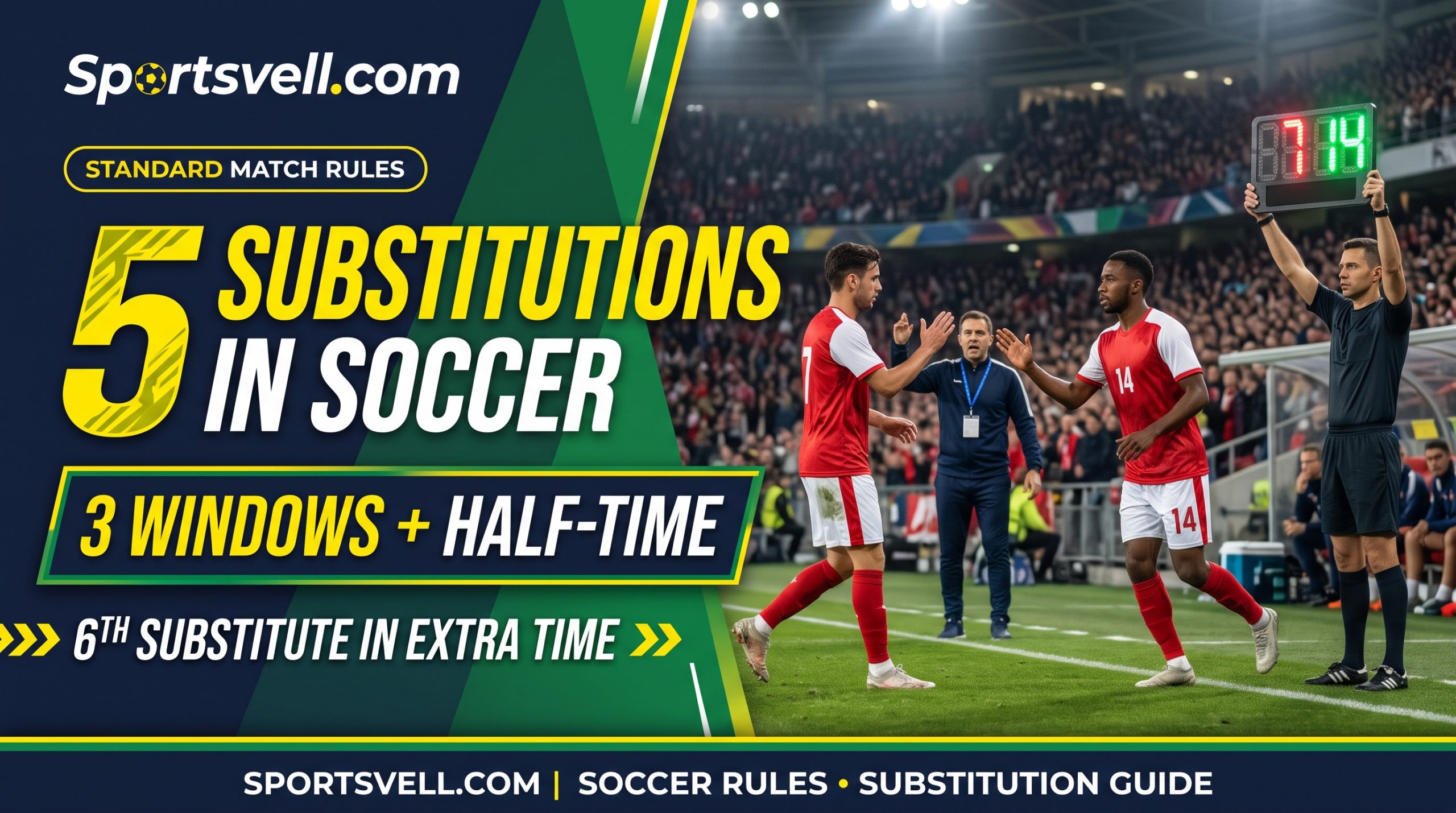
How many players on a soccer team? A soccer team fields 11 players: one goalkeeper and ten outfield players. Both teams together put 22 players on the field at kickoff, and that number is the same in every senior competition in the world.
The full answer is wider than 11. A match cannot start or continue with fewer than 7 players on a side, teams may make 5 substitutions in 3 windows plus half-time, a World Cup squad has 26 players with 15 named substitutes, and youth soccer uses smaller formats that grow with the age of the players.
The confusion comes from three different numbers. The number on the field is 11, the number on the bench is the named substitutes, and the number on the roster is the registered squad. This guide separates all three, then gives the youth formats by age, the substitution rules, and the roster sizes by level.
Every rule here comes from IFAB Law 3 of the Laws of the Game, checked against the Football Association’s official Law 3 page. IFAB, the International Football Association Board, writes the Laws. FIFA applies them in its competitions, but FIFA does not write them.
The Short Answer: 11 Players Per Team
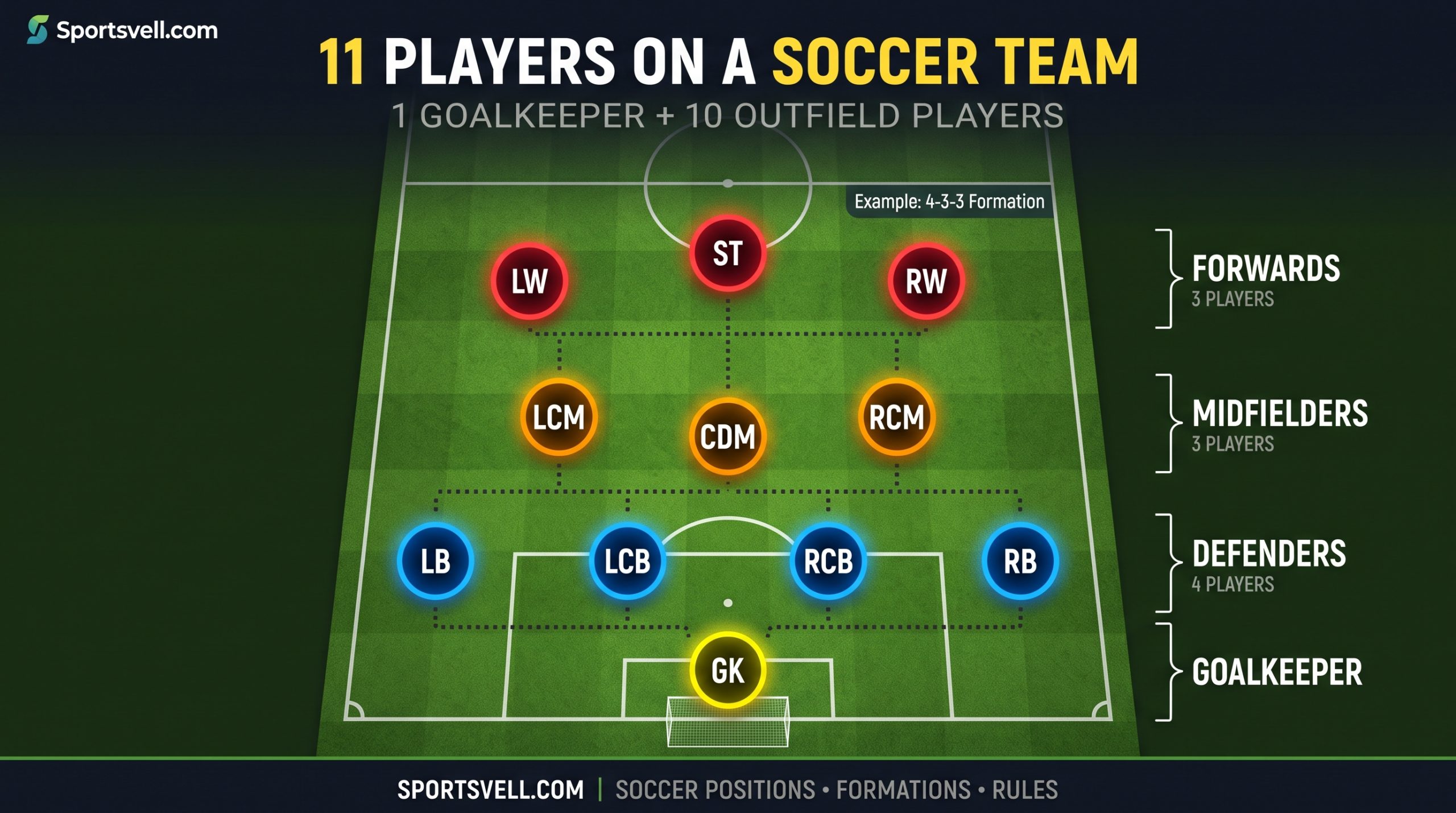
The short answer is 11 players per team. One of the eleven must be the goalkeeper, and the other ten are outfield players. The outfield players split into defenders, midfielders, and forwards, depending on the formation the coach chooses.
Both teams together put 22 players on the field. Add the referee and the two assistant referees, and there are 25 people on the field during play. The fourth official and the team benches stand on the touchline, not on the field.
The 11-Player Breakdown
| Position group | Players | Role |
|---|---|---|
| Goalkeeper | 1 | Defends the goal; the only player allowed to handle the ball inside the penalty area |
| Defenders | 3 to 5 | Protect the goal; stop the other team’s attacks |
| Midfielders | 2 to 5 | Link defence and attack; control the ball in the middle of the field |
| Forwards | 1 to 3 | Score goals; press the other team’s defence |
| Total | 11 | One goalkeeper plus ten outfield players |
The exact split changes with the formation. A 4-4-2 uses four defenders, four midfielders, and two forwards. A 4-3-3 uses four defenders, three midfielders, and three forwards. A 3-5-2 uses three defenders, five midfielders, and two forwards. The total is always eleven, but the balance between defence and attack shifts.
22 Players on the Field
Twenty-two players start every standard match. Eleven wear one team’s colours and eleven wear the other’s, and each side has its own goalkeeper. The number stays at 22 unless a player is sent off or substituted, and it never rises above 22 during play.
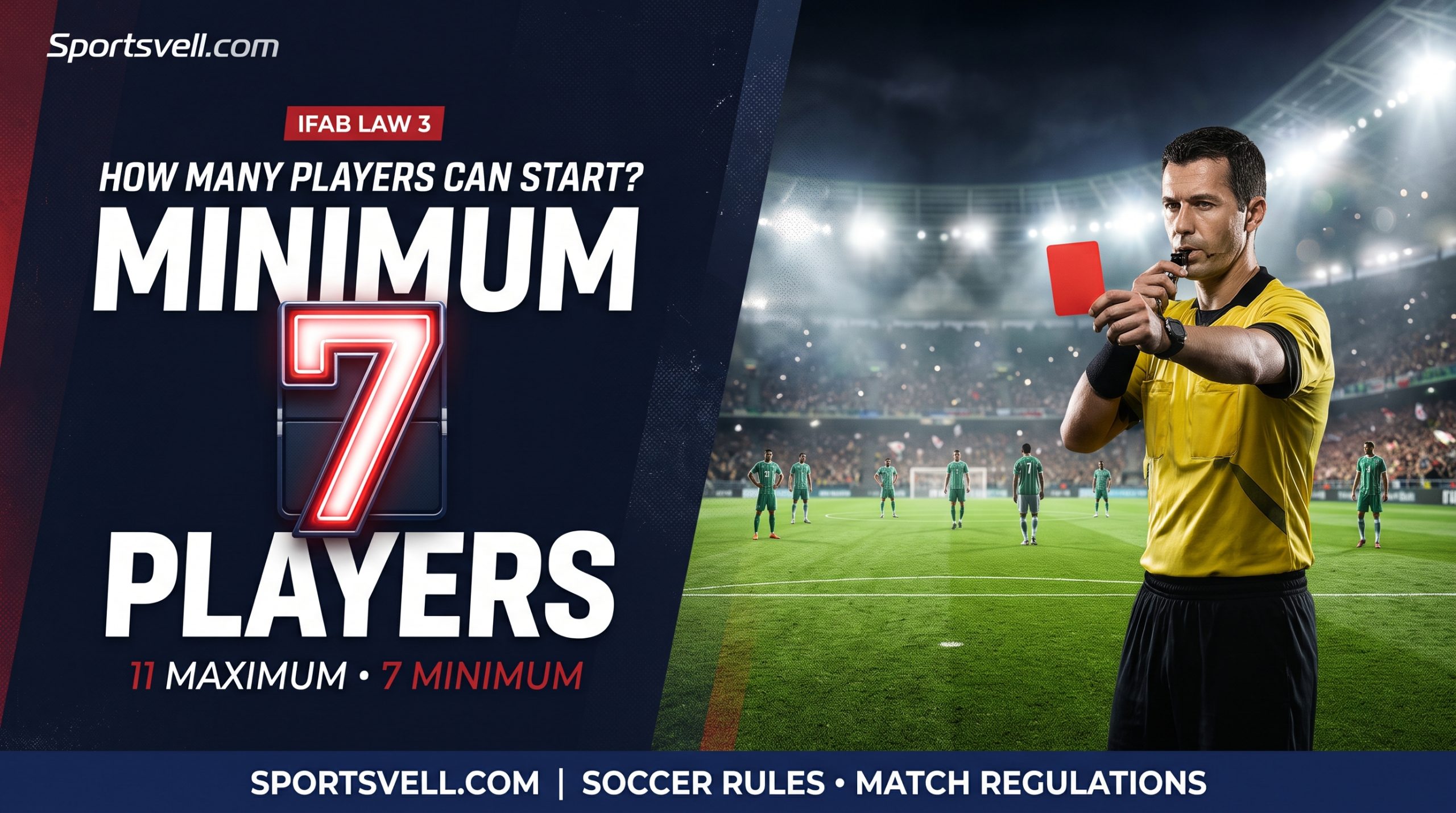
The number can fall during the match. A red card removes a player for the rest of the game, and the team plays with ten. Two red cards leave nine, and the slide continues until the 7-player minimum is reached. The match is abandoned if a team falls below seven players.
What IFAB Law 3 Actually Says
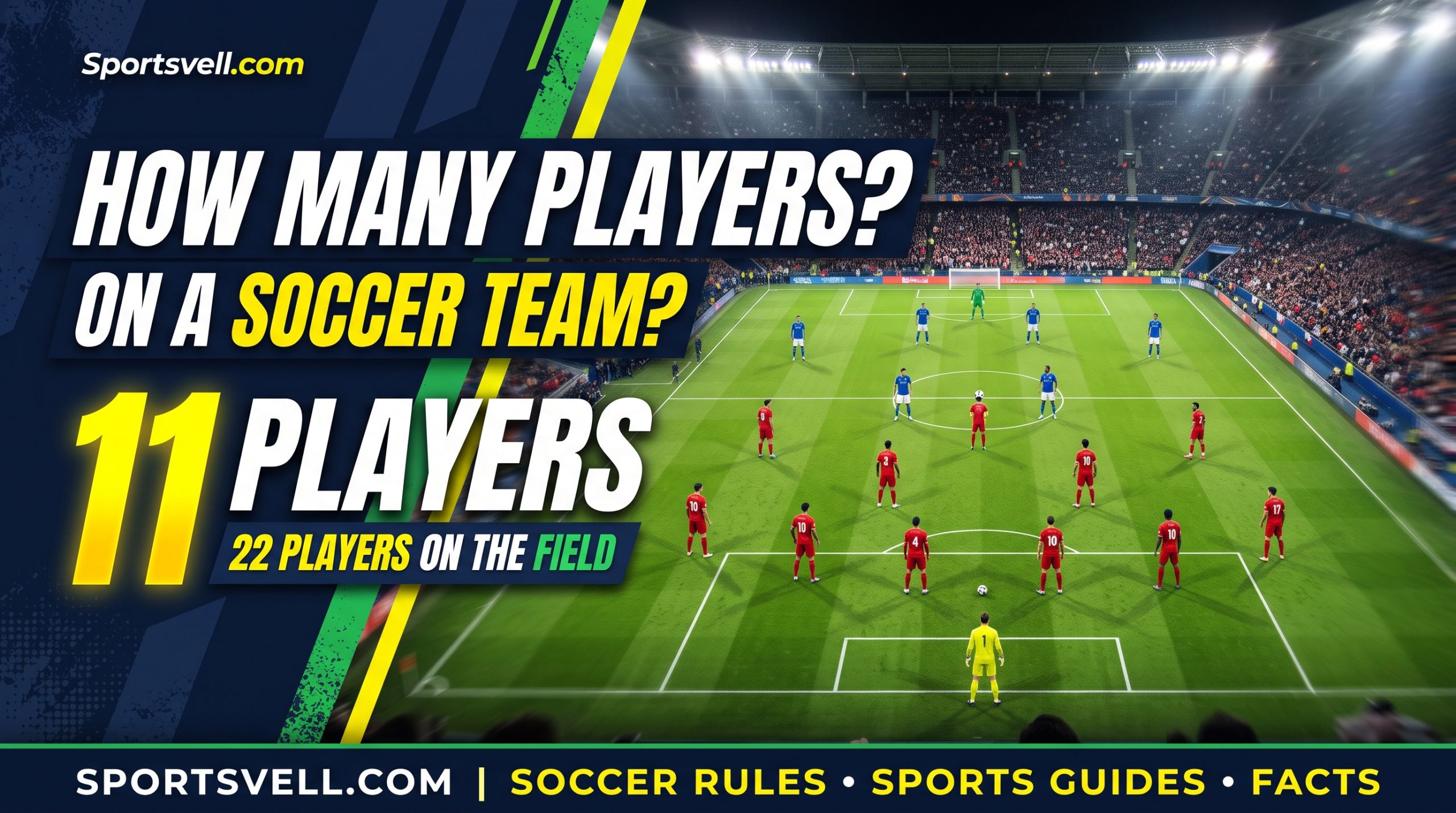
Law 3 is called “The Players,” and it is short. It states that a match is played by two teams, each with a maximum of eleven players, and one must be the goalkeeper. It also states that a match may not start or continue if either team has fewer than seven players.
The rule is a maximum, not a fixed team size. A team may start with fewer than eleven players, as long as it has at least seven. A team that starts with ten because one player is late may add the eleventh when the player arrives, if the player was named before kick-off.
Maximum 11, Minimum 7
Eleven is the most players a team may field, and seven is the fewest. The Football Association’s Law 3 page states both limits in the same paragraph, and it adds that the match must not resume after the ball goes out of play if a team does not have the minimum number of seven players.
The minimum exists because a match with six players is not a fair contest. The field is too large, the spaces are too open, and the game stops resembling soccer. The referee abandons the match, and the competition’s disciplinary process decides the outcome, not the players on the field.
IFAB Writes the Laws, Not FIFA
The International Football Association Board writes the Laws of the Game. IFAB is a small body made up of the four British football associations and FIFA, and it has owned the Laws since the game was formalised. FIFA applies the Laws in its competitions, including the World Cup, but FIFA does not write them.
Several top-ranking pages get this wrong. One competitor names FIFA as the rulemaking body, and that error is worth correcting because it misleads readers about where the rules come from. When a rule changes, it changes because IFAB agreed it, and the change appears in the next edition of the Laws of the Game.
The current edition is the Laws of the Game 2026/27, which came into force on July 1, 2026. Competitions that were mid-season on that date could wait until their next season began. The IFAB Laws of the Game page carries the current edition, and the FA Law 3 page carries the current Law 3 text.
What Happens Below 7 Players
A team that falls below seven players cannot continue. Red cards, injuries after all substitutions are used, and players leaving the field can all push a team under the line. The referee stops the match and reports it to the league, and the competition decides whether the result stands, the match is replayed, or the team forfeits.
There is one narrow exception. If a team has fewer than seven players because one or more players deliberately left the field of play, the referee is not obliged to stop play at once, and advantage may be played. The match must not resume after the ball goes out of play if the team still does not have seven players.
A player who leaves the field for a minor injury does not count against the minimum at once. The game continues with fewer than seven while the player is off the field, and it pauses until the player returns. If the player cannot return and the team has no substitutes left, the match is abandoned.
On the Field vs Bench vs Roster: Three Different Numbers
Three numbers describe a soccer team, and people mix them up. The number on the field is 11, the number on the bench is the named substitutes, and the number on the roster is the registered squad. A “25-man squad” means 25 players are registered for the season, not 25 on the field.
The distinction matters because the numbers differ by level. A World Cup squad has 26 players, a Premier League squad has 25 senior players, an MLS roster has 30 players, and a youth team may have only 12. The on-field number is always 11 in senior soccer, but the roster number is set by each competition.
On the Field: 11
Eleven players take the field for each team at kickoff. That is the starting eleven, and it always includes the goalkeeper. The starting eleven is the only group that plays, and every other player on the roster watches from the bench or the stands.
The starting eleven is chosen by the coach before the match. The coach names the eleven starters and the substitutes, and the referee receives the team sheet before kick-off. A player who is not named cannot take part in the match.
On the Bench: Named Substitutes
The bench holds the named substitutes. Law 3 allows between three and fifteen named substitutes, and the competition rules set the exact number. A World Cup bench holds 15 named substitutes, so all 26 squad members are available on matchday.
Named substitutes are the only players who may enter the game. A player who was not named before kick-off cannot be substituted in, even if the team has substitutions left. The rule stops teams from adding players mid-match.
Club benches are smaller than World Cup benches. A Premier League bench holds nine substitutes, and an MLS bench holds seven. The competition sets the number, and it varies by league, so always check the competition rules for the exact figure.
On the Roster: Registered Squad
The roster is every player registered to the club or team for the season or tournament. It includes the starters, the substitutes, and the players who are injured, suspended, or simply not selected for a given match. The roster is the largest of the three numbers.
Roster limits exist to keep competitions fair. The Premier League caps senior squads at 25 players, of whom at least eight must be home-grown, and players under 21 sit outside the cap entirely. The cap stops rich clubs from hoarding players, and the home-grown rule protects local talent.
The Three Numbers by Level
| Level | On the field | Matchday squad | Registered roster | Substitutes allowed |
|---|---|---|---|---|
| World Cup | 11 | 26 | 26 | 5 (6 in extra time) |
| Premier League | 11 | 20 (11 + 9 subs) | 25 senior players | 5 |
| MLS | 11 | 18 (11 + 7 subs) | 30 | 5 |
| NCAA Division I | 11 | 18 to 22 | 26 to 30 | Competition rules |
| High school | 11 | 18 to 20 | 18 to 20 | Competition rules |
| Youth U13+ | 11 | 18 | 14 to 18 | Rolling, by league |
The table shows why the question has three answers. The on-field number never changes in senior soccer, but the matchday squad and the roster change with the competition. A fan who hears “26-man squad” is hearing the roster number, not the number on the field.
How Many Substitutes Can a Soccer Team Use?
A team may make 5 substitutions in a standard match. The five substitutes must be used in no more than 3 substitution windows, plus half-time, which does not count as a window. The window limit stops teams from breaking the game into pieces with constant stoppages.
The 5-substitute rule is recent. It began as a temporary measure during the congested 2020 fixture calendar, when the pandemic forced matches into a shorter window. IFAB made it permanent in the Laws of the Game 2022/23, which came into force on July 1, 2022.
The 5-Substitute Rule
Five substitutions give coaches real tactical flexibility. A coach can change a third of the outfield players, bring on fresh legs late in the game, and react to injuries without losing the match. The rule also protects player welfare, because tired players are more likely to get injured.
The rule applies in official competitions. FIFA, the confederations, and the national associations set the number for their own competitions, up to a maximum of five. Most top competitions use all five, but lower leagues and youth leagues may use fewer, or allow rolling substitutions instead.
Three Substitution Windows
The three windows are the part most fans miss. A team may make five substitutions, but it may stop the game to do so only three times. A coach who uses one substitute in the first window, two in the second, and two in the third has used all five and all three windows.
Half-time does not count as a window. A coach can make substitutions during the interval without using one of the three windows. Smart coaches use half-time for tactical changes, and save their windows for injuries and late-game fresh legs.
Multiple substitutions in one window count as one window. A coach who brings on three players at the same stoppage uses one window, not three. The rule rewards coaches who plan their changes in groups rather than one at a time.
Extra Time and Concussion Substitutes
Extra time adds a sixth substitution. If a knockout match goes to extra time, each team receives one additional substitute, bringing the total to six for that match. The extra substitute may be used in an additional window during extra time.
A concussion substitute is separate from the five. If a player is suspected of suffering a concussion, the team may make one permanent concussion substitution, regardless of how many regular substitutions it has already used. The rule protects players, and it does not cost the team one of its five changes.
Senior international matches have their own limits. In senior A international team matches, a maximum of fifteen substitutes may be named, and a maximum of eight may be used, unless the two teams agree that more may be used, up to a maximum of eleven. The referee must be informed before the match if the teams agree to more.
The 10-Second Rule (2026/27)
The 2026/27 Laws add a 10-second limit for substituted players. Since the 2026/27 edition, a substituted player must leave the field within ten seconds, at the nearest point on the boundary line, unless the referee indicates otherwise. The rule targets time-wasting, which was the most common complaint about substitutions.
The penalty for a slow exit is a delayed substitution. If the player takes longer than ten seconds, the substitution cannot be cancelled, and the substitute waits for the first stoppage after one minute. The team plays short-handed for that minute, which is a real cost for stalling.
The rule is new, so verify it at publication. It comes from the IFAB Laws of the Game 2026/27, as reported by Football-Law, and competitions that were mid-season on July 1, 2026 could wait until their next season began. Check the current Law 3 text on the FA page before publishing.
Substitution History: 3 Subs to 5 Subs
| Era | Substitutes allowed | What changed |
|---|---|---|
| Before 1958 | 0 | No substitutions; an injured player left the team short-handed |
| 1958 to 1967 | 1 (injury only) | One substitute for an injured player, later for any reason |
| 1967 to 1995 | 2 | A second substitute added for tactical changes |
| 1995 to 2020 | 3 | Three substitutes, the standard for a generation |
| 2020 to 2022 | 5 (temporary) | Temporary increase for the congested pandemic calendar |
| 2022 onward | 5 (permanent) | Made permanent in Laws 2022/23, effective July 1, 2022 |
The history shows the direction of travel. Substitutions started as an injury measure, became a tactical tool, and are now a player-welfare measure. The 5-substitute rule is the largest change to the Laws in a generation, and it reshaped how coaches manage a match.
Soccer Team Sizes by Age: Youth Formats
Youth soccer uses smaller formats because children are smaller and the full field is too big. A seven-year-old on a full-size field touches the ball rarely and runs too far between actions. Small-sided games give every child more touches, more decisions, and more fun, which is why every youth system in the United States uses them.
The formats grow with the age group. The youngest players use 3v3 or 4v4 with no goalkeeper, then the game adds a goalkeeper at 7v7, then grows to 9v9, and finally reaches 11v11 at U13. The progression matches the child’s physical growth and tactical understanding.
U6-U8: 4v4 (Some Leagues 3v3)
US Youth Soccer sets the format at 4v4 for U6 to U8, with no goalkeeper, and some leagues use 3v3 for the youngest players. MLS GO, Major League Soccer’s recreational youth programme, recommends 3v3 for ages 4 to 6 and 4v4 for ages 7 to 8, also with no goalkeeper.
The ball is size 3, the smallest standard ball. The field is 25 to 35 yards long and 15 to 25 yards wide, roughly a quarter of a full-size field. There is no offside rule, no score is kept in the youngest groups, and the game is four short quarters rather than two halves.
MLS GO caps rosters at 7 players for 3v3 and 9 players for 4v4, and it recommends rosters of 5 and 6 players. The recommendation exists because MLS GO wants every player to get at least 50 percent of the game playing time, and a roster of 5 in a 3v3 game guarantees it.
U9-U10: 7v7
US Youth Soccer sets the format at 7v7 for U9 to U10, and the goalkeeper arrives at this age. Six outfield players plus a goalkeeper play on a field 55 to 65 yards long and 35 to 45 yards wide, with a size 4 ball and a 6.5-foot goal.
The build-out line appears at 7v7. It is a line across the field, roughly halfway between the halfway line and the penalty area, and the opposing team must retreat behind it when the goalkeeper has the ball. The rule gives young defenders time to play the ball out from the back.
MLS GO caps 7v7 rosters at 12 players and recommends 10. US Youth Soccer state associations generally cap 7v7 teams at around 12 players for a single match. The minimum to play a 7v7 match is generally 5 players, though the team plays at a disadvantage.
U11-U12: 9v9 (and the MLS GO Conflict)
US Youth Soccer sets the format at 9v9 for U11 to U12, with a goalkeeper, on a field 70 to 80 yards long and 45 to 55 yards wide, with a size 4 ball. Eight outfield players plus a goalkeeper play, and the offside rule applies in full.
MLS GO disagrees, and the conflict matters. MLS GO recommends 7v7 for ages 9 to 12, not 9v9, with a roster cap of 12 and a recommended roster of 10. A parent whose child plays MLS GO will see 7v7 at age 11, while a parent whose child plays US Youth Soccer will see 9v9 at the same age.
Both are right, because formats are set by the league, not by a single national rule. The US Soccer Player Development Initiatives give the standard progression, but leagues adapt it to their own registration numbers and field availability. Parents should check their own league’s rulebook, not assume the national standard applies everywhere.
AYSO, the American Youth Soccer Organization, adds a third variation. AYSO groups U9/U10 and U11/U12 together, with 7v7 or 9v9 play including goalkeepers, and rosters of up to 14 or 18 players. The variation is normal, and it is why this guide names the source for every format figure.
U13 and Older: 11v11
US Youth Soccer sets the format at 11v11 for U13 and older, with a goalkeeper, on a full-size field, with a size 5 ball and two 45-minute halves. The game is now the adult game, with the full Laws of the Game, including offside, and the full 90-minute match length at older ages.
MLS GO uses 9v9 for ages 13 to 14, with a roster cap of 16 and a recommended roster of 12, because MLS GO is a recreational programme that keeps the game smaller for longer. Competitive leagues move to 11v11 at U13, while recreational programmes may wait a year or two.
The jump to 11v11 is the biggest change in youth soccer. The field doubles in size, the ball gets bigger, the game gets longer, and the tactical demands jump. Coaches plan for it by teaching positions and spacing in the 9v9 years, so the players are ready when the format changes.
Roster Sizes and Playing Time
| Age group | Format | Goalkeeper | Ball size | MLS GO roster cap | MLS GO recommended roster |
|---|---|---|---|---|---|
| 4 to 6 (U6) | 3v3 | No | 3 | 7 | 5 |
| 7 to 8 (U8) | 4v4 | No | 3 | 9 | 6 |
| 9 to 12 (U10, U12) | 7v7 | Yes | 4 | 12 | 10 |
| 13 to 14 (U14) | 9v9 | Yes | 4 | 16 | 12 |
| 15 and older | 11v11 | Yes | 5 | 18 | 16 |
The roster caps exist to protect playing time. MLS GO requires rosters that allow each player at least 50 percent of the game playing time, and its recommended roster sizes are built around that rule. A youth roster of 16 for an 11v11 team (11 starters plus 5 substitutes) is the ideal balance between injury cover and playing time.
Large rosters hurt development. SoccerNovo notes that most MLS NEXT, ECNL, and GA teams carry 18 players, which can leave some players with minimal minutes. A roster that is too large means some children pay to watch, and that is the opposite of what youth soccer is for.
Other Soccer Formats
Not every version of soccer uses 11 players. Futsal, beach soccer, and indoor soccer each have their own team size, and recreational leagues use 5v5, 7v7, and 9v9 for adults as well as children. The format changes the game, and the team size is the first thing that changes.
Futsal: 5 Players
Futsal uses 5 players per team: four outfield players and one goalkeeper. It is played indoors on a hard court, with a smaller, heavier ball that bounces less. The game is fast, technical, and built for close control, and it is the official indoor format recognised by FIFA.
Futsal allows rolling substitutions. Players enter and leave freely during the game, without the three-window limit that applies in 11v11 soccer. The rolling rule keeps the tempo high, because tired players leave and fresh players enter without stopping play.
Beach Soccer: 5 Players
Beach soccer also uses 5 players per team: four outfield players and one goalkeeper. It is played on sand, in three 12-minute periods, with a smaller pitch and a ball that is lighter and softer than a standard soccer ball. The sand makes running harder, so the game is built around short bursts and acrobatic shots.
Beach soccer is often confused with futsal, but the surface is the difference. Futsal is indoors on a hard court, beach soccer is outdoors on sand, and both use five players. The team size is the same, but the game is entirely different.
Indoor Soccer: 6 Players
Indoor soccer uses 6 players per team: five outfield players and one goalkeeper. It is played in an arena with walls, and the ball stays in play off the walls, which makes the game continuous and fast. Indoor soccer is the winter-league format in much of the United States.
Indoor soccer also allows rolling substitutions. Like futsal, the game uses free entry and exit, and the team size stays at six during play. The walls and the rolling substitutions make indoor soccer the fastest version of the game.
Recreational 5v5, 7v7, 9v9
Adult recreational leagues use the same small-sided formats as youth soccer. A 5v5 league needs only ten players for a game, a 7v7 league needs fourteen, and a 9v9 league needs eighteen. Small-sided adult leagues are popular because they need fewer players, smaller fields, and less time.
The recreational formats are also the training formats. Professional teams use 5v5 and 7v7 in training to work on close control, quick passing, and decision-making under pressure. The small-sided game is where technique is built, at every level of the sport.
Roster Sizes by Level
Roster sizes grow with the level of play. A youth team needs 12 to 18 players, a high school team needs 18 to 20, a college team needs 26 to 30, and a professional team needs 25 to 30. The growth reflects longer seasons, more competitions, and more injuries to cover.
High School: 18 to 20
High school teams typically roster 18 to 20 players, mirroring professional game-day squads. The roster covers the 11 starters and 7 to 9 substitutes, which is enough for a season of two or three games a week without burning out the starters.
High school soccer follows state association rules, not FIFA rules, for some details. The number on the field is still 11, and the minimum is still 7, but substitution rules vary by state. Some states allow unlimited substitutions with re-entry, which is very different from the professional 5-substitute rule.
College (NCAA Division I): 26 to 30
NCAA Division I teams typically carry 26 to 30 players. The roster is large because the college season is short and intense, with two games a week, and because injuries and academic commitments thin the squad. Not everyone on a 30-player roster will see minutes.
College substitution rules are more generous than professional rules. NCAA soccer allows re-entry in many divisions, which means a substituted player may return to the game later. The rule exists because college soccer is a development level, and coaches want every player to get game time.
MLS: 30-Player Roster, 18 Matchday
Major League Soccer teams carry a 30-player roster. The roster is the largest in American professional soccer, and it reflects the long season, the travel, and the mix of domestic and international competitions. Only 18 players dress for a match: 11 starters and 7 substitutes.
MLS teams name 7 substitutes for a matchday. That is fewer than the 9 on a Premier League bench and far fewer than the 15 on a World Cup bench. The competition sets the number, and MLS sets it at 7, which means 12 roster players sit out every game.
Premier League: 25-Player Squad, 8 Home-Grown
Premier League clubs register a maximum of 25 senior players per season. At least eight of the 25 must be home-grown, which means they spent three years at an English or Welsh club before turning 21. Players under 21 sit outside the cap entirely, so a club can register unlimited young players.
The Premier League bench holds 9 substitutes. The matchday squad is 20 players: 11 starters and 9 substitutes. Five of the nine may be used, in three windows plus half-time, under the same rule that applies across top-level soccer.
World Cup: 26-Player Squad, 15 Named Substitutes
A World Cup squad has 26 players, with a minimum of 23. FIFA increased the maximum from 23 to 26 in June 2022, ahead of the World Cup in Qatar, because of the unusual timing of the tournament and the impact of the pandemic on squads. The 26-player limit has applied at every World Cup since, including the 48-team World Cup in 2026.
All 26 squad members are named for every match. Up to 15 substitutes may be named, so no player misses out, and no more than 26 people, up to 15 substitutes and 11 team officials, may sit on the team bench. One of the 11 officials must be the team doctor.
Five substitutions are allowed, with a sixth in extra time. The five must be used in three windows plus half-time, and a knockout match that goes to extra time adds one more substitute. A concussion substitute is available in addition to the five.
One competitor still carries the old figure. HornetsCentral says the World Cup squad is 23 players with 12 substitutes on the bench, which was correct before 2022 and wrong ever since. The squad has been 26 with 15 named substitutes for four years, and any page that still says 23 is out of date.
How the 11 Split Into Positions
The eleven players split into four groups: goalkeeper, defenders, midfielders, and forwards. The goalkeeper is fixed, but the other ten move between the three outfield groups depending on the formation. The formation is the coach’s plan for how the ten outfield players are arranged.
Goalkeeper, Defenders, Midfielders, Forwards
The goalkeeper defends the goal and is the only player who may handle the ball. The goalkeeper may use hands only inside the penalty area, and must release the ball within six seconds. A team always has exactly one goalkeeper on the field, and if the goalkeeper is sent off, an outfield player must take the gloves or a substitute goalkeeper must enter.
Defenders protect the goal and stop the other team’s attacks. Centre-backs mark the strikers, full-backs cover the wide areas, and wing-backs push forward when the team has the ball. A team usually fields three to five defenders, depending on the formation.
Midfielders link defence and attack. Defensive midfielders shield the defence, central midfielders control the tempo, and attacking midfielders create chances. A team usually fields two to five midfielders, and the midfield is where most matches are won and lost.
Forwards score goals and press the other team’s defence. Strikers lead the line, wingers attack from wide areas, and second strikers link the midfield to the attack. A team usually fields one to three forwards, depending on how attacking the coach wants to be.
Common Formations: 4-4-2, 4-3-3, 3-5-2
| Formation | Defenders | Midfielders | Forwards | Style |
|---|---|---|---|---|
| 4-4-2 | 4 | 4 | 2 | Balanced and simple; two banks of four, two strikers |
| 4-3-3 | 4 | 3 | 3 | Attacking; three forwards stretch the defence wide |
| 3-5-2 | 3 | 5 | 2 | Midfield control; wing-backs provide the width |
| 5-3-2 | 5 | 3 | 2 | Defensive; five at the back, counter-attacking |
| 4-2-3-1 | 4 | 5 (2 holding, 3 attacking) | 1 | Modern standard; one striker, three creators behind |
The formation numbers always add to ten, plus the goalkeeper. The first number is the defenders, the second is the midfielders, and the third is the forwards, and the three numbers always sum to ten. The goalkeeper is not counted in the formation numbers, because there is always exactly one.
Cricket also fields 11 players per team, which makes it the closest cousin to soccer in team size. A cricket side has 11 players on the field, with the same tension between batting depth and bowling cover that soccer has between attack and defence. Our India vs New Zealand match scorecard and our England vs India match scorecard both cover 11-player teams in a different sport, where the count works the same way.
Why 11 Players? A Short History
The 11-player format was settled in England in the 1860s, when soccer was formalised. Teams experimented with different numbers before that, and some early matches used 15 or more players per side. The game settled on 11 because it provided the right balance between attack and defence on a full-size field.
Eleven works because the field is large and the ball moves fast. Fewer players would leave the field too open and the game too stretched, while more players would crowd the field and kill the space. Eleven gives each player a role, gives the team shape, and leaves room for skill to show.
The number has not changed in more than 150 years. Substitutions, squad sizes, and youth formats have all changed, but the on-field number has stayed at 11 since the first Laws were written. The stability is the reason the question has a simple answer, and the reason the rest of the answer is about everything around the 11.
American football also counts its players carefully, and the numbers are close cousins. A football team fields 11 players, just like a soccer team, but the roster is far larger and the substitutions are unlimited. Our guides on how long a football game lasts and how many acres a football field covers measure the other 11-player game, and our Monday Night Football hub tracks its biggest weekly stage.
FAQs About How Many Players Are on a Soccer Team
How many players on a soccer team?
A soccer team fields 11 players: one goalkeeper and ten outfield players. Both teams together put 22 players on the field at kickoff. The rule comes from IFAB Law 3 of the Laws of the Game.
How many players are on a soccer team including the goalkeeper?
Eleven players, including the goalkeeper. The eleven break down as one goalkeeper and ten outfield players, who split into defenders, midfielders, and forwards depending on the formation.
How many players on a soccer field?
Twenty-two players are on the field at kickoff, eleven per team. Add the referee and the two assistant referees, and there are 25 people on the field during play.
How many players on a soccer team including substitutes?
It depends on the competition. A World Cup matchday squad has 26 players (11 starters and 15 substitutes), a Premier League matchday squad has 20 (11 starters and 9 substitutes), and an MLS matchday squad has 18 (11 starters and 7 substitutes).
What is the minimum number of players for a soccer game?
Seven players per team is the minimum. A match may not start or continue if either team has fewer than seven players, per IFAB Law 3. The match is abandoned if a team falls below seven.
Can a soccer game start with 7 players?
Yes, a match may start with 7 players. Law 3 sets seven as the minimum to start or continue, so a team with seven, eight, nine, or ten players may start, and may add named players when they arrive.
What happens if a soccer team has less than 7 players?
The match is abandoned. The referee stops the game and reports it to the competition, which decides whether the result stands, the match is replayed, or the team forfeits. Red cards and injuries after all substitutions are used are the usual causes.
How many substitutes are allowed in soccer?
Five substitutions are allowed in a standard match, in no more than three substitution windows plus half-time. Extra time adds a sixth substitute, and a concussion substitute is available in addition to the five.
How many substitutes can a soccer team name?
Law 3 allows between three and fifteen named substitutes, and the competition sets the exact number. A World Cup bench holds 15 named substitutes, a Premier League bench holds 9, and an MLS bench holds 7.
How many substitution windows are there in soccer?
Three substitution windows, plus half-time. A team may stop the game to make substitutions only three times, but half-time does not count as a window, and multiple substitutions in one window count as one window.
What is the 10-second substitution rule?
Since the 2026/27 Laws, a substituted player must leave the field within ten seconds, at the nearest point on the boundary line, unless the referee indicates otherwise. If the player takes longer, the substitute waits for the first stoppage after one minute.
How many players on a World Cup squad?
A World Cup squad has 26 players, with a minimum of 23. FIFA increased the maximum from 23 to 26 in June 2022, and the 26-player limit has applied at every World Cup since, including the 48-team tournament in 2026.
How many players on a youth soccer team?
It depends on the age group. US Youth Soccer uses 4v4 for U6-U8, 7v7 for U9-U10, 9v9 for U11-U12, and 11v11 for U13 and older. MLS GO uses 3v3 for ages 4-6, 4v4 for ages 7-8, 7v7 for ages 9-12, and 9v9 for ages 13-14.
How many players on a U10 soccer team?
Seven players are on the field for U10: six outfield players and one goalkeeper. The format is 7v7, the ball is size 4, and the roster is usually 10 to 12 players. The minimum to play a 7v7 match is generally 5 players.
How many players on a U12 soccer team?
Nine players are on the field for U12 under US Youth Soccer: eight outfield players and one goalkeeper. The format is 9v9. MLS GO uses 7v7 for ages 9-12, so the format depends on the league, and parents should check their own league’s rulebook.
How many players on a high school soccer team?
High school teams typically roster 18 to 20 players. Eleven start, and 7 to 9 sit on the bench as substitutes. Substitution rules vary by state, and some states allow unlimited substitutions with re-entry.
How many players on a college soccer team?
NCAA Division I teams typically carry 26 to 30 players. The roster is large because the season is short and intense, and not everyone on a 30-player roster will see minutes. College substitution rules are more generous than professional rules, and re-entry is allowed in many divisions.
How many players on a professional soccer team?
Eleven players are on the field, and the roster is 25 to 30 players. A Premier League squad has 25 senior players, an MLS roster has 30 players, and the matchday squad is 18 to 20 depending on the competition.
How many players on a futsal team?
Five players are on the court for futsal: four outfield players and one goalkeeper. Futsal is played indoors on a hard court with a smaller, heavier ball, and it allows rolling substitutions.
How many players on a beach soccer team?
Five players are on the sand for beach soccer: four outfield players and one goalkeeper. The game is played in three 12-minute periods, and it is different from futsal, which is played indoors on a hard court.
How many players on an indoor soccer team?
Six players are on the field for indoor soccer: five outfield players and one goalkeeper. The game is played in an arena with walls, and the ball stays in play off the walls. Rolling substitutions are allowed.
What positions are on a soccer team?
The positions are goalkeeper, defender, midfielder, and forward. The goalkeeper defends the goal, defenders stop attacks, midfielders link defence and attack, and forwards score goals. The exact split depends on the formation.
What is the starting eleven in soccer?
The starting eleven are the 11 players who begin the game on the field. The coach names them before kick-off, along with the substitutes, and the referee receives the team sheet. A player who is not named cannot take part in the match.
What is a matchday squad in soccer?
The matchday squad is the starters plus the named substitutes for one match. A World Cup matchday squad has 26 players, a Premier League matchday squad has 20, and an MLS matchday squad has 18. Only the matchday squad may take part in that game.
Why are there 11 players on a soccer team?
Eleven was settled in England in the 1860s because it balanced attack and defence on a full-size field. Fewer players would leave the field too open, and more players would crowd it. The number has not changed in more than 150 years.
Conclusion
How many players on a soccer team? Eleven on the field, one goalkeeper and ten outfield players, with 22 players on the field at kickoff. The match cannot start or continue with fewer than seven players per side, and the team may make five substitutions in three windows plus half-time.
The roster is a different number, and it depends on the competition. A World Cup squad has 26 players, a Premier League squad has 25 senior players, an MLS roster has 30, and a youth team has 12 to 18. The on-field number never changes in senior soccer, but the roster number is set by each competition.
Youth soccer grows with the child. The youngest players use 3v3 or 4v4 with no goalkeeper, then 7v7, then 9v9, and finally 11v11 at U13. The formats exist so every child touches the ball more, makes more decisions, and enjoys the game more.
The rules keep changing, so check the current edition. The 5-substitute rule became permanent in 2022, and the 10-second substitution rule arrived in the 2026/27 Laws. The IFAB Laws of the Game and the FA Law 3 page carry the current text, and they are the first place to look when a rule changes.
Soccer is the world’s game because the number is simple and the game is deep. Eleven players, one ball, and 90 minutes have filled stadiums for more than a century. Keep exploring the sport, from the latest cricket scorecards to Monday Night Football, and keep the count in mind: eleven on the field, seven at the minimum, and twenty-six in a World Cup squad.