NHL Overtime Rules 2026–27: How OT and Shootouts Work
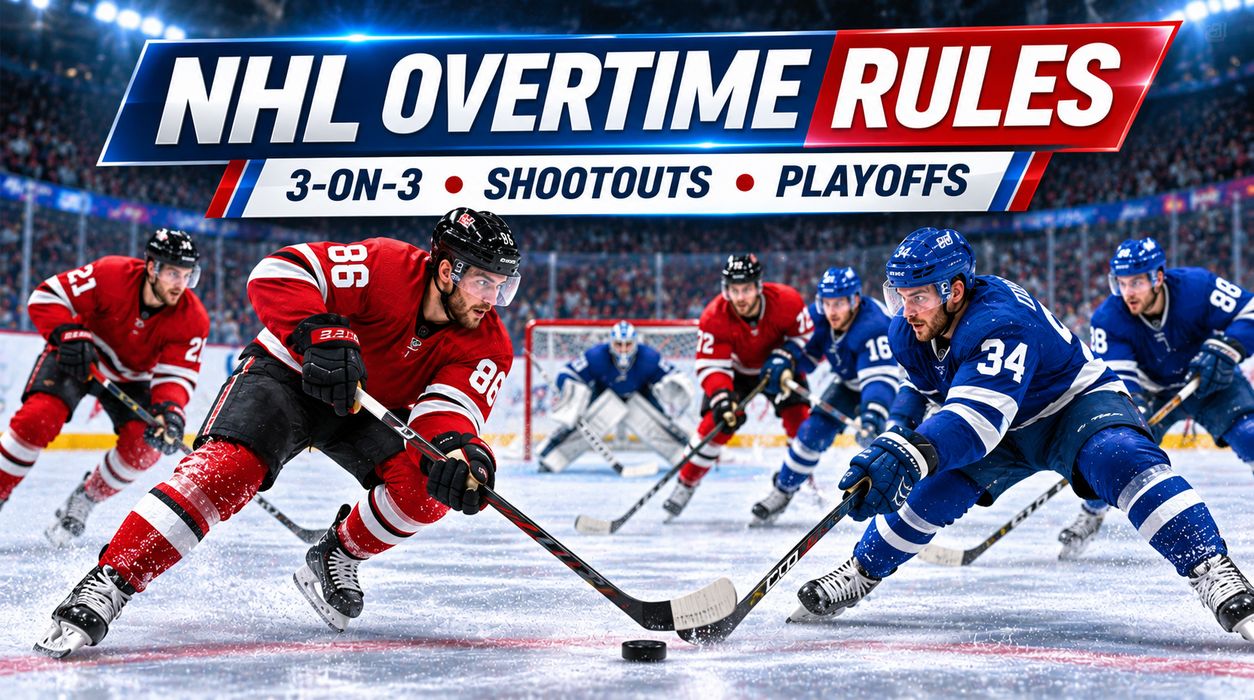
NHL overtime rules in 2026–27 give teams five minutes of three-on-three sudden-death hockey during the regular season. If neither team scores, the game moves to a shootout. In the Stanley Cup Playoffs, overtime works differently: teams play full 20-minute periods at five-on-five until someone scores.
These differences can confuse fans, especially when a regular-season game and a playoff game both end regulation tied.
Why does the NHL use three skaters in regular-season overtime? How many shootout attempts does each team get? Can a playoff game continue for several hours? And why does a team still earn a standings point after losing in overtime?
This guide explains the NHL’s 2026–27 overtime rules, including game length, shootout procedures, penalties, standings points, and the differences between regular-season and playoff hockey.
NHL Overtime Rules 2026–27: Quick Answer
The NHL uses two different overtime systems depending on the competition.
| Rule | Regular Season | Stanley Cup Playoffs |
|---|---|---|
| Overtime length | 5 minutes | 20 minutes per period |
| Players at full strength | 3-on-3 | 5-on-5 |
| Sudden death | Yes | Yes |
| Shootout | Yes, if still tied | No |
| Multiple overtime periods | No | Yes |
| Can the game end tied? | No | No |
| Standings points | 2 for winner, 1 for OT/SO loser | Not applicable |
Both systems follow the principle of sudden death: the first legal goal in overtime immediately ends the game.
The rules are published in the NHL’s official 2026–27 rulebook and video rulebook.
How Does NHL Overtime Work in the Regular Season?
A standard NHL game includes three 20-minute regulation periods.
That creates 60 minutes of scheduled regulation playing time.
If the score is tied after the third period, the game proceeds to overtime.
Step 1: Regulation Ends in a Tie
Imagine the New York Rangers and Boston Bruins are tied 3–3 after 60 minutes.
Neither team wins in regulation, so both teams earn one standings point.
The game then proceeds to a five-minute overtime period.
Step 2: Three-on-Three Overtime Begins
Each team normally starts overtime with three skaters and one goaltender.
The teams change ends, and the game resumes after a short break.
Unlike regulation hockey, where five skaters compete for each team, the reduced lineup creates more open ice.
Step 3: The First Goal Wins
Overtime uses sudden-death scoring.
If the Rangers score after two minutes, the game ends immediately.
The Rangers receive the victory and two standings points.
The Bruins receive one standings point for reaching overtime.
Step 4: A Shootout Decides an Unresolved Tie
If neither team scores during the five-minute overtime period, the game advances to a shootout.
The shootout determines the winner through individual scoring attempts against the opposing goaltender.
The regular-season game cannot finish as a tie.
Why Does the NHL Use Three-on-Three Overtime?
The NHL introduced three-on-three regular-season overtime in the 2015–16 season.
Previously, the league used four-on-four overtime.
The change was designed to create more scoring opportunities and reduce the number of games requiring shootouts.
More Open Ice
A standard NHL rink is approximately 200 feet long and 85 feet wide.
With only three skaters per team, players have more room to accelerate, pass, and create scoring opportunities.
The reduced number of defenders can lead to breakaways and odd-man rushes.
Faster Transitions
Three-on-three hockey can change direction quickly.
One moment, a team may be attacking with possession.
Seconds later, an intercepted pass can produce a scoring opportunity at the opposite end.
This makes puck control especially important.
Greater Importance of Possession
Teams often avoid unnecessary shots or risky passes during overtime.
A missed opportunity can immediately give the opponent possession and open ice.
Coaches may prefer players who can maintain possession, skate effectively, and make quick decisions.
More Responsibility for Each Skater
With fewer players on the ice, individual defensive mistakes become more noticeable.
Every skater must contribute to both offense and defense.
A player who loses an assignment may leave a dangerous scoring opportunity.
How Long Is NHL Overtime?
During the regular season, NHL overtime lasts a maximum of five minutes.
However, the period can end much earlier if a team scores.
For example:
- A goal after 25 seconds ends overtime immediately.
- A goal after three minutes ends the game with two minutes remaining.
- No goal after five minutes sends the game to a shootout.
The five-minute limit refers to actual game-clock time.
The real-world duration can be longer because of stoppages, penalties, reviews, and other delays.
This distinction also applies to other sports. SportsVell’s guide to how long a football game lasts explains why scheduled playing time and the actual duration of a sporting event are not the same.
How Do NHL Shootout Rules Work?
If the game remains tied after five minutes of regular-season overtime, the teams participate in a shootout.
A shootout consists of individual attempts in which a shooter tries to score against the opposing goaltender.
Three Initial Rounds
Each team selects three eligible shooters.
The teams alternate attempts.
After three rounds, the team with more successful attempts wins.
For example:
| Round | Team A | Team B |
|---|---|---|
| 1 | Goal | Save |
| 2 | Save | Goal |
| 3 | Goal | Save |
| Total | 2 | 1 |
Team A wins the shootout because it scored twice while Team B scored once.
The shootout can end before all six scheduled attempts if one team has an insurmountable lead.
What Happens If the Shootout Is Still Tied?
If both teams have the same number of goals after three rounds, the shootout moves into sudden-death rounds.
Each team receives one additional attempt per round.
If one team scores and the other fails in the same round, the scoring team wins.
If both score or both miss, another round is played.
The process continues until there is a winner.
Can the Same Player Shoot Twice?
A player cannot take a second shootout attempt until all eligible players on that team have had an opportunity to shoot.
This prevents teams from repeatedly using only their best scorers.
Do Shootout Goals Count Toward Player Statistics?
Shootout goals do not count toward a player’s regular-season goal total.
A shootout winner is reflected in the official team result, but individual shootout scoring is tracked separately from normal game scoring.
This distinction matters when comparing player statistics.
How Are NHL Standings Points Awarded in Overtime?
The NHL uses a standings system that awards two points for a victory.
Teams that lose in overtime or a shootout normally receive one point.
| Game Result | Standings Points |
|---|---|
| Regulation win | 2 |
| Overtime win | 2 |
| Shootout win | 2 |
| Overtime loss | 1 |
| Shootout loss | 1 |
| Regulation loss | 0 |
Example: A 4–3 Overtime Victory
Suppose the Toronto Maple Leafs defeat the Montreal Canadiens 4–3 in overtime.
Toronto receives two standings points.
Montreal receives one standings point.
The game distributes three total standings points.
Example: A 4–3 Regulation Victory
If Toronto wins the same game in regulation, Toronto receives two points and Montreal receives zero.
The game distributes only two total standings points.
This difference is one reason overtime results can influence playoff races.
Why Is the Overtime Loser Awarded a Point?
Both teams receive a point when regulation ends tied.
The overtime or shootout winner receives an additional point.
The system rewards teams for avoiding a regulation loss while still providing an incentive to win.
There is an important exception involving a team that removes its goaltender for an extra attacker during overtime. That situation is explained later in this guide.
NHL Playoff Overtime Rules: What Changes?
Stanley Cup Playoff overtime is significantly different from regular-season overtime.
The playoffs do not use the five-minute three-on-three format.
Instead, teams play full 20-minute overtime periods at normal five-on-five strength.
Full-Length Overtime Periods
If a playoff game is tied after regulation, the teams take an intermission before beginning a 20-minute overtime period.
The first team to score wins immediately.
If neither team scores during the period, the teams take another intermission and play another 20-minute overtime period.
This continues until someone scores.
There Is No Shootout in the Playoffs
The NHL does not use shootouts to determine Stanley Cup Playoff games.
Every playoff game must be decided by a goal scored during normal hockey play.
That means a playoff game can continue into double overtime, triple overtime, or even longer.
Why Does the NHL Use Five-on-Five Playoff Overtime?
The playoffs use the traditional full-strength game format to determine the winner.
Teams must continue playing standard hockey until a decisive goal is scored.
This preserves the normal structure of the game rather than switching to the more open three-on-three format.
What Is Double Overtime in Hockey?
Double overtime occurs when a playoff game remains tied after the first 20-minute overtime period.
The teams then play a second overtime period.
For example:
- Regulation: 60 minutes
- First overtime: 20 minutes
- Second overtime: Up to 20 additional minutes
If the winning goal comes 12 minutes into the second overtime, the game has included 92 minutes of actual playing time.
That does not include intermissions or stoppages.
What Is Triple Overtime?
Triple overtime begins when neither team scores during the first two overtime periods.
The third overtime period is another 20-minute sudden-death period.
A game reaching triple overtime has already completed 100 minutes of playing time.
Can an NHL Playoff Game Last Forever?
There is no fixed maximum number of overtime periods in the Stanley Cup Playoffs.
The game continues until a legal goal determines the winner.
In practice, extremely long playoff games are rare, but they remain possible under the rules.
What Happens When a Player Gets a Penalty in Three-on-Three Overtime?
Penalties work differently during regular-season overtime because teams cannot be reduced below three skaters.
If a player receives a minor penalty, the opposing team generally adds a skater.
Four-on-Three Power Play
Imagine Team A receives a minor penalty during three-on-three overtime.
Team B gains a four-on-three advantage.
Team A keeps three skaters, while Team B uses four.
This differs from regulation, where a standard minor penalty typically creates a five-on-four situation.
Five-on-Three Advantage
If a team receives another penalty that creates a two-player disadvantage, the opposing team may have five skaters against three.
The penalized team does not drop below three skaters.
What Happens When a Penalty Expires?
When a penalty expires, the player can return to the ice.
This may temporarily create four-on-four play.
At the appropriate stoppage, the officials restore the normal three-on-three format.
These adjustments are covered by the NHL’s overtime penalty rules.
Can a Team Pull Its Goalie During NHL Overtime?
Yes, but the decision involves a special risk.
A team may remove its goaltender to add an extra skater during regular-season overtime.
However, if that team loses while its goaltender is removed for an extra attacker, it normally forfeits the standings point earned by reaching overtime.
There is an exception when the goaltender is removed because of a delayed penalty against the opposing team.
Example of the Risk
Suppose a game is tied 2–2 after regulation.
Team A removes its goaltender during overtime to create an offensive advantage.
Team B gains possession and scores into the empty net.
Team A loses the game and, under the applicable rule, forfeits its overtime standings point.
This makes pulling the goaltender an unusually risky strategy during regular-season overtime.
Do NHL Overtime Goals Count Toward Player Statistics?
Yes.
A goal scored during regular-season or playoff overtime counts as an official goal for the player.
Assists may also be awarded.
For example, if a player scores a sudden-death overtime winner, the goal contributes to that player’s statistics.
Shootout goals are different because they are not included in ordinary player goal totals.
Overtime Goals vs. Shootout Goals
| Statistical Category | Overtime Goal | Shootout Goal |
|---|---|---|
| Counts toward player goals | Yes | No |
| Assists possible | Yes | No |
| Can end the game | Yes | Yes |
| Recorded as regular game scoring | Yes | No |
Understanding this distinction is useful when comparing scoring totals or analyzing player performance.
How Does Overtime Affect NHL Team Records?
NHL standings distinguish between several types of results.
Common abbreviations include:
- W: Wins
- L: Regulation losses
- OT: Overtime and shootout losses
- PTS: Standings points
- RW: Regulation wins
- ROW: Regulation and overtime wins
These categories help determine standings positions and can be used in tiebreaking procedures.
For example, two teams may have the same number of standings points but different numbers of regulation victories.
The NHL uses a defined tiebreaking system to determine which team ranks higher.
The distinction between different types of victories becomes especially important near the end of the regular season.
Why Do NHL Games Sometimes Have More Than Two Total Standings Points?
A regulation game distributes two standings points.
An overtime or shootout game normally distributes three.
This happens because both teams earn a point for reaching overtime, and the eventual winner receives a second point.
Some fans refer to the additional point as the “loser point.”
However, that expression is informal.
The official standings system simply records the result as an overtime or shootout loss.
Does This Affect Playoff Races?
Yes.
Teams competing for a playoff position can benefit from earning one point in an overtime loss rather than receiving no points in a regulation loss.
Over an entire season, these results may affect the standings.
A team with several overtime losses could accumulate more points than another team with a similar number of wins but more regulation losses.
Why Is Three-on-Three Overtime So Different From Five-on-Five Hockey?
Three-on-three hockey changes how teams use the rink.
With fewer skaters, defensive positioning becomes more difficult.
Players often need to cover larger areas.
A single turnover may create a dangerous scoring opportunity.
Offensive Strategy
Teams may prioritize possession rather than shooting immediately.
Skaters can circle back into the neutral zone to reset an attack.
The objective is to create a high-quality chance without exposing the team to an easy counterattack.
Defensive Strategy
Defenders must carefully manage spacing.
Aggressive pressure can be dangerous if it leaves an opponent unmarked.
Teams may focus on protecting the middle of the ice and preventing breakaways.
Player Selection
Coaches frequently choose players with strong skating ability, puck control, and defensive awareness.
Three-on-three overtime requires a combination of offensive creativity and responsible positioning.
The importance of player roles is also visible in other team sports. SportsVell’s article on how many players are on a soccer team explains how positioning and player numbers shape the structure of a game.
How Do NHL Overtime Rules Compare With Other Sports?
Different professional leagues use different methods to resolve tied games.
The NHL combines sudden-death overtime with shootouts during the regular season.
The NFL uses a separate overtime system based on football possession and scoring rules.
Soccer competitions may use extra time and penalty shootouts, depending on the competition.
Basketball typically uses additional timed periods until a winner is determined.
The differences reflect the structure and traditions of each sport.
For readers interested in how team size influences gameplay, SportsVell’s football team roster guide explains the distinction between active players and the larger roster.
How Did NHL Overtime Rules Change Over Time?
The NHL has adjusted its overtime system several times.
1983–84: Five-Minute Overtime Returns
The league introduced a five-minute sudden-death overtime period for regular-season games.
1999–2000: Four-on-Four Overtime
The NHL moved to four-on-four overtime and introduced the standings point for overtime losses.
2005–06: Shootouts Begin
The NHL introduced shootouts to eliminate ties from regular-season games.
2015–16: Three-on-Three Overtime
The league replaced four-on-four overtime with three-on-three play.
The objective was to increase the likelihood of a goal before the shootout.
2026–27: Current Format
The NHL continues using five-minute three-on-three overtime followed by a shootout when necessary.
Playoff overtime remains full-length, five-on-five sudden-death hockey.
The historical changes illustrate how the league has tried to balance entertainment, competition, and game duration.
What Is the Difference Between Overtime and a Shootout?
Overtime is an additional period of normal hockey play, although the regular-season format uses fewer skaters.
A shootout is a separate competition involving individual scoring attempts.
Overtime
During overtime, players skate, pass, defend, and compete for possession.
A legal goal ends the game immediately.
Shootout
During a shootout, one player attempts to score against the opposing goaltender.
Other skaters do not participate in that attempt.
The result is determined by the number of successful attempts under the shootout procedure.
A shootout is therefore not simply another overtime period.
It is a separate method of deciding a tied regular-season game.
Does the NHL Use Overtime During the All-Star Game?
All-Star events can use special tournament formats that differ from the normal NHL rulebook.
For example, the announced 2027 NHL All-Star Game uses short three-on-three round-robin games.
Those preliminary games can end tied and use a special tournament points system.
That is different from a standard NHL regular-season game, which must produce a winner.
Fans should therefore avoid applying ordinary NHL overtime rules automatically to exhibition tournaments or international competitions.
Common NHL Overtime Mistakes Fans Should Avoid
Several misunderstandings appear frequently when people discuss overtime.
Mistake 1: Every NHL Overtime Period Lasts Five Minutes
Only regular-season overtime uses the five-minute format.
Playoff overtime periods last 20 minutes.
Mistake 2: NHL Playoff Games Can End in Shootouts
The Stanley Cup Playoffs do not use shootouts.
Games continue through additional overtime periods until a goal is scored.
Mistake 3: An Overtime Loss Always Means Zero Points
During the regular season, an overtime loss normally earns one standings point.
Mistake 4: Shootout Goals Count Toward a Player’s Goal Total
Shootout goals are tracked separately from normal player scoring statistics.
Mistake 5: A Team Plays With Two Skaters After a Minor Penalty in Three-on-Three Overtime
The penalized team generally keeps three skaters, while the opposing team gains an additional skater.
Frequently Asked Questions About NHL Overtime Rules
How long is NHL overtime in 2026–27?
Regular-season overtime lasts up to five minutes. Stanley Cup Playoff overtime consists of 20-minute periods that continue until a team scores.
Is NHL overtime three-on-three?
Yes, during the regular season. Each team normally uses three skaters and one goaltender. Playoff overtime uses five-on-five hockey at full strength.
What happens if nobody scores in NHL overtime?
During the regular season, the game moves to a shootout. During the playoffs, another 20-minute overtime period begins after an intermission.
How many rounds are in an NHL shootout?
Each team initially receives three attempts. If the score remains tied, additional sudden-death rounds determine the winner.
Can an NHL regular-season game end in a tie?
No. Overtime and shootout rules ensure every regular-season game has a winner.
Is there a shootout in the Stanley Cup Playoffs?
No. Playoff games continue through sudden-death overtime periods until a goal is scored.
Does the losing team get a point in overtime?
Normally, yes. A regular-season overtime or shootout loss earns one standings point, subject to the special rule involving a team that pulls its goaltender for an extra attacker.
Do overtime goals count toward NHL statistics?
Yes. Goals scored during overtime count toward official player statistics. Shootout goals do not.
What happens after a penalty in three-on-three overtime?
The opposing team generally adds a skater, creating a four-on-three power play.
Can a playoff game go to quadruple overtime?
Yes. The NHL has no fixed limit on the number of playoff overtime periods.
Why did the NHL introduce three-on-three overtime?
The league introduced the format to create more open ice, increase scoring opportunities, and reduce the number of games decided by shootouts.
When did the NHL stop allowing regular-season ties?
The NHL eliminated regular-season ties when it introduced the shootout in the 2005–06 season.
Final Thoughts
Understanding the NHL overtime rules for 2026–27 makes it easier to follow close games, playoff races, and postseason drama.
During the regular season, teams play five minutes of three-on-three sudden-death hockey. If neither team scores, a shootout determines the winner.
In the Stanley Cup Playoffs, teams play full 20-minute overtime periods at five-on-five until a goal ends the game.
The standings system also makes overtime important because teams that lose after regulation normally receive one point.
For fans, the key difference is simple: regular-season overtime is designed to produce a winner quickly, while playoff overtime continues under traditional hockey rules until a decisive goal is scored.
For further information, consult the NHL’s official rules FAQ.
You can also explore other SportsVell sports explainers, including how many acres are in a football field, for additional comparisons of sporting rules and playing environments.

Washim is a passionate sports writer and editor at SportsVell.com, covering the latest sports news, match updates, player performances, and expert analysis. He focuses on football, cricket, basketball, NFL, NBA, UFC, and other major sports. His goal is to provide sports fans with accurate, engaging, and easy-to-understand content from around the world.