Australia vs England Match Scorecard: Ashes 2025-26 Results (4-1)

Australian men’s cricket team vs England cricket team match scorecard searches all lead to one answer. Australia won the Ashes 2025-26 by four Tests to one.
The five-match series ran from November 21, 2025 to January 8, 2026.
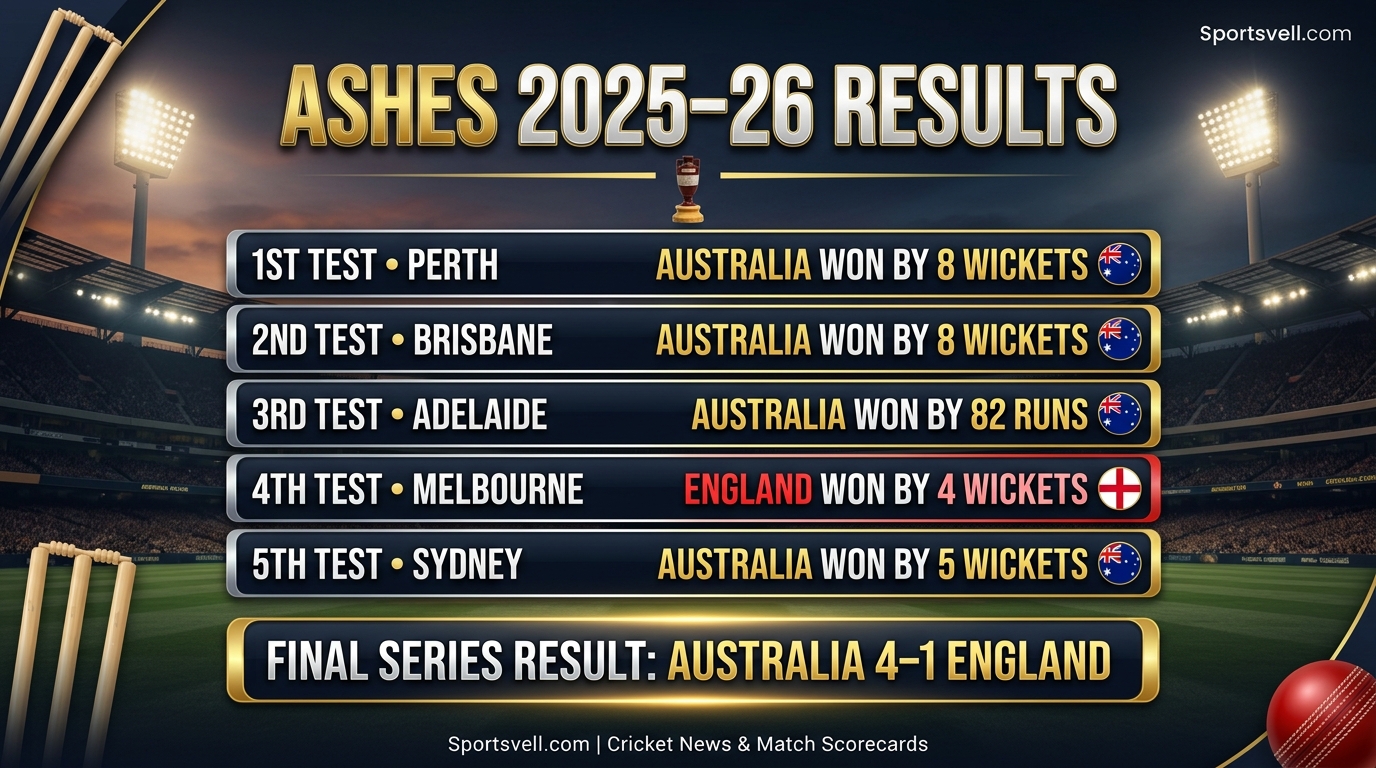
Every Test produced a result. No match ended in a draw. Australia won in Perth, Brisbane, Adelaide and Sydney. England won once, at Melbourne, on Boxing Day.
This page gives you the full scorecard for each Test, the series table, the head-to-head record, both squads and the broadcast details. It is a complete record of a finished series, not a preview.
That matters because many pages still ranking for this keyword were written in November 2025. They describe the series as about to start. Those pages are stale. The scores below are final.
Quick Answer: Who Won the Ashes 2025-26?
Australia won the Ashes 2025-26 by 4-1. They won the first three Tests to retain the urn in Adelaide, just eleven days into the series.
England then won the Boxing Day Test in Melbourne before Australia closed out the series in Sydney.
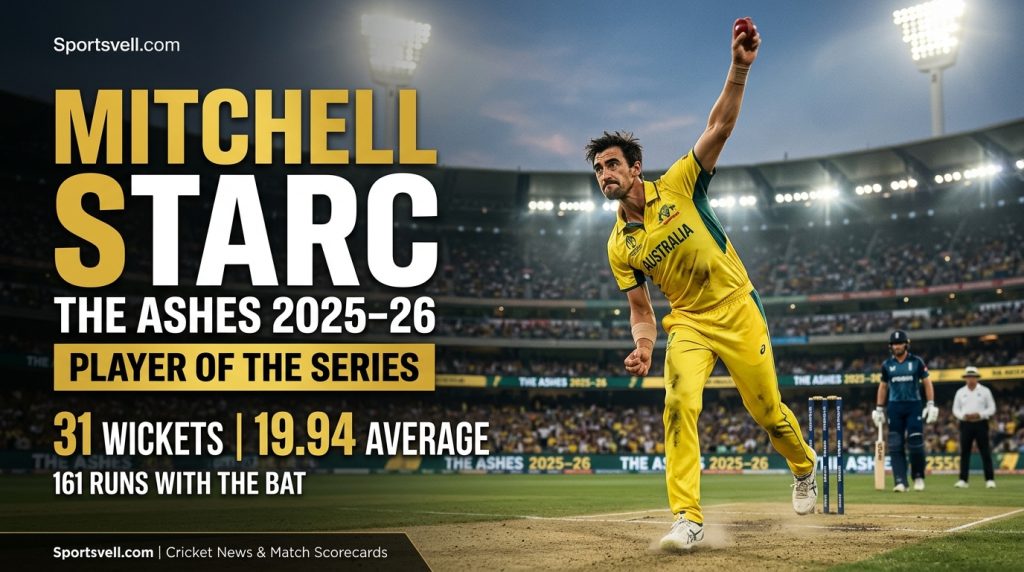
Mitchell Starc was the player of the series. He took 31 wickets in ten innings at an average of 19.94, with best figures of 7 for 58. He also scored 161 runs with the bat.
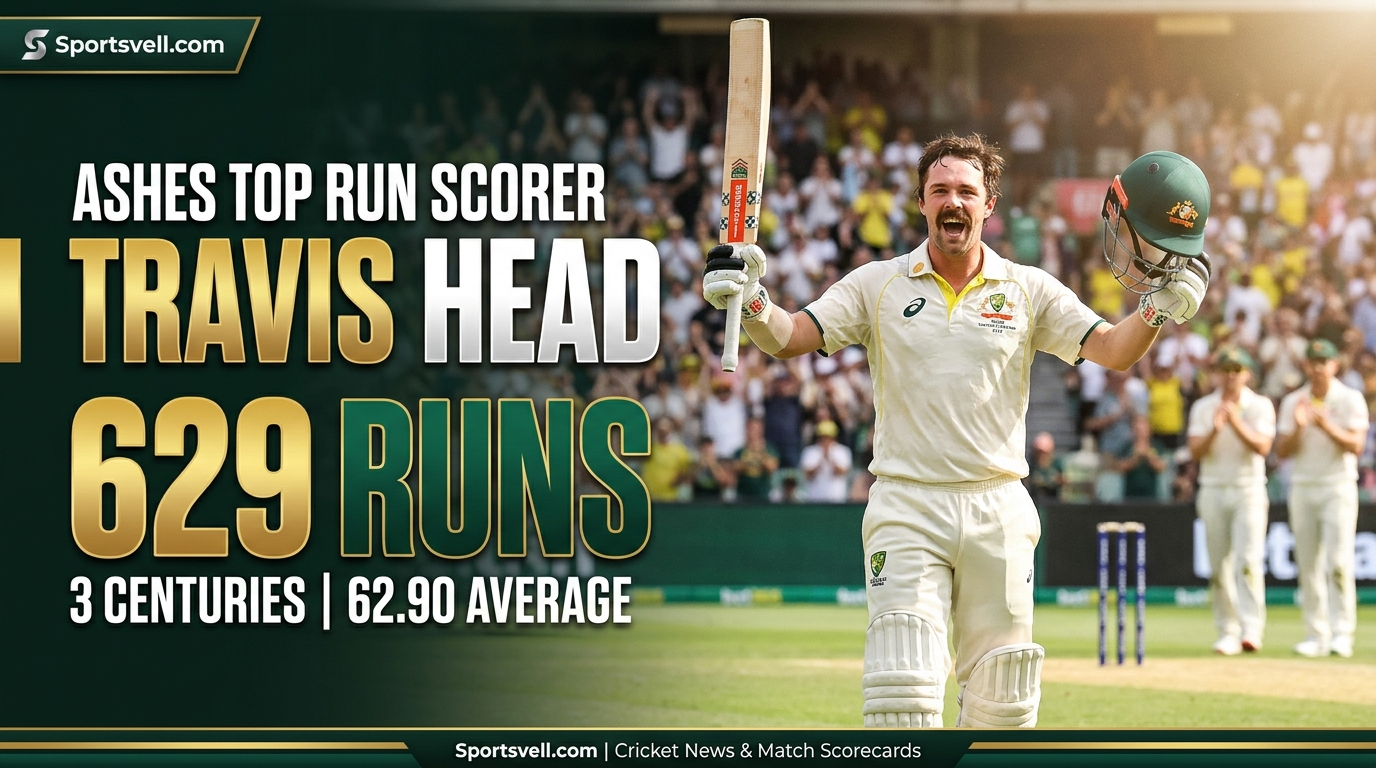
Travis Head scored the most runs. He made 629 runs in ten innings at an average of 62.90, with three hundreds. Joe Root led England with 400 runs, including hundreds in Brisbane and Sydney.
Key takeaways from the series:
- Result: Australia 4, England 1, over five Tests
- Player of the series: Mitchell Starc, 31 wickets and 161 runs
- Most runs: Travis Head, 629 runs for Australia
- Shortest Test: Perth, finished inside two days, the first two-day Ashes Test since 1921
- England’s win: Melbourne, their first Test win in Australia since January 2011
- Next Ashes: 2027, in England
Australia vs England Match Scorecard: All Five Tests
The table below is the whole series at a glance. Each row links to the full scorecard detail further down the page. Dates are the scheduled dates for each Test.
| Test | Dates | Venue | Result |
|---|---|---|---|
| 1st Test | Nov 21-25, 2025 | Perth Stadium, Perth | Australia won by 8 wickets |
| 2nd Test | Dec 4-8, 2025 | The Gabba, Brisbane (day-night) | Australia won by 8 wickets |
| 3rd Test | Dec 17-21, 2025 | Adelaide Oval, Adelaide | Australia won by 82 runs |
| 4th Test | Dec 26-30, 2025 | Melbourne Cricket Ground | England won by 4 wickets |
| 5th Test | Jan 4-8, 2026 | Sydney Cricket Ground | Australia won by 5 wickets |
The series was the 74th edition of the Ashes. It was branded the NRMA Insurance Men’s Ashes Series. It also formed part of the 2025-2027 ICC World Test Championship.
Four of the five Tests were won by the team fielding first. Only the 2001 Ashes in England has matched that.
The series run rate of 4.07 was the highest in any Test series of four or more matches.
Australia have now held the urn since the 2017-18 series. They have won three of the five series since then, with the other two drawn 2-2 in England.
England last won the Ashes in 2015, at home, by 3-2.
For another completed series hub on this site, see the India vs New Zealand match scorecard hub, which follows the same format.
1st Test, Perth: Australia Won by 8 Wickets
The series opened at Perth Stadium on Friday, November 21, 2025. It ended inside two days. That had not happened in an Ashes Test since 1921, more than a hundred years earlier.
England batted first and were bowled out for 172 in 32.5 overs. Australia replied with 132 in 45.2 overs. England then made 164 in their second innings. Australia chased 205 and reached 205 for 2.
| Innings | Score | Top scorer | Best bowling |
|---|---|---|---|
| England 1st | 172 in 32.5 overs | Harry Brook 52 | Mitchell Starc 7/58 |
| Australia 1st | 132 in 45.2 overs | Not confirmed in detail | England attack shared wickets |
| England 2nd | 164 | Ollie Pope 33 | Mitchell Starc 3/55 |
| Australia 2nd | 205/2 | Travis Head 123 | Target reached with 8 wickets left |
England 172 and 164
England lost Zak Crawley for 0 in the first over of the series. Mitchell Starc trapped him in front with the last ball of that over. It set the tone for the whole match.
Ben Duckett made 21 before falling to Starc. Joe Root was out with the score on 39. Ollie Pope made 46, the best of the top order, and England reached 94 for 4.
Ben Stokes made only 6. Harry Brook made 52 off 61 balls, but England slipped from 160 for 5 to 172 all out. Starc finished with 7 for 58 in 12.5 overs.
Brendan Doggett took 2 for 27 on debut. Cameron Green took 1 for 10. Nathan Lyon bowled just two overs for 10 runs. Scott Boland went wicketless for 62.
In the second innings, Pope again top scored with 33 off 57 balls. Root made 8 before Starc bowled him. Stokes made 2 before Starc had him caught by Steve Smith.
Starc took 3 for 55 in the second innings. That gave him ten wickets in the match, 7 for 58 and 3 for 55.
It was the first ten-wicket haul of his Ashes career in a single Test.
Australia 132 and 205 for 2
Australia were bowled out for 132 in their first innings. That gave England a 40-run first-innings lead. Debutant Jake Weatherald was out for 0 in the second ball of the innings.
Marnus Labuschagne, Steve Smith, Usman Khawaja, Travis Head and Cameron Green all fell cheaply. Mitchell Starc, Alex Carey, Scott Boland and Nathan Lyon followed. The innings lasted 45.2 overs.
The chase of 205 belonged to Travis Head. Usman Khawaja did not open in either innings because of a niggle, so Head opened with debutant Jake Weatherald. The pair added 75 for the first wicket.
Head raced to a 36-ball fifty and a hundred off 69 balls. He was out for 123 with 13 runs needed.
Labuschagne finished 51 not out off 49 balls, and Smith finished 2 not out off 4 balls. It was the first time a team had won batting second in six Tests at Perth Stadium.
The win gave Australia a 1-0 lead. It also gave them a huge psychological edge. England had lost 19 wickets in a day and still lost the match.
Mitchell Starc’s 10-Wicket Haul
Starc was named player of the match. His first-innings figures of 7 for 58 were a career best in Test cricket. He struck in the very first over of the series.
His ten wickets in the match were the foundation of everything that followed. He would go on to take 31 wickets in the series. No other bowler in either team came close to that total.
Starc also made 12 runs and did not bat in the second innings. His batting mattered far more later in the series, especially at Brisbane and Adelaide.
Why the Test Finished Inside Two Days
Nineteen wickets fell on day one. That is the most on an opening day of an Ashes Test in the modern era. Both batting line-ups collapsed against pace and swing.
The Perth pitch offered pace and bounce. The ball moved all day. Batters from both sides played loose shots under pressure. The match lasted only two days in total.
Two-day Tests are rare in modern cricket. The last Ashes Test to finish inside two days was in 1921. The Perth result was therefore historic before the series had even settled.
The match lasted only 847 balls. That makes it the shortest Ashes Test by balls bowled since the start of the 20th century.
For the full ball-by-ball scorecard of this Test, see the Cricbuzz 1st Test scorecard, which lists every dismissal and bowling figure.
2nd Test, Brisbane (Day-Night): Australia Won by 8 Wickets
The second Test was a day-night match at The Gabba, played with a pink ball from December 4 to 8, 2025. Australia won by 8 wickets again. The series score moved to 2-0.
England batted first and made 334 in 76.2 overs. Australia replied with 511 in 117.3 overs. England made 241 in their second innings. Australia chased 65 and reached 69 for 2.
| Innings | Score | Top scorer | Best bowling |
|---|---|---|---|
| England 1st | 334 in 76.2 overs | Joe Root 138* | Mitchell Starc 6/75 |
| Australia 1st | 511 in 117.3 overs | Mitchell Starc 77 | Brydon Carse 4/152 |
| England 2nd | 241 | Not confirmed in detail | Michael Neser 5 wickets |
| Australia 2nd | 69/2 | Steven Smith 23* | Target reached with 8 wickets left |
England 334 and 241
Joe Root made 138 not out off 206 balls in the first innings. It was his first ever century in Australia. He had waited his whole career for that hundred on Australian soil.
Root was on 6 when he edged to slip and Steve Smith nearly held a stunning catch. The drop cost England dearly. Root went on to top score in the match.
Mitchell Starc took 6 for 75 in 20 overs. It was his second six-wicket haul in two Tests. England still reached 334, a strong total for a day-night Test.
In the second innings, England made 241. Michael Neser took five wickets on his home ground, including the key wickets of Jacks and Stokes after their three-hour rearguard stand.
Starc added 2 for 64 to his first-innings six. The target for Australia was only 65.
Australia 511 and 69 for 2
Australia made 511 in their first innings. That gave them a 177-run lead. The star with the bat was Mitchell Starc, who made 77 off 141 balls.
Starc top scored for Australia in that innings with 77. No Australian batter made a hundred in Brisbane. The lower order batted for 50 overs to build the lead.
Brydon Carse took 4 for 152 in 29 overs for England. He bowled more overs than any other England bowler in the series. His effort could not stop Australia’s big total.
The chase of 69 was simple. Jake Weatherald made 17 off 23 balls. Steven Smith finished 23 not out off 9 balls. Australia won by 8 wickets with two days to spare.
Joe Root’s First Hundred in Australia
Root’s 138 not out was the top score of the match. It ended years of talk about his record in Australia. He had never made a hundred there before this series.
He would make another hundred later in the series, 160 in Sydney. Those two hundreds were the best batting of England’s tour. No other England batter made two hundreds.
Root finished the series with 400 runs. That was the second highest total in either team, behind only Travis Head’s 629. His Brisbane hundred was the turning point of his personal series.
The Day-Night Record England Set for the Wrong Reason
England became the first team to lose a day-night Test after scoring 300 or more batting first. Their 334 in the first innings should have been enough to stay in the match.
Australia’s 511 wiped out that advantage. The pink ball swung under lights, but Australia handled it better. Their lower order added vital runs through Starc and the tail.
The Gabba had been a fortress for Australia against England. They had won 13 of 22 Ashes Tests there and were unbeaten against England at the ground since 1986.
This was the first time since the 1982-83 series that an Ashes series in Australia did not begin at The Gabba. Perth hosted the opener instead, and Brisbane hosted the second Test.
3rd Test, Adelaide: Australia Won by 82 Runs
The third Test was played at Adelaide Oval from Wednesday, December 17, 2025. Australia won the toss and chose to bat.
Australia won by 82 runs. The win retained the Ashes with two Tests still to play.
Australia made 371 in 91.2 overs and 349 in their second innings. England made 286 in 87.2 overs and 352 in 102.5 overs. The margin was 82 runs in a hard-fought Test.
| Innings | Score | Top scorer | Best bowling |
|---|---|---|---|
| Australia 1st | 371 in 91.2 overs | Alex Carey 106 | Jofra Archer 5/53 |
| England 1st | 286 in 87.2 overs | Ben Stokes 83 | Australia attack shared wickets |
| Australia 2nd | 349 | Not confirmed in detail | England attack shared wickets |
| England 2nd | 352 in 102.5 overs | Zak Crawley 85 | Starc, Cummins and Lyon took 3 each |
Australia 371 and 349 (Alex Carey 106)
Travis Head made only 10 off 28 balls in the first innings. He was caught by Zak Crawley off Brydon Carse. It was a rare failure for the series’ top scorer.
Alex Carey made 106 off 143 balls. He hit 8 fours and 1 six. His hundred held the innings together after early wickets. Scott Boland finished 14 not out off 21 balls.
Australia were bowled out for 371 in 91.2 overs. The run rate was 4.06 per over. That is fast scoring for a Test match, and it reflected Australia’s attacking style.
In the second innings, Australia made 349. The Cricbuzz scorecard records that they were bowled out for 349. That set England a target of 435 to win.
England 286 and 352 (Ben Stokes 83)
Zak Crawley made 9 off 19 balls before Pat Cummins had him caught by Carey. Cummins was back in the team after missing the first Test with a back injury.
Ben Duckett made 29 off 30 balls before Nathan Lyon bowled him. Ben Stokes made 83 off 198 balls before Mitchell Starc bowled him. It was the best innings of England’s match.
England were bowled out for 286 in 87.2 overs. That gave Australia an 85-run first-innings lead. The lead mattered in a low-scoring, tight Test.
In the second innings, England made 352 in 102.5 overs. They fell 82 runs short of the 435 target. Australia’s bowlers held their nerve on the final day.
Zak Crawley top scored in the second innings with 85 off 151 balls. Jamie Smith made 60, and Will Jacks made 47 in a 91-run stand with Smith.
Starc, Cummins and Lyon took three wickets each in that innings.
Jofra Archer’s Five-Wicket Haul
Jofra Archer took 5 for 53 in 20.2 overs in Australia’s first innings. His economy rate was 2.61 runs per over. It was the best bowling of England’s series up to that point.
Brydon Carse took 2 for 89. Josh Tongue took 1 for 64. Ben Stokes bowled 19 overs for 53 runs without a wicket. Will Jacks took 2 for 105.
Archer’s five-wicket haul showed what England’s pace attack could do at full strength. He had missed the first part of the tour through injury management. His Adelaide spell was his best of the series.
Australia Retain the Ashes
The win in Adelaide meant Australia retained the Ashes. They led 3-0 with two Tests left. England could no longer win the series, only reduce the margin.
The retention came just eleven days into the series. That is how fast the first three Tests were finished. Two of the first three Tests ended well inside five days.
By the end of the Adelaide Test, Mitchell Starc had 22 wickets in the series. He had taken 10 in Perth, 8 in Brisbane and 4 more in Adelaide.
No England bowler was within eight wickets of him.
4th Test, Melbourne (Boxing Day): England Won by 4 Wickets
The fourth Test was the Boxing Day Test at the Melbourne Cricket Ground, starting Friday, December 26, 2025. England won by 4 wickets. It was their only win of the series.
Australia made 152 and 132. England made 110 and 178 for 6. The match was low scoring throughout. Twenty wickets fell on the opening day.
| Innings | Score | Top scorer | Best bowling |
|---|---|---|---|
| Australia 1st | 152 | No batter reached 50 | Josh Tongue 5/45 |
| England 1st | 110 | No batter reached 50 | Australia attack shared wickets |
| Australia 2nd | 132 | No batter reached 50 | Josh Tongue 2/44 |
| England 2nd | 178/6 | No batter reached 50 (Brook 18*) | Australia attack shared wickets |
Australia 152 and 132
Australia were bowled out for 152 in their first innings. Their batting, so strong in the first three Tests, collapsed at the MCG. The pitch offered seam movement all day.
In the second innings, Australia made only 132. That set England a target of 175 to win. It was a small target, but England had to earn it on a tricky pitch.
The two Australian totals of 152 and 132 were their lowest of the series. They had made 511 in Brisbane and 567 in Sydney. Melbourne was a different story entirely.
England 110 and 178 for 6
England made 110 in their first innings. That gave Australia a 42-run lead. The match stayed close because neither side could build a big total.
In the second innings, England chased 175 and reached 178 for 6. They won by 4 wickets. The win was nervy, but it was a win, and it ended a long wait.
The match aggregate was only 572 runs across four innings. That is one of the lowest aggregates in a completed Ashes Test. The bowlers ruled from start to finish.
Josh Tongue’s Match-Winning Spell
Josh Tongue was named player of the match. He took 5 for 45 in the first innings and 2 for 44 in the second. He also made 1 not out with the bat.
His first-innings five-wicket haul broke Australia’s batting. His second-innings wickets kept England in control during the chase. It was the best match of his Test career.
Tongue finished the series with 18 wickets. That made him England’s third highest wicket-taker, behind Brydon Carse with 22 and ahead of Ben Stokes with 15.
England’s First Win in Australia Since 2011
The Melbourne win was England’s first Test win in Australia since January 2011. That is a gap of almost fifteen years.
Their last win before this one came in the 2010-11 series, which England won 3-1.
England had lost their previous three tours of Australia by 5-0, 4-0 and 4-0. They had not won a single Test on those three tours. The Melbourne win broke that run.
Twenty wickets fell on the opening day at the MCG. That is an Ashes high for a first day since 1909. The Perth Test had seen 19 wickets on day one.
Both matches were bowler dominated.
The series score moved to 3-1. England had saved some pride. Australia still held the urn, and one Test remained in Sydney.
No batter in either team reached 50 in the match. The aggregate of 572 runs is the lowest for a completed Ashes Test without a single fifty.
The match lasted only 852 balls. Perth lasted 847 balls. Those are the third and fourth shortest completed Ashes Tests ever, after two matches in 1888.
England’s win ended an 18-Test winless run in Australia, stretching back to November 2013. It was Joe Root’s first Test win in Australia in 18 Tests, and Ben Stokes’ first in 13.
Jacob Bethell played the crucial knock in the chase. He added 47 with Crawley after a 50-plus opening stand with Duckett. Brook and Smith then finished the job.
Crowds of more than 90,000 watched on both days. Stokes won the toss and chose to bowl. Jhye Richardson bowled the final over, and the winning runs came from leg byes.
Smith said 50 or 60 more runs across both innings might have been enough for Australia. The Melbourne chase went at 5.5 runs per over, the second fastest 150-plus Ashes chase after Perth’s 7.23.
5th Test, Sydney: Australia Won by 5 Wickets
The fifth Test was played at the Sydney Cricket Ground from Sunday, January 4, 2026. Australia won by 5 wickets. The series finished 4-1 to the home side.
England made 384 in 97.3 overs and 342 in their second innings. Australia made 567 in 133.5 overs and 161 for 5. The match had the highest aggregate of the series.
| Innings | Score | Top scorer | Best bowling |
|---|---|---|---|
| England 1st | 384 in 97.3 overs | Joe Root 160 | Michael Neser 4/60 |
| Australia 1st | 567 in 133.5 overs | Travis Head 163 | Brydon Carse 3/130 |
| England 2nd | 342 | Not confirmed in detail | Mitchell Starc 3/72 |
| Australia 2nd | 161/5 | Travis Head 29 | Target reached with 5 wickets left |
England 384 and 342 (Joe Root 160)
England chose to bat first in Sydney. They posted 384 in 97.3 overs. Joe Root top scored with 160 off 242 balls, including 15 fours. It was his second hundred of the series.
Zak Crawley made 16 off 29 balls before Michael Neser trapped him in front. Ben Duckett made 27 off 24 balls before Starc had him caught by Carey.
Harry Brook was out with the score on 226. Ben Stokes was out on 229. Jamie Smith was out on 323. Will Jacks was out on 375. Brydon Carse was out on 382.
Root was out for 160 with the score on 384. Josh Tongue was out for a two-ball duck. Neser finished with 4 for 60 in 18.3 overs. Starc took 2 for 93.
Boland took 2 for 85.
In the second innings, England made 342. Starc took 3 for 72. Boland took 2 for 46. Neser took 1 for 55. Beau Webster took 3 for 64. The target for Australia was 160.
Australia 567 and 161 for 5 (Travis Head 163, Steve Smith 138)
Australia replied with 567 in 133.5 overs. That gave them a 183-run first-innings lead. Travis Head top scored with 163 off 166 balls, including 24 fours and 1 six.
Steve Smith made 138 off 220 balls, including 16 fours and 1 six. Head and Smith put Australia in total control. The innings lasted 133.5 overs at a fast rate.
For England, Brydon Carse took 3 for 130. Josh Tongue took 3 for 97. Ben Stokes took 2 for 95. Will Jacks took 1 for 34. Jacob Bethell took 1 for 52.
The chase of 160 was comfortable. Head made 29 in the second innings. Alex Carey drove Australia home. The win was sealed by 5 wickets, and the series ended 4-1.
Mitchell Starc, Player of the Series
Mitchell Starc was named player of the series and received the Compton-Miller Medal. He finished with 31 wickets in ten innings at an average of 19.94.
He also scored 161 runs with the bat. His 77 in Brisbane and 54 in Adelaide were back-to-back fifties, the first time he had done that in his Test career.
Starc became only the fifth bowler this century to take 30 or more wickets in an Ashes series.
The others are Shane Warne with 40 in 2005, Mitchell Johnson with 37 in 2013-14, Glenn McGrath with 32 in 2001 and Warne again with 31 in 2001.
He dismissed 14 of the 15 England players he bowled to in the series. He dismissed Ben Duckett and Ben Stokes five times each, Zak Crawley four times and Joe Root three times.
Only Matthew Potts, who faced one ball from him, escaped.
Record Attendance Across the Series
The series set a record attendance across all five Tests, according to Cricbuzz. Crowds were strong in every city, from Perth to Sydney. The Ashes remains the biggest draw in Test cricket.
Travis Head was named player of the match in Sydney for his 163 and 29. He finished as the highest run-getter of the series with 629 runs. No other batter passed 400 except Joe Root.
The final Test also confirmed the series pattern. Australia’s pace attack took the wickets, Head and Smith made the runs, and England fought hard but lost the key moments.
Australia vs England Head-to-Head Record
The Ashes is the oldest rivalry in Test cricket. It began in 1882-83, when England won a three-Test series in Australia by 2-1. The urn has been contested ever since.
Two different totals appear online for this rivalry. They count different things. This section keeps them separate so you can use the right one.
Ashes Tests Only (350 Tests)
The Ashes-only record covers only Tests played as part of an Ashes series. After the 2025-26 series, the totals are 350 Tests, Australia 146 wins, England 111 wins, 93 draws.
| Where played | Tests | Australia wins | England wins | Draws |
|---|---|---|---|---|
| All Ashes Tests | 350 | 146 (41.7%) | 111 (31.7%) | 93 (26.6%) |
| In Australia | 177 | 94 (53.1%) | 57 (32.2%) | 26 (14.7%) |
| In England | 173 | 52 (30.1%) | 54 (31.2%) | 67 (38.7%) |
Australia lead by 35 wins overall. Their advantage is much bigger at home, where they have won 94 of 177 Tests. In England, the record is almost even, with England ahead 54 to 52.
The series record is closer. Across 74 Ashes series, Australia have won 35, England have won 32, and 7 have been drawn. Only three series separate the two sides.
| Where played | Series | Australia wins | England wins | Drawn |
|---|---|---|---|---|
| All Ashes series | 74 | 35 (47.3%) | 32 (43.2%) | 7 (9.5%) |
| In Australia | 37 | 21 (56.8%) | 14 (37.8%) | 2 (5.4%) |
| In England | 37 | 14 (37.8%) | 18 (48.6%) | 5 (13.5%) |
For the full history behind these numbers, see the OLBG Ashes head-to-head and winners guide, which lists every series result since 2009 and the full Test record.
All Tests Between the Two Teams (361 Tests)
Some sources give a bigger total: 361 Tests, Australia 152 wins, England 112 wins, 97 draws.
That figure counts every Test between the two teams, including Tests that were not part of an Ashes series.
In Australia, the all-Tests total is 185 Tests, with Australia winning 99, England winning 57 and 29 drawn.
The gap between the two totals is 11 Tests, 6 Australian wins, 1 England win and 4 draws.
Both totals are correct. They simply count different sets of matches. Use the Ashes-only total when you talk about the Ashes. Use the all-Tests total only when you talk about the wider rivalry.
Why the Two Totals Differ
Before the Ashes became a fixed five-Test series, the two teams sometimes played Tests outside the Ashes. A few early tours included extra matches.
Those Tests count in the all-Tests total but not in the Ashes total.
Business Standard and Newsbytes report the 361-Test figure. OLBG, Sky Blogs and Mystery Cricket report the 350-Test Ashes figure.
The BBC reported 345 Ashes Tests before the 2025-26 series, which matches the 350 total after five more Tests were played.
The maths checks out. Before the series, Australia had 142 Ashes wins and England had 110. Add Australia’s four wins and England’s one win from 2025-26, and you get 146 and 111.
The 93 draws did not change.
Last Five Ashes Series
The last five Ashes series show how strong home advantage has become. The hosts have won seven of the last ten series. The only away win in that run was England in Australia in 2010-11.
| Series | Host | Result | Holder after |
|---|---|---|---|
| 2025-26 | Australia | Australia won 4-1 | Australia |
| 2023 | England | Drawn 2-2 | Australia (retained) |
| 2021-22 | Australia | Australia won 4-0 | Australia |
| 2019 | England | Drawn 2-2 | Australia (retained) |
| 2017-18 | Australia | Australia won 4-0 | Australia |
A drawn series leaves the Ashes with the side that already held them. That is why Australia kept the urn after the 2-2 draws in England in 2019 and 2023.
England kept it after the 2-2 draw in 1972.
Since the start of this century, Australia have hosted England in 30 Tests. England have won only four of those, lost 23 and drawn three. That was the record before the 2025-26 series began.
Since their 2010-11 Ashes win, England have played 20 Tests in Australia. They have won one, lost 17 and drawn two. The Melbourne win was the only victory in that run.
For another series hub on this site, see the India vs South Africa match scorecard hub, which covers a different rivalry in the same format.
Ashes 2025-26 Squads and Playing XIs
The squads told the story of the series before a ball was bowled. Australia were missing their captain and their best fast bowler. England were at full strength on paper.
Australia Squad and 1st Test XI
Australia named a 15-man squad for the first Test. Steve Smith captained the side. Pat Cummins was out with a lower-back stress injury.
The squad was: Steve Smith (captain), Sean Abbott, Scott Boland, Alex Carey, Brendan Doggett, Cameron Green, Josh Hazlewood, Travis Head, Josh Inglis, Usman Khawaja, Marnus Labuschagne, Nathan Lyon, Mitchell Starc, Jake Weatherald and Beau Webster.
The playing XI for Perth was: Usman Khawaja, Jake Weatherald, Marnus Labuschagne, Steve Smith (captain), Travis Head, Cameron Green, Alex Carey (wicketkeeper), Mitchell Starc, Nathan Lyon, Brendan Doggett and Scott Boland.
Beau Webster, Josh Inglis and Michael Neser were on the bench. Neser later played a key role in Sydney, taking 4 for 60 in the first innings of the final Test.
England Squad and 1st Test XII
England named a 12-player squad for the first Test in Perth. Ben Stokes captained the side. The ECB announced the squad on November 19, 2025.
The 12 were: Ben Stokes (captain), Jofra Archer, Gus Atkinson, Shoaib Bashir, Harry Brook, Brydon Carse, Zak Crawley, Ben Duckett, Ollie Pope, Joe Root, Jamie Smith (wicketkeeper) and Mark Wood.
The wider squad also included Jacob Bethell, Matthew Potts, Josh Tongue and Will Jacks. Tongue and Jacks both played important roles later in the series.
For the official announcement, see the ECB squad announcement for the first Ashes Test in Perth, which names all twelve players.
The Injury Story: Cummins and Hazlewood Out of the Opener
Pat Cummins missed the first Test with a stress injury in his lower back. He was Australia’s regular captain and their best bowler. His absence was the biggest story before the series.
Australia hoped Cummins would return for the second Test in Brisbane on December 4. Coach Andrew McDonald confirmed that Cummins would resume bowling in the week of the first Test.
Josh Hazlewood also missed the opener with a hamstring injury. He was Australia’s most reliable fast bowler. His absence opened the door for Brendan Doggett, who debuted in Perth.
Cummins did return during the series. He played the third Test in Adelaide and took Zak Crawley’s wicket. His return strengthened an attack that was already winning without him.
The Debutants: Jake Weatherald and Brendan Doggett
Jake Weatherald made his Test debut in Perth. He was picked to open the batting ahead of Matt Renshaw and Sam Konstas. He was out for 0 in the second ball of Australia’s first innings.
Weatherald was one of three uncapped players in the 15-man squad. The other two were Sean Abbott and Brendan Doggett. All three were rewarded for strong domestic form.
Doggett took 2 for 27 in England’s first innings in Perth. He bowled with pace and control on debut. His selection was a gamble that paid off for the selectors.
Ricky Ponting had named Weatherald in his preferred XI for the first Test on the ICC Review. His predicted XI matched the actual XI, including Weatherald opening with Khawaja.
Steve Smith, Stand-In Captain
Steve Smith led Australia in the first Test in Cummins’ absence. He was the natural choice, having captained Australia many times before. He also led the batting order at number four.
Smith made 138 in Sydney in the final Test. That was his best innings of the series. He finished with 286 runs in total, the fifth highest tally in either team.
Smith’s captaincy was calm and attacking. He set fields that kept England’s batters under pressure. His leadership was a quiet strength of Australia’s series win.
The Coaches
Australia were coached by Andrew McDonald. His assistants were Andre Borovec and Daniel Vettori. Michael Di Venuto was the batting coach. Adam Griffith was the bowling coach.
England were coached by Brendon McCullum. Jeetan Patel was the spin bowling coach. Paul Collingwood was an assistant coach. Marcus Trescothick was the batting coach.
Neil Killeen was the pace bowling coach. Tim Southee, the former New Zealand captain, worked as a pace bowling consultant. The coaching teams were both experienced and well resourced.
Key Players of the Series
The series was decided by two players more than any others. Mitchell Starc took the wickets. Travis Head scored the runs. Joe Root was England’s best batter by a clear margin.
Mitchell Starc (Player of the Series)
Starc took 31 wickets in ten innings at an average of 19.94. His best figures were 7 for 58 in Perth. He took two five-wicket hauls in the series.
He struck in the very first over of the series, dismissing Zak Crawley for 0.
He took 10 wickets in Perth, 8 in Brisbane and had 22 wickets by the time Australia retained the Ashes in Adelaide.
Starc also scored 161 runs with the bat. His 77 in Brisbane was the top score for Australia in that innings.
His 54 in Adelaide gave him back-to-back fifties for the first time in his Test career.
He passed Wasim Akram to become the highest wicket-taking left-arm fast bowler in Test cricket. He also passed Stuart Broad for the most Test runs at number nine.
His series was one of the great all-round Ashes performances.
Travis Head (Most Runs, 629)
Head scored 629 runs in ten innings at an average of 62.90. His strike rate was 87.36. His highest score was 170. He hit three hundreds and 73 fours and 9 sixes.
He scored 608 of his 629 runs while opening the batting. He reached his 4,000th Test run during the series. He was the only batter in either team to pass 600 runs.
He opened the chase in Perth because Khawaja had a niggle. He made 123 off 69 balls, with a 36-ball fifty, before falling with 13 runs needed.
Head became only the second batter in Test history to record a match’s top score four times in a series. His 69-ball hundred in Perth was one of the fastest of the series.
His 163 in Sydney was the top score of the final Test. He was named player of the match in Sydney. His series set a new standard for attacking opening batting in the Ashes.
Joe Root (England’s Most Runs, 400)
Root scored 400 runs in ten innings at an average of 44.44. His strike rate was 58.31. His highest score was 160 in Sydney. He hit two hundreds.
His 138 not out in Brisbane was his first hundred in Australia. His 160 in Sydney was his second hundred of the series. No other England batter made two hundreds.
Root was the only England batter to pass 350 runs except Harry Brook, who made 358. Root’s two hundreds were the best batting of England’s tour. He carried the top order almost alone.
Steve Smith (286 Runs)
Smith scored 286 runs in the series. His best innings was 138 in Sydney, where he shared a big stand with Head. He captained Australia in the first Test in Cummins’ absence.
Smith’s 138 in Sydney came off 220 balls with 16 fours and 1 six. It was his only hundred of the series. He also took important catches, including the catch that dismissed Stokes in Perth.
As stand-in captain in Tests, Smith has won 8, drawn 3 and lost none in 11 matches.
As an Ashes captain, he has won 8, lost 1 and drawn 1 in 10 matches, an 80 percent win rate.
Alex Carey (323 Runs)
Carey scored 323 runs in the series. His best innings was 106 in Adelaide, where he held Australia’s first innings together. He hit 8 fours and 1 six in that hundred.
Carey also kept wicket throughout the series. He took the catch that dismissed Crawley off Cummins in Adelaide. His batting at number seven gave Australia vital lower-order runs.
Carey took 28 dismissals behind the stumps in the series. Only Adam Gilchrist, twice, has combined 300-plus runs with 25-plus dismissals in a Test series.
He stood up to the stumps to Neser in Brisbane. Smith called it one of the best keeping performances he had ever seen.
Brydon Carse (England’s Most Wickets, 22)
Carse took 22 wickets for England. He bowled more overs than any other England bowler, 138.4 in total. His best figures were 4 for 152 in Brisbane.
He took 3 for 130 in Australia’s first innings in Sydney. Carse was England’s workhorse. He bowled long spells on flat pitches and kept coming back.
Josh Tongue (18 Wickets)
Tongue took 18 wickets in the series. His best match was Melbourne, where he took 5 for 45 and 2 for 44 and was named player of the match.
His spell won England their only Test.
He took 3 for 97 in Sydney. His pace and bounce troubled Australia’s batters throughout the series. He was England’s third highest wicket-taker.
Ben Stokes (15 Wickets, 83 in Adelaide)
Stokes took 15 wickets in the series. He also made 83 off 198 balls in Adelaide, the best innings of England’s match there. He captained England throughout the tour.
Stokes bowled 19 overs for 53 runs without a wicket in Adelaide’s first innings. He took 2 for 95 in Sydney. His leadership kept England fighting after the series was lost.
| Rank | Player | Team | Runs | Average | Highest | Hundreds |
|---|---|---|---|---|---|---|
| 1 | Travis Head | Australia | 629 | 62.90 | 170 | 3 |
| 2 | Joe Root | England | 400 | 44.44 | 160 | 2 |
| 3 | Harry Brook | England | 358 | Not stated | Not stated | Not stated |
| 4 | Alex Carey | Australia | 323 | Not stated | 106 | 1 |
| 5 | Steve Smith | Australia | 286 | Not stated | 138 | 1 |
| 6 | Zak Crawley | England | 273 | Not stated | Not stated | 0 |
| Rank | Player | Team | Wickets | Average | Best | Five-fors |
|---|---|---|---|---|---|---|
| 1 | Mitchell Starc | Australia | 31 | 19.94 | 7/58 | 2 |
| 2 | Brydon Carse | England | 22 | Not stated | 4/152 | 0 |
| 3 | Scott Boland | Australia | 20 | Not stated | Not stated | Not stated |
| 4 | Josh Tongue | England | 18 | Not stated | 5/45 | 1 |
| 5 | Michael Neser | Australia | 15 | Not stated | 4/60 | 0 |
| 6 | Ben Stokes | England | 15 | Not stated | Not stated | 0 |
Across the series, 175 wickets fell in total. Of those, 124 were caught, 29 were bowled, 17 were LBW, 4 were run out and 1 was stumped.
Only 7,677 balls were bowled in the whole series.
That ball total is the fewest for any Test series of five or more matches in which every game was completed. Two Tests finished by the end of day two.
Those two Tests lasted only 1,699 balls between them.
England’s fielding cost them dearly. Australia scored 547 runs from and after dropped catches, nearly twice England’s 298. Root’s drop on 6 in Brisbane alone cost England 132 more runs.
Australia held 85.3 percent of their catches and dropped 12. England held 75.3 percent and dropped 18. The gap in the field was as big as the gap with the bat.
Ashes 2025-26 Schedule and Venues
The series was played across five cities in seven weeks. It began in Perth on November 21, 2025 and ended in Sydney on January 8, 2026. Each Test was scheduled for five days.
| Test | Dates | Venue | Start time (local) |
|---|---|---|---|
| 1st Test | Nov 21-25, 2025 | Perth Stadium, Perth | 10:20 AM |
| 2nd Test | Dec 4-8, 2025 | The Gabba, Brisbane | Day-night Test |
| 3rd Test | Dec 17-21, 2025 | Adelaide Oval, Adelaide | 10:00 AM |
| 4th Test | Dec 26-30, 2025 | Melbourne Cricket Ground | 10:30 AM |
| 5th Test | Jan 4-8, 2026 | Sydney Cricket Ground | 10:30 AM |
The first Test in Perth started at 7:50 AM IST. The Boxing Day Test in Melbourne started at 5:30 AM IST. Those early starts are normal for Ashes series played in Australia.
Why Perth Opened the Series, Not the Gabba
The Gabba in Brisbane had hosted the first Test of every Ashes series in Australia since 1982-83. That run ended in 2025-26. Perth Stadium hosted the opener instead.
The Gabba hosted the second Test, a day-night match. Australia had won 13 of 22 Ashes Tests at the Gabba and were unbeaten there against England since 1986. The venue switch did not help England.
Perth Stadium is known for pace and bounce. It produced a two-day Test. The Gabba under lights produced swing and seam. Both venues suited Australia’s fast bowlers.
For the full schedule with squads and timings, see the Sportskeeda Ashes 2025-26 schedule, squads and timings guide.
Where to Watch the Ashes (USA, India, UK, Australia)
The series is over, so this section records how it was shown. The same broadcasters are likely to carry the Ashes 2027 in England, but check closer to that series for the latest rights.
| Country | TV channel | Streaming | Price reported |
|---|---|---|---|
| USA | Willow TV | Willow TV app, Sling TV, Fubo | From $10 per month via Sling; $15 per month via Fubo after a 7-day trial |
| India | Star Sports | JioHotstar | From Rs 299 per month; Rs 899 per year |
| UK | TNT Sports | TNT Sports app | Subscription required |
| Australia | Channel 7 | 7Plus | Free stream |
In the USA, Willow TV showed every Test on its linear channel and digital platforms. It was available through cable providers including Dish, Spectrum, Xfinity and Verizon Fios, and as a standalone service.
Fans in the USA could also watch through Sling TV, on the Desi Binge Plus or Dakshin Flex plans from $10 per month.
Fubo carried Willow TV in its International Sports Plus package at $15 per month after a 7-day free trial.
In India, Star Sports showed the Tests on TV and JioHotstar streamed them online. A JioHotstar subscription cost around Rs 299 per month, with an annual package at Rs 899.
Prices are reported figures from the series and may have changed.
In the UK, TNT Sports broadcast all five Tests. In Australia, the free-to-air coverage was on Channel 7, with a free stream on 7Plus. That free option was the best value for Australian fans.
For a full streaming guide with prices, see the TechRadar guide to watching the Ashes 2025-26, which lists the free and paid options by country.
Our where-to-watch pages follow the same pattern as this guide. See the where to watch Ohio State vs Indiana football page for another example.
How to Read a Cricket Scorecard
The keyword for this page is written in full form. That wording often comes from casual fans who want the score but do not follow cricket closely. This section explains the scorecard in plain terms.
The Four Lines That Matter
First, find the innings totals. A Test has up to four innings, two per team. The scorecard lists each innings total, such as England 384 and Australia 567 in Sydney.
Second, find the result line. It says who won and by how much, such as “Australia won by 5 wickets” or “Australia won by 82 runs”.
A win by wickets means the chasing team had wickets left. A win by runs means the team batting last fell short.
Third, find the top scorers. Each batter has runs, balls faced, fours and sixes listed. A star next to a score means the batter was not out when the innings ended.
Fourth, find the bowling figures. Each bowler has overs, maidens, runs and wickets listed, such as 7 for 58. That means 7 wickets for 58 runs. Lower runs and more wickets is better.
Common Abbreviations
LBW means leg before wicket, a dismissal where the ball would have hit the stumps. DNB means did not bat. C means caught, and b means bowled by the named bowler.
SR is strike rate, runs per 100 balls for a batter. Eco is economy rate, runs per over for a bowler. Ov is overs, with six balls in each over.
A cricket team fields 11 players, the same number as a soccer team and an American football team.
See our explainers on how many players are on a soccer team and how many players are on a football team for the comparison.
Two batters bat at a time, and the other nine field. Bowlers take turns in spells of several overs. A Test can last up to five days, with about 90 overs bowled each day.
What Happens Next: Ashes 2027 in England
The next Ashes series is in England in 2027. Australia will arrive as holders. England will arrive as hosts with a point to prove after losing 4-1 away.
The Retention Rule
Australia need only avoid defeat to retain the Ashes in 2027. If the series is drawn, the holders keep the urn. England must win the series outright to take it back.
That rule has shaped recent Ashes history. Australia retained the urn after 2-2 draws in England in 2019 and 2023. They did not need to win either series to keep the trophy.
England last won the Ashes in 2015, at home, by 3-2. They have not won an Ashes series in more than a decade. The 2027 series is their best chance to end that wait.
What England Must Fix
England must fix their batting against pace. They lost 19 wickets on day one in Perth and 20 wickets on day one in Melbourne. Their top order collapsed too often.
They must also hold their catches. Australia scored 547 runs from and after dropped catches, nearly twice England’s 298. Those extra runs decided close matches in Brisbane and Adelaide.
England’s bowling was competitive at times. Archer took 5 for 53 in Adelaide. Tongue took 5 for 45 in Melbourne. Carse took 22 wickets in the series.
The attack is good enough when it is fit.
Since June 2022, England have won 7 of 21 Tests against Australia and India combined. Against all other teams in the same period, they have won 19 of 25.
What Australia Must Protect
Australia must protect their home record. They have won 94 of 177 Ashes Tests at home. Their pace attack of Starc, Cummins and Hazlewood is the best in the world when fit.
They must also plan for life after their senior batters. Smith, Khawaja and Labuschagne are all in their thirties. Head, at the top of the order, is the future of the batting.
Winning in England is harder. Australia have won only 14 of 37 Ashes series in England. England have won 18 there. The 2027 series will test Australia’s away record.
Frequently Asked Questions
Who won the Ashes 2025-26?
Australia won the Ashes 2025-26. They beat England 4-1 across five Tests played in Australia from November 21, 2025 to January 8, 2026. Australia have held the urn since 2017-18.
What was the score in the Ashes 2025-26?
The series score was Australia 4, England 1. Australia won in Perth, Brisbane, Adelaide and Sydney. England won once, in Melbourne on Boxing Day. No Test was drawn.
Who won the 1st Test of the Ashes 2025-26?
Australia won the 1st Test in Perth by 8 wickets. England made 172 and 164. Australia made 132 and 205 for 2.
Mitchell Starc took 10 wickets in the match and was player of the match.
Who won the 2nd Test of the Ashes 2025-26?
Australia won the 2nd Test in Brisbane by 8 wickets. It was a day-night Test at The Gabba. England made 334 and 241. Australia made 511 and 69 for 2.
Starc was player of the match.
Who won the 3rd Test of the Ashes 2025-26?
Australia won the 3rd Test in Adelaide by 82 runs. Australia made 371 and 349. England made 286 and 352. The win retained the Ashes with two Tests still to play.
Who won the 4th Test of the Ashes 2025-26?
England won the 4th Test in Melbourne by 4 wickets. It was the Boxing Day Test at the MCG. Australia made 152 and 132. England made 110 and 178 for 6.
Josh Tongue was player of the match.
Who won the 5th Test of the Ashes 2025-26?
Australia won the 5th Test in Sydney by 5 wickets. England made 384 and 342. Australia made 567 and 161 for 5. Travis Head made 163 and was player of the match.
Who was the player of the series in the Ashes 2025-26?
Mitchell Starc was the player of the series. He received the Compton-Miller Medal. He took 31 wickets in ten innings at an average of 19.94 and scored 161 runs with the bat.
Who scored the most runs in the Ashes 2025-26?
Travis Head scored the most runs, with 629 in ten innings at an average of 62.90. He hit three hundreds. Joe Root was second with 400 runs, and Harry Brook was third with 358.
Who took the most wickets in the Ashes 2025-26?
Mitchell Starc took the most wickets, with 31 in ten innings. Brydon Carse was second for England with 22.
Scott Boland took 20, Josh Tongue took 18, and Michael Neser and Ben Stokes took 15 each.
Why did the 1st Test finish inside two days?
Nineteen wickets fell on day one as both batting line-ups collapsed against pace and swing on a fast Perth pitch. It was the first Ashes Test to finish inside two days since 1921.
Why did Pat Cummins miss the first Test?
Cummins missed the first Test with a stress injury in his lower back. Australia hoped he would return for the second Test in Brisbane. He did return during the series and played in Adelaide.
Who captained Australia in the first Test?
Steve Smith captained Australia in the first Test in Cummins’ absence. Smith was the natural choice, having captained Australia many times before. He also batted at number four.
Who made their debut for Australia in the Ashes 2025-26?
Jake Weatherald and Brendan Doggett both debuted in Perth. Weatherald opened the batting and was out for 0. Doggett took 2 for 27 in England’s first innings. Both were uncapped before the series.
What is the head-to-head record between Australia and England in the Ashes?
After the 2025-26 series, the Ashes-only record is 350 Tests, Australia 146 wins, England 111 wins, 93 draws. Across 74 series, Australia have won 35, England have won 32, and 7 have been drawn.
How many Ashes series has Australia won?
Australia have won 35 Ashes series out of 74 played since 1882-83. England have won 32, and 7 have been drawn. Australia have held the urn since the 2017-18 series.
When did England last win the Ashes?
England last won the Ashes in 2015, at home, by 3-2. They have not won an Ashes series in more than a decade. Their next chance is the 2027 series in England.
When did England last win a Test in Australia before 2025?
England last won a Test in Australia in January 2011, during the 2010-11 series which they won 3-1. Their win in Melbourne in December 2025 ended a wait of almost fifteen years.
What is the Ashes, and why is it called that?
The Ashes is a Test series between Australia and England, played for a small urn since 1882-83.
The name comes from a mock obituary published in 1882, which said English cricket had died and its ashes would be taken to Australia.
When is the next Ashes series?
The next Ashes series is in England in 2027. Australia will arrive as holders. England will be the hosts. The exact dates and venues will be confirmed closer to the series.
What happens if an Ashes series is drawn?
If an Ashes series is drawn, the holders keep the urn. Australia retained the Ashes after 2-2 draws in England in 2019 and 2023.
England must win the 2027 series outright to take the urn back.
How long has Australia held the Ashes?
Australia have held the Ashes since the 2017-18 series, which they won 4-0 at home. They have since won in 2021-22 and 2025-26, and retained the urn after drawn series in 2019 and 2023.
Did Joe Root score a century in Australia in 2025-26?
Yes, Joe Root scored two centuries in Australia. He made 138 not out in Brisbane, his first hundred in Australia, and 160 in Sydney. He finished the series with 400 runs.
Where can I watch the Ashes in the USA?
Willow TV showed every Test of the Ashes 2025-26 in the USA, on its linear channel and digital platforms. It was available through cable providers and through Sling TV and Fubo.
Check closer to 2027 for the latest rights.
How do I read a cricket scorecard?
Start with the innings totals, then the result line, then the top scorers and the bowling figures. A win by wickets means the chasing team had wickets left.
A win by runs means the team batting last fell short. See the “How to Read a Cricket Scorecard” section above for the full guide.
Conclusion
The Australian men’s cricket team vs England cricket team match scorecard for the Ashes 2025-26 tells a clear story. Australia won 4-1, with Mitchell Starc taking 31 wickets and Travis Head scoring 629 runs.
England won once, in Melbourne, and Joe Root made two hundreds.
The series had everything a great Ashes should have.
There was a two-day Test in Perth, a day-night Test in Brisbane, a series decided in Adelaide, a Boxing Day win for England and a high-scoring finale in Sydney.
Bookmark this page for the Ashes 2027 in England. Australia need only avoid defeat to retain the urn. England must win the series outright to take it back. The rivalry will be just as fierce.
For more completed series hubs on this site, see the India vs New Zealand match scorecard hub and the Monday Night Football results hub.
Both follow the same format: full results, verified scores and no stale preview language.