
How Does the MLB ABS Challenge System Work? 2026 Rules Explained
Baseball has always had arguments over balls and strikes. A fastball catches the outside corner, the umpire calls it a ball, and the pitcher stares toward home plate in disbelief. A hitter takes a pitch that looks low, only to hear the umpire call strike three.
For generations, those decisions were final.
That changed in 2026 when Major League Baseball introduced the MLB ABS challenge system, allowing certain players to request an immediate review of a home plate umpire’s ball-or-strike call.
The Automated Ball-Strike (ABS) Challenge System uses advanced cameras and pitch-tracking technology to determine whether a pitch crossed the official electronic strike zone.
However, MLB has not completely replaced human umpires with robots. Instead, umpires continue calling pitches, and players can challenge selected decisions.
Here’s how the new system works, how many challenges each team receives, and why the change matters.
What Is the MLB ABS Challenge System?
The MLB ABS challenge system is a technology-assisted review process that allows players to challenge an umpire’s ball-or-strike decision.
It officially entered MLB regular-season competition in 2026 after extensive testing in Minor League Baseball, Spring Training, and the 2025 All-Star Game.
The technology uses Hawk-Eye cameras positioned around the ballpark to track each pitch.
When an eligible player challenges a call, the system compares the ball’s position with the batter’s electronically defined strike zone.
The result appears on the stadium video board and television broadcast.
If the umpire made the wrong call, the decision is overturned. If the original call was correct, it stands.
According to MLB’s official ABS announcement, the system was designed to improve accuracy while preserving the traditional role of human umpires.
The important distinction is that ABS does not automatically decide every pitch during a game.
Human umpires remain responsible for the initial call.
How Does the MLB ABS Challenge System Work?
The review process is straightforward and usually takes only a few seconds.
Step 1: The umpire makes the original call
The home plate umpire calls a pitch a ball or strike as usual.
Players can disagree with that decision, but the umpire’s judgment remains official unless an eligible player requests a valid challenge.
Step 2: A player requests a challenge
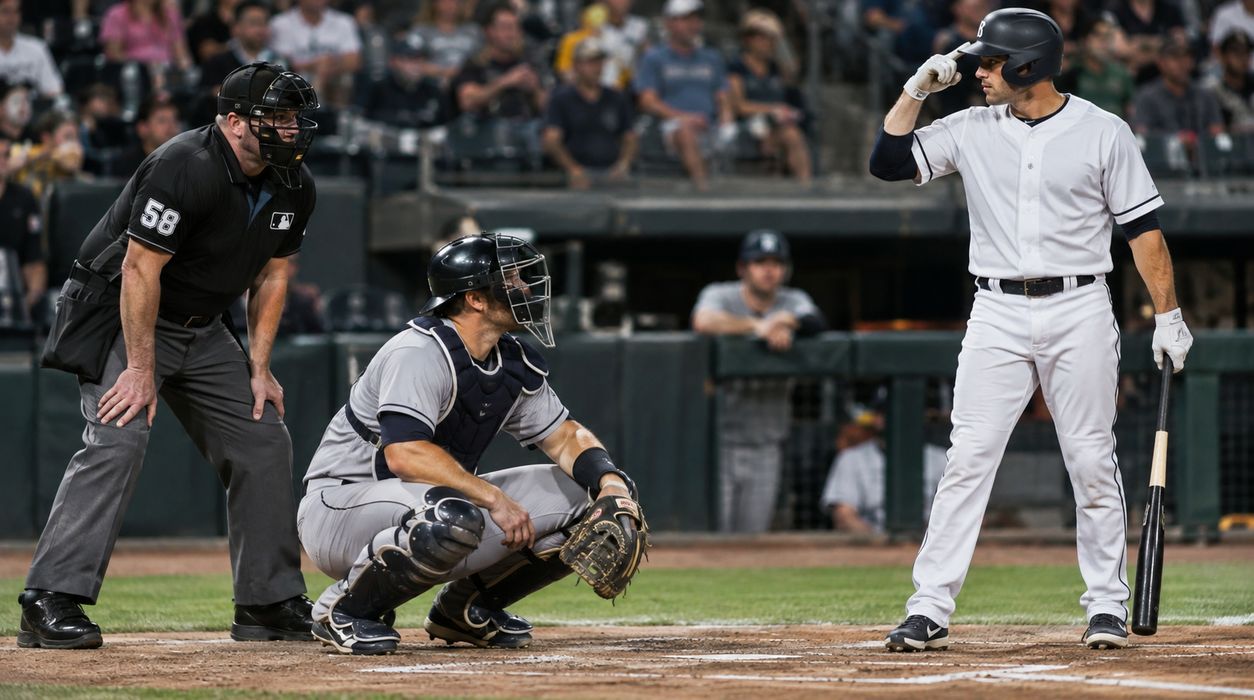
The batter, pitcher, or catcher must immediately signal that they want the call reviewed.
The official signal is a tap on the cap or helmet.
Players are encouraged to communicate verbally as well, but the head tap is the recognizable signal.
The request must be made almost immediately, generally within approximately two seconds of the call.
Step 3: The automated system checks the pitch
Once the umpire accepts the challenge, Hawk-Eye technology determines whether the baseball touched the electronic strike zone.
The system uses the batter’s officially measured height to establish the upper and lower boundaries.
Step 4: The result appears on the screen
An animated graphic shows the baseball’s location relative to the strike zone.
Fans in the stadium and viewers watching the broadcast can see the outcome.
Step 5: The call stands or is overturned
If the system confirms the umpire’s decision, the original call remains.
If the system shows that the pitch was incorrectly called, the umpire changes the decision.
The game then resumes.
This process gives players a way to correct important mistakes without turning every pitch into a lengthy replay review.
Who Can Challenge Balls and Strikes in MLB?
Only three players are allowed to initiate an ABS challenge:
- The batter
- The pitcher
- The catcher
Managers cannot request an ABS challenge.
Neither can coaches, baserunners, or other fielders.
The player must make the decision independently and immediately.
For example, a catcher who believes a pitch caught the lower corner can challenge the umpire’s ball call.
Similarly, a batter who believes a called third strike was outside the zone can request a review.
A pitcher can also challenge a call, although some teams may prefer catchers to handle most defensive challenges.
The restriction prevents teams from reviewing video footage or consulting the dugout before deciding whether to challenge.
It also introduces an interesting element of player judgment.
A catcher who understands the strike zone and recognizes pitch movement may become particularly valuable.
How Many ABS Challenges Does Each MLB Team Get?
Each team starts a regulation game with two ABS challenges.
However, teams do not automatically lose a challenge whenever they use one.
A successful challenge is retained.
An unsuccessful challenge is lost.
Consider this example:
A team starts with two challenges.
In the third inning, its catcher challenges a called ball. The system determines that the pitch was actually a strike.
The team wins the challenge and still has two available.
In the fifth inning, a batter challenges a called strike. The system confirms that the pitch was inside the zone.
The team loses that challenge and has one remaining.
If the team later loses another challenge, it cannot request additional reviews during the remaining regulation innings.
This makes challenge management an important strategic decision.
Teams must balance correcting an early mistake against preserving their opportunities for more important situations later.
What Happens to ABS Challenges in Extra Innings?
MLB provides additional challenge opportunities during extra innings.
If a team enters an extra inning without any challenges remaining, it receives one challenge for that inning.
If it uses that challenge unsuccessfully and the game continues into another inning, it can receive another.
However, a team that already has a challenge available does not receive an automatic additional challenge simply because the game reaches the 10th inning.
The rule prevents a team from being completely unable to challenge a crucial call during a long extra-inning game.
It also encourages teams to use their challenges when they believe an important call was incorrect.
For fans interested in how baseball’s extra-inning rules differ from other sports, SportsVell’s guide to how long a football game lasts provides a comparison of regulation time and overtime formats.
How Does the Automated MLB Strike Zone Work?
The electronic strike zone is one of the most important features of the ABS system.
Unlike a human umpire, who judges the pitch visually, the automated system relies on a precisely defined measurement.
The ABS strike zone is:
- 17 inches wide, matching home plate.
- A two-dimensional rectangle.
- Positioned over the middle of home plate.
- Adjusted vertically according to each batter’s officially measured height.
The top of the zone is set at 53.5% of the batter’s height.
The bottom is set at 27% of the batter’s height.
For example, imagine a batter who measures exactly 72 inches tall.
The upper boundary would be approximately 38.52 inches above the ground.
The lower boundary would be approximately 19.44 inches above the ground.
These figures are based on the player’s official height measurement, not the exact position of the player’s knees or shoulders during a particular swing.
The electronic system also evaluates the pitch at the middle of home plate rather than at the front edge.
If any part of the baseball touches any part of the electronic strike zone, the pitch is considered a strike.
Fans can explore additional information about the system through Baseball Savant’s official ABS dashboard.
Why Is the ABS Strike Zone Two-Dimensional?
Traditional baseball rules describe a three-dimensional strike zone.
That means a pitch can theoretically pass through part of the strike zone at different points over home plate.
However, MLB chose a two-dimensional electronic zone for its challenge system.
The decision followed testing that revealed problems with certain breaking pitches.
For example, a curveball might briefly touch the front edge of a three-dimensional zone before dropping sharply into the dirt.
Although such a pitch could technically intersect the zone, players and fans might reasonably expect it to be called a ball.
By measuring the pitch at the middle of home plate, MLB created a more consistent standard for electronic reviews.
The result is not an exact digital copy of every traditional umpiring judgment.
Instead, it is a standardized system designed to produce predictable results.
Is MLB Using Robot Umpires in 2026?
The term “robot umpires” is commonly used to describe ABS technology, but it can be misleading.
MLB is not using fully automated ball-and-strike calls throughout every game.
Human umpires still call the pitches.
The automated system becomes involved only when a player makes a valid challenge.
This is an important difference between two possible approaches.
Under a fully automated system, technology would determine every ball and strike without requiring a challenge.
Under MLB’s 2026 challenge system, technology reviews selected calls while the umpire remains responsible for normal officiating.
The hybrid approach also preserves the importance of catcher pitch framing.
Pitch framing is the skill of receiving a pitch in a way that makes it appear more likely to be a strike.
Because most pitches are still judged by human umpires, framing remains relevant.
However, catchers must now combine traditional receiving skills with the ability to recognize when a call should be challenged.
How Accurate Is the MLB ABS Challenge System?
The ABS system uses 12 Hawk-Eye cameras positioned around the field.
These cameras track the baseball and calculate its location relative to the electronic strike zone.
The system is designed to provide a highly precise measurement.
Nevertheless, like any technology, it can experience occasional technical problems.
MLB’s testing showed that tracking failures were uncommon.
During 2025 Spring Training testing, only four pitches out of 88,534 could not be tracked successfully.
When technical problems prevent a reliable review, procedures exist to preserve the original call without unfairly penalizing the challenging team.
If the system cannot track the pitch, the original umpire decision stands and the team retains its challenge.
If technical problems become persistent, officials can temporarily suspend the challenge system until reliable operation resumes.
These safeguards matter because a technology-based review system must work consistently to maintain trust.
How Often Are MLB ABS Challenges Successful?
Testing before the 2026 regular season produced encouraging results.
During 2025 Spring Training, players challenged approximately 2.6% of called pitches.
Of those challenges, 52.2% resulted in an overturned decision.
Catchers performed particularly well, with a success rate of approximately 56%.
Hitters succeeded about 50% of the time, while pitchers succeeded approximately 41% of the time.
These numbers suggest that players can recognize questionable calls with reasonable accuracy.
They also show why challenges must be used carefully.
A player who challenges every close pitch could quickly exhaust the team’s opportunities.
For current challenge data, fans can consult MLB’s official tracking resources.
The percentages above describe the 2025 testing period and should not be confused with final 2026 regular-season statistics.
Does the ABS Challenge System Slow Down MLB Games?
One concern surrounding automated reviews was whether they would increase game length.
MLB has spent recent seasons introducing rules intended to improve the pace of play.
Adding another review mechanism might appear to work against that goal.
However, testing indicated that ABS challenges generally take relatively little time.
During 2025 Spring Training, the average review lasted approximately 13.8 seconds.
Games averaged 4.1 challenges.
That produced roughly 57 seconds of additional review time per game.
Compared with traditional replay reviews, ABS challenges are relatively quick because the system already tracks each pitch.
The process does not require officials to spend several minutes reviewing multiple camera angles.
This distinction is important because the pitch clock has already helped shorten MLB games.
The challenge system attempts to improve officiating accuracy without substantially reversing those gains.
Can an ABS Challenge Change a Strikeout or Walk?
Yes. Some of the most important ABS challenges occur during full counts or two-strike situations.
Imagine a batter facing a 3-2 count with two outs and the bases loaded.
The pitcher throws a fastball near the outside corner.
The umpire calls ball four.
The batter begins walking toward first base, apparently forcing in a run.
However, the catcher immediately challenges.
If ABS determines that the pitch touched the electronic strike zone, the call changes to strike three.
Instead of a bases-loaded walk, the inning ends.
The opposite can also happen.
A batter called out on strikes may challenge and have the pitch changed to a ball.
On a full count, that could turn a strikeout into a walk.
Such decisions can directly affect scoring opportunities, pitching statistics, and game outcomes.
That is why a limited number of challenges can have an impact far greater than the number of reviews suggests.
Can ABS Challenges Affect Baserunners?
Yes, although the situation can become complicated when other action occurs during the pitch.
Suppose a runner attempts to steal third base while a pitch is called a ball.
The catcher throws to third, but the runner slides in safely.
The catcher then challenges the ball call.
If ABS changes the pitch to strike three, the batter may be out.
However, the runner’s successful steal can still stand if the original ball-or-strike decision did not affect the play at third base.
Umpires determine whether the incorrect call influenced the actions of the runners or defenders.
This prevents a corrected pitch call from unnecessarily reversing unrelated plays.
The system also has specific procedures for situations involving a dropped third strike.
Understanding these details helps explain why ABS is more than a simple graphic showing a baseball crossing a rectangle.
Will ABS Be Used in the MLB Playoffs?
Yes. MLB introduced the challenge format for both regular-season and postseason competition in 2026.
That includes the World Series.
The rules are particularly important during the postseason because individual pitches can carry enormous consequences.
A borderline strike-three call in a playoff elimination game may decide whether a team advances.
With ABS available, eligible players have an opportunity to correct an incorrect decision before the next pitch.
The system is intended for games played at MLB ballparks, although certain special-event games at venues without the necessary infrastructure were exceptions in 2026.
Fans following major matchups can also explore SportsVell’s San Francisco Giants vs. New York Yankees player statistics guide for additional baseball coverage.
How Does ABS Change Baseball Strategy?
The ABS challenge system introduces a new decision-making skill.
Previously, a batter could argue about a strike call, but the argument rarely changed the outcome.
Now, the player must quickly decide whether the pitch was incorrectly called and whether the situation justifies using a limited challenge.
Catchers have a new responsibility
Catchers must recognize the strike zone while managing pitchers, receiving pitches, and controlling the running game.
Their ability to identify incorrect calls can become a measurable skill.
Batters must understand the zone
Hitters who know their strike zone well may make better challenge decisions.
However, confidence alone is not enough.
A batter who repeatedly challenges correct calls can hurt the entire team.
Teams must consider game situations
A questionable pitch in the second inning may not be as important as a borderline strike-three call with the tying run on third in the ninth.
Teams therefore need clear expectations about when players should challenge.
Because players cannot receive immediate dugout assistance, preparation and communication before games become especially important.
How Is MLB ABS Different From Banana Ball Challenges?
MLB’s ABS system should not be confused with the challenge rules used in Banana Ball.
Banana Ball is an entertainment-focused variation of baseball with several unusual rules.
Its challenge format can involve coaches and fans, depending on the situation.
MLB’s ABS format is narrower.
Only eligible players can challenge ball-and-strike decisions, and the review uses a defined electronic strike zone.
The differences reflect the goals of the two competitions.
MLB focuses on officiating accuracy within traditional professional baseball.
Banana Ball emphasizes entertainment, audience participation, and a faster-paced experience.
For a broader look at the alternative baseball format, read SportsVell’s guide explaining how much Banana Ball players make.
What Does ABS Mean for the Future of Baseball?
The introduction of ABS represents a significant development in baseball officiating.
It shows that MLB is willing to use technology to correct mistakes while maintaining familiar elements of the sport.
The system could influence how teams evaluate catchers, train hitters, and prepare pitchers.
It may also change how fans understand the strike zone.
Instead of relying entirely on television graphics or personal judgment, viewers can see the official electronic result when a pitch is challenged.
Still, the long-term direction of automated officiating remains uncertain.
MLB could eventually adjust challenge limits, strike-zone measurements, or other procedures.
Any future changes would require official confirmation.
For now, the 2026 challenge format represents a compromise between traditional umpiring and fully automated decision-making.
Fans can follow additional rule explanations and baseball developments through SportsVell’s MLB coverage.
The league’s official ABS rules explainer also provides detailed information about implementation and special situations.
Frequently Asked Questions
How many ABS challenges does each MLB team get?
Each team begins a game with two challenges. Successful challenges are retained, while unsuccessful challenges are lost.
Can an MLB manager challenge a ball or strike?
No. Only the batter, pitcher, or catcher can initiate an ABS challenge. Managers and coaches cannot request one.
How does a player signal an ABS challenge?
The player immediately taps their cap or helmet after the umpire’s call. The request must be made promptly without outside assistance.
Is the MLB strike zone completely automated in 2026?
No. Human umpires continue calling balls and strikes. ABS is used to review eligible challenged calls.
How long does an ABS review take?
MLB testing in 2025 found that challenges took approximately 13.8 seconds on average.
Do teams receive extra ABS challenges in extra innings?
A team that enters an extra inning without any remaining challenges receives one for that inning.
Does ABS work during the World Series?
Yes. The ABS challenge system was introduced for postseason competition as well as regular-season games in 2026.
Can a player challenge every pitch?
No. Teams have a limited number of unsuccessful challenges available. Once those are exhausted, they cannot continue challenging during regulation play.
Final Thoughts
The MLB ABS challenge system is one of the most important recent changes to baseball officiating.
It allows players to correct incorrect ball-and-strike calls using advanced tracking technology while keeping human umpires involved in the game.
Each team begins with two challenges, successful challenges are retained, and only batters, pitchers, and catchers can request reviews.
The electronic strike zone uses standardized measurements, making challenged decisions more consistent.
For fans, the result is an additional moment of suspense. For players, it introduces a new strategic decision that can influence the outcome of an at-bat or an entire game.
As MLB continues using ABS, understanding how the challenge system works will become an essential part of following modern baseball.