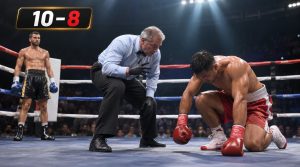
What Is a Standing 8 Count in Boxing? Rules Explained
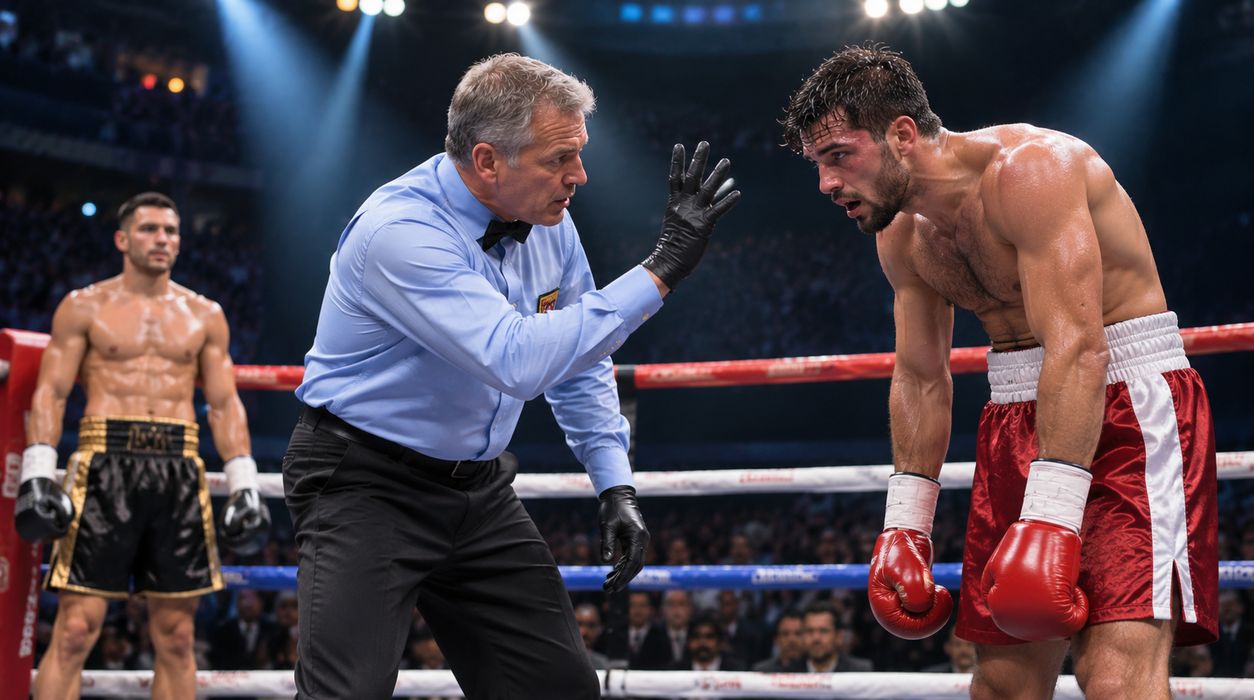
A standing 8 count in boxing is a referee’s count given to a fighter who is still on their feet but appears seriously hurt or unable to defend themselves properly. The referee stops the action, counts to eight, and assesses whether the boxer can safely continue.
However, there is an important rule that many boxing fans misunderstand: standing eight counts are not permitted under the Association of Boxing Commissions’ Unified Rules of professional boxing.
The mandatory eight count after a knockdown is a different procedure, and it remains part of professional boxing.
Whether you are watching a championship fight, an amateur tournament, or an older boxing match, understanding the difference helps explain what the referee is doing inside the ring.
This guide covers how a standing eight count works, why professional boxing generally prohibits it, how mandatory counts work, and what happens when a boxer cannot continue.
What Is a Standing 8 Count in Boxing?
A standing eight count is a protective procedure that allows a referee to temporarily stop a boxing match when a fighter appears badly hurt but has not fallen to the canvas.
Imagine two boxers exchanging punches in the center of the ring.
Boxer A lands several powerful combinations. Boxer B remains standing but begins stumbling, loses defensive control, and appears unable to respond effectively.
In a competition that permits standing eight counts, the referee may intervene and begin counting.
The referee uses the count to evaluate whether Boxer B can safely continue.
The boxer does not need to touch the canvas for this type of count to occur.
That is what makes it different from the mandatory eight count following an official knockdown.
How Does a Standing 8 Count Work?
When standing eight counts are permitted, the procedure generally follows several steps.
1. The Referee Notices a Fighter in Trouble
A boxer may remain upright despite receiving several powerful punches.
Signs of distress can include:
- Unsteady balance
- Difficulty maintaining a defensive position
- Delayed reactions
- Inability to respond to punches
- Apparent confusion or disorientation
The referee must decide whether the fighter can continue defending themselves.
2. The Referee Stops the Action
If the competition rules permit a standing eight count, the referee interrupts the exchange.
The attacking boxer is directed away from the hurt fighter.
The referee begins the count and observes the affected boxer.
3. The Referee Evaluates the Fighter
During the count, the referee looks for signs that the boxer is alert and physically capable of continuing.
A fighter might be asked to raise their gloves, walk toward the referee, or respond to instructions.
The exact procedure depends on the governing rules.
4. The Referee Makes a Decision
After assessing the boxer, the referee may allow the fight to resume.
However, the referee can also stop the contest if the fighter appears unable to continue safely.
An eight count is not a guarantee that the fight will resume.
The referee’s responsibility is to protect the boxers.
Is the Standing 8 Count Allowed in Professional Boxing in 2026?
Under the ABC Unified Rules, standing eight counts are not allowed.
The official Association of Boxing Commissions Unified Rules of Boxing explicitly prohibit standing eight counts while requiring mandatory eight counts after knockdowns.
This distinction applies to professional contests conducted under those rules.
Major professional championship fights generally follow this approach.
However, boxing regulations can vary between jurisdictions and competitions. Fans should check the approved rules of a specific event rather than assume that every boxing match worldwide uses identical procedures.
Why Does Professional Boxing Generally Prohibit Standing Eight Counts?
One concern is that a standing eight count can interrupt a dangerous exchange without necessarily resolving the underlying safety problem.
A fighter who is badly hurt may remain vulnerable even after receiving additional recovery time.
Under the Unified Rules, a referee who believes a boxer cannot intelligently defend themselves may stop the contest instead.
The referee does not need to wait for the fighter to fall.
This places the emphasis on determining whether the boxer is fit to continue rather than automatically providing an additional count.
Standing 8 Count vs. Mandatory 8 Count: What’s the Difference?
The biggest difference is whether the boxer has officially been knocked down.
A standing eight count involves a hurt fighter who has not been knocked down.
A mandatory eight count follows an official knockdown.
| Feature | Standing 8 Count | Mandatory 8 Count |
|---|---|---|
| Boxer must be knocked down | No | Yes |
| Fighter may remain standing | Yes | Fighter has already been ruled down |
| Used under ABC Unified Rules | No | Yes |
| Purpose | Assess a hurt standing boxer | Assess a boxer after a knockdown |
| Referee may stop the fight | Yes | Yes |
| Automatically guarantees continuation | No | No |
This is one of the most important distinctions in modern boxing officiating.
A fighter who gets up immediately after being knocked down must still receive the mandatory count under the Unified Rules.
In contrast, a boxer who remains standing but is unable to defend themselves can have the fight stopped without receiving a standing eight count.
What Is a Mandatory 8 Count in Boxing?
A mandatory eight count is the minimum count a referee administers following an official knockdown under the ABC Unified Rules.
Suppose Boxer A lands a legal punch that sends Boxer B to the canvas.
Boxer B immediately stands up after the referee reaches three.
The referee does not simply restart the action.
Instead, the referee continues the count to eight and evaluates whether Boxer B can safely continue.
The referee may then resume the contest if the boxer is fit.
If the boxer cannot continue safely, the referee can stop the fight.
The ABC Regulatory Guidelines explain the mandatory knockdown count and the referee’s authority to stop a contest when a fighter’s safety is at risk.
Does the Referee Always Count to Eight?
Following a knockdown, the mandatory eight count is standard under the Unified Rules.
However, a referee can stop the contest when the fighter is clearly unable to continue safely.
The count should never be treated as a reason to delay a necessary stoppage.
What Counts as a Knockdown in Boxing?
A knockdown does not always mean a fighter falls completely onto their back.
Under professional boxing regulations, a boxer may be considered knocked down when a legal blow causes them to touch the canvas with a body part other than their feet.
A knockdown can also occur when the ropes prevent a boxer from falling or when the fighter is defenseless while hanging on the ropes, depending on the applicable rules.
Common Knockdown Examples
Example 1: A knee touches the canvas
A fighter receives a clean punch and drops to one knee.
This is normally ruled a knockdown.
Example 2: A glove touches the canvas
A boxer is struck and uses a glove to support their body against the canvas.
That contact can constitute a knockdown.
Example 3: The ropes prevent a fall
A boxer absorbs a punch and becomes helpless against the ropes.
The referee may determine that the ropes are holding the fighter up.
Example 4: A fighter slips
A boxer loses their footing without being knocked down by a legal punch.
A genuine slip is not automatically a knockdown.
The referee’s ruling determines whether a count is required.
Can a Referee Stop a Boxing Match Without a Knockdown?
Yes.
A referee can stop a professional boxing match even when neither fighter has been knocked down.
This can happen when one boxer absorbs repeated punches and can no longer defend themselves intelligently.
For example, a fighter may become trapped against the ropes while the opponent lands unanswered combinations.
If the referee believes the fighter cannot safely continue, the contest can be stopped.
The official result may be a technical knockout, commonly called a TKO.
This is an important reason why standing eight counts are unnecessary under the Unified Rules.
The referee already has the authority to protect a fighter without waiting for a knockdown.
Is a Standing 8 Count the Same as a TKO?
No.
A standing eight count is a temporary interruption in competitions where it is permitted.
A technical knockout ends the contest.
A standing eight count may be followed by continued boxing if the referee determines that the fighter is fit.
A TKO means the fight has been stopped.
Example of a TKO Without a Knockdown
Imagine a boxer receiving repeated unanswered punches.
The fighter remains standing but is no longer effectively defending themselves.
The referee steps between the boxers and waves off the contest.
The result can be a TKO even though the losing boxer never touched the canvas.
This illustrates why the ability to remain standing does not necessarily mean a fighter is safe to continue.
Are Standing Eight Counts Used in Amateur Boxing?
The answer depends on the amateur competition’s governing rules.
Some amateur and regional boxing systems have used standing eight counts or protective counts for fighters who remain upright but are unable to defend themselves.
However, it is inaccurate to assume that every modern amateur boxing organization uses the same procedure.
For example, World Boxing’s published competition rules provide compulsory counts and specific criteria for when a boxer is considered down.
Those rules must be distinguished from professional boxing’s ABC Unified Rules.
The World Boxing Federation’s professional rules and regulations also specify mandatory eight counts after knockdowns while prohibiting standing eight counts.
The safest approach is to consult the governing rules for the actual competition.
Can a Boxer Be Saved by the Bell During an Eight Count?
Under the ABC Unified Rules, a boxer who has been knocked down cannot be saved by the bell in any round.
That means the end of the scheduled round does not automatically cancel the knockdown count.
If a boxer is knocked down near the end of a round, the referee continues the required procedure.
A fighter who cannot recover sufficiently may lose even though the round has technically ended.
This rule helps prevent a seriously hurt fighter from avoiding a knockout simply because the bell sounded.
Boxing uses different timing and stoppage procedures from many other sports. For comparison, SportsVell explains the distinction between official game time and actual elapsed time in its guide to how long a football game lasts.
What Happens If a Boxer Cannot Beat the Count?
If a boxer cannot rise before the referee completes the ten count following a legal knockdown, the result is normally a knockout.
A knockout is commonly abbreviated as KO.
A TKO, by contrast, may occur when the referee stops the contest because a boxer cannot safely continue.
KO vs. TKO
| Result | Meaning |
|---|---|
| KO | A boxer is counted out following a legal knockdown |
| TKO | The contest is stopped because a boxer cannot safely continue |
| Decision | Judges determine the winner after the scheduled rounds |
| Disqualification | A boxer loses because of a serious or repeated rules violation |
Understanding these distinctions helps explain official boxing records and fight results.
Does a Standing Eight Count Affect Boxing Scoring?
In competitions that recognize standing eight counts as knockdown-equivalent scoring events, the count can affect the judges’ scores.
However, scoring treatment depends on the specific rules.
In professional boxing under the ABC Unified Rules, the issue does not arise because standing eight counts are prohibited.
A mandatory eight count follows a knockdown, which normally has a significant effect on the score.
For example, a round featuring one knockdown is commonly scored 10-8 in favor of the boxer who scored it.
Judges still evaluate the complete round and apply the relevant scoring criteria.
Why Knockdowns Matter
A knockdown can turn a close fight into a decisive result.
In a contest where two fighters win approximately the same number of rounds, one additional scoring point can determine the winner.
The scoring system is different from team sports, where points are accumulated through goals, touchdowns, or other scoring plays.
For example, SportsVell’s guide to how many players are on a football team explains the team-based structure of American football, while boxing uses individual competitors and round-by-round judging.
Is There a Three-Knockdown Rule in Professional Boxing?
The ABC Unified Rules do not include an automatic three-knockdown rule.
That means a fighter is not automatically declared the loser simply because they have suffered three knockdowns in a single round.
However, this does not mean a referee must allow the contest to continue after repeated knockdowns.
The referee may stop the fight whenever the boxer cannot safely continue.
Other competitions may have different count limits.
Fans should always distinguish between an automatic knockdown-limit rule and the referee’s independent authority to stop a dangerous contest.
Why Do Boxing Rules Differ Between Competitions?
Boxing is regulated by multiple commissions, governing bodies, and sanctioning organizations.
Rules can vary according to:
- Professional or amateur status
- Governing organization
- State or national jurisdiction
- Age and competition category
- Championship regulations
- Approved event-specific rules
These differences explain why a procedure seen in one boxing tournament may not appear in another.
The same broader principle applies across sports.
Different levels of American football, for example, have their own roster and eligibility regulations. SportsVell’s article on whether college football players get paid explores how rules can change depending on the governing system.
How Can Fans Recognize an Eight Count During a Fight?
When watching a boxing match, pay attention to what happened immediately before the referee began counting.
If the boxer was officially knocked down, the referee is administering a knockdown count.
If the boxer never went down but the referee interrupts the action to assess the fighter, the procedure may resemble a standing eight count in a competition that allows one.
However, a referee stopping the action to inspect a hurt boxer does not automatically mean an official standing eight count has been issued.
The governing rules and referee’s signals determine what is happening.
Fans should also watch for the referee directing the opponent to a neutral corner after a knockdown.
This is a standard part of the count procedure.
Why Is Fighter Safety So Important in Boxing?
Boxing involves repeated head and body impacts.
A fighter may remain conscious and upright while still being unable to defend themselves adequately.
For that reason, referees must evaluate more than whether a boxer can physically stand.
Balance, responsiveness, awareness, and defensive ability all matter.
A referee’s decision to stop a contest can protect a boxer from additional unnecessary punishment.
Boxing officials, ringside physicians, and athletic commissions share responsibility for enforcing safety procedures.
Unlike sports that involve large team rosters and frequent substitutions, boxing usually involves one competitor facing another throughout a round.
SportsVell’s explanation of how many acres a football field covers offers a useful comparison of how different sporting environments are structured.
Frequently Asked Questions
What is a standing 8 count in boxing?
A standing eight count is a referee’s count administered to a hurt boxer who remains on their feet in a competition that permits the procedure.
Is a standing eight count legal in professional boxing?
It is prohibited under the ABC Unified Rules of professional boxing. Specific regulations may vary in other jurisdictions or competitions.
What is the difference between a standing 8 count and a mandatory 8 count?
A standing eight count involves a hurt boxer who has not been knocked down. A mandatory eight count follows an official knockdown.
Why did professional boxing stop using standing eight counts?
Modern professional rules generally favor allowing referees to stop unsafe contests rather than interrupting the action with a standing count. The precise regulatory history varies.
Can a referee stop a fight without a knockdown?
Yes. A referee can stop a contest when a boxer is unable to defend themselves intelligently, even if they remain standing.
What happens if a boxer gets up before eight?
Under the ABC Unified Rules, the referee continues the mandatory count to eight after a knockdown before determining whether the fight may resume.
Does a standing eight count mean an automatic loss?
No. In competitions that permit standing eight counts, the referee may allow the boxer to continue if they are fit.
Is a standing eight count the same as a knockout?
No. A standing eight count is a protective count, while a knockout ends the contest.
Is the three-knockdown rule used in professional boxing?
The ABC Unified Rules do not include an automatic three-knockdown rule, although other competitions may use different regulations.
Can a boxer be saved by the bell?
Under the ABC Unified Rules, a boxer who has been knocked down cannot be saved by the bell in any round.
Final Thoughts
A standing eight count is designed to give a referee an opportunity to assess a hurt boxer who has not been knocked down.
However, it is not part of the ABC Unified Rules used in professional boxing.
The mandatory eight count after a knockdown remains a separate and important procedure.
Understanding this distinction helps boxing fans interpret referee decisions, knockdowns, stoppages, and official fight results.
The most important principle is that a referee does not need to wait for a boxer to fall before stopping a dangerous fight.
For additional sports education and athlete-related stories, explore SportsVell’s coverage of former NBA players and their backgrounds.
As boxing rules can differ by governing body and jurisdiction, always consult the official regulations for the particular contest you are watching.

Washim is a passionate sports writer and editor at SportsVell.com, covering the latest sports news, match updates, player performances, and expert analysis. He focuses on football, cricket, basketball, NFL, NBA, UFC, and other major sports. His goal is to provide sports fans with accurate, engaging, and easy-to-understand content from around the world.