
Can Tennis Players Talk to Their Coaches During a Match? 2026 Coaching Rules Explained
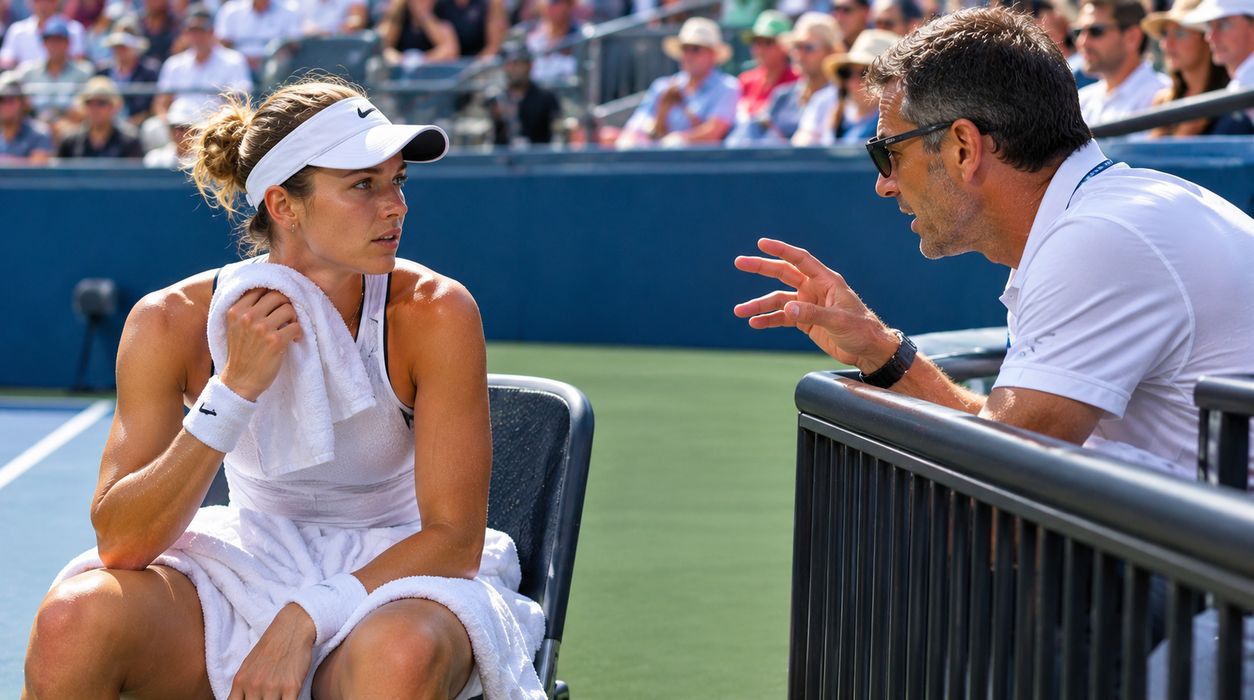
A tennis player loses three games in a row, walks toward the bench, and looks at their coach in the stands. The coach gestures toward the opposite side of the court and says a few words about changing the return position.
A few years ago, that exchange might have led to a coaching violation.
Today, the rules are different.
Tennis players can receive coaching during matches in 2026, but only when the competition permits it and the communication follows specific rules.
On the ATP Tour, coaches can provide brief verbal instructions when they are at the same end of the court as the player. Hand signals are also permitted at appropriate times.
However, coaching is prohibited while a point is being played, and ordinary conversations between players and coaches are not allowed during routine play.
The International Tennis Federation (ITF) changed its rules in 2025 to permit off-court coaching when authorized by the competition’s governing body.
That change remains relevant throughout the 2026 tennis season.
This guide explains when players can talk to coaches, what communication is allowed, how the rules differ between tournaments, and what happens when someone breaks the coaching regulations.
Can Tennis Players Talk to Their Coaches During Matches in 2026?
Yes. Players can receive coaching during matches in competitions that authorize off-court coaching.
The rules are not identical across every tournament.
Under ITF Rule 30, the sanctioning body responsible for an event decides whether off-court coaching is permitted.
The ATP Tour and ATP Challenger Tour allow coaching under their established conditions.
For example, an ATP player can receive a short tactical instruction from a coach sitting in the designated coaching area.
The coach might suggest serving wider or adjusting the return position.
However, the instruction must be brief and must not interrupt play or hinder the opponent.
Quick Summary of 2026 Tennis Coaching Rules
| Situation | Is Coaching Allowed? |
|---|---|
| Between points | Yes, where authorized |
| During a rally | No |
| During a changeover | Yes, under competition rules |
| During a set break | Yes, under competition rules |
| Brief verbal advice | Yes, subject to location restrictions |
| Hand signals | Yes, when coaching is permitted |
| Long conversations during routine ATP play | No |
| Coach entering the court during ordinary singles play | Generally no |
| Coaching during an approved ATP medical interruption | Certain conversations permitted |
| Coaching at every recreational tournament | Depends on event regulations |
The most important distinction is between receiving brief advice and engaging in an unrestricted conversation.
What Does ITF Rule 30 Say About Coaching?
ITF Rule 30 establishes the general framework for coaching during tennis matches.
The rule defines coaching broadly as advice or instruction provided to a player.
That includes spoken instructions, hand signals, and other forms of communication.
The ITF allows off-court coaching when the sanctioning body authorizes it.
However, the rule does not give coaches unrestricted access to players.
Coaching is prohibited while a point is being played.
The rule also distinguishes between off-court coaching and on-court coaching.
Off-court coaching takes place from a location outside the playing court.
On-court coaching involves a coach or authorized team captain being present on the court.
Under the general ITF rules, on-court coaching is permitted only in certain team events involving an authorized team captain.
The official ITF Rules of Tennis provide the governing framework.
What Changed in 2025?
Before 2025, tennis generally prohibited coaching during matches unless a specific competition operated under an approved exception or trial.
The ITF had tested off-court coaching for several years.
Trials began in 2017, and by 2023, major international tennis organizations were participating.
After reviewing feedback, the ITF approved a permanent rule change.
Beginning January 1, 2025, sanctioning bodies could permit off-court coaching under Rule 30 and Appendix IV.
The change did not require every tournament to allow coaching.
Instead, it gave organizers the authority to decide whether coaching would be permitted.
What Are the ATP Coaching Rules in 2026?
The ATP Tour has specific regulations governing communication between players and coaches.
Under the 2026 ATP Rulebook, coaching is allowed at ATP Tour and Challenger Tour tournaments, subject to several conditions.
Coaches must sit in the tournament’s designated coaching seats.
Verbal instructions are permitted only when the coach and player are at the same end of the court.
Those instructions must consist of a few words or short phrases.
Normal conversations are not permitted during routine play.
Nonverbal coaching through hand signals is allowed.
Both verbal and nonverbal coaching must avoid interrupting play or hindering an opponent.
These conditions appear in the official ATP 2026 Rulebook, Chapter VIII: The Code.
Example of Legal ATP Coaching
Imagine a player preparing to receive serve.
The player is standing near the baseline between points.
Their coach is sitting at the same end of the court.
The coach briefly says, “Stand closer.”
The player adjusts their position.
Provided the communication does not delay play or interfere with the opponent, that type of brief instruction is permitted.
Example of Illegal ATP Coaching
Now imagine the same coach beginning a lengthy discussion with the player between points.
The coach explains several tactical adjustments while the server waits.
That conversation goes beyond the normal permitted brief verbal instructions.
The chair umpire may intervene because the communication violates the coaching conditions or delays play.
Can Tennis Coaches Talk During a Rally?
No.
Coaching is not permitted while a point is being played.
This restriction applies even when the competition allows off-court coaching.
For example, a coach cannot shout tactical instructions while a player is exchanging shots with an opponent.
The prohibition protects the normal conduct of the point.
It also prevents coaches from distracting players or interfering with the opponent.
What About Hand Signals During a Point?
Hand signals are permitted only at times when coaching is allowed.
A coach cannot use gestures to provide instructions during an active rally.
The distinction is based on timing, not simply whether the communication is audible.
A silent signal can still constitute coaching.
Can a Coach Cheer During a Point?
Ordinary spectator behavior is not necessarily coaching.
However, conduct that disrupts play or interferes with an opponent can create a separate problem.
Coaches must comply with tournament conduct rules.
The chair umpire may intervene if the coach’s behavior becomes disruptive.
Can Tennis Players Talk to Coaches During Changeovers?
Yes, where the competition permits coaching.
Changeovers are useful opportunities for tactical communication.
A player might receive advice about serve placement, return positioning, or an opponent’s playing patterns.
Under the general ITF framework, authorized coaching may occur during changes of ends and set breaks.
However, ATP coaching restrictions still apply.
Brief instructions are allowed, but ordinary conversations during routine play are not automatically permitted.
What About Set Breaks?
Set breaks provide another opportunity for coaching.
A player who has just lost a set may need to adjust tactics.
The coach might suggest attacking second serves more aggressively or changing the direction of baseline rallies.
Such communication must follow the applicable tournament rules.
A set break does not automatically authorize an unlimited conversation.
Can Players Speak to Coaches During Medical Timeouts?
The ATP allows more direct communication during certain approved interruptions.
Under the 2026 ATP Rulebook, players may approach or converse with their coaches during an opponent’s medical timeout, an opponent’s toilet or change-of-attire break, or another approved break during which the players remain on court.
This differs from the restrictions governing routine play.
For example, if one player receives medical treatment, the opponent may be allowed to speak with their coach during that interruption.
However, the specific conditions of the break matter.
Players should not assume that every interruption creates an unrestricted opportunity for coaching.
Can a Coach Speak to a Player Who Leaves the Court?
Under ATP regulations, coaches may not speak to their players when the players leave the court for any reason.
That restriction prevents players from using off-court interruptions to obtain unauthorized coaching.
The applicable tournament rules and officials’ instructions remain controlling.
Are Hand Signals Allowed in Tennis?
Yes.
Hand signals are a permitted form of coaching in competitions that authorize off-court coaching.
They allow coaches to communicate tactical information without speaking.
For example, a coach might use a previously agreed gesture to suggest a particular return position.
Another signal might remind the player to use more topspin or change the direction of a serve.
However, the signals must occur at permitted times.
They must not interrupt play or create a hindrance.
Why Are Hand Signals Useful?
Professional tennis stadiums can be noisy.
A coach may be sitting several rows away from the court.
Verbal instructions may be difficult to hear.
Hand signals provide a practical alternative.
They can also communicate simple tactical ideas quickly.
However, players must understand the meaning of the signals before the match.
A complicated signal system may be less useful than a few clear instructions.
Can a Tennis Coach Sit Next to the Player?
Not ordinarily in professional singles competition.
ATP coaches must occupy designated coaching seats.
The rules do not generally allow a coach to sit beside a player on the court throughout an ordinary singles match.
The distinction between off-court and on-court coaching is important.
Off-court coaching allows communication from an approved location.
On-court coaching involves the coach or authorized captain being present within the playing area.
Under ITF Rule 30, on-court coaching is generally restricted to qualifying team-event situations involving a team captain.
Therefore, permission to coach does not automatically mean permission to enter the court.
Are Coaching Rules Different at Grand Slam Tournaments?
Grand Slam tournaments operate under their own competition regulations.
The ITF’s general framework permits off-court coaching when authorized by the sanctioning body.
Grand Slam events participated in coaching trials before the 2025 permanent rule change.
However, players must follow the specific rules adopted for the tournament.
The exact coaching arrangements, approved locations, and enforcement procedures can differ.
For example, a tournament may designate particular coaching seats or establish additional procedures for communication.
The safest approach is to check the event’s current regulations rather than assume every tournament follows identical ATP procedures.
Can Tennis Players Use Technology to Receive Coaching?
ITF Rule 30 permits sanctioning bodies to authorize access to approved Player Analysis Technology when coaching is allowed.
This technology may collect or analyze performance information.
For example, approved equipment might help provide information about serve placement or shot patterns.
However, the ITF does not give players unrestricted permission to use any electronic device during matches.
Technology must meet the relevant approval requirements.
The competition must also permit its use.
A player cannot assume that a smartphone, smartwatch, or other device is acceptable simply because off-court coaching is allowed.
The rules governing equipment and communication remain separate considerations.
What Happens If a Tennis Player Receives Illegal Coaching?
Unauthorized coaching can lead to penalties.
The exact consequences depend on the competition and the nature of the violation.
On the ATP Tour, violations of the coaching conditions can result in penalties under the Point Penalty Schedule.
The ATP also provides for financial penalties.
Under the 2026 ATP Code, a coaching-related violation can result in a fine of up to $5,000 per violation.
Serious misconduct may lead to additional action.
For example, the supervisor may relocate a coach who repeatedly violates the rules.
In sufficiently serious circumstances, the coach may be ordered to leave the match site or tournament site.
Can a Player Lose a Point?
Yes.
Coaching violations can be subject to the competition’s point-penalty procedures.
However, the exact penalty depends on the applicable code and disciplinary circumstances.
Players and coaches should not assume that every coaching violation automatically produces the same punishment.
Officials apply the relevant regulations.
Why Did Tennis Change Its Coaching Rules?
For decades, professional tennis emphasized individual decision-making.
Players were expected to solve tactical problems without receiving instructions during matches.
Supporters of that tradition believed it made tennis distinctive.
However, critics argued that the old rules were difficult to enforce consistently.
Coaches sometimes communicated through subtle gestures or coded messages.
Some players received warnings while others appeared to avoid punishment.
The ITF’s decision followed years of testing and consultation.
The organization identified several potential benefits.
These included more consistent enforcement, reduced subjectivity, and improved player development.
The change also recognized that coaching had already become part of the professional game through approved trials.
The ITF explained its reasoning in its official announcement about off-court coaching.
Does Coaching Give Some Players an Unfair Advantage?
This remains a subject of debate.
Players with experienced coaches may benefit from receiving tactical advice during matches.
A coach might recognize an opponent’s weakness or suggest a change that the player has not considered.
However, tennis players already differ in their access to training, equipment, travel support, and professional resources.
Supporters of coaching argue that clearer rules make communication more transparent.
Opponents argue that tennis should remain a contest in which players solve problems independently.
Both perspectives raise legitimate questions about the sport’s identity.
The current regulations attempt to balance tactical assistance with the player’s responsibility to compete.
Coaches can provide limited guidance, but they cannot direct every rally.
How Does Tennis Coaching Compare With Other Sports?
Tennis coaching differs from the communication systems used in many team sports.
In soccer, coaches can issue instructions from the technical area throughout much of a match, subject to conduct rules.
Soccer teams also have multiple players who can communicate and adjust their positions collectively.
SportsVell explains the team structure in how many players are on a soccer team.
American football uses a different approach.
Coaches coordinate offensive and defensive strategies, and teams can rotate players between plays.
SportsVell’s guide to how many players are on a football team explains the structure of those squads.
In tennis singles, one player must execute the strategy without teammates on the court.
Even when coaching is permitted, the player remains responsible for shot selection, movement, and decision-making during rallies.
How Can Coaches Help Players During Matches?
Effective coaching is not necessarily about delivering complicated instructions.
Short, practical suggestions can be more useful.
Adjusting Serve Placement
A coach may notice that an opponent struggles to return wide serves.
A brief reminder can encourage the player to target that area.
Changing Return Position
If a player repeatedly misses returns against a powerful server, the coach might suggest moving farther behind the baseline.
Managing Emotions
Tennis is mentally demanding.
A coach may provide encouragement or remind a player to focus on the next point.
Recognizing Tactical Patterns
A coach watching from outside the court may notice repeated shot patterns.
For example, an opponent might consistently approach the net after hitting a short backhand.
A brief instruction can help the player prepare.
Maintaining Focus
Players can become frustrated after close calls or missed opportunities.
A coach’s concise message may help restore concentration.
These benefits depend on the quality of communication and the player’s ability to apply the advice.
How Did Famous Tennis Players Handle Coaching?
Tennis history includes many successful player-coach partnerships.
Roger Federer worked with several coaches during his career, including Peter Lundgren, Tony Roche, Paul Annacone, Stefan Edberg, and Ivan Ljubicic.
Their contributions involved technical development, preparation, and tactical planning.
However, much of Federer’s career took place before the current off-court coaching framework.
Players from that era generally faced stricter restrictions on receiving instructions during matches.
That historical difference matters when comparing tennis generations.
For more about Federer’s career and influence, read SportsVell’s feature on Roger Federer and Conor McGregor.
Modern players compete under a different communication framework, but preparation and independent execution remain essential.
Common Mistakes About Tennis Coaching Rules
Mistake 1: Tennis players can never receive coaching during matches.
Off-court coaching is permitted in competitions that authorize it, including ATP Tour events.
Mistake 2: Coaches can talk whenever they want.
ATP verbal coaching is restricted to brief instructions when the coach and player are at the same end of the court.
Mistake 3: Hand signals are always illegal.
Hand signals are permitted when coaching is authorized and the communication follows the applicable rules.
Mistake 4: Coaches can provide instructions during rallies.
Coaching is prohibited while a point is being played.
Mistake 5: Allowing off-court coaching means coaches can enter the court.
On-court coaching remains restricted under the ITF framework.
Mistake 6: Every tennis competition has identical coaching rules.
The sanctioning body determines whether coaching is permitted and may establish additional conditions.
Frequently Asked Questions
Can tennis players talk to coaches during matches in 2026?
Yes, where coaching is authorized. ATP Tour and Challenger Tour players may receive brief coaching under specific conditions.
Can coaches talk between tennis points?
Yes, in competitions that permit coaching. ATP verbal instructions must be brief and given when the coach and player are at the same end of the court.
Can tennis coaches use hand signals?
Yes. Hand signals are permitted at authorized coaching times, provided they do not interfere with play.
Can a coach give advice during a rally?
No. ITF Rule 30 prohibits coaching while a point is being played.
Can players talk to coaches during changeovers?
Authorized coaching is permitted during changeovers, subject to the competition’s communication restrictions.
Can ATP players have full conversations with coaches?
Not during routine play. The ATP generally limits verbal coaching to a few words or short phrases. Certain approved interruptions allow conversations.
Can coaches enter the court during singles matches?
Generally, no. Ordinary singles competition permits off-court coaching rather than unrestricted on-court coaching.
Can a player receive a penalty for illegal coaching?
Yes. Coaching violations may result in penalties under the applicable competition code, including point penalties or fines.
Is coaching allowed at Grand Slam tournaments?
Off-court coaching can be permitted under the ITF framework, but the tournament’s own regulations determine the exact conditions.
When did tennis begin allowing off-court coaching?
The ITF made the rule change effective January 1, 2025, following several years of trials.
Final Thoughts
So, can tennis players talk to their coaches during matches in 2026?
Yes, but the communication must follow the rules established by the competition.
The ITF permits off-court coaching when authorized by the sanctioning body.
The ATP allows brief verbal advice, hand signals, and certain conversations during approved interruptions.
However, coaching is prohibited while a point is being played.
ATP coaches must use designated seating areas, and ordinary conversations during routine play remain restricted.
The changes have made coaching more visible and easier to regulate, but they have not removed the player’s responsibility to make decisions on the court.
For fans, understanding these rules helps explain why a coach may gesture toward a player during one moment but remain silent during the next.
For players, the rules provide opportunities to receive tactical support without interrupting the natural flow of the match.
For coaches, they establish clear boundaries around communication and conduct.
As professional tennis continues to evolve, the relationship between player independence and coaching assistance will remain an important part of the sport.
For more tennis articles, sports rules, and player stories, explore SportsVell.
Readers interested in how other sports manage coaching, match structure, and recovery can also explore SportsVell’s guides to how long a football game lasts and how many rounds are in a boxing match.