What Happens After an Accidental Eye Poke in UFC? No Contest vs. Technical Decision
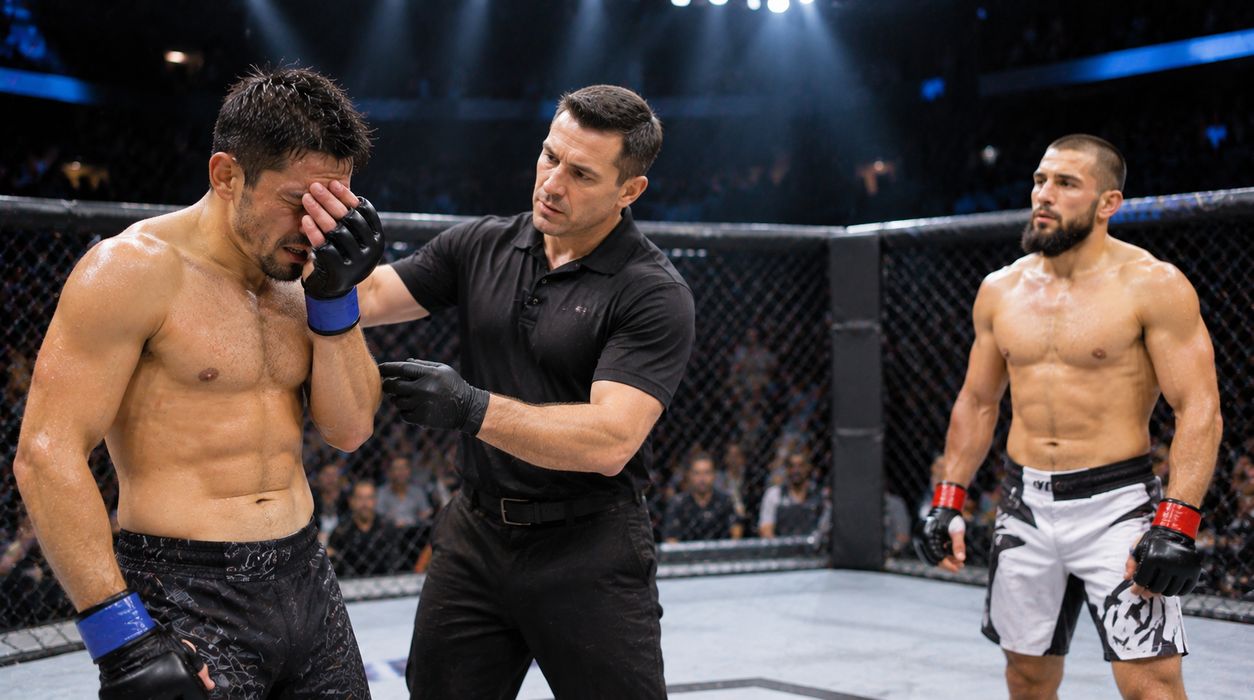
A UFC fighter throws a punch during a close exchange. Their fingers extend forward, accidentally catching the opponent in the eye. The injured fighter immediately turns away, blinking and holding their face.
The referee steps between the athletes and stops the action.
What happens next?
Under the Unified Rules of Mixed Martial Arts, an accidental eye poke can lead to a temporary stoppage, medical examination, resumed action, or an official result such as a no contest or technical decision.
The outcome depends on whether the injured fighter can safely continue, how the referee classifies the foul, how much of the scheduled fight has been completed, and which athletic commission’s rules apply.
An accidental eye poke does not automatically end the fight. It also does not automatically give the injured fighter a victory.
In 2026, understanding these distinctions is especially important because MMA organizations and athletic commissions may apply different foul-recovery procedures.
This guide explains the UFC accidental eye poke rules, the recovery period, referee decisions, medical stoppages, no contests, technical decisions, and disqualifications.
What Happens After an Accidental Eye Poke in UFC?
When a referee recognizes an accidental eye poke, the first step is generally to stop the action.
The referee separates the fighters and evaluates the situation.
If necessary, the injured fighter receives attention from the ringside physician.
The referee must determine whether the contact was accidental or intentional.
If the injured fighter is medically cleared and can continue, the contest may resume.
If the injury prevents the fighter from continuing, the official result depends on the governing rules and the timing of the stoppage.
Quick Summary of UFC Eye Poke Outcomes
| Situation | Possible Outcome |
|---|---|
| Accidental eye poke, fighter recovers | Fight resumes |
| Accidental eye poke, fighter cannot continue early | No contest |
| Accidental eye poke, fighter cannot continue after required rounds | Technical decision or draw |
| Intentional eye poke causing immediate stoppage | Disqualification |
| Repeated eye pokes | Warning, point deduction, or disqualification |
| Fighter suffers injury from a legal strike | Potential TKO rather than accidental-foul ruling |
These are general outcomes. The specific commission’s rules control the final decision.
The Association of Boxing Commissions’ current Unified Rules provide the central framework used by many professional MMA events.
Is an Eye Poke Illegal in UFC?
Yes.
Eye gouging and related attacks to the eyes are prohibited under the Unified Rules.
An eye poke can occur when a fighter extends their fingers toward an opponent’s face during a striking exchange.
For example, a fighter may attempt to measure distance with an open hand.
If a finger enters or contacts the opponent’s eye, the referee may determine that a foul occurred.
However, not every contact near the face automatically qualifies as an eye poke.
The referee evaluates the action and the circumstances.
Accidental vs. Intentional Eye Pokes
An accidental eye poke occurs when the referee determines that the prohibited contact was not deliberate.
An intentional eye poke involves deliberate misconduct.
That distinction matters because intentional fouls can lead to more severe penalties.
For example, a fighter who deliberately targets an opponent’s eye may be disqualified.
A fighter who accidentally catches an opponent’s eye during a defensive movement may instead receive a warning or another appropriate penalty.
The referee’s judgment is central to the ruling.
How Long Does a UFC Fighter Have to Recover From an Eye Poke?
An eye-poke recovery period can extend up to five minutes under applicable modern MMA rules.
However, five minutes is a maximum, not an automatic entitlement to continue fighting or a guarantee that the full period must be used.
The referee and ringside physician must consider whether the fighter can safely resume.
If the fighter is clearly unable to continue, the contest may be stopped.
The official ABC MMA Rules Committee’s eye-poke recovery amendment addresses the five-minute recovery provision.
Does the Fighter Always Receive Five Full Minutes?
Not necessarily.
The applicable commission’s rules determine how the recovery period operates.
Medical judgment also matters.
If the ringside physician determines that continuing would be unsafe, the fight should not resume simply because time remains.
What If the Fighter Recovers Quickly?
The referee may restart the contest once the fighter is ready and medically cleared.
The fighter does not need to use the entire available period.
For example, an athlete who experiences temporary discomfort but quickly regains normal vision may be permitted to continue.
The referee follows the applicable restart procedure.
What Does the Ringside Doctor Check After an Eye Poke?
The ringside physician evaluates whether the injured fighter can safely continue.
An eye injury can affect vision, coordination, and the ability to defend against strikes.
The physician may assess the fighter’s symptoms and visible condition.
Potential concerns include blurred vision, persistent pain, impaired visual function, and suspected injury to the eye.
The doctor may recommend that the contest stop if continuing would be unsafe.
Can the Fighter Override the Doctor?
No.
A fighter’s willingness to continue does not automatically override medical restrictions.
An athlete may insist they feel capable of fighting.
However, the referee and medical professionals must apply the governing safety procedures.
A fighter should not be permitted to continue solely because they want to preserve their opportunity to win.
When Does an Accidental Eye Poke Result in a No Contest?
A no contest can occur when an accidental foul causes an injury severe enough to stop the bout before the required portion of the scheduled contest has been completed.
Under the current ABC Unified Rules, the relevant thresholds are:
- Before two completed rounds in a scheduled three-round fight.
- Before three completed rounds in a scheduled five-round fight.
If an accidental eye poke makes a fighter unable to continue before those thresholds, the result is generally a no contest under the applicable accidental-foul provisions.
Example: Eye Poke in Round One
Imagine a three-round UFC fight.
During the first round, Fighter A accidentally pokes Fighter B in the eye.
Fighter B cannot safely continue.
The referee stops the contest.
Because the fight has not reached the required completed-round threshold, the result is generally a no contest.
Neither fighter receives an ordinary victory.
Example: Eye Poke Early in Round Two
The same principle applies if a three-round bout ends from an accidental eye poke before the second round is completed.
The fight has not reached the threshold required for a technical decision under the standard ABC framework.
The exact commission regulations remain controlling.
When Does an Accidental Eye Poke Lead to a Technical Decision?
A technical decision becomes possible when an accidental foul causes a stoppage after the required number of rounds has been completed.
Under the ABC Unified Rules:
- A three-round fight generally requires two completed rounds.
- A five-round fight generally requires three completed rounds.
Once the applicable threshold is reached, the judges’ scorecards determine the result.
The fighter ahead on the scorecards receives the technical decision.
Example: Eye Poke in Round Three of a Three-Round Fight
Fighter A and Fighter B complete two rounds.
During the third round, Fighter A accidentally pokes Fighter B in the eye.
Fighter B cannot continue.
The referee stops the contest.
Because two rounds have been completed, the judges’ scorecards are used to determine the outcome.
If Fighter B is ahead, Fighter B may win by technical decision.
If Fighter A is ahead, the standard ABC accidental-foul provisions may award Fighter A the technical decision, although some jurisdictions have additional eye-poke-specific restrictions.
Why Does the Commission Matter?
Not every commission uses identical language.
For example, California has published eye-poke-specific procedures that can prevent the offending fighter from being declared the winner in certain circumstances.
Therefore, the general ABC framework should not be treated as an unconditional rule for every UFC event.
What Is a Technical Draw After an Eye Poke?
A technical draw occurs when the applicable scoring procedure produces a tied result after an accidental-foul stoppage.
For example, a fight may be stopped after the required completed rounds.
The judges score the contest, including any partial round as required.
If the resulting scorecards produce a draw, the official result may be a technical draw.
Some jurisdictions also provide specific technical-draw treatment when the fighter responsible for an accidental eye poke is ahead on the cards.
No Contest vs. Technical Decision vs. Technical Draw
| Result | Meaning |
|---|---|
| No contest | Fight ends without an ordinary winner or loser |
| Technical decision | Judges determine a winner after a qualifying foul-related stoppage |
| Technical draw | Qualifying stoppage produces a draw under applicable scoring rules |
| Disqualification | Fighter loses because of a sufficiently serious rules violation |
These results should not be confused with a knockout or technical knockout caused by legal strikes.
Can a UFC Fighter Be Disqualified for an Eye Poke?
Yes.
An intentional eye poke can result in disqualification.
The referee considers the circumstances and the applicable regulations.
For example, deliberately targeting an opponent’s eye is substantially different from an accidental finger contact during an exchange.
An intentional foul that immediately prevents the opponent from continuing may result in the offending fighter losing by disqualification.
Can Repeated Accidental Eye Pokes Cause Disqualification?
Yes, depending on the governing regulations and referee’s assessment.
Repeated fouls can lead to escalating penalties.
A referee may issue warnings, deduct points, or disqualify a fighter when the circumstances justify that action.
However, a warning is not necessarily required before every serious penalty.
Can a Referee Deduct Points for an Accidental Eye Poke?
Yes.
An accidental foul does not necessarily prevent the referee from deducting points.
The referee may consider the severity, frequency, and circumstances of the violation.
A single accidental eye poke may result in a warning.
Repeated eye pokes may produce point deductions.
A serious foul may justify stronger action.
How Does a Point Deduction Affect the Score?
UFC judges generally use the 10-point must scoring system.
Suppose a judge initially scores a round 10–9 for Fighter A.
If Fighter A receives a one-point deduction, the recorded score for that round may become 9–9.
That deduction can affect the final result.
In a close three-round fight, one deducted point can change a decision into a draw or alter which fighter wins.
Are Eye Poke Rules Different From Low Blow Rules?
Yes, although both involve prohibited contact and may allow a recovery period.
A low blow involves an illegal strike to the groin.
An eye poke involves prohibited contact with the eye.
The applicable recovery procedures may be similar in some jurisdictions, but they are not necessarily identical.
Historically, the ABC rules treated recovery time for low blows differently from other fouls.
Later committee amendments addressed eye-poke recovery specifically.
That history explains why some older online explanations incorrectly claim that eye pokes never receive a five-minute recovery period.
For current interpretation, the event’s commission rules should take priority over older summaries.
What Happens If a Fighter Says They Cannot See?
The referee should treat that statement seriously.
Vision is essential for defending against strikes.
A fighter who cannot see properly may be unable to protect themselves.
The ringside physician may examine the athlete and determine whether continuing is medically appropriate.
If the fighter cannot safely continue, the bout must be stopped and classified under the applicable rules.
Can the Fighter Change Their Mind?
A fighter may initially report discomfort and later feel ready to continue.
However, the final decision must follow the referee’s instructions and medical assessment.
The athlete’s preference is only one part of the process.
Why Are Eye Pokes Common in MMA?
Eye pokes can occur during fast exchanges when fighters use open hands to manage distance.
MMA gloves leave the fingers exposed.
That design allows fighters to grip, wrestle, and attempt submissions.
However, it also creates situations where extended fingers can contact an opponent’s face.
Distance Management
Fighters sometimes extend their hands to measure distance or maintain space.
If the fingers point toward the opponent’s eyes, accidental contact can occur.
Defensive Reactions
During a sudden attack, a fighter may raise an open hand to defend.
A finger can unintentionally contact the opponent’s eye.
Clinch Exchanges
Close-range grappling creates frequent hand and arm movement near the face.
This can increase the risk of accidental contact.
None of these situations automatically excuses a foul.
Fighters remain responsible for using legal techniques.
Do UFC Gloves Prevent Eye Pokes?
Not completely.
MMA gloves are designed to permit grappling while providing some hand protection.
Unlike traditional boxing gloves, they leave the fingers exposed.
This allows athletes to grip an opponent, control wrists, and attempt submissions.
However, exposed fingers can also create opportunities for eye contact.
Glove design has therefore been part of ongoing discussions about eye-poke prevention.
Why Doesn’t UFC Use Boxing Gloves?
Boxing gloves would significantly change the sport.
MMA requires fighters to use their hands for wrestling and submission grappling.
Large, fully enclosed boxing gloves would interfere with many techniques.
For a comparison of combat-sport structures, SportsVell explains how many rounds are in a boxing match.
Boxing and MMA have different equipment and permitted techniques because they are different sports.
How Do Referees Try to Prevent Eye Pokes?
Referees can warn fighters about extended fingers and dangerous hand positioning.
They may instruct athletes to keep their fingers away from an opponent’s face.
These warnings are preventive measures.
They do not replace the official foul procedures if an eye poke occurs.
Can a Referee Warn a Fighter Before Contact Happens?
Yes.
Referees often communicate with fighters during exchanges.
For example, an official may warn a fighter to close their fingers or adjust an extended hand.
The goal is to reduce the likelihood of a foul.
However, a preventive warning does not mean a later eye poke is automatically intentional.
The referee must assess the actual incident.
What Happens If an Eye Injury Comes From a Legal Punch?
This is an important distinction.
Not every eye injury results from an eye poke.
A legal punch may cause swelling, cuts, or other injuries around the eye.
If a legal strike causes an injury that prevents the fighter from continuing, the result may be a technical knockout.
That differs from an accidental-foul stoppage.
Example: Legal Punch Causes Eye Swelling
Fighter A lands a legal punch.
Fighter B’s eye becomes badly swollen.
The ringside physician determines that Fighter B cannot safely continue.
The contest may end by TKO.
Example: Accidental Finger Contact Causes Eye Injury
Fighter A accidentally pokes Fighter B in the eye.
Fighter B cannot continue.
The referee classifies the incident as an accidental foul.
The outcome is determined under the accidental-foul rules rather than automatically being recorded as a TKO.
The cause of the injury matters.
Can Video Replay Help Officials Review an Eye Poke?
Potentially.
Some athletic commissions authorize video review under specified circumstances.
Replay may help officials examine whether prohibited contact occurred or clarify the circumstances of a stoppage.
However, replay availability and permitted uses vary by jurisdiction.
A UFC event in one state may operate under different replay procedures from an event elsewhere.
The referee and commission must follow the rules approved for that particular contest.
How Does an Eye Poke Compare With an Illegal Knee?
Both are fouls under the Unified Rules when the prohibited conditions are met.
However, they involve different actions.
An eye poke concerns illegal contact with the eye.
An illegal knee may occur when a fighter strikes the head of a grounded opponent.
The grounded-opponent definition was revised in 2024.
Under the updated rule, touching the canvas with only the hands does not make a fighter grounded.
That change affects whether certain knees to the head are legal.
The injury and stoppage procedures for fouls may overlap, but the underlying violations are different.
Are 12–6 Elbows Treated Like Eye Pokes?
No.
The straight downward 12–6 elbow motion is no longer prohibited under the updated Unified Rules.
A legal elbow to a permitted target is not a foul simply because of its direction.
An eye poke remains prohibited.
However, an elbow can still be illegal if it lands on a prohibited target, such as the back of the head.
The distinction is between a permitted technique and a prohibited action.
Both situations demonstrate why fans need to consider the specific rules rather than assume every unusual-looking strike is illegal.
How Are UFC No Contests Different From Boxing No Contests?
Both sports can record a no contest when a bout ends under qualifying circumstances without an ordinary winner.
However, the exact rules differ.
Boxing has its own accidental-foul procedures and completed-round thresholds.
MMA uses the applicable Unified Rules and commission regulations.
SportsVell’s article on No Contest in Boxing: NC vs. DQ vs. Technical Draw explains the boxing distinctions.
For another comparison, What Is a Catchweight Fight in Boxing? explores how combat sports handle special contractual conditions.
These articles provide useful context, but boxing rules should not be applied directly to UFC fights.
Why Do Athletic Commissions Have the Final Say?
The UFC promotes and organizes events, but professional MMA bouts are regulated by the appropriate athletic commission or other authorized governing body.
That authority oversees the contest under applicable regulations.
It can establish rules for fouls, medical examinations, scoring, and official results.
This is why two apparently similar incidents may be handled differently in different jurisdictions.
For example, California has published detailed eye-poke procedures that differ in important respects from the general ABC accidental-foul language.
The California State Athletic Commission’s published MMA rule materials describe those eye-poke-specific provisions.
Fans should check the governing commission before making a definitive claim about a controversial result.
Can an Eye Poke Affect a Fighter’s Career?
Yes.
A serious eye injury can affect training, competition schedules, and medical clearance.
The extent of the impact depends on the injury.
Some fighters recover quickly.
Others may require additional medical evaluation or treatment.
Repeated fouls may also affect how officials and opponents view a fighter’s conduct.
However, one accidental incident does not automatically establish a pattern of intentional misconduct.
Professional athletes are judged on the circumstances of each case.
For a broader look at the preparation and public profiles of major combat-sports athletes, SportsVell’s Roger Federer and Conor McGregor feature examines two athletes from very different competitive disciplines.
Why Does the Timing of an Eye Poke Matter?
The timing can determine whether a fight ends without a winner or goes to the scorecards.
Consider a scheduled three-round contest.
If an accidental eye poke ends the fight during the first round, the standard ABC framework generally produces a no contest.
If the same type of accidental foul ends the fight after two full rounds have been completed, a technical decision becomes possible.
The injury may be similar, but the official result differs because the contest has reached the scoring threshold.
Three-Round vs. Five-Round Thresholds
| Scheduled Fight | Early Stoppage | Later Stoppage |
|---|---|---|
| Three rounds | Before two completed rounds | After two completed rounds |
| Five rounds | Before three completed rounds | After three completed rounds |
This table reflects the general ABC Unified Rules framework.
Specific commission provisions may alter the result, particularly for eye-poke incidents.
Common Mistakes About UFC Eye Poke Rules
Mistake 1: Every eye poke automatically ends the fight.
The contest may resume if the injured fighter is medically cleared.
Mistake 2: Every accidental eye poke produces a no contest.
A later stoppage may result in a technical decision or draw.
Mistake 3: Every fighter automatically gets five minutes.
The recovery process depends on the applicable regulations and medical assessment.
Mistake 4: Accidental fouls can never cause point deductions.
Referees may deduct points under the relevant rules.
Mistake 5: Every intentional eye poke results in the same penalty.
The severity and circumstances matter.
Mistake 6: UFC events follow identical commission procedures everywhere.
Regulatory differences can affect the official result.
Frequently Asked Questions
What happens after an accidental eye poke in UFC?
The referee generally stops the action, assesses the foul, and may request a medical examination. The fight can resume if the injured athlete is cleared.
Does an accidental eye poke automatically cause a no contest?
No. The fight may continue, or a later stoppage may lead to a technical decision.
How much recovery time does a UFC fighter get after an eye poke?
Applicable rules may allow up to five minutes, subject to referee and medical decisions.
Can a UFC fighter be disqualified for an eye poke?
Yes. Intentional or sufficiently serious repeated fouls can lead to disqualification.
What is a technical decision in UFC?
A technical decision occurs when a qualifying foul-related stoppage sends the fight to the judges’ scorecards.
What is a technical draw?
A technical draw is a draw produced under the applicable technical-decision or foul-related scoring provisions.
Can an accidental eye poke result in a point deduction?
Yes. The referee may deduct points depending on the circumstances and governing rules.
Does an eye poke count as a knockout?
No. An accidental-foul stoppage is classified under the applicable foul rules, not automatically as a knockout.
Can a fighter continue after an eye poke?
Yes, if the fighter can safely continue and receives the necessary clearance.
Are eye poke rules the same in every UFC location?
Not necessarily. Athletic commissions may apply different approved regulations.
Final Thoughts
An accidental eye poke can change the outcome of a UFC fight, but the result is not always straightforward.
The first question is whether the injured fighter can safely continue.
If the fighter recovers and receives medical clearance, the bout may resume.
If the injury prevents continued competition, the referee applies the relevant accidental-foul procedures.
Under the general ABC Unified Rules, an early stoppage can produce a no contest, while a stoppage after the required completed rounds can lead to a technical decision.
However, some commissions have additional eye-poke-specific provisions.
Intentional eye pokes can lead to disqualification, and repeated violations may result in escalating penalties.
The most important lesson for fans is that no contest, technical decision, technical draw, and disqualification describe different situations.
Understanding those differences makes controversial UFC stoppages easier to interpret and highlights the important roles of referees, medical professionals, and athletic commissions.