Another Word for Entertainment: 65+ Synonyms & Examples
Another word for entertainment depends on what you mean. There is no single perfect synonym, because the word has two senses. The best default choices are amusement, recreation, and pastime, and each one fits a different sentence.
Amusement works for the general feeling of being entertained. Recreation works for leisure activities and formal writing. Pastime works for a hobby or a regular activity. For a show or event itself, use performance, show, or production.
Merriam-Webster lists 65 similar and opposite words for entertainment, while Cambridge lists only 16 synonyms. The gap between those two counts shows why a short list is not enough. You need the full list, plus guidance on which word fits your sentence.
Readers will learn the complete synonym list, the formal and informal picks, the differences between the four most confused words, example sentences for every major synonym, and the words that look like synonyms but are not. Every claim here is tied to a named dictionary source.
The Best Synonyms for Entertainment at a Glance
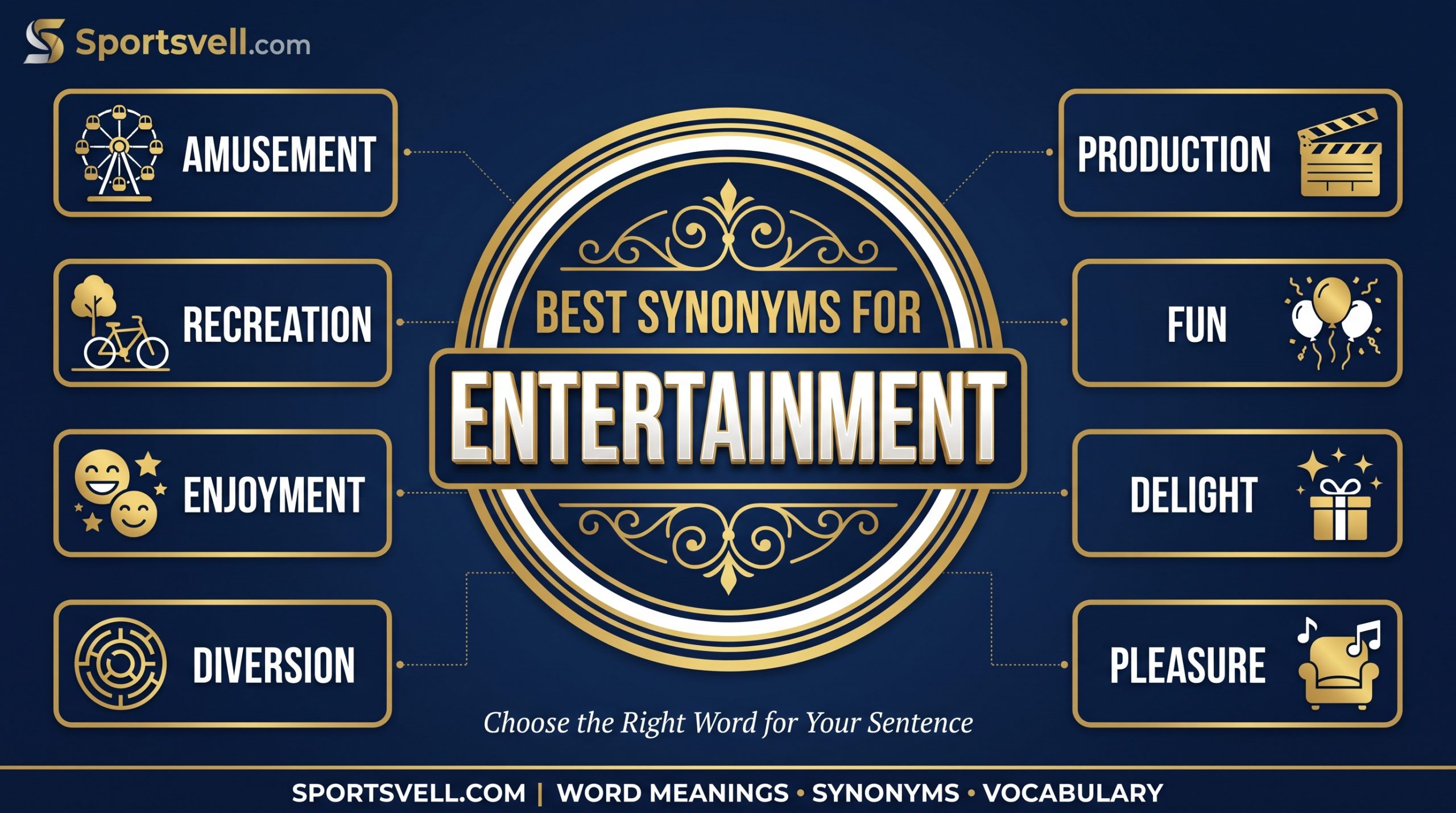
The eight best all-purpose synonyms are amusement, recreation, enjoyment, diversion, production, fun, delight, and pleasure. These are the top eight words across the major dictionaries. They cover both senses of the word and most everyday sentences.
Not every synonym on the full list is useful. Words like delectation, presentment, and divertissement are real synonyms, but they are rare, formal, or French. They belong in a complete list, not in your essay. The table below ranks the most useful twenty.
| Synonym | Meaning | Register | Best use |
|---|---|---|---|
| Amusement | The feeling of being entertained | Neutral | General replacement in almost any sentence |
| Recreation | Leisure activity done for enjoyment | Formal | Essays, reports, and official writing |
| Enjoyment | The pleasure of doing something | Neutral | Talking about how an activity feels |
| Diversion | A pleasant break from routine | Formal | Literary and academic writing |
| Fun | Light-hearted enjoyment | Informal | Conversation, captions, and casual writing |
| Delight | Great pleasure and happiness | Neutral | Strong positive feeling about an event |
| Pleasure | Something that gives enjoyment | Neutral | General use, slightly formal |
| Pastime | A regular activity done for enjoyment | Neutral | Hobbies and regular leisure activities |
| Leisure | Free time used for enjoyment | Formal | Writing about free time and lifestyle |
| Performance | A show put on for an audience | Neutral | Theatre, music, dance, and live events |
| Show | A staged entertainment for an audience | Neutral | Everyday talk about theatre and TV |
| Production | A staged work such as a play | Formal | Theatre and film contexts only |
| Spectacle | A large, impressive public show | Formal | Big events, ceremonies, and displays |
| Distraction | Something that takes attention away | Neutral | A break from work or worry |
| Relaxation | Gentle activity that rests the mind | Formal | Calm, restful leisure activities |
| Play | Activity done for enjoyment, often by children | Neutral | Children’s activities and games |
| Game | A competitive activity done for fun | Neutral | Sports and board games |
| Festivity | A joyful celebration or party | Formal | Festivals, holidays, and parties |
| Show business | The entertainment industry | Informal | Talking about the industry itself |
| Nightlife | Evening entertainment in a city | Neutral | Bars, clubs, and evening events |
The table shows the key pattern. The feeling words (amusement, enjoyment, delight, pleasure) replace entertainment when you mean the experience. The activity words (recreation, pastime, leisure, play) replace it when you mean what someone does. The show words (performance, show, production, spectacle) replace it when you mean the event itself.
Sports are a clear example of all three at once. A football game is a performance for the crowd, a pastime for the fans who watch every week, and pure amusement for a neutral viewer. Our guide on how long a football game lasts shows how much time that entertainment fills on game day.
What Does Entertainment Mean?
Entertainment is a noun with two main senses. Merriam-Webster gives the first sense as the act or activity of providing pleasure or amusement, especially for the public. The second sense is someone or something that provides amusement or enjoyment. Most synonyms fit only one of the two senses.
The two senses explain most synonym mistakes. A word that fits sense one may fail in sense two. Amusement fits both senses well. Production fits sense one only when it means a staged work, and it never fits sense two. Knowing the sense first prevents the error.
Sense 1: The Act of Providing Pleasure or Amusement
Sense one covers the act itself. The film is purely for entertainment and not meant to be taken seriously. Here entertainment means the act of amusing an audience, not the film as an object. Amusement, diversion, and enjoyment are the closest matches for this sense.
We did not stay for the featured entertainment because we do not care for comedy acts. That sentence, used by Merriam-Webster as its example, shows sense one in action. The entertainment is the comedy performance, the act of amusing the crowd.
Production belongs to sense one when it means a staged work. A theatre production is entertainment in this sense. A factory production is not, and that is why production is a dangerous synonym. It only works inside theatre and film contexts.
Sense 2: Someone or Something That Provides Amusement
Sense two covers the thing or person. What do you do for entertainment in this town? That question, used by Merriam-Webster as its example for sense two, asks about the activities and places that provide amusement. Recreation, pastime, and fun are the closest matches here.
A band, a game, or a festival can all be entertainment in sense two. The word names the provider, not the act. When you ask what a town offers for entertainment, you want the recreation and pastime words, not the feeling words.
Live sport is entertainment in sense two. Monday Night Football is a weekly event that millions of people watch for amusement, and our who won Monday Night Football hub tracks each game as a piece of live entertainment. The game itself is the provider, and the broadcast is the delivery.
Entertainment as a Countable and Uncountable Noun
Entertainment is usually uncountable. You say “we need entertainment” rather than “we need an entertainment.” The uncountable form covers the general idea of amusement, and most synonyms in the feeling group are uncountable too.
The countable form exists for events. He organized entertainments and events for elderly people. Here “entertainments” means individual shows or activities. Merriam-Webster lists 62 similar and opposite words for the plural form, with amusements, diversions, recreations, delights, pleasures, and fun at the top.
Most synonyms follow the same pattern. Amusement, recreation, enjoyment, and pleasure are usually uncountable. Show, performance, game, and party are countable. Matching the countability of your replacement word to the sentence keeps the grammar clean.
The Full Synonym List: All 65 Words, Grouped by Meaning
Full synonym entries for entertainment are also available from Thesaurus.com and Vocabulary.com. Both pages are useful second checks when a thesaurus list looks thin.
Merriam-Webster lists 65 similar and opposite words for entertainment, and the list is far more useful when it is grouped by meaning. A flat alphabetical list hides the differences. The five groups below show which words mean the feeling, which mean the activity, which mean the show, which mean the industry, and which are rare.
Cambridge lists only 16 synonyms for the same word: amusement, diversion, distraction, recreation, divertissement, fun, play, good time, pastime, novelty, pleasure, enjoyment, and satisfaction, plus three more in its extended list. The Cambridge list is clean and fast, but it leaves out the show words, the industry words, and most of the rare words.
Collins groups its synonyms by sense into nine groups: fun, leisure, performance, play, pleasure, presentation, recreation, satisfaction, and show. That sense grouping is the best of any competitor, and the groups below follow the same idea with more detail and more words.
Synonyms for the Feeling: Amusement, Enjoyment, Delight, Pleasure
The feeling group names what entertainment does to you. Amusement is the closest general synonym, and it works in almost any sentence where entertainment means the feeling. Enjoyment is slightly warmer, and it stresses the pleasure of doing something rather than watching it.
Delight means great pleasure and happiness. It is stronger than enjoyment, so it fits events that truly impress. Pleasure is the most general feeling word of all, and it works in both formal and informal writing. Joy, mirth, gaiety, and jollity sit in the same group, but they are more literary.
Satisfaction and gratification are quieter feeling words. They describe contentment rather than excitement, so they fit calm pleasures better than loud ones. Relief belongs here too, because entertainment can relieve stress, and a good game can feel like relief after a long week.
Delectation is the rare word in this group. It means delight or enjoyment, but it is old-fashioned and almost never used in modern writing. Keep it in the complete list for accuracy, and leave it out of your own sentences.
- Amusement: the feeling of being entertained; the safest general replacement.
- Enjoyment: the pleasure of doing or watching something.
- Delight: great pleasure, stronger than enjoyment.
- Pleasure: something that gives enjoyment; the most general feeling word.
- Joy: a strong feeling of happiness from an experience.
- Mirth: laughter and happiness, a literary word.
- Gaiety: cheerfulness and fun, a formal word.
- Jollity: cheerful celebration, a formal word.
- Satisfaction: quiet contentment from an experience.
- Gratification: pleasure from getting what you wanted.
- Relief: comfort after stress, when entertainment relaxes you.
- Delectation: delight, rare and old-fashioned.
Synonyms for the Activity: Recreation, Pastime, Diversion, Leisure
The activity group names what people do. Recreation is the formal word for leisure activities done for enjoyment, and it is the best choice for essays and reports. Pastime is the everyday word for a regular activity, such as golf, reading, or watching football every Sunday.
Diversion means a pleasant break from routine. It stresses the escape from work, not the activity itself. Distraction is close to diversion, but it is weaker, because a distraction can be unwanted. Use diversion for a chosen break and distraction for an accidental one.
Leisure means free time used for enjoyment. It is a formal word, and it often appears in phrases like leisure activities and leisure time. Play means activity done for enjoyment rather than work, and it usually refers to children, though adults play games too.
Game, picnic, festivity, and merrymaking are specific activities in this group. A game is competitive, a picnic is outdoors, a festivity is a celebration, and merrymaking is joyful social fun. Hilarity, romp, revelry, frolic, spree, and gambol are livelier members of the same group, and they suit parties and celebrations.
Sport is a Collins synonym for entertainment in the activity sense, and it is the most relevant one for a sports audience. Football is my favourite sport is a natural sentence, and it shows how sport replaces entertainment when the activity is athletic. Our Green Bay Packers vs Dallas Cowboys player stats page covers one such sporting entertainment in full detail.
- Recreation: formal word for leisure activities.
- Pastime: a regular activity done for enjoyment.
- Diversion: a pleasant break from routine.
- Leisure: free time used for enjoyment.
- Play: activity done for fun, often by children.
- Game: a competitive activity done for fun.
- Distraction: something that takes attention away from work.
- Escape: getting away from routine through entertainment.
- Escapism: the habit of escaping reality through entertainment.
- Festivity: a joyful celebration or party.
- Merrymaking: joyful social fun and celebration.
- Revelry: loud, joyful celebration.
- Frolic: playful, light-hearted fun.
- Spree: a short period of unrestrained fun.
- Picnic: an outdoor meal and leisure activity.
- Lark: a fun adventure, an informal word.
- Romps and gambols: playful, energetic fun, both literary words.
Synonyms for the Show: Performance, Show, Production, Spectacle
The show group names the event itself. Performance is the most versatile word here, and it covers theatre, music, dance, and sport. Show is the everyday version, and it works for theatre, television, and live events alike. Production is formal and specific, and it means a staged work such as a play.
Spectacle means a large, impressive public show. It fits ceremonies, parades, and big stadium events. Exhibition is close, but it usually means a display of art or objects rather than a performance. Presentation is formal, and it fits a public performance such as a play or a ballet.
WordReference adds the richest show vocabulary of any dictionary in this report. Its sense two list includes stage show, floor show, motion picture, movie, film, dance, concert, reception, game, pageant, parade, exhibition, party, cabaret, feast, banquet, fete, extravaganza, garden party, and festivity. Those words are the concrete events that entertainment names in sense two.
A football match is a spectacle in the show sense. Tens of thousands of people in a stadium, a live broadcast, and a four-hour event make it one of the largest regular spectacles in American life. The field itself is part of the show, and our guide on how many acres a football field covers measures the stage where that spectacle happens.
- Performance: a show put on for an audience.
- Show: a staged entertainment, the everyday word.
- Production: a staged work, formal, theatre and film only.
- Spectacle: a large, impressive public show.
- Exhibition: a public display, usually of art or objects.
- Presentation: a public performance, formal.
- Stage show: a live performance on a stage.
- Concert: a live music performance.
- Pageant: a public show with costumes and processions.
- Cabaret: entertainment with music and dancing in a club.
- Extravaganza: a large, spectacular show.
- Movie and film: cinema as entertainment.
Synonyms for the Industry: Show Business, Nightlife, Live Events
The industry group names the business of entertainment. Show business is the informal name for the entertainment industry, and it covers film, television, theatre, and music as a trade. Nightlife means evening entertainment in a city, including bars, clubs, and late shows.
Live events is the modern industry phrase. It covers concerts, sports, festivals, and theatre as a single market. The performing arts is the formal name for theatre, dance, and music as a sector, and it appears in government and arts funding documents.
Streaming is the newest industry word. It names the delivery of entertainment over the internet, and it has become the default way most people watch films and series. The industry sense matters because entertainment in a business sentence almost always means show business, not amusement.
Rare and Literary Synonyms: Divertissement, Delectation, Presentment
Divertissement is a French borrowing that means a light entertainment or diversion, and it is used in formal and literary writing. Merriam-Webster gives it its own thesaurus page with 46 similar and opposite words. It is correct but rare, so it suits academic writing and fails in casual writing.
Delectation means delight or enjoyment, but it is old-fashioned and almost never appears in modern text. Presentment means a presentation or display, and it is a legal and literary word that rarely means entertainment. Both belong in a complete list, and neither belongs in your own writing.
Regalement is another rare word in this group, listed by WordReference. It means the act of entertaining guests with food and drink, and it belongs to the hosting sense of the word. Use it only when you mean a feast, never for a film or a game.
Formal vs Informal: Which Synonym Fits Your Sentence?
Register is the decision that matters most. A synonym can be correct in meaning and still wrong in tone. Recreation is formal, fun is informal, and amusement is neutral. Picking the wrong register is the most common synonym mistake, and it is the one the dictionaries rarely warn you about.
The Oxford Advanced Learner’s Dictionary makes the register distinction explicit. Fun is rather informal, recreation is rather formal, relaxation is rather formal, play refers mostly to children, and pleasure is the activity of enjoying yourself in contrast to working. Those five notes are the best register guidance any dictionary gives for this word family.
| Synonym | Register | Use in | Do not use in |
|---|---|---|---|
| Recreation | Formal | Essays, reports, official writing | Text messages, casual captions |
| Diversion | Formal | Academic and literary writing | Everyday conversation |
| Divertissement | Very formal | Academic writing, arts criticism | Almost everywhere else |
| Leisure | Formal | Reports on lifestyle and free time | Casual chat |
| Spectacle | Formal | Journalism, ceremony, big events | Talking about a small gathering |
| Amusement | Neutral | Almost any sentence | Nowhere; it is the safest choice |
| Enjoyment | Neutral | Almost any sentence | Nowhere; it is the second safest choice |
| Pastime | Neutral | Talking about hobbies and habits | Formal reports (use recreation) |
| Performance | Neutral | Theatre, music, sport, live events | Talking about a feeling |
| Fun | Informal | Conversation, captions, casual writing | Essays, resumes, formal emails |
| Good time | Informal | Parties, outings, casual talk | Formal writing |
| Laughs | Informal | Comedy and light talk | Formal writing |
| Show business | Informal | Talking about the industry casually | Formal industry reports |
Formal Synonyms for Essays, Resumes, and Business Writing
Recreation is the best formal synonym. It is precise, widely understood, and safe in academic and official writing. Diversion is the second choice, and it works when the sentence stresses a break from work. Leisure is the third, and it fits sentences about free time and lifestyle.
Use pleasure in formal writing when you mean the feeling rather than the activity. Pleasure is neutral enough for formal use, and it is more natural than enjoyment in many formal sentences. Spectacle works in formal writing only for large public events, never for small ones.
Informal Synonyms for Conversation, Captions, and Casual Writing
Fun is the best informal synonym. It is short, clear, and understood by everyone. Good time is the phrase for a party or an outing, and laughs is the word for comedy. Show business is the informal name for the industry, and it sounds natural in conversation.
Do not use fun in an essay. It is too casual for academic writing, and it weakens a formal argument. The Oxford register note is clear on this point: fun is rather informal, and formal writing needs recreation or amusement instead.
Synonyms That Work in Both Registers
Amusement and enjoyment work everywhere. They are neutral, widely understood, and correct in both senses of the word. Pastime works in both registers too, though recreation is safer in the most formal writing. Performance and show are neutral, and they work wherever the sentence means an event.
When in doubt, choose amusement. It is the top synonym in Merriam-Webster, Collins, and Cambridge alike, and it never sounds wrong. Enjoyment is the backup when the sentence stresses the feeling of doing something rather than watching it.
Entertainment vs Amusement vs Recreation vs Diversion
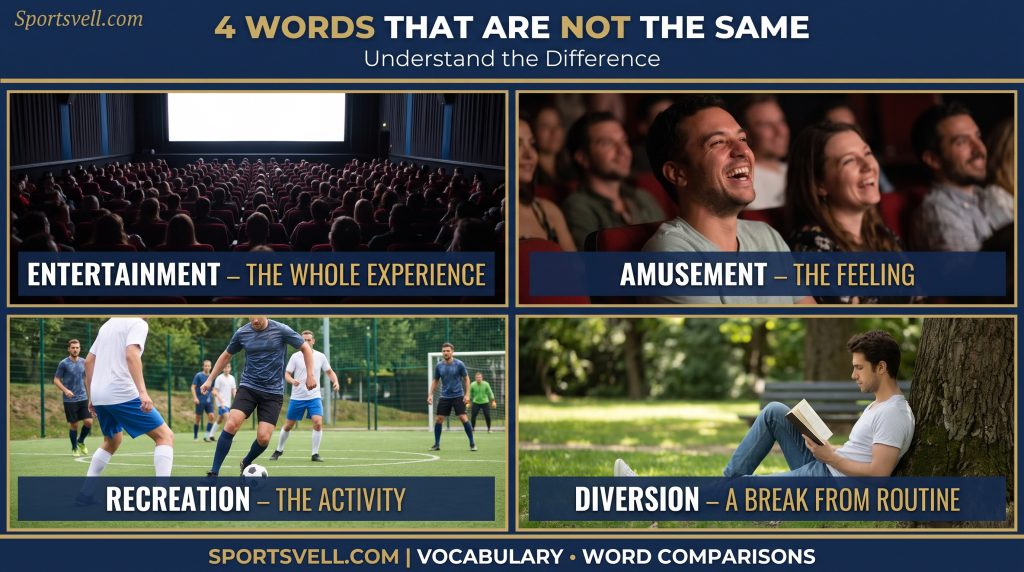
The four most confused synonyms are amusement, recreation, diversion, and pastime. They all mean something like entertainment, but they are not interchangeable. The table below separates them by meaning, register, and best use, and the sections after it explain each pair.
| Word | Core meaning | Register | Emphasis | Best use |
|---|---|---|---|---|
| Entertainment | Amusement provided for the public | Neutral | The whole idea | General use, both senses |
| Amusement | The feeling of being entertained | Neutral | The feeling | General replacement anywhere |
| Recreation | Leisure activity done for enjoyment | Formal | The activity | Essays, reports, formal writing |
| Diversion | A pleasant break from routine | Formal | The escape | Literary and academic writing |
| Pastime | A regular activity done for enjoyment | Neutral | The habit | Hobbies and regular activities |
| Leisure | Free time used for enjoyment | Formal | The time | Writing about free time |
| Enjoyment | The pleasure of doing something | Neutral | The feeling | Talking about how it feels |
| Fun | Light-hearted enjoyment | Informal | The mood | Casual writing and talk |
Entertainment vs Amusement
Entertainment is the broader word. It covers the industry, the event, and the feeling. Amusement is narrower, and it covers the feeling and the act of amusing. You can replace entertainment with amusement in most sentences, but you cannot replace amusement with entertainment in every sentence about a feeling.
Use amusement when the sentence is about the feeling. “What do you do for amusement round here?” is the Oxford example, and it sounds natural. Use entertainment when the sentence is about the industry or the event, because amusement never means show business.
Entertainment vs Recreation
Recreation is the formal activity word. It means things people do for enjoyment when they are not working, and it is the best synonym for formal writing. Entertainment is the general word, and it covers both the activity and the feeling. Recreation never covers the feeling alone.
Use recreation in essays and reports. “His only form of recreation is playing football” is the Oxford example, and it shows the formal register clearly. Use entertainment when you mean the whole idea, including films, television, and music as a category.
Amusement vs Recreation
Amusement is the feeling, recreation is the activity. That is the simplest way to separate them. Amusement answers the question “how did it feel?” Recreation answers the question “what did you do?” A film can provide amusement, and playing football is recreation.
The Oxford distinction is worth quoting. Both words can cover a wide range of activities, physical and mental, but relaxation is sometimes used for gentler activities than recreation. Amusement sits between them: lighter than recreation, more active than relaxation.
Diversion vs Distraction
Diversion is a chosen break, distraction is often unwanted. A diversion is a pleasant activity you pick to escape routine. A distraction is something that pulls your attention away, and it can be annoying. Finger-painting is an excellent diversion, says Collins, and the sentence shows the positive sense.
Use diversion for a deliberate escape. A holiday, a game, or a concert is a diversion from work. Use distraction when the interruption is accidental or unwelcome, such as noise during a meeting. The two words overlap, but their tone is different.
Pastime vs Hobby
Pastime and hobby are close, but not identical. A pastime is an activity done regularly for enjoyment, and a hobby is a pastime pursued with interest and skill. Golf is a pastime for a casual player and a hobby for someone who studies the game. Collins lists pastime as a synonym for entertainment, and hobby is its nearest neighbour.
Use pastime for the general idea and hobby for a serious pursuit. “His favourite pastime is golf” is the Collins example, and it works because golf is regular and enjoyable. A hobby sentence usually adds detail about skill, equipment, or time spent.
Example Sentences for Every Major Synonym
A synonym without an example is a guess. No competitor gives an example sentence for every major synonym, and that is the gap this section closes. Each sentence below is written to show the word in its natural context, with the register it belongs to.
Amusement, Recreation, Enjoyment, and Diversion in Sentences
- Amusement: “The town has little amusement for visitors after dark, so most people stay home.”
- Recreation: “The city funds recreation centres where families can swim, play, and learn together.”
- Enjoyment: “She found real enjoyment in the concert, and she stayed until the final song.”
- Diversion: “A walk in the park was a welcome diversion from a long week of meetings.”
- Pleasure: “Watching television is our only pleasure on quiet winter evenings.”
- Delight: “The children’s delight at the magic show was clear on every face.”
- Leisure: “He had little leisure during the harvest, and he missed his evening games.”
- Relaxation: “She goes hillwalking for relaxation, and she returns home calm and rested.”
Pastime, Pleasure, Delight, and Fun in Sentences
- Pastime: “His favourite pastime is golf, and he plays every Saturday morning.”
- Fun: “You still have time to join in the fun, so bring your friends along.”
- Good time: “We had a good time at the festival, and we stayed until the fireworks ended.”
- Play: “The happy sounds of children at play filled the park all afternoon.”
- Game: “Board games are our favourite entertainment on rainy weekends at home.”
- Festivity: “The town’s annual festivity draws thousands of visitors every summer.”
- Merrymaking: “The street was full of merrymaking after the team won the championship.”
- Escape: “A good novel is an escape from the stress of a busy week.”
Performance, Show, Production, and Spectacle in Sentences
- Performance: “The band did three performances at the Royal Albert Hall last spring.”
- Show: “How about going to see a show in London this weekend?”
- Production: “The theatre’s new production of the classic play opens on Friday night.”
- Spectacle: “The opening ceremony was a spectacle of light, music, and colour.”
- Exhibition: “The art exhibition drew crowds who came for culture and entertainment.”
- Concert: “The outdoor concert was the highlight of the summer festival.”
- Nightlife: “The city’s nightlife offers bars, clubs, and live music every evening.”
- Show business: “She spent twenty years in show business before retiring to teach drama.”
Cricket is a performance in the show sense and a pastime in the activity sense, and the two senses meet in every match. A five-day Test is a long spectacle, and a T20 game is a short, loud one. Our India vs New Zealand match scorecard and our England vs India match scorecard both cover cricket as live entertainment, with the scores and the stories that make each game worth watching.
Words That Do NOT Mean Entertainment (Common Mistakes)
Thesaurus lists mislead writers. A word can appear on a synonym list and still fail in your sentence. The three words below are the most dangerous traps on the entertainment list, because each one is correct in a narrow sense and wrong everywhere else.
| Word | Why it looks right | Why it fails | Use instead |
|---|---|---|---|
| Production | It is on every synonym list | It also means manufacturing; it only means entertainment for a staged work | Performance or show |
| Presentment | Merriam-Webster lists it | It is a rare legal and literary word; readers will not know it | Presentation or display |
| Delectation | It means delight | It is old-fashioned and almost never used today | Delight or enjoyment |
| Divertissement | It is a real synonym | It is French and formal; it sounds pretentious in casual writing | Diversion or amusement |
| Distraction | Cambridge lists it | It can mean an unwanted interruption, not a pleasure | Diversion, when the break is chosen |
| Relief | Merriam-Webster lists it | It means comfort after stress, not fun itself | Relaxation, when the activity is calming |
Production: Only When It Means a Staged Work
Production is the most common trap. It appears on the Merriam-Webster list because a theatre production is entertainment. A factory production is not, and a film production usually means the making of the film, not the film itself. Use performance or show unless the sentence is clearly about a staged work.
Presentment and Delectation: Too Rare for Normal Writing
Presentment and delectation are correct but useless. They appear in the dictionary lists, and they are real words with real meanings. Readers will not know them, and using them makes the writing harder to read. Delight and enjoyment say the same thing in words everyone understands.
Divertissement: Formal and French, Use With Care
Divertissement is correct in academic and arts writing. It names a light entertainment or a short ballet piece, and it is the right word in those contexts. In an essay about weekend activities, it sounds pretentious. Use diversion or amusement instead, and save divertissement for the arts page.
Modern Words for Entertainment: Streaming, VR, and Beyond
Entertainment has changed faster than the dictionaries. The thesaurus lists were built for films, theatre, and music, and they cover those forms well. They do not cover streaming, virtual reality, gaming, or binge-watching, and only one competitor page even mentions them. This section closes that gap.
Oreate AI is the only top-10 page that mentions modern entertainment, and it does so in about 350 words with no list. It names streaming services, virtual reality, immersive experiences, and digital escapism as new phrases. Those four phrases are the start of the modern synonym set, not the end of it.
Immersive Experiences and Digital Escapism
An immersive experience is entertainment that surrounds you. Virtual reality headsets, interactive theatre, and escape rooms all count, because the audience is inside the experience rather than watching it. The phrase is modern, widely used in marketing, and it names a real category that no old synonym covers.
Digital escapism is entertainment used to escape reality through screens. Binge-watching a series, playing a long video game, or scrolling short videos are all forms of digital escapism. The phrase is honest about the motive, and it is useful in writing about screen habits and mental health.
Streaming is the delivery word, not the content word. You stream a film, a series, or a concert, and the stream is the method. Binge-watching is the behaviour word, and it means watching many episodes in one sitting. Gaming is the activity word, and it covers video games as entertainment.
Streaming, Binge-Watching, and Gaming as Entertainment
Live sport is the oldest form of streaming entertainment and the newest at the same time. Fans once watched games only in stadiums, then on television, and now on phones and laptops. Our guide on where to watch Ohio State vs Indiana football shows how fans find a game across television and streaming, and it is a practical example of modern entertainment delivery.
Cricket streaming works the same way. Fans follow a Test match over five days or a T20 game over three hours, and the scorecard is the second screen. Our India vs South Africa match scorecard hub is built for that habit, with the latest match at the top and the full history below it.
- Streaming: watching films, series, or live events over the internet.
- Binge-watching: watching many episodes of a series in one sitting.
- Gaming: playing video games as entertainment.
- Immersive experience: entertainment that surrounds the audience, such as virtual reality.
- Digital escapism: escaping reality through screens and online content.
- Content: the modern industry word for films, videos, and posts as a product.
- Live stream: a real-time broadcast over the internet.
Antonyms of Entertainment
Antonyms complete a thesaurus entry. They show what entertainment is not, and they help writers who need the opposite word. Cambridge lists three antonyms for entertainment: work, job, and preoccupation. Merriam-Webster adds boredom and tedium through its related-word lists.
| Antonym | Meaning | When to use it |
|---|---|---|
| Work | Activity done for duty or pay | The opposite of leisure and free time |
| Job | Paid employment | The opposite of a pastime or hobby |
| Preoccupation | Something that fills the mind | The opposite of a diversion or escape |
| Boredom | The feeling of having nothing to do | The opposite of amusement and fun |
| Tedium | Boring, repetitive time | The opposite of delight and excitement |
| Drudgery | Hard, dull, routine work | The opposite of recreation and play |
Work, Job, and Preoccupation
Work is the main antonym of entertainment. Entertainment happens in free time, and work happens in duty time. The contrast is the oldest one in the language, and it is why the word leisure exists at all. A sentence about work-life balance needs both words.
Job is the concrete version of work. It means paid employment, and it is the antonym when the sentence is about a career rather than effort. Preoccupation is the mental version: something that fills the mind so fully that no entertainment can get in.
Boredom and Tedium
Boredom is the feeling antonym. Entertainment produces amusement, and boredom is the absence of it. Tedium is the time antonym: long, dull, repetitive hours with nothing engaging. Both words are useful in writing about why entertainment matters, because they name the problem it solves.
The History of the Word Entertainment
Entertainment comes from the verb entertain, which comes from Old French entretenir, meaning to hold together or maintain. The Latin roots are inter, meaning between, and tenere, meaning to hold. The original sense was keeping something up, not amusing someone.
The meaning shifted in stages. First entertain meant to maintain or keep up, then to receive guests and provide for them, then to keep someone agreeably occupied, and finally to amuse an audience. The Oxford English Dictionary traces that shift across centuries, and it is the authority for the history in this section.
From Old French Entretenir to Modern English
Entretenir entered Middle English as entertinen. The early sense was maintenance: to keep a household, an army, or a position going. The guest sense followed, because hosting a guest meant maintaining them with food, drink, and company. The modern sense grew from the hosting sense.
The noun entertainment followed the verb. It first meant the act of receiving guests, then the food and company provided, and then any amusement provided for an audience. The two modern senses in Merriam-Webster are the end of that long shift.
How the Meaning Shifted From Hosting to Amusing
Hosting and amusing share one idea: keeping someone occupied. A host keeps guests agreeably occupied with food and talk. A performer keeps an audience agreeably occupied with a show. The word kept the idea and changed the setting, from the dining room to the theatre.
The industry sense is the newest shift. Show business, nightlife, and streaming are all modern uses, and they treat entertainment as a product and a market. The word that once meant keeping a household going now names a global industry.
How to Choose the Right Synonym in 4 Steps
Choosing a synonym is a decision, not a lookup. A thesaurus gives you a list, but it does not tell you which word fits your sentence. The four steps below turn the list into a choice, and they work for any synonym, not just this one.
Step 1: Name the Sense You Mean
Ask whether you mean the feeling, the activity, or the show. The feeling needs amusement, enjoyment, or delight. The activity needs recreation, pastime, or leisure. The show needs performance, show, or spectacle. Naming the sense first cuts the list from 65 words to about 10.
Step 2: Pick the Register
Ask whether the writing is formal or informal. Formal writing needs recreation, diversion, or leisure. Informal writing needs fun, good time, or laughs. Neutral writing can use amusement, enjoyment, or pastime. The register table in this article gives the label for every major synonym.
Step 3: Test the Sentence
Put the synonym into your sentence and read it aloud. If it sounds natural, it fits. If it sounds stiff or odd, try the next word on the list. A synonym that needs the sentence rewritten around it is usually the wrong choice.
Step 4: Check the Collocation
Check which words naturally pair with your synonym. Recreation pairs with activities and centres. Pastime pairs with favourite and regular. Diversion pairs with welcome and pleasant. Amusement pairs with for and provides. A synonym with the wrong collocation will sound translated, even when the meaning is right.
FAQs About Another Word for Entertainment
What is another word for entertainment?
The best general synonym is amusement. Recreation is the best formal synonym, pastime is the best synonym for a hobby, and performance is the best synonym for a show. The right word depends on whether you mean the feeling, the activity, or the event.
What is the best synonym for entertainment?
Amusement is the best all-purpose synonym. It is the top synonym in Merriam-Webster, Collins, and Cambridge, and it works in both senses of the word. Recreation is the best choice for formal writing, and fun is the best choice for casual writing.
What are the top 10 synonyms for entertainment?
The top 10 are amusement, recreation, enjoyment, diversion, production, fun, delight, pleasure, pastime, and leisure. Those ten cover both senses of the word and most everyday sentences. The full Merriam-Webster list has 65 words, and the comparison table in this article ranks the top 20.
What is a formal word for entertainment?
Recreation is the best formal word for entertainment. Diversion, leisure, and spectacle are also formal. Use recreation in essays, reports, and official writing, and use diversion when the sentence stresses a break from routine.
What is an informal word for entertainment?
Fun is the best informal word for entertainment. Good time and laughs are also informal. Use them in conversation, captions, and casual writing, and never use fun in a formal essay.
What is a fancy word for entertainment?
Divertissement is the fanciest synonym for entertainment. It is a French borrowing used in formal and literary writing. Spectacle is a fancy word for a large public show, and extravaganza is a fancy word for a big, impressive event.
What is another word for entertainment in an essay?
Use recreation or amusement in an essay. Recreation is the safest formal choice, and amusement is the safest neutral choice. Do not use fun, good time, or laughs in an essay, because they are too informal.
What is another word for entertainment in a resume?
Use recreation or leisure in a resume. Both words are formal and professional. A resume sentence about organising recreation activities sounds stronger than one about organising fun.
Is amusement a synonym for entertainment?
Yes, amusement is the closest synonym for entertainment. It is the top synonym in Merriam-Webster, Collins, and Cambridge. It works in both senses: the act of amusing and the feeling of being amused.
Is recreation a synonym for entertainment?
Yes, recreation is a formal synonym for entertainment. It means leisure activities done for enjoyment. It fits the activity sense, not the feeling sense, so it works for what people do, not how they feel.
Is fun a synonym for entertainment?
Yes, fun is an informal synonym for entertainment. It means light-hearted enjoyment. It works in conversation and casual writing, but it is too informal for essays and formal reports.
Is pleasure a synonym for entertainment?
Yes, pleasure is a synonym for entertainment. It means something that gives enjoyment. It is neutral in register, so it works in both formal and informal writing.
Is pastime a synonym for entertainment?
Yes, pastime is a synonym for entertainment. It means a regular activity done for enjoyment, such as golf or reading. It is the best synonym when the sentence is about a hobby or a habit.
Is diversion a synonym for entertainment?
Yes, diversion is a formal synonym for entertainment. It means a pleasant break from routine. It is the best choice when the sentence stresses escaping work, and it suits literary and academic writing.
What is the difference between entertainment and amusement?
Entertainment is broader, amusement is narrower. Entertainment covers the industry, the event, and the feeling. Amusement covers the feeling and the act of amusing. Use amusement for the feeling and entertainment for the whole idea.
What is the difference between entertainment and recreation?
Recreation is the formal activity word, entertainment is the general word. Recreation means leisure activities done for enjoyment. Entertainment covers the activity, the feeling, and the industry. Use recreation in formal writing about activities.
What is the difference between amusement and recreation?
Amusement is the feeling, recreation is the activity. Amusement answers how it felt, and recreation answers what you did. A film provides amusement, and playing football is recreation.
What is the difference between diversion and distraction?
Diversion is a chosen break, distraction is often unwanted. A diversion is a pleasant activity you pick to escape routine. A distraction pulls attention away and can be annoying. Use diversion for a deliberate escape.
What is the difference between pastime and hobby?
A pastime is a regular enjoyable activity, a hobby is a pastime pursued with interest and skill. Golf is a pastime for a casual player and a hobby for someone who studies the game. Use pastime for the general idea and hobby for a serious pursuit.
What is the opposite of entertainment?
The opposite of entertainment is work. Cambridge lists work, job, and preoccupation as the antonyms. Boredom and tedium are the feeling antonyms, and they name the absence of amusement.
What is another word for entertainment industry?
Show business is the informal name for the entertainment industry. The performing arts is the formal name for theatre, dance, and music as a sector. Live events is the modern industry phrase for concerts, sports, and festivals.
What is another word for live entertainment?
Performance and show are the best synonyms for live entertainment. A live performance means a show put on for an audience in real time. Nightlife is the word for evening live entertainment in a city.
What do you call entertainment in one word?
Amusement is the best one-word answer. It is short, widely understood, and correct in both senses. Recreation is the best one-word answer in formal writing, and fun is the best one-word answer in casual writing.
Can I use “fun” instead of “entertainment” in an essay?
No, do not use fun instead of entertainment in an essay. Fun is rather informal, and it weakens formal writing. Use recreation or amusement in an essay, and save fun for conversation and captions.
How many synonyms does entertainment have?
Merriam-Webster lists 65 similar and opposite words for entertainment. Cambridge lists 16 synonyms. The counts differ because each dictionary groups and counts words differently, and Merriam-Webster includes rare, literary, and industry words that Cambridge leaves out.
Conclusion
Another word for entertainment depends on what you mean. Amusement is the best general synonym, recreation is the best formal synonym, pastime is the best synonym for a hobby, and performance is the best synonym for a show. The four-step chooser in this article turns that list into a decision: name the sense, pick the register, test the sentence, and check the collocation.
The dictionaries agree on the top words and disagree on the count, because Merriam-Webster lists 65 words and Cambridge lists 16. The difference is coverage, not correctness. A complete guide needs the full list, the register labels, the example sentences, and the mistakes, and that is what this page provides.
Start with amusement when you are unsure. It is the top synonym in every major dictionary, it works in both senses, and it never sounds wrong. Then refine the choice: recreation for formal writing, fun for casual writing, pastime for a hobby, and spectacle for a large public event. The right synonym is the one that fits your sentence, your reader, and your tone.
Sport shows all three senses at once. A game is a performance for the crowd, a pastime for the fans who watch every week, and pure amusement for a neutral viewer. Keep exploring the games that entertain you, from Monday Night Football to the latest India vs New Zealand cricket, and the right word will follow the experience.