How Much Do Banana Ball Players Make? (2026)
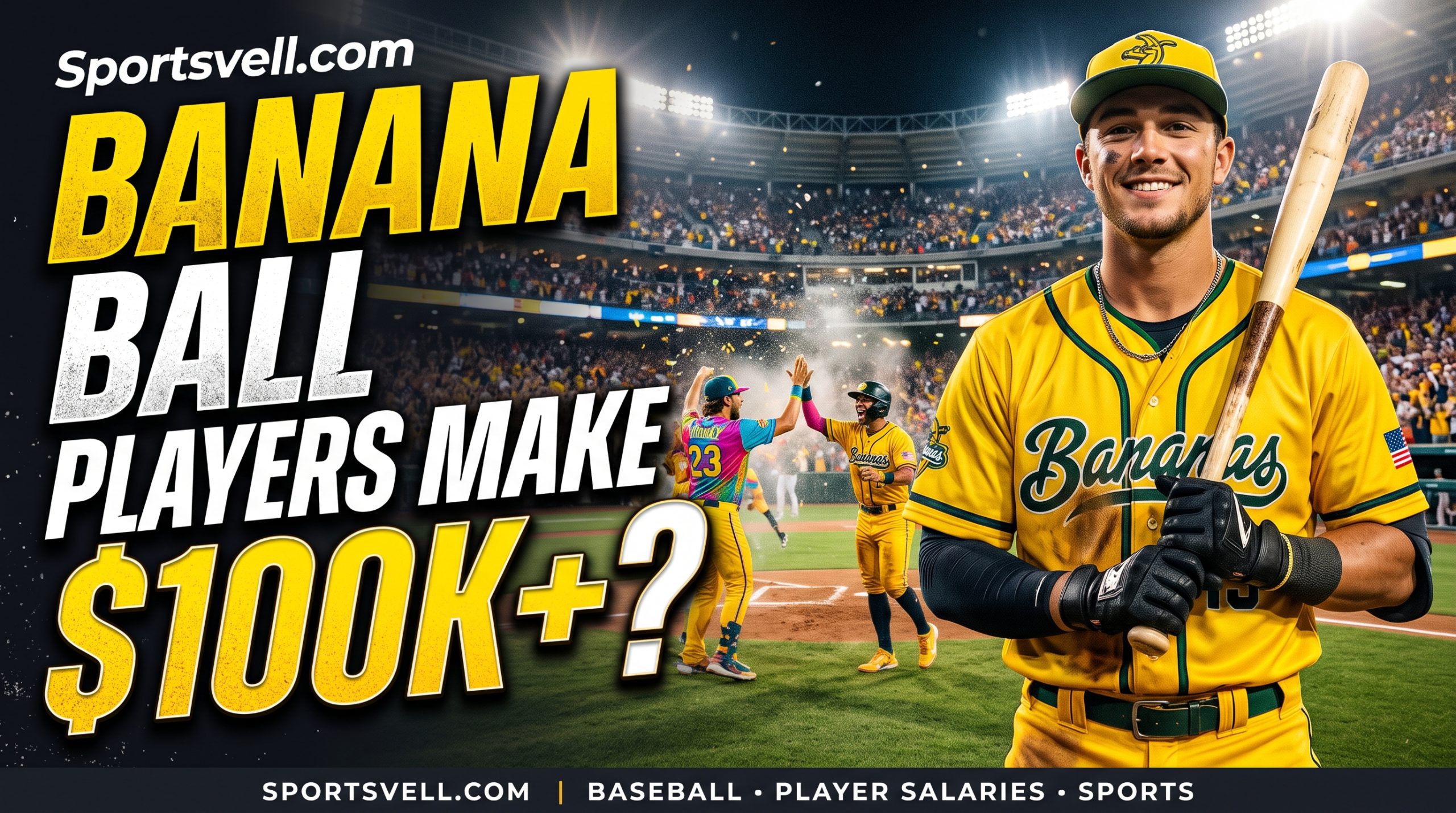
How much do banana ball players make? Banana Ball players earn more than $100,000 a year on average, according to the league itself.
The figure comes from Banana Ball’s first annual Fans First Report, released on January 21, 2026.
That average works out to more than $8,300 a month before taxes. Players earn it across a season of about 65 games.
That is roughly 100 fewer games than a Major League Baseball or minor league season.
The number is new, and it matters because most of the internet still quotes old figures. Older pages say players earn $500 to $1,000 a month, or $50 to $200 a game.
Those figures describe an older era, and they are out of date now.
This page gives you the official number, the source behind it, and the context around it.
You will see how the pay changed, how it compares with minor league and MLB pay, what benefits players get, and how to try out.
The Short Answer: More Than $100,000 a Year on Average
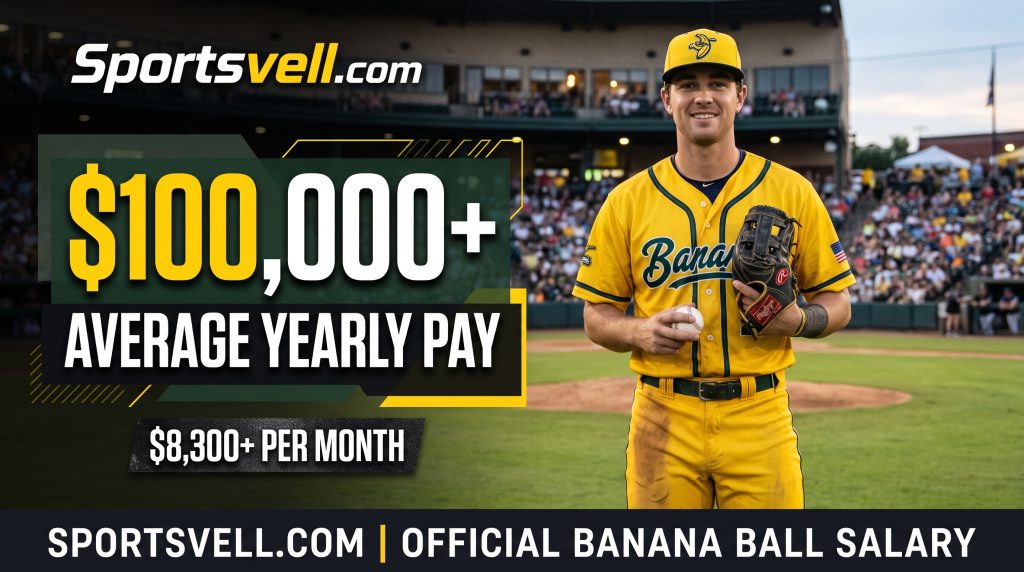
Banana Ball players earn more than $100,000 a year on average. The league disclosed the figure in its 2026 Fans First Report. Front Office Sports covered the report on the same day it was released.
The average covers the 2025 season, the first full season of the six-team Banana Ball Championship League. Each team plays around 65 games, so the per-game equivalent of the average is about $1,540.
That is simple arithmetic on the average, not a per-game wage.
The figure is an average, not a promise for every player. The league has not published a pay scale, a floor, or a ceiling.
No individual contract has been made public, and no outside auditor has checked the number.
Still, the figure is the first pay number ever released by the league itself. Before January 2026, every salary figure came from reporters, estimates, or outdated web pages.
Now the league has put its own number on the record.
What the average does not tell you
An average hides the spread, and the spread here is unknown. The league has not said what the lowest-paid player earns or what the highest-paid player earns.
A star and a rookie could sit far apart.
The league has also not said who counts as a player in the average. The cast includes dancers, the Dad Bod Cheer Squad, the Man-Nanas, and broadcasters. Whether they are in the pool is unconfirmed.
The figure is self-reported, so treat it as the league’s own claim. It is the best number available, and it is far better sourced than the estimates it replaced.
It is not an audited financial statement.
What the January 2026 Fans First Report Actually Says
Banana Ball released its first annual Fans First Report on January 21, 2026. The report covers the 2025 season and lists the business in plain numbers.
Front Office Sports reported the salary figure the same day.
The report says the average Banana Ball player salary is more than $100,000 a year. Athlon Sports covered the same report the next day and did the monthly math.
The average works out to north of $8,300 a month.
The Wall Street Journal also covered the figure in its Innovators issue. The Journal wrote that the average has drifted north of $100,000, which is three times the Triple-A minor league minimum.
The Journal added that players earn further incentives for social media milestones.
Ministry of Sport covered the report as well, and noted the league’s growth figures. The report itself frames the pay as rising every year with the size of the audience.
The league says the figure will keep rising based on the number of fans served each season.
Jesse Cole, the founder and owner, framed the disclosure as voluntary. Fans First Entertainment is privately held, so it has no legal duty to publish pay.
Cole chose to share the number anyway, which is rare in sports.
The 2025 season in numbers
The same report lists the scale of the 2025 season. Banana Ball sold 2.2 million tickets across the year. Fans bought 1.97 million merchandise items at the ballpark and online.
The league played 113 shows in 2025 across its teams. The ticket redemption rate hit 91 percent, which means nearly every ticket sold turned into a fan in a seat.
Few sports properties reach that rate.
Those numbers explain why the pay figure is possible. A touring show that sells out stadiums and moves merchandise can pay players more than a minor league club can.
The money comes from fans, not from a parent club.
| 2025 season figure | Number | Source |
|---|---|---|
| Tickets sold | 2.2 million | Fans First Report, via Front Office Sports |
| Merchandise items sold | 1.97 million | Fans First Report, via Ministry of Sport |
| Shows played | 113 | Fans First Report, via Ministry of Sport |
| Ticket redemption rate | 91 percent | Fans First Report, via Ministry of Sport |
| Games per team | About 65 | Fans First Report, via Athlon Sports |
| Average player salary | More than $100,000 | Fans First Report, via Front Office Sports |
How Banana Ball Pay Changed: From Stipends to Six Figures
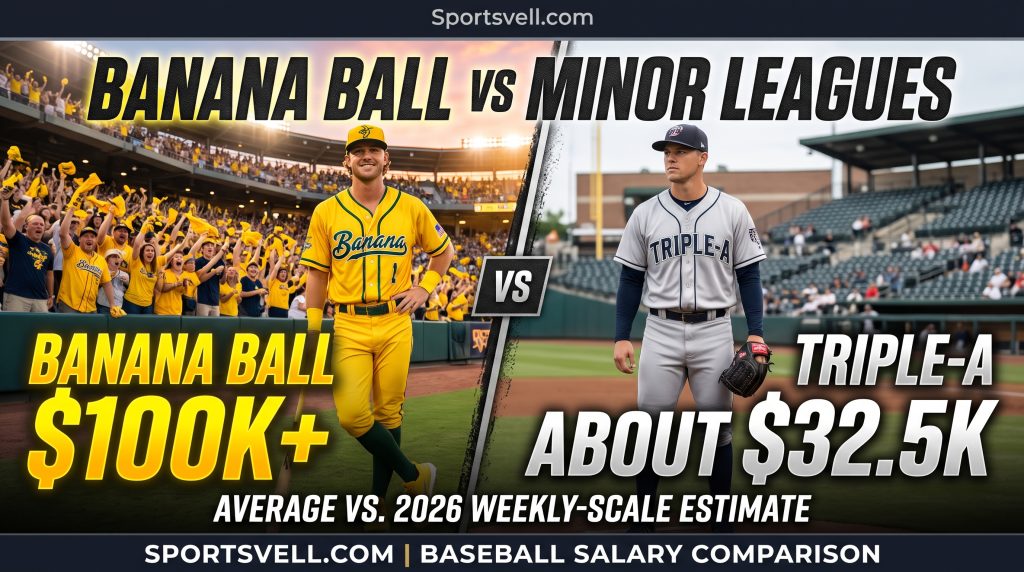
Banana Ball pay has changed fast, and the timeline explains why the internet is full of wrong numbers. The team started as a summer college league club.
It now runs a professional touring league with six teams.
In the early years, players were college athletes on summer stipends. They played for experience, exposure, and small monthly payments. The old stipend figures still rank on Google, and they describe that era.
The team left the Coastal Plain League in August 2022 to tour full time. The pay model changed with the business model. Players became touring professionals, and the salaries rose with the audience.
By 2025, Forbes reported that most players earned two, and sometimes three, times what minor leaguers typically make.
The same year, a newspaper report said players made $20,000 to $37,000 over a 65-game season the year before. The January 2026 report then set the average above $100,000.
| Era | Pay figure | What it describes |
|---|---|---|
| 2016 to 2022 | Summer stipends | Coastal Plain League college players, small monthly payments |
| 2023 to 2024 | $20,000 to $37,000 per season | Touring era, 65-game season, newspaper report |
| 2025 | Two to three times minor league pay | Forbes, September 2025, no single dollar figure given |
| 2026 | More than $100,000 average | Fans First Report, January 21, 2026, league-reported |
Why the old figures are wrong now
One salary site still claims players receive monthly stipends of $500 to $1,000. It calls the team a summer collegiate league, which stopped being true in 2022.
The page was published in April 2025 and updated in December 2025, but it never mentions the January 2026 report.
Another old page claims a per-game stipend of $50 to $200. It also says players get no health insurance and no retirement plans.
Forbes reported in June 2025 that player contracts include full health benefits, so the page is out of date.
Two mirror sites quote an average of $30,000 to $40,000 a year and a base of $30,000 to $50,000. They also claim players earn roughly $1,000 per game.
Those figures are pre-report estimates, and the two sites carry near-identical text on unrelated domains. Treat them as content-farm estimates, not reporting.
A net worth page quotes an average of $40,000 to $75,000 and says top players earn $100,000 or more with endorsements. That range is also a pre-report estimate.
The league’s own figure now sits above the top of that range.
| Stale claim | Figure quoted | Why it is out of date |
|---|---|---|
| Monthly stipends | $500 to $1,000 a month | Summer college era framing; Bananas left that league in 2022 |
| Per-game stipend | $50 to $200 a game | Claims no health insurance; Forbes confirmed full benefits in June 2025 |
| Annual base range | $30,000 to $50,000 a year | Pre-report estimate; league now reports a $100,000 plus average |
| Average range | $40,000 to $75,000 a year | Pre-report estimate; the league figure sits above this range |
| Per-game claim | About $1,000 a game | Conflicts with the annual contract structure; no source given |
How the Pay Is Structured
Banana Ball players are paid on annual contracts, not by the game.
The league has never published a standard contract or a pay scale, so the structure below is an honest composite of what has been reported. Where a detail is unverified, it is labelled as such.
The average salary is an annual figure, which means players are not clocking in per game. A per-game number is useful for comparison, but it is not how the pay works.
The league pays for a season of touring, rehearsing, and performing.
Players also earn more than base salary. The Wall Street Journal reported further incentives for social media milestones. A player whose highlights go viral can earn more than a player who stays quiet online.
Forbes reported in September 2025 that the organization aims to give players significant raises each year. The Fans First Report frames the same idea as a rule: pay rises with the number of fans served.
Growth in the audience should mean growth in the paycheck.
Annual contracts, not per-game pay
The league describes the figure as an average annual salary, and that wording matters. Annual pay means the contract covers the season, the travel, and the rehearsal time.
It is not a day rate for showing up at the ballpark.
Some content-farm pages claim players are W-2 employees on one-year contracts. That claim is unverified, so do not treat it as fact.
What is verified is that the pay is annual, and that it is far above the old stipend model.
One low-quality page claims many players are on full-year contracts. That is also unverified. The touring season runs from February to October, and the league has not said how the offseason is paid.
Do not assume a 12-month salary from a seasonal average.
Monthly, weekly, and per-game equivalents
The table below converts the official average into monthly, weekly, and per-game equivalents. These are arithmetic on the average, not separate pay claims.
They help you compare Banana Ball pay with other jobs and other leagues.
| Time period | Equivalent | How it is calculated |
|---|---|---|
| Per year | More than $100,000 | League-reported average, Fans First Report |
| Per month | More than $8,300 | $100,000 divided by 12 months |
| Per week | More than $1,920 | $100,000 divided by 52 weeks |
| Per game | About $1,540 | $100,000 divided by about 65 games |
| Prior year per game | $310 to $570 | $20,000 to $37,000 divided by 65 games |
The per-game equivalent jumped from roughly $310 to $570 a game to about $1,540 a game. That is the clearest way to see how much the pay changed in one year.
The games did not change; the business did.
All of these figures are gross pay before taxes. Take-home pay depends on federal tax, state tax, and deductions, and the league has not published any take-home figures.
Do not quote a net number unless you are doing your own tax math.
Social media and performance incentives
Social media is part of the job, and the pay reflects it. The Wall Street Journal reported that players earn further incentives for hitting social media milestones. A viral highlight can be worth real money.
The Bananas have more than 15 million followers on social media. The University of Virginia Darden School of Business reports that the team has more TikTok followers than every Major League Baseball team combined.
That audience is the product, and players who grow it get paid for it.
Performance incentives are less clearly documented. The league has not published a bonus schedule for wins, trick plays, or championships.
The first Banana Bowl championship was scheduled for October 2026, and no prize money has been disclosed for it.
Who is in the average, and who might not be
The biggest open question is who counts as a player. The Banana Ball cast is bigger than the roster, and it includes dancers, the Dad Bod Cheer Squad, the Man-Nanas, and broadcasters.
The league has not said whether they are in the average.
The roster itself is about 40 full-timers per team, according to one low-quality net worth page. That figure is unverified, so treat it as a rough guide rather than a fact.
The published rosters list around 25 to 30 players per team.
Guest players add another wrinkle. Former Major League Baseball players appear as occasional special guests, and their pay is not disclosed.
They are almost certainly paid differently from full-time roster players, and they are probably not in the average.
Banana Ball Pay vs Minor League Pay
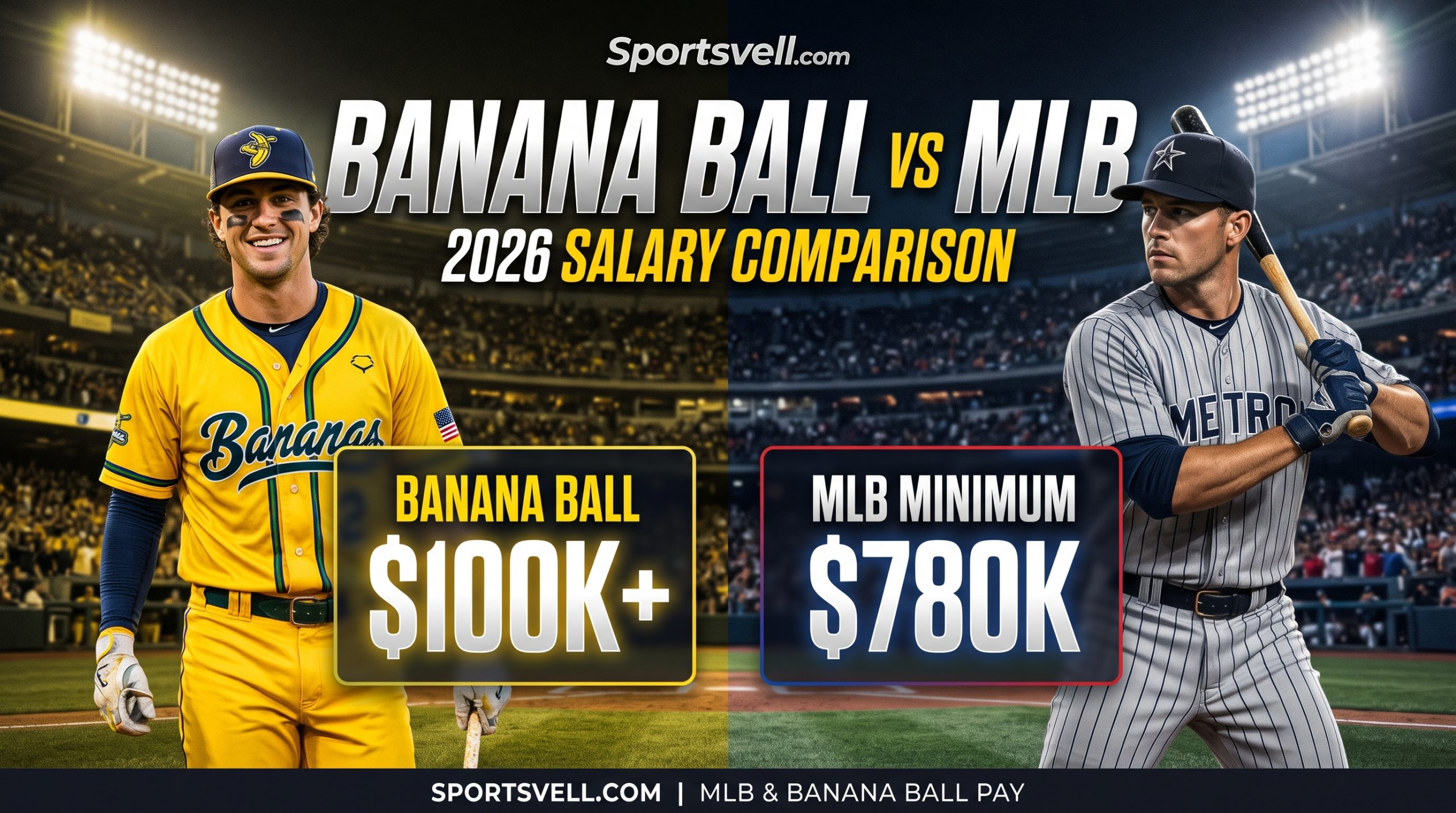
The comparison with minor league baseball is the heart of the story. Banana Ball players earn more than minor leaguers, and they play far fewer games.
That is why the salary figure made headlines in January 2026.
Forbes reported in September 2025 that most Banana Ball players earn two, and sometimes three, times what minor leaguers typically make. The players do it while playing almost 100 fewer games a season.
The gap is the story.
Shortstop Ryan Cox told Forbes that the team takes care of its players better than any minor league club would. He also acknowledged that Banana Ball players are not on big league contracts.
The comparison is with the minors, not with MLB.
| Level | Average or typical pay | Games per season | Health benefits |
|---|---|---|---|
| Banana Ball average | More than $100,000 a year | About 65 | Full health benefits |
| Triple-A | About $32,500 a season | About 150 | Yes, under the MiLB CBA |
| Double-A | About $27,000 a season | About 138 | Yes, under the MiLB CBA |
| High-A | About $24,000 a season | About 132 | Yes, under the MiLB CBA |
| Low-A | About $23,000 a season | About 132 | Yes, under the MiLB CBA |
| Rookie league | About $18,000 a season | About 60 | Yes, under the MiLB CBA |
| MLB minimum | $780,000 a year | 162 | Full benefits |
The minor league season figures above are calculated from the 2026 weekly scale, using a 26-week season for Triple-A and similar lengths below.
They sit inside the range Baseball America reports for most minor leaguers, which is $18,000 to $44,000 a year. The calculation is labelled so you can check it.
The 2026 minor league pay scale
Baseball America published the 2026 minor league pay scale on April 2, 2026. These are the official weekly minimums under the first minor league collective bargaining agreement, which covers 2023 to 2027.
Minor league players unionized in 2022, and the pay scale is part of that deal.
| Level | Weekly salary, 2026 | Weekly salary, 2021 | Weekly salary, 2019 |
|---|---|---|---|
| Rookie and complex league | $710 | $400 | $290 |
| Low-A | $885 | $500 | $290 |
| High-A | $935 | $500 | $290 |
| Double-A | $1,040 | $600 | $350 |
| Triple-A | $1,250 | $700 | $502 |
Minor league pay has risen sharply since the union formed. Triple-A weekly pay more than doubled from $502 in 2019 to $1,250 in 2026. Rookie pay rose from $290 to $710 over the same period.
Even so, the annual totals stay far below the Banana Ball average.
Two content-farm pages quote different weekly figures, including Triple-A at $700 or $1,000 and a rookie rate of $420 or $650. Those tables contradict Baseball America and each other.
Use the Baseball America scale only, and ignore the content-farm tables.
Triple-A vs Banana Ball
A Triple-A player earns $1,250 a week in 2026. Over a 26-week season, that is about $32,500.
The Banana Ball average is more than three times that amount, for about 65 games instead of about 150.
The Wall Street Journal made the same point in different words. It wrote that the Banana Ball average is three times the Triple-A minor league minimum. The Journal’s framing and the Baseball America math agree.
Triple-A is the highest minor league level, one step below the majors. Most Triple-A players are not on a 40-man roster, and their pay is capped by the weekly scale.
Banana Ball players earn more than the best-paid standard minor leaguers.
The highest-paid minor leaguer problem
One claim needs care, because two sources disagree. Athlon Sports wrote that the highest-paid minor leaguers are now capped at $100,000 in total compensation per season. Baseball America reports a different ceiling for some players.
Baseball America says a player on a 40-man roster who is assigned to the minors makes a minimum of $63,600 in season.
A minor league free agent can earn up to $8,400 a week, which is about $201,500 over a full Triple-A season. Those figures are higher than the $100,000 cap Athlon describes.
The two claims can both be true for different groups. The $100,000 cap likely covers standard first-contract players, while the higher figures cover 40-man players and free agents.
The article keeps them separate by source, and does not merge them into one number.
Most minor leaguers sit at the bottom of the scale, not the top. Baseball America reports that most minor league players in the United States make between $18,000 and $44,000 a year.
The maximum for a player who has not reached the 40-man roster or free agency is roughly $44,000 to $45,000 a season.
Games played: 65 vs 120-plus
Banana Ball teams play about 65 games a season, according to the Fans First Report. A minor league season runs about 120 to 150 games, depending on the level. An MLB season is 162 games.
The game count matters because the pay is annual. A Banana Ball player earns more than $100,000 for 65 games, while a Triple-A player earns about $32,500 for about 150 games.
The Banana Ball player earns more money for less than half the games.
The shorter season also means a shorter grind. Minor leaguers play six games a week for six months, often with long bus rides.
Banana Ball players tour by plane and play in sold-out stadiums, with dance rehearsals and show work filling the rest of the week.
Banana Ball Pay vs MLB Pay
Banana Ball pay is nowhere near MLB pay, and that is the honest limit of the comparison. The MLB minimum salary for 2026 is $780,000, under the 2022 to 2026 collective bargaining agreement.
That is nearly eight times the Banana Ball average.
One content-farm page lists the 2026 MLB minimum as $740,000. That figure is wrong, and two other sources confirm $780,000. Use $780,000, and ignore the $740,000 figure.
The average MLB salary is far higher than the minimum, running into the millions. Banana Ball does not compete with MLB on pay, and it does not try to.
It competes with the minor leagues, where most professional players actually work.
The right comparison is with the minors, not the majors. A Banana Ball player earns more than a Triple-A player and far more than a rookie leaguer.
An MLB player earns far more than both, and plays a 162-game season to do it.
The Six Teams of the Banana Ball Championship League
The Banana Ball Championship League, or BBCL, is the league that pays these salaries. It launched its first six-team season in 2026, with a full regular season, standings, and a championship.
The league was announced in 2024, and the 2026 season started on February 26 in Tallahassee, Florida.
All six teams play by the same 11 Banana Ball rules. They tour the country together, playing in major league stadiums, minor league parks, and football stadiums.
The standings rank teams by winning percentage, because the teams play an uneven number of games.
The first Banana Bowl championship was scheduled for October 10, 2026, at Nationals Park in Washington, D.C. Four teams reach the playoffs, with semifinals scheduled for October 1 to 4 at Grayson Stadium in Savannah.
The Banana Bowl is now the league’s championship game.
| Team | Joined | Identity |
|---|---|---|
| Savannah Bananas | 2016 | The original team, yellow uniforms, home at Grayson Stadium |
| Party Animals | 2020 | Long-time rivals, black, pink, and green uniforms |
| Firefighters | 2023 | Third team, firefighter theme |
| Texas Tailgaters | 2023 | Fourth team, Texas tailgate theme |
| Loco Beach Coconuts | 2026 | Expansion team, beach theme |
| Indianapolis Clowns | 2026 | Expansion team, tribute to the historic Negro Leagues franchise |
Savannah Bananas
The Bananas are the original team and the face of the league. They play at home in Grayson Stadium in Savannah, Georgia, a century-old ballpark with brick walls and mossy oaks.
The team was founded in 2016 and has sold out every home game since its first season.
The Bananas led the 2026 standings at 36 wins and 25 losses, a .590 winning percentage. They are the team most fans know, and the team most players want to join.
The roster includes pitcher Dakota Albritton, who plays on stilts.
Party Animals
The Party Animals debuted in July 2020 as the Bananas’ first rivals. They wear black, pink, and green, and their games against the Bananas are the league’s oldest rivalry.
One student newspaper compared the matchup to the Harlem Globetrotters versus the Washington Generals.
The Party Animals finished the 2026 season at 30 wins and 31 losses. They are a full touring team with their own roster, their own walk-up routines, and their own fan base.
Their players earn the same league average as the Bananas.
Firefighters and Texas Tailgaters
The Firefighters joined as the third team in 2023, and the Texas Tailgaters followed as the fourth team. They gave the league enough teams to run a real schedule instead of a two-team barnstorming tour.
Both teams tour the country with the Bananas and the Party Animals.
The Texas Tailgaters finished second in the 2026 standings at 32 wins and 29 losses. The Firefighters finished fifth in the standings.
Both teams play the same rules, the same show, and the same pay structure as the rest of the league.
Loco Beach Coconuts and Indianapolis Clowns
The Loco Beach Coconuts and the Indianapolis Clowns joined as expansion teams in 2026. The Coconuts bring a beach theme, and the Clowns pay tribute to the historic Negro Leagues franchise of the same name.
Both teams finished the 2026 season with losing records, but both sold out their dates.
The Clowns finished at 26 wins and 35 losses, the worst record in the league. The Coconuts finished at 30 wins and 31 losses.
Expansion teams rarely win in year one, and the standings show it.
Why Banana Ball Can Pay More: The Business Model
Banana Ball can pay more than the minor leagues because it makes more money per fan.
The business model is entertainment first and baseball second, and every part of it is built to sell tickets, merchandise, and attention.
Forbes estimated in September 2025 that the four-team organization would post more than $100 million in revenue that year. Revenue was more than $45 million in 2024 and more than $20 million in 2023.
The growth curve is steep, and the pay curve follows it.
Forbes valued the organization at roughly $500 million in September 2025, based on revenue multiples from sales of MLB and minor league franchises.
The Miami Marlins, the least valuable MLB team, were worth about $1.05 billion at the time. Cole has been approached by parties valuing the enterprise at $1 billion, and he has said no.
Sold-out stadiums
Every Banana Ball game sells out, and that is the foundation of the pay model.
The team sold out 17 of its first 25 home games in 2016, and it has sold out every game since.
The streak now covers hundreds of games, including two nights at Clemson University’s football stadium in front of 81,000 fans each night.
The 2026 tour visited 75 stadiums in 45 states, with 190 games on the schedule. The venues include major league parks like Fenway Park and Yankee Stadium, and football stadiums like Raymond James Stadium.
A sold-out football stadium holds far more fans than a minor league park.
Tickets are sold through a lottery and a waiting list, because demand far exceeds supply. The waiting list has swelled to 3.2 million fans, according to the University of Virginia Darden School of Business.
Scarcity keeps the price and the demand high.
Merchandise
Merchandise is the second engine of the business. Fans bought 1.97 million merchandise items in 2025, according to the Fans First Report. Jerseys, hats, and yellow tuxedo gear sell at every stop on the tour.
One low-quality net worth page claims fans spend $24 to $25 per head on merchandise. That figure is unverified, so do not quote it as fact.
What is verified is the 1.97 million item total, which is large for any sports property.
Merchandise matters because it is high-margin revenue. A ticket sale brings a fan into the building, and a merchandise sale adds profit on top of it.
The combination is why a touring show can pay more than a minor league club.
Television: ESPN and TNT Sports
Television is the third engine, and it is growing fast. Banana Ball signed a 25-game package with ESPN for 2026, described as its biggest partnership to date.
A TNT Sports deal was also reported for 2025 and 2026, though the details are less clearly documented.
Television money is new for Banana Ball, and it changes the pay math. A minor league team earns almost nothing from television, while Banana Ball now sells its games to national networks.
The ESPN deal puts the product in front of millions of viewers who cannot get tickets.
ESPN also carries Monday Night Football, and the league has learned from prime-time sports television.
You can check who won Monday Night Football in our weekly update, and the same network now carries Banana Ball games.
No stadium ads, all-you-can-eat food
Banana Ball runs no stadium advertising, which is unusual in sports. The ballpark has no outfield billboards and no sponsored segments, because the league wants the show to be the product.
The money comes from tickets and merchandise instead.
Food is included in the ticket price, with all-you-can-eat concessions at Grayson Stadium and on tour. The model trades concession revenue for a better fan experience, and the experience is what sells the next ticket.
It is a different way to run a ballpark.
The approach works because the audience is the asset.
A fan who eats for free, watches a two-hour show, and buys a jersey is worth more than a fan who watches a three-hour game with ads. The pay figure follows from that math.
Entertainment spending adds up fast for fans too, and a night at the ballpark is only one part of it.
See how much entertainment costs per month for the full breakdown of what American households spend on fun.
What Else Players Get: Benefits and Perks
Salary is only part of the package, and the rest of it matters. Banana Ball players get full health benefits, paid travel, and a touring lifestyle that looks very different from minor league baseball.
The perks are part of why players choose Banana Ball over the minors.
Forbes confirmed in a June 2025 feature that player contracts include full health benefits. That matters because minor league players only gained reliable health coverage with the 2023 collective bargaining agreement.
Banana Ball offers it as standard, not as a negotiated win.
Forbes also reported that the organization spends about $40,000 a year per traveling party member on hotels and travel, on top of pay.
That figure covers the made-to-order-breakfast tier of road life, not the minor league host-family tier. The number comes from Forbes, via an independent Banana Ball guide.
Full health benefits
Full health benefits mean medical coverage for the player, which is a real cost in the United States. Minor league players fought for years to get reliable coverage, and the 2023 agreement finally provided it.
Banana Ball players get it without a union fight.
One stale web page claims Banana Ball players get no health insurance or retirement plans. That claim is wrong, and Forbes confirmed the benefits in June 2025.
Do not repeat the old claim, and do not cite the stale page.
Retirement plans are less clearly documented. No source confirms a 401(k) or pension for Banana Ball players, so do not claim one exists. Health benefits are verified; retirement benefits are not.
Travel, hotels, and food
Banana Ball players travel by plane, stay in hotels, and eat well on the road. The $40,000 per person travel figure from Forbes covers hotels and travel for each member of the traveling party.
Minor league players travel by bus and often stay with host families, so the contrast is sharp.
Food is included at the ballpark, and the all-you-can-eat model extends to the team. Players are not buying their own meals on the road, which is a real expense for minor leaguers.
The touring lifestyle is built into the job, not added on top of it.
The show itself
The show is a perk as well as a job. Players dance, perform choreographed walk-ups, and appear in viral videos watched by millions.
A player who goes viral gains a personal audience that follows them beyond Banana Ball.
Dakota Albritton, the pitcher who plays on stilts, is the most recognized player on the team. He stands 10 feet 9 inches tall on stilts, and he pitches, bats, and fields in them.
He was pouring concrete when his mother signed him up for a tryout, and he had not walked on stilts in 10 years.
Kyle Jackson, a former Kent State player, turns his plate appearances into music videos. RobertAnthony Cruz, a backflipping former Washington Nationals prospect, regularly goes viral with his highlights.
The show makes players famous, and fame has value beyond the salary.
If you need another word for entertainment, try spectacle, because that is what Banana Ball sells every night. The game is real, the dancing is real, and the audience is there for both.
How to Become a Banana Ball Player
Banana Ball players come from college baseball, the minor leagues, and open tryouts. The team looks for skill first, but it also looks for showmanship.
A player who cannot dance, cannot perform, or cannot handle a crowd will not last, no matter how well they hit.
Manager Tyler Gillum summed up the job in the Wall Street Journal. He said the game is hard enough as it is, and now you have to dance.
That is the job description in one sentence, and it explains why tryouts are different here.
One low-quality page claims tryouts draw about 1,000 hopefuls for about 40 full-time roster spots. Both figures are unverified, so treat them as rough guides.
What is verified is that tryouts are open, competitive, and focused on more than baseball skill.
What the team looks for
Baseball skill is the baseline, and most roster players have college or minor league experience. The published rosters list former college players, former minor leaguers, and a few players with major league experience.
The level is high, even if the format is unusual.
Showmanship is the second requirement, and it is not optional. Players choreograph their walk-ups, dance between innings, and perform trick plays on the field.
A player who is shy on camera or stiff on the dance floor will struggle in this job.
Character matters too, because the team is a touring family. Players travel together for months, rehearse together, and perform together every night.
The team looks for players who enjoy the crowd, not players who tolerate it.
How tryouts work
Banana Ball holds open tryouts, and the most famous tryout story belongs to Dakota Albritton. His mother signed him up for a tryout and told the team he could walk on stilts.
He had not walked on stilts in 10 years, and the straps were dry rotted.
Albritton drove to the tryout, stopped at a tractor supply store, and fixed the straps with dog collars. He hit in the tryout, surprised himself, and signed with the team in 2021.
He told the story to 60 Minutes in April 2025, and it is now part of the team’s legend.
Most tryouts are more conventional, with batting, fielding, and pitching drills. The team also watches how players move, how they interact, and whether they enjoy performing.
A great hitter who hates the spotlight is a bad fit here.
The odds
The odds of making a Banana Ball roster are long, because the rosters are small and the applicant pool is large.
The league has six teams with roughly 25 to 30 players each, which means about 150 to 180 roster spots in total. Thousands of players want those spots.
College and minor league experience helps, but it is not enough on its own.
The team has signed players who were pouring concrete, players who were out of baseball for years, and players whose main skill was a trick.
The door is open wider than a normal pro tryout, but the bar is still high.
The best path is to play college baseball, build a highlight reel, and show personality on camera. The team finds players through tryouts, through social media, and through recommendations.
A viral video can open a door that a stat line cannot.
What Banana Ball Is: The 11 Rules
Banana Ball is a faster, entertainment-first version of baseball, invented by the Bananas in 2018. The first game under Banana Ball rules was played in June 2020, and the Party Animals debuted the next month.
The format has 11 rules, and each one is designed to cut dead time and pull fans into the game.
The rules are the reason the game fits in two hours, and the reason the pay model works. A fast game means more shows per tour, more tickets per season, and more money for players.
The rules are not gimmicks; they are the business model.
A Banana Ball game is capped at two hours, which is far shorter than a standard football broadcast. See how long is a football game for the full breakdown of football game lengths.
1. Every inning is worth a point
Each inning is worth one point, and the team that scores more runs in that inning wins the point. The final inning is the exception, because every run counts as a point there.
A team that trails can catch up in a hurry in the last frame.
2. Two-hour time limit
No new inning can start after the game reaches two hours in length. Some sources phrase the cutoff as 1 hour 50 minutes, while others say two hours.
The practical result is the same: the game ends on time, every night.
3. No stepping out of the batter’s box
A batter cannot step out of the batter’s box once they step in. If the hitter leaves the box, the umpire calls a strike.
The rule kills the dead time between pitches that slows down normal baseball.
4. No bunting, ever
Bunting is banned, and a hitter who bunts is ejected from the game. The rulebook states it plainly: bunting sucks, and a bunter leaves the game.
The rule forces hitters to swing, which is what fans pay to see.
5. Batters can steal first
A batter can steal first base on a passed ball or a wild pitch. If the catcher drops the pitch, the batter can run.
The rule turns a routine pitch into a live play, and it keeps the defense alert on every pitch.
6. No walks: the Ball-Four Sprint
There are no traditional walks in Banana Ball. On ball four, the batter sprints and can advance as far as possible, while every defensive player except the pitcher and catcher must touch the ball first.
The sprint can turn a walk into a triple.
7. No mound visits
Mound visits are banned, for players and coaches alike. No one can walk to the mound to slow the game down, calm a pitcher, or change a sign.
The pitcher works fast, and the game keeps moving.
8. Fans can catch foul balls for outs
A fan who catches a foul ball records an out for the defense. Anyone sitting in foul territory can become part of the box score.
The rule turns the crowd into players, and it is the most famous rule in the format.
9. Tie games go to a Showdown
Tied games do not go to extra innings. They go to a Showdown, where the hitter must score to earn a point.
If the hitter is out, it is called a Showdown Shutdown, and no point is scored. The Showdown ends the game quickly.
10. Fans and teams can challenge calls
Each team has one challenge per game, and the coach must throw an indicator on the field before the next pitch to start it.
Fans can also challenge umpire calls, which puts the crowd in charge of the review. The rule keeps the umpires honest and the fans engaged.
11. The Golden Batter Rule
The Golden Batter Rule lets a team send any hitter in the lineup to the plate at any time.
A team can bring its best hitter to the plate in the biggest moment, regardless of the batting order. The rule creates the dramatic at-bats that fans remember.
Two more rules round out the format, according to team coverage. The Designated Fielder Rule lets one bench player replace an active player on defense.
Trick plays, dance breaks, and choreographed walk-ups are part of the show, not violations of it.
Each Banana Ball team fields nine players at a time, like traditional baseball, while soccer fields eleven.
See how many players on a soccer team for that breakdown, and the contrast shows how different the two sports are.
The History: From a Summer League Team to a Touring League
The Savannah Bananas began in November 2015, when Fans First Entertainment announced it would field a Coastal Plain League expansion team at Grayson Stadium in Savannah.
The league was a summer college league, and the team would play college players for three months a year.
The name was unveiled in February 2016, after a poll in the Savannah Morning News. The finalists were the Ports, the Seagulls, the Anchors, and the Party Animals.
The Bananas won, and the Party Animals name would return four years later as the rival team.
The first game was played in June 2016, in front of a sellout crowd of 4,000 fans at Grayson Stadium. The Bananas lost to the Lexington Blowfish, but the show was a hit.
The team sold out 17 of 25 home games in that first season, and it has sold out every game since.
The early years were not easy, and the money nearly ran out in 2016. Jesse and Emily Cole sold their house and emptied their savings accounts to keep the team going.
The gamble worked, and the team won the Coastal Plain League championship in its first season.
The Bananas won three Coastal Plain League titles, in 2016, 2021, and 2022. More than 35 players from the team were drafted by Major League Baseball clubs.
The summer league team had become a national story, and the Coles saw a bigger opportunity.
Banana Ball was invented in 2018, after two seasons as a normal collegiate summer league team.
The first game under Banana Ball rules was played in June 2020, and the Party Animals debuted in July 2020. The format was faster, funnier, and built for television.
In August 2022, the Bananas announced they were leaving the Coastal Plain League to focus on Banana Ball full time.
ESPN reported the announcement, and Cole said the team could reach more people on tour than in a summer league. The amateur team had sold out every home game since its founding.
The touring era began with two teams, then four, then six. The Firefighters joined in 2023, and the Texas Tailgaters followed. The Loco Beach Coconuts and the Indianapolis Clowns joined in 2026.
The league was announced in 2024, and the first six-team season started in February 2026.
The business grew with the tour. Revenue passed $20 million in 2023, $45 million in 2024, and $100 million in 2025, according to Forbes.
The team played two nights at Clemson University’s football stadium in front of 81,000 fans each night, and sold out Yankee Stadium in September 2026.
The University of Virginia Darden School of Business now teaches the Bananas as a case study in disruption.
The case asks where the team goes next, after selling out every home game in Savannah and major league stadiums on the road. The pay figure is part of the answer.
A baseball field covers about 1.32 acres, which is far smaller than the football stadiums Banana Ball now fills. See how many acres is a football field for the full measurement breakdown.
The Bananas have played at NFL venues like Raymond James Stadium, and the Cowboys are one of the biggest draws in American sports.
For the numbers behind one famous matchup, see our Green Bay Packers vs Dallas Cowboys match player stats breakdown.
FAQs About How Much Banana Ball Players Make
How much do Banana Ball players make?
Banana Ball players earn more than $100,000 a year on average, according to the league’s January 2026 Fans First Report.
The figure is an average, not a floor or a ceiling, and it covers about 65 games a season.
How much do Savannah Bananas players make?
Savannah Bananas players earn the same league average as every other Banana Ball team, which is more than $100,000 a year.
The league has not published separate pay figures for each team, so the average applies to all six clubs.
How much do Banana Ball players make per game?
Banana Ball players are paid on annual contracts, not per game. The per-game equivalent of the $100,000 average is about $1,540, based on a 65-game season.
That is arithmetic on the average, not a per-game wage.
How much do Banana Ball players make per month?
The $100,000 average works out to more than $8,300 a month before taxes. The figure is a simple division of the annual average, and the league has not published a monthly pay schedule.
Take-home pay depends on taxes.
How much do Banana Ball players make a year?
Banana Ball players make more than $100,000 a year on average, per the Fans First Report released on January 21, 2026.
The prior year, players made $20,000 to $37,000 over a 65-game season, so the average rose sharply.
Do Banana Ball players get paid?
Yes, Banana Ball players are paid professionals on annual contracts. The team is a professional touring league, not a summer college league, and it has been professional since leaving the Coastal Plain League in 2022.
Are Banana Ball players professional?
Yes, Banana Ball players are professional athletes. They play in the Banana Ball Championship League, a six-team professional touring league. The team left the collegiate summer league system in August 2022.
Do Banana Ball players get health insurance?
Yes, Banana Ball player contracts include full health benefits, according to Forbes in June 2025.
One stale web page claims players get no health insurance, but that claim is out of date and contradicted by Forbes.
What is the average Banana Ball player salary?
The average Banana Ball player salary is more than $100,000 a year, according to the league’s 2026 Fans First Report.
The figure is an average, so it does not tell you the lowest or highest salary on any roster.
Who is the highest paid Banana Ball player?
No one knows, because the league has not published individual salaries. The only figure released is the average of more than $100,000 a year. Any site that names a highest-paid player is guessing, not reporting.
How much do Party Animals players make?
Party Animals players earn the same league average as the rest of Banana Ball, which is more than $100,000 a year.
The league has not published separate pay figures for any team, including the Party Animals.
Do all Banana Ball teams pay the same?
The league has published only one average, and it covers all players, so there is no evidence of different pay by team.
The six teams share the same rules, the same tour, and the same business model. Team-by-team pay is unconfirmed.
How much did Banana Ball players make last year?
Players made $20,000 to $37,000 over a 65-game season the year before the January 2026 report, according to a newspaper report.
The average then rose to more than $100,000, which is the largest single-year jump in the team’s history.
How much do Banana Ball players make compared to minor leaguers?
Banana Ball players earn two to three times what minor leaguers typically make, according to Forbes.
A Triple-A player earns about $32,500 a season, while the Banana Ball average is more than $100,000, for about 65 games instead of 150.
How much do Banana Ball players make compared to MLB players?
Banana Ball players earn far less than MLB players. The MLB minimum salary for 2026 is $780,000, which is nearly eight times the Banana Ball average.
The right comparison is with the minor leagues, not the majors.
How much do minor league baseball players make in 2026?
Most minor league players make between $18,000 and $44,000 a year, according to Baseball America.
Weekly minimums for 2026 are $710 for rookies, $885 for Low-A, $935 for High-A, $1,040 for Double-A, and $1,250 for Triple-A.
How much does a Triple-A player make?
A Triple-A player earns $1,250 a week in 2026, which is about $32,500 over a 26-week season.
The Banana Ball average is more than three times that amount, for about 65 games instead of about 150.
How much is the MLB minimum salary in 2026?
The MLB minimum salary for 2026 is $780,000, under the 2022 to 2026 collective bargaining agreement. One content-farm page lists $740,000, but that figure is wrong, and two other sources confirm $780,000.
Do Banana Ball players get paid in the offseason?
The league has not said how the offseason is paid, so the answer is unconfirmed. The $100,000 figure is an annual average, and the touring season runs from February to October.
Do not assume a 12-month salary from a seasonal average.
Are Banana Ball players W-2 employees?
Some low-quality pages claim Banana Ball players are W-2 employees on one-year contracts, but that claim is unverified. The league has never published a standard contract, so the employment structure is not confirmed.
Do not treat the claim as fact.
Do Banana Ball players get bonuses?
The Wall Street Journal reported that players earn further incentives for social media milestones.
No bonus schedule for wins, trick plays, or championships has been published, and no prize money for the Banana Bowl has been disclosed.
Do Banana Ball players get paid for social media?
Yes, in part. The Wall Street Journal reported that players earn incentives for hitting social media milestones. The Bananas have more than 15 million followers, and players who grow that audience are rewarded for it.
How do Banana Ball players make money besides salary?
Players can earn social media incentives, and some earn endorsement income, though no endorsement figures are published. One pre-report estimate said top players earn $100,000 or more with endorsements, but that figure is unverified.
Salary is the main income source.
How many games do Banana Ball players play?
Banana Ball teams play about 65 games a season, according to the Fans First Report. That is roughly 100 fewer games than a Major League Baseball or minor league season.
The 2026 tour had 190 games across all six teams.
How many teams are in Banana Ball?
There are six teams in the Banana Ball Championship League: the Savannah Bananas, Party Animals, Firefighters, Texas Tailgaters, Loco Beach Coconuts, and Indianapolis Clowns. The six-team league launched its first season in 2026.
Conclusion
How much do banana ball players make? Banana Ball players earn more than $100,000 a year on average, according to the league’s own January 2026 Fans First Report.
The figure is the first pay number the league has ever published, and it replaces years of stale estimates.
The average is real, but it is also limited. It is an average, not a range, and the league has not said who is in the pool or what the floor and ceiling are.
The number is self-reported, not audited, and it should always carry those caveats.
The comparison is what makes the figure matter. Banana Ball players earn two to three times what minor leaguers make, for about 65 games instead of 150.
They get full health benefits, paid travel, and a touring show that sells out every night. That is a better job than the minor leagues offer, even if it is far from MLB pay.
The pay rose because the business grew. The team sold 2.2 million tickets and 1.97 million merchandise items in 2025, signed a 25-game ESPN package, and filled football stadiums.
The league says pay will keep rising with the audience, and the next Fans First Report will show whether that promise holds.