Do College Football Players Get Paid? (2026 Pay Explained)
Do college football players get paid? Yes, four ways. A college football player can earn a scholarship, an academic award, NIL money, and a direct revenue-sharing check from the school.
The revenue-sharing cap is $21.3 million per school in 2026-27. It was $20.5 million in the first year, and it rises about 4 percent a year.
That answer is new. Before July 1, 2025, schools could not pay players directly. Now they can, and they do.
Many of the pages that rank for this question are out of date. Four of the top seven results still say schools cannot pay players, and one page dated January 2026 still says it.
Those pages were written before the House settlement took effect. They are wrong now, and this page explains what changed.
You will see the four pay streams, how much each position earns from new official data, how the House settlement works, how NIL Go reviews deals, and what most players actually take home.
The Short Answer: Yes, Four Ways
College football players get paid through four streams that stack on top of one another. A player can receive all four at once.
First, the scholarship. A full ride covers tuition, fees, housing, meals, and books, plus a cost-of-attendance stipend for living expenses.
Second, the Alston academic award. Schools can pay up to $5,980 a year in cash for academic achievement, under a 2021 Supreme Court ruling.
Third, NIL deals. Since July 1, 2021, players can earn money from endorsements, social media, appearances, autographs, and licensing.
Fourth, direct revenue sharing. Since July 1, 2025, schools can pay players directly from athletic revenue, up to the cap.
Players are not employees. The settlement was written to avoid employee status, so players get no workers’ compensation, no union, and no traditional benefits.
The money is real, and it is taxed. NIL and revenue-share income counts as taxable income, and players get tax forms for it.
| Pay stream | Who pays | When it started | Cap or limit |
|---|---|---|---|
| Scholarship | The school | Always | Full cost of attendance |
| Alston academic award | The school | 2021 | $5,980 per year |
| NIL deals | Third parties | July 1, 2021 | No cap, clearinghouse review over $600 |
| Revenue sharing | The school | July 1, 2025 | $21.3 million per school, 2026-27 |
One warning before the numbers. Published valuations are estimates, not contracts. Player contracts are private, and the gap between the top and the middle of the sport is wide.
The figures in this page come from the College Sports Commission, the court filings, and published reporting. Each figure is labelled with its source and its date.
The Four Ways College Football Players Get Paid
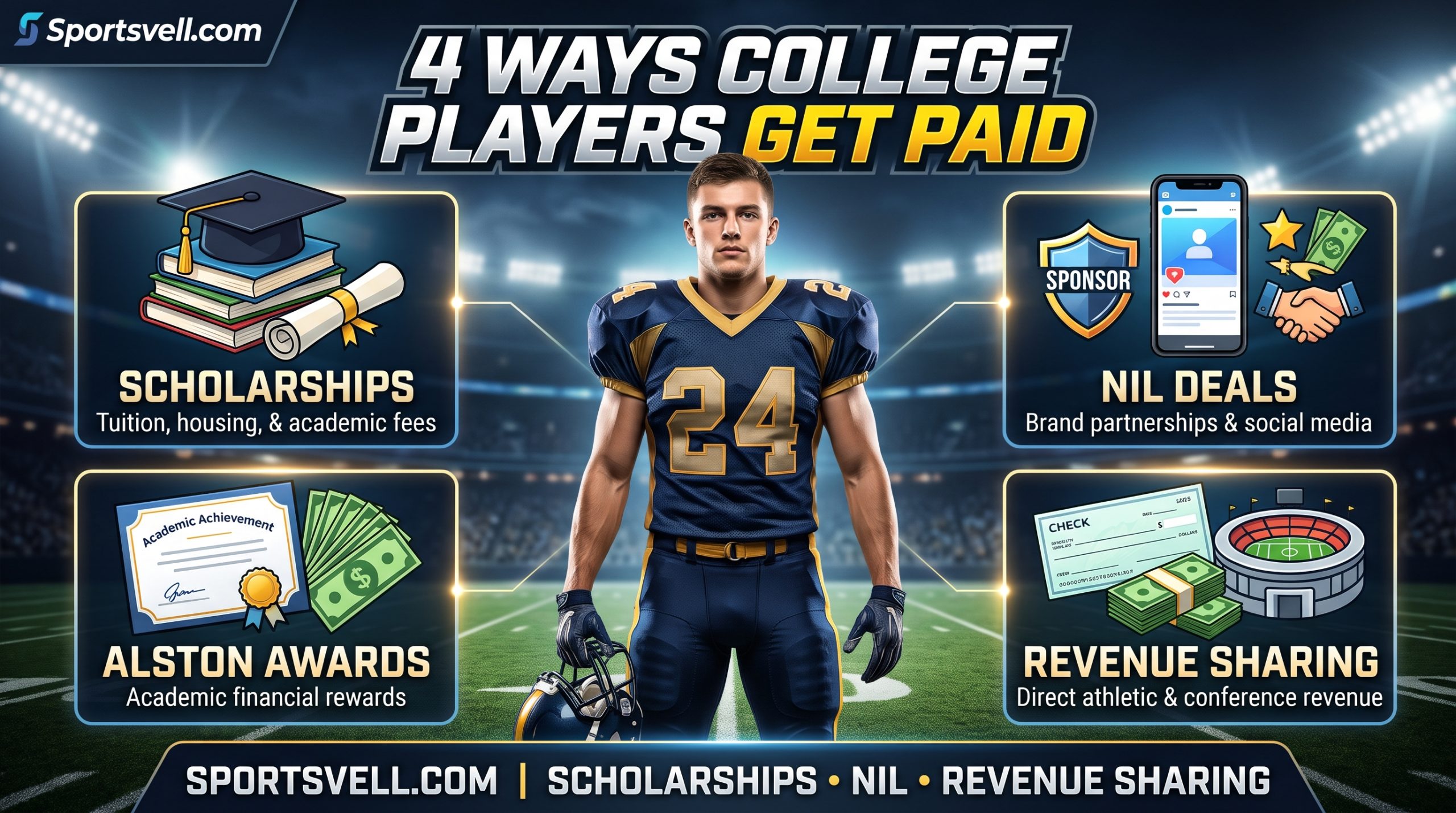
Each stream works differently, and each one has its own rules. A player who understands all four can see the full picture of college football pay.
The scholarship is the oldest stream. NIL is the most famous. Revenue sharing is the newest and the largest for most players.
Put them together, and a Power Four starter can earn six figures a year. A walk-on at a smaller school may earn nothing beyond a scholarship.
1. The Scholarship
The scholarship is the oldest form of college football pay. It is also the one every rostered player can count on.
A full ride covers tuition, mandatory fees, housing, meals, and books. It also includes a cost-of-attendance stipend, which is cash for living expenses.
A full scholarship at a public university is typically worth $25,000 to $35,000 a year for an in-state student. A full ride at a private school can exceed $250,000 over four years.
The scholarship is real compensation, even though it is not a salary. A player who never signs an NIL deal still receives tens of thousands of dollars a year in education and living costs.
The House settlement changed the scholarship rules too. The old system capped football at 85 scholarships, and walk-ons got nothing.
Now the cap is a 105-player roster, and schools that opt into the settlement can offer scholarships to every player on the roster. A walk-on can now be a scholarship player.
That change matters for the bottom of the roster. Players who used to pay their own way can now get a full ride, and the scholarship is no longer limited to 85 players.
See how many players on a football team for the full breakdown of roster sizes, from the NFL 53-man roster to the college 105-player limit.
2. The Alston Academic Award
The Alston award lets schools pay players up to $5,980 a year in cash for academic achievement. It comes from a Supreme Court case, not from the House settlement.
NCAA v. Alston was decided on June 21, 2021. The Court ruled unanimously that the NCAA could not cap education-related benefits for athletes.
The ruling let schools award up to $5,980 a year for academic achievement benchmarks. Over a four-year career, that is roughly $24,000 in cash.
The figure comes from the court’s injunction, which tied the academic award to a cap the NCAA already allowed for athletic achievement awards. The cap has not changed since the ruling.
Not every school pays the full amount. Some pay less, and some tie the award to grades, graduation progress, or other academic marks.
The award is small next to NIL and revenue sharing, but it is the only stream that rewards the classroom directly. A player who hits the academic marks gets paid for it.
Alston also mattered for the bigger fight. The Court’s opinion gutted the NCAA’s amateurism defense, and it paved the way for the House settlement four years later.
3. NIL Deals
NIL stands for name, image, and likeness. Since July 1, 2021, college athletes can earn money by letting businesses use their name, face, or fame.
NIL deals are contracts between the player and a third party, not the university. A local car dealer, a national brand, or a booster collective can pay a player for an endorsement.
Common NIL work includes social media posts, public appearances, autograph signings, camps, merchandise, and licensing. A player can also start a business and sell products under his own name.
NIL income is market-driven. A star quarterback at a big program can earn millions, while a backup at a small school may earn nothing.
Only 15 to 20 percent of Division I football players secure meaningful NIL deals, according to one industry estimate. Most players earn little or nothing from NIL.
The average cleared NIL deal runs around $14,778, according to NCSA, a recruiting service. The median athlete earns much less than that, because the top deals skew the average.
NIL deals must now go through a clearinghouse called NIL Go, which reviews every deal over $600. That process is covered in its own section below.
Players can also earn licensing money from the EA Sports College Football video game. Every player in the game gets a licensing cheque, though the amount is not publicly confirmed.
4. Direct Revenue Sharing
Direct revenue sharing is the biggest change in college sports history. Schools now pay players directly from athletic revenue.
It began on July 1, 2025, when the House v. NCAA settlement took effect. For the first time, a college could pay its own quarterback simply for playing quarterback.
Each school that opts into the settlement can distribute up to $20.5 million in 2025-26. The cap rose to $21.3 million in 2026-27, and it climbs about 4 percent a year.
The cap is set at 22 percent of average Power Five athletic revenue. It covers the whole athletic department, not football alone.
Most Power Four programs put about 75 percent of the cap into football. That puts the capped football payroll near $16 million a year.
Revenue sharing stacks on top of the scholarship, the Alston award, and NIL. A player can receive all four streams at once.
The cap is not a floor. A school can share less than the cap, or nothing at all. As of mid-2026, 328 of 365 Division I schools had opted in, and 37 had not.
Three out of four Power Four football players received a revenue-sharing check in 2025-26. Outside the Power Four, it was fewer than one in three.
That gap is the story of college football pay in 2026. The money is real, and it is unevenly spread.
How Much Do College Football Players Make? (Position by Position, 2026)
The College Sports Commission released position-by-position pay data in November 2026, for the first time. The numbers are the best official picture of college football pay ever published.
The data comes from two systems. CAPS records revenue-share payments from schools. NIL Go records third-party NIL deals that were submitted and cleared.
The windows matter. Revenue share covers payments made or scheduled between January 1 and December 31, 2026, for players on 2026 rosters.
NIL covers deals submitted and cleared between January 1 and September 30, 2026. Deals below the review threshold are not all captured, so the NIL figures undercount the smallest deals.
The data is reported as percentiles, not averages. The median is the 50th percentile, and the 90th percentile is the top 10 percent.
247Sports published the figures first, and Business of College Sports compiled them position by position.
| Position (Power Four) | Median revenue share, paid players | Median NIL, paid players | 90th percentile revenue share | 90th percentile NIL |
|---|---|---|---|---|
| Quarterback | $230,000 | $65,550 | $1,611,000 | $996,049 |
| Defensive lineman | $150,000 | Not reported separately | Not reported separately | Not reported separately |
| Offensive lineman | Not reported separately | Not reported separately | Not reported separately | Not reported separately |
| Defensive back | Not reported separately | Not reported separately | Not reported separately | Not reported separately |
The table above shows the figures the sources published in full. The quarterback row is the only one with all four numbers reported.
For the other positions, the sources reported medians across all rostered players, including those who got nothing. Those figures are in the next table.
| Position (Power Four) | Median revenue share, all rostered players |
|---|---|
| Defensive lineman | $105,000 |
| Offensive lineman | $75,000 |
| Defensive back | $75,000 |
| Quarterback | $75,000 |
Across all rostered players at the eight core positions, the median revenue share runs from $50,000 to $105,000. The NIL median is $0 at every position.
That zero matters. Half of all rostered players at every position earn nothing from NIL. Revenue sharing is the bigger stream for most players.
Quarterbacks
Quarterbacks earn more than any other position, by a wide margin. They are the face of the program, and the market pays for it.
Among Power Four quarterbacks who get paid, the median revenue share is $230,000. The median NIL deal is $65,550.
At the 90th percentile, a Power Four quarterback earns $1,611,000 in revenue share alone. The NIL 90th percentile is $996,049, just short of $1 million.
A top 10 percent quarterback is earning seven figures from revenue share alone. Add NIL, and the total passes $2.5 million for the best-paid quarterbacks.
Quarterback is the only position where the 90th percentile NIL approaches seven figures. No other position comes close.
Elite Power Four quarterbacks earn $2 million to $6 million or more in total, according to Legion Report estimates. Fewer than a dozen players sit in that range.
Power Four starting quarterbacks, top receivers, and edge rushers earn $1 million to $2 million. A few dozen players sit in that range.
Arch Manning at Texas is the highest earner in the sport. On3 values his NIL at $6.8 million for 2025-26, and his reported 2025 NIL income was above $6 million.
On3 valuations are estimates, not contracts. They measure market value, not bank deposits. Treat them as a ranking tool, not a pay stub.
Manning earns more than the base salary of several NFL starting quarterbacks on rookie contracts. That comparison shows how far college pay has come.
Offensive and Defensive Linemen
Linemen are the second-best-paid group, and the gap to quarterbacks is large. They do the heavy work, and the market pays them well, but not like quarterbacks.
Among Power Four defensive linemen who get paid, the median revenue share is $150,000. That is the highest median of any non-quarterback position.
Across all rostered players, including those who get nothing, the median defensive lineman earns $105,000 in revenue share. The median offensive lineman earns $75,000.
Linemen rarely earn big NIL money. Their NIL median is $0 at every position, and their deals tend to be local: car dealers, restaurants, and regional brands.
Revenue sharing is the main stream for linemen. A starting lineman at a Power Four school commonly earns six figures from revenue share alone.
Outside the Power Four, the picture flips. A non-Power Four defensive lineman at the 90th percentile earns $103,000, while the median paid Power Four defensive lineman earns $150,000.
That means the best-paid Group of Five lineman earns less than the middle of the Power Four. The conference gap is bigger than the position gap.
Skill Positions and Everyone Else
Receivers, running backs, and defensive backs earn less than quarterbacks and linemen, but more than most of the roster. Their pay depends on playing time and profile.
Power Four starters across positions commonly earn $150,000 to $750,000 in total, once revenue share and NIL are combined. Several hundred players sit in that range.
Power Four rotation players and backups earn $25,000 to $150,000. Most of the roster sits in this range.
Group of Five starters earn $10,000 to $100,000, depending on the school. The range is wide, because Group of Five budgets vary sharply.
Depth players, walk-ons, and FCS players earn $0 to a few thousand, plus licensing fees. The majority of all college football players sit here.
A three-year starter at a mid-tier Power Four program might hold a revenue-share contract worth $200,000 to $400,000 a year.
He might add $10,000 to $50,000 in local deals, plus a licensing cheque from the EA Sports game.
That middle is the real story of college football pay. The headlines are about Manning. The middle is about a starter earning a solid salary while still in school.
Fans check match player stats for every big game, and the same habit drives the pay question.
See our Green Bay Packers vs Dallas Cowboys match player stats breakdown for how detailed sports stat coverage has become.
The 90th Percentile Problem
The gap between the top and the middle is wider in college football than in any professional league. The percentiles prove it.
A median Power Four quarterback earns $230,000 in revenue share. A 90th percentile quarterback earns $1,611,000. The top 10 percent earns seven times the median.
For NIL, the gap is wider still. The median is $0 at every position, and the 90th percentile quarterback earns $996,049.
That means half the roster earns nothing from NIL, while the top 10 percent at quarterback earns nearly $1 million. No pro league has that shape.
The reason is the market. NIL pays for fame, and fame is concentrated at quarterback. Revenue sharing pays for playing, and it is spread more evenly.
Revenue sharing is the equalizer. It gives the median lineman $105,000, even though his NIL is $0. Without it, the roster would be split between a few rich stars and a large unpaid majority.
The cap is what makes revenue sharing spread. A school cannot pay its quarterback $10 million, because the whole department shares $21.3 million.
That cap is also what keeps the top down. Manning earns $6 million-plus from NIL, which sits outside the cap, but his revenue share is capped by the same pool as his teammates.
The House Settlement, Explained Simply
The House settlement is the court deal that ended amateurism. It resolved three antitrust cases and rewrote the economics of college sports in one stroke.
Judge Claudia Wilken granted final approval on June 6, 2025, in the U.S. District Court for the Northern District of California. The case is In re College Athlete NIL Litigation, No. 20-cv-03919.
It resolved three cases: House, Hubbard (also called Oliver), and Carter. The settlement runs for ten years.
It has four pillars: direct revenue sharing, back pay, roster limits, and NIL oversight. Each one changed the sport.
| Date | Event |
|---|---|
| June 21, 2021 | Supreme Court decides NCAA v. Alston, 9-0, against the NCAA |
| July 1, 2021 | NCAA adopts interim NIL policy, athletes can earn NIL money |
| June 6, 2025 | Judge Wilken grants final approval of the House settlement |
| July 1, 2025 | Revenue sharing begins, roster limits take effect |
| March 1, 2026 | Deadline for schools to opt in for 2026-27 revenue sharing |
| September 28, 2026 | Senate passes the Protect College Sports Act, 77-22 |
| November 2026 | College Sports Commission releases first position pay data |
The Cap: $20.5 Million to $21.3 Million
The revenue-sharing cap is $21.3 million per school in 2026-27. It was $20.5 million in the first year, 2025-26.
The cap is set at 22 percent of average Power Five athletic revenue. It rises about 4 percent a year, and it will be recalculated every three years over the ten-year term.
At that pace, the cap is projected near $33 million by 2035. That figure comes from Legion Report, and it is a projection, not a promise.
The cap covers the whole athletic department. Football takes about 75 percent at most Power Four programs, which puts the capped football payroll near $16 million.
Men’s basketball takes most of the rest. Women’s sports and Olympic sports share what is left, which is why the Title IX appeal matters.
The cap is not a floor. A school can share less, or nothing. As of mid-2026, 328 of 365 Division I schools had opted in, and 37 had not.
Schools that opt in must report their revenue sharing and other academic benefits within 60 days of the close of each academic year.
The College Sports Commission enforces the cap. It can sanction programs that overspend, though its legal power is still being tested.
The Back Pay: $2.8 Billion, Frozen
The settlement sets aside about $2.8 billion in back pay for athletes who competed from 2016 to 2024 without NIL compensation. The money is frozen, and no former athlete has received a check.
The figure needs care, because two sources describe it differently. Most sources report $2.8 billion over ten years, about $280 million a year.
Court-filing sources describe a $2.576 billion damages fund. That fund splits into two pools: $1.976 billion for lost broadcast NIL, and $600 million for pay-for-play claims.
Within the pay-for-play pool, 95 percent is reserved for Power Five football and basketball players. The split is 75 percent to football, 15 percent to men’s basketball, and 5 percent to women’s basketball.
Football and men’s basketball players stand to receive an average of roughly $91,000 from broadcast NIL alone, with top earners collecting over $280,000. They average about $40,000 more from pay-for-play.
Women’s basketball players average about $23,000 from broadcast NIL. Athletes in other sports average about $5,300 from the lost-opportunities category, though some awards could exceed $1.8 million.
The fund is frozen because a group of female athletes appealed the settlement to the Ninth Circuit Court of Appeals. They argue the back-pay distribution violates Title IX.
The appeal triggered an automatic stay, so no back-pay money has been distributed as of October 2026. The forward-looking revenue sharing runs on its own, and it is not affected.
New class actions are also challenging the deal’s caps. The settlement is live, but its future is still being litigated.
The Roster Change: 85 Scholarships to 105 Players
The House settlement replaced the 85-scholarship limit with a 105-player roster cap. It is one of the biggest structural changes in the deal.
Under the old rules, an FBS football team could offer 85 scholarships. Walk-ons paid their own way, and they could not be paid.
Under the new rules, schools that opt in can offer scholarships to every athlete on the roster, up to the 105-player limit. A walk-on can now be a scholarship player.
The change took effect on July 1, 2025, when the Division I Board of Directors formally adopted the new roster limits.
The settlement also created a protected class called designated student-athletes. These are players who were cut because of the roster limits, and they keep their eligibility protections.
Walk-ons now count toward the 105, which means coaches must choose between a scholarship player and a walk-on for each roster spot. The old free walk-on is gone.
The SEC funds the full 105 from 2026. Other conferences are phasing in, and some schools share less than the full roster.
An NBA game runs 48 minutes of playing time, and a college football game runs 60 minutes. See how long is a football game for the full breakdown of football game lengths.
What Is NIL, and How Does It Work?
NIL is the oldest of the new pay streams, and it is the one most fans know best.
It began on July 1, 2021, when the NCAA adopted an interim policy letting athletes profit from their name, image, and likeness.
Before that date, an athlete could lose eligibility for taking money from a local business. After that date, the same deal was legal.
NIL is not a salary. It is a commercial deal between the player and a third party, and the university is not a party to it.
That distinction is the whole point of NIL. The school does not pay the player for playing. A business pays the player for promoting its products.
What Counts as an NIL Deal?
An NIL deal is any agreement where a player is paid for the use of his name, image, or likeness. The work can take many forms.
Social media posts are the most common. A player posts about a product, tags the brand, and gets paid per post or per campaign.
Public appearances are next. A player shows up at a car dealership, a restaurant opening, or a charity event, and gets paid an appearance fee.
Autograph signings and camps are common too. A player signs memorabilia for fans, or runs a youth camp under his own name, and keeps the income.
Merchandise is another stream. A player can sell shirts, hats, or other gear with his name or number on it.
Licensing is the quietest stream. The EA Sports College Football game pays every player in the game a licensing cheque, and group licensing deals pay players for the use of their likeness in bulk.
Athletes cannot be paid for performance on the field. NIL deals cannot be pay-for-play in disguise, and the clearinghouse exists to catch that.
A deal also cannot be an inducement to enroll. A booster cannot promise a recruit a deal to pick a school, though in practice the line is hard to police.
What Is a Collective?
A collective is a booster-funded group that pays players for NIL work. Collectives are the engine of most NIL money.
A collective is usually a nonprofit or a business set up by alumni and boosters. Fans donate money, and the collective signs players to NIL deals.
The deals are supposed to involve real work: posts, appearances, autographs, or camps. In the early years, many deals involved little work, and the collective was just a way to pay players.
In high-revenue football programs, starting players can receive collective contracts worth $100,000 to $300,000 or more per year. Athletes in lower-profile sports typically receive $5,000 to $25,000 a year.
Collectives sit outside the revenue-sharing cap. The cap covers only what the school pays directly, so collective money is extra.
That is why the top programs can spend far more than the cap.
One report says top-tier football roster costs run closer to $40 million when collective money is added to the $16 million revenue-share payroll.
Collectives are also the main target of the NIL Go clearinghouse. Deloitte has estimated that around 70 percent of the collective deals done under the old rules would not pass the new review.
The collective era is not over, but it is regulated now. A collective deal must show a valid business purpose and real activation, or it gets rejected.
Who Is Arch Manning, and Why Is He the Top Earner?
Arch Manning at Texas is the highest earner in college football. On3 values his NIL at $6.8 million for 2025-26.
His reported 2025 NIL income was above $6 million, more than the base salary of several NFL starting quarterbacks on rookie contracts.
Manning is the nephew of Peyton and Eli Manning, and the grandson of Archie Manning. His family name is the most famous in football, and his market value reflects it.
He is also the starting quarterback at Texas, one of the biggest brands in college sports. The combination of family fame and program size makes him the top earner by a wide margin.
On3 valuations are estimates, not contracts. They measure market value based on performance, exposure, and social media reach. They do not show bank deposits.
Manning’s deals include national brands, and his social media following is far larger than a typical college player’s. That reach is what brands pay for.
He is the exception, not the rule. Fewer than a dozen players earn $2 million or more, and most of them are quarterbacks at major programs.
The next tier is a few dozen players earning $1 million to $2 million. Then several hundred starters earning $150,000 to $750,000.
Manning shows the ceiling. The median player shows the floor. Both are part of the same market.
College football is a television product, and its biggest games draw prime-time audiences.
See who won Monday Night Football for our weekly update on the NFL’s prime-time game, and see where to watch Ohio State Buckeyes football vs Indiana Hoosiers football for a college game guide.
What Is NIL Go, and Why Does It Reject Deals?
NIL Go is the clearinghouse that reviews third-party NIL deals. It is run by the College Sports Commission in partnership with Deloitte, the accounting firm.
It began operating after the House settlement was approved. Its job is to separate real NIL deals from pay-for-play in disguise.
The clearinghouse is the most important part of the new system, and it is the least understood. Most fans have never heard of it.
Here is how it works, why deals get rejected, and what changed in July 2026.
The $600 Rule
Every third-party NIL deal worth more than $600 must be submitted to NIL Go. That includes multiple deals with the same party that add up to $600 in total.
The athlete or the school submits the deal through the NIL Go portal. Deloitte reviews it, and the College Sports Commission makes the decision.
The system returns one of three answers: cleared, flagged for more information, or rejected. An athlete can revise the deal, cancel it, or appeal the decision.
The standard is called a “reasonable range of compensation.” The Commission avoids calling it fair market value, though many reports use that phrase.
The range is anchored in valuation principles. It asks whether the pay is commensurate with what similarly situated individuals with comparable NIL value receive.
Deloitte checks three things. First, whether the payor is a booster or an affiliated entity. Second, whether the deal has legitimate deliverables, like posts, appearances, or autographs.
Third, whether the pay fits a proprietary algorithm based on the athlete’s profile. That profile includes athletic performance, personal branding, and market factors.
If the deal has reasonable comparison contracts, it is cleared. If it falls outside the range, the athlete may need to provide more information, or the deal will not be cleared.
Mandatory reporting began on June 7, 2025, the day after the court approved the settlement.
The Three Denial Reasons
NIL Go denies a deal for one of three reasons. Each one targets a different kind of fake deal.
First, no valid business purpose. The deal must involve the promotion of a for-profit good or service, reflect fair market value, and serve a legitimate business purpose.
A deal that pays a player to do nothing for a company that sells nothing is not a business deal. It is pay-for-play, and it gets denied.
Second, no real NIL activation. The Commission calls this warehousing: paying a player who does nothing, with no posts, no appearances, and no deliverables.
A collective that signs a player and asks for nothing in return is warehousing him. The deal is denied, because no NIL is actually being used.
Third, compensation misaligned with market rates. The pay must fit the range for comparable individuals doing similar promotional work.
A backup lineman paid $500,000 for one social media post is misaligned. A star quarterback paid $500,000 for a national campaign may not be.
Through December 31, 2025, the Commission denied 524 deals worth $14.94 million. Through July 1, 2026, it had approved 34,195 deals worth $355 million, an average of about $10,400 per deal.
In the same period, 1,812 deals worth about $90 million were rejected, an average near $50,000.
The rejected deals were far larger than the approved ones, which is a rough picture of what collectives were still trying to pay.
About 44 percent of cleared deals were in sports other than football or men’s basketball. The clearinghouse is not just a football tool.
The July 2026 Change
In July 2026, the Commission changed the review threshold for small deals. The change matters for most athletes.
Deals valued between $600 and $15,000 are no longer subject to range-of-compensation review until an athlete reaches $50,000 in “associated” deals over an academic year.
Associated deals are deals with the same party, or with parties tied to the same school. The $50,000 total is what triggers the review, not any single deal.
The change means most small deals now pass without a full review.
A player who signs a $2,000 deal with a local restaurant does not face the same scrutiny as a player who signs a $200,000 collective deal.
The data reflects that change. The CSC compensation reports do not capture every third-party NIL deal, because small deals below the threshold are not all reviewed.
The Commission also updated its guidance on collectives in October 2026. It clarified how it evaluates the valid business purpose of a transaction, and it said it expects to review deals before they are finalized.
Enforcement is still uncertain. Schools have not all signed the participant agreements the Commission needs to shield it from legal challenges.
NIL Go has no subpoena power, and boosters can try to split big deals into sub-$600 slices.
The Commission is hoping schools cooperate, and the legality of the system will almost certainly be tested in court.
The College Sports Commission publishes its NIL guidance and its compensation data on its own site, and that is the best source for the current rules.
The Non-Power Four Reality: Most Players Earn Little
The headlines are about Manning and the Power Four. The reality for most players is very different.
Outside the Power Four, two-thirds or more of the players at every position receive no revenue share at all. The range runs from 65 percent of defensive linemen to 89 percent of long snappers.
Fewer than one in three players outside the Power Four got a revenue-sharing check in 2025-26. Inside the Power Four, three out of four did.
Among non-Power Four players who do get paid, the median runs from $10,000 to $31,000 depending on position. That is a real paycheck, but it is far from the Power Four middle.
A non-Power Four defensive lineman at the 90th percentile earns $103,000. The median paid Power Four defensive lineman earns $150,000.
The best-paid Group of Five lineman earns less than the middle of the Power Four. The conference gap is bigger than the position gap.
NIL is even more uneven. The non-Power Four NIL median falls between $1,500 and $1,570 at every one of the 11 named positions.
At most positions, the 10th, 25th, and 50th percentiles are all exactly $1,500. Even the 75th percentile rarely tops $1,600.
That $1,500 figure is the EA Sports licensing cheque. It is the only NIL money most non-Power Four players ever see.
If you want to understand non-Power Four NIL, you only need one number: $1,500. That is the median, and it is the same at every position.
FCS players earn even less. Depth players, walk-ons, and FCS players earn $0 to a few thousand, plus licensing fees, and most of them earn nothing beyond a scholarship.
The majority of all college football players sit in that range. The sport has more than 10,000 players across FBS and FCS, and only a few hundred earn six figures.
That is the honest counterweight to the Manning headlines. College football players get paid, and most of them get paid very little.
College football is not the only sport with a pay gap. A soccer team fields 11 players, and its economics are different again. See how many players on a soccer team for that breakdown.
Do College Football Players Pay Taxes?
Yes. NIL and revenue-share income is taxable income. Players owe federal tax, and usually state tax, on what they earn.
This is the part of college pay that surprises players and families most. The money arrives like a salary, and the tax bill arrives like one too.
For payments received in 2026, the 1099-NEC reporting threshold is $2,000. A player who receives $2,000 or more from a payer gets a 1099-NEC form.
Revenue-share payments from the school are reported the same way. The school is the payer, and the player is an independent contractor for tax purposes, not an employee.
Players who earn significant NIL income must make estimated quarterly tax payments. The fourth-quarter estimated payment is due January 15, 2027, and the full return is due in April.
A player who earns $100,000 and spends it all can face a tax bill with no cash left to pay it.
That trap is real, and it has a name in the industry: the NIL tax trap.
Agents and financial advisors take a cut too. A typical agent fee is 10 to 20 percent of NIL income, and it comes off the top.
Taxes and agent fees can take a third or more of a player’s gross NIL income. A $100,000 deal can leave $60,000 to $70,000 after tax and fees.
Players should keep records of every deal, every payment, and every expense. The clearinghouse wants documentation, and the IRS wants it too.
This section is general information, not tax advice. A player with significant income should talk to a tax professional before spending it.
Are College Football Players Employees?
No. College football players are not employees, and the House settlement was written to keep it that way.
Players do not receive traditional employment benefits. They get no workers’ compensation, no union representation, and no health insurance through employment.
They get a scholarship, an Alston award, NIL income, and revenue sharing. None of those makes them an employee under the settlement.
The distinction matters for injuries. A player who is hurt on the field cannot claim workers’ compensation, because he is not an employee.
Schools provide medical care for athletic injuries, but that care is part of the scholarship package, not an employment benefit. The rules vary by school.
Players also cannot unionize under the settlement.
The Dartmouth men’s basketball team voted to unionize in 2024, in a National Labor Relations Board case, but that case was withdrawn and never set a precedent for football.
The Fair Labor Standards Act question is also unresolved. Some legal scholars argue players are employees under the FLSA, and others argue they are not. No court has settled it for football.
Congress may settle it instead. The Protect College Sports Act would give the settlement’s structure a legal shield, and it would block employee classification by statute.
Until then, players sit in a middle ground. They are paid like professionals, and they are classified like students.
That middle ground is the most unusual part of college football pay. No other American industry pays its workers this much while insisting they are not workers.
What Happens Next: The Senate Bill, the Appeal, and the Cap
College football pay is not settled. Three things will shape it in 2027: a Senate bill, a court appeal, and the cap itself.
Each one could change how much players earn, and each one is moving now.
The Protect College Sports Act
On September 28, 2026, the United States Senate passed the Protect College Sports Act by a bipartisan vote of 77 to 22. The bill now moves to the House of Representatives.
The bill was introduced on May 27, 2026, by Senators Ted Cruz of Texas and Maria Cantwell of Washington, the chair and ranking member of the Senate Commerce Committee.
Senators Eric Schmitt of Missouri and Chris Coons of Delaware co-sponsored it.
The bill aims to stabilize college athletics. It would prohibit circumvention of the revenue-sharing cap, including any future changes to the cap made through the settlement’s own amendment process.
It would also give the settlement’s structure a legal shield, which would protect the College Sports Commission from the legal challenges it now faces.
The bill does not automatically continue the cap after the settlement expires. Continuation would need a joint resolution of approval from Congress.
After that approval, the cap would rise 4 percent a year for two years, then be recalculated every three years based on 22 percent of Average Shared Revenue.
The bill also includes a new retention fund exception, which was added after it was first introduced. The details of that exception are still being worked out.
The House path is uncertain. House dynamics, a limited legislative calendar, and competing priorities mean enactment is far from guaranteed.
The bill follows President Trump’s executive order of April 3, 2026, called Urgent National Action to Save College Sports. The order pushed the same stabilization goals from the White House.
Ropes and Gray published a detailed analysis of the bill in October 2026, and it is the best source for the current text.
The Title IX Appeal
The back-pay fund is frozen by a Title IX appeal. A group of female athletes appealed the settlement to the Ninth Circuit Court of Appeals shortly after final approval.
They argue the back-pay distribution violates Title IX, the federal law that requires equal opportunity in education programs that receive federal funding.
Their argument is about the split. Football and men’s basketball receive the vast majority of the back-pay money, while women’s sports receive far less.
The appeal triggered an automatic stay, so no back-pay money has been distributed. The fund sits frozen while the appeal is pending.
The forward-looking revenue sharing is not affected. Schools keep paying current players under the cap, and that money flows on schedule.
The appeal could take months or years. If the female athletes win, the back-pay formula would have to change. If they lose, the money would finally flow.
Either way, the back pay is not in anyone’s bank account yet. A former player who expects a check should not spend it before the appeal ends.
The Cap Keeps Rising
The revenue-sharing cap rises about 4 percent a year. It was $20.5 million in 2025-26, and it is $21.3 million in 2026-27.
At that pace, it is projected near $33 million by 2035. That projection comes from Legion Report, and it assumes the 4 percent escalator holds.
The cap is recalculated every three years based on 22 percent of average Power Five revenue. If media revenue grows faster, the cap grows faster.
Football will keep taking about 75 percent of the cap at most Power Four programs. That puts the capped football payroll near $16 million in 2026-27, and higher each year after.
The cap is also the target for circumvention. Programs that want to spend more use collective money outside the cap, and the Commission is trying to catch that.
One report says top-tier football roster costs run closer to $40 million when collective money is added. The cap is $21.3 million, so the gap is the story.
The next three years will decide whether the cap holds. If the Commission can enforce it, the cap is a real limit. If it cannot, the cap is a suggestion.
College football fans follow the sport through streaming and television, and the money behind it keeps growing. See how much entertainment costs per month for what American households spend on streaming and entertainment.
For another college game guide, see where to watch Ole Miss Rebels football vs Georgia Bulldogs football.
FAQs About College Football Player Pay
Do college football players get paid?
Yes. College football players get paid through four streams: a scholarship, an Alston academic award of up to $5,980 a year, NIL deals, and direct revenue sharing from their school.
How much do college football players make?
It depends on the school, the position, and the player. A Power Four starter commonly earns $150,000 to $750,000 a year in total.
A non-Power Four player often earns $10,000 to $31,000, and most players earn very little.
Do college football players get a salary?
No, not in the traditional sense. Players are not employees, and they do not get a salary with benefits.
They get a scholarship, NIL income, and a revenue-sharing payment, which together work like a salary for many players.
How much does a college football quarterback make?
Among Power Four quarterbacks who get paid, the median revenue share is $230,000 and the median NIL deal is $65,550.
At the 90th percentile, a Power Four quarterback earns $1,611,000 in revenue share and $996,049 in NIL.
How much do college football players make from NIL?
The median NIL earnings for all rostered players is $0 at every position. Among players who do get paid, the median Power Four quarterback earns $65,550 in NIL.
The average cleared NIL deal is around $14,778.
What is NIL?
NIL stands for name, image, and likeness. Since July 1, 2021, college athletes can earn money by letting businesses use their name, face, or fame in endorsements, social media, appearances, and merchandise.
When did college football players start getting paid?
Players have long received scholarships, and NIL began on July 1, 2021. Direct pay from schools began on July 1, 2025, when the House v. NCAA settlement took effect.
What is the House settlement?
The House settlement is the court deal that lets schools pay athletes directly from revenue.
Judge Claudia Wilken approved it on June 6, 2025, and it took effect on July 1, 2025, with a ten-year term.
How much is the revenue sharing cap?
The cap is $21.3 million per school in 2026-27. It was $20.5 million in 2025-26, and it rises about 4 percent a year. It covers the whole athletic department, not football alone.
Do all college football players get revenue sharing?
No. Three out of four Power Four football players received a revenue-sharing check in 2025-26. Outside the Power Four, fewer than one in three did.
How much do walk-on college football players get paid?
Walk-ons can now receive a scholarship, because the House settlement lets schools scholarship every player on the 105-man roster.
A walk-on who gets revenue sharing typically earns $0 to a few thousand dollars, plus licensing fees.
Do college football players get paid per game?
No. Players are not paid per game. Revenue sharing and NIL deals are paid on a contract basis, usually monthly or in installments, and the scholarship is paid each semester.
Do college football players get paid for bowl games?
Players are not paid extra for bowl games. Their revenue sharing, NIL deals, and scholarship continue as normal. Bowl bonuses do not exist for players.
Do college football players get paid for the playoff?
Players are not paid extra for playoff games. The playoff generates television money for conferences and schools, and some of that money flows to players through revenue sharing.
How much does Arch Manning make?
On3 values Arch Manning’s NIL at $6.8 million for 2025-26, and his reported 2025 NIL income was above $6 million. He is the highest earner in college football. On3 valuations are estimates, not contracts.
Who is the highest paid college football player?
Arch Manning at Texas is the highest earner. On3 values his NIL at $6.8 million for 2025-26, and his reported 2025 NIL income was above $6 million.
Fewer than a dozen players earn $2 million or more.
What is a NIL collective?
A collective is a booster-funded group that pays players for NIL work. Fans donate money, and the collective signs players to deals for social media posts, appearances, autographs, and camps.
What is NIL Go?
NIL Go is the clearinghouse that reviews third-party NIL deals. It is run by the College Sports Commission in partnership with Deloitte, and it must clear every deal worth more than $600.
Why do NIL deals get rejected?
NIL Go rejects a deal for one of three reasons: no valid business purpose, no real NIL activation, or pay that does not fit the market range for comparable players.
Through July 1, 2026, it had rejected 1,812 deals worth about $90 million.
Do college football players pay taxes on NIL?
Yes. NIL and revenue-share income is taxable income. For payments received in 2026, the 1099-NEC reporting threshold is $2,000. Players should make estimated quarterly tax payments.
Are college football players employees?
No. The House settlement was written to avoid employee classification. Players get no workers’ compensation, no union, and no traditional employment benefits. The question is still being debated in courts and Congress.
What is the Alston award?
The Alston award lets schools pay players up to $5,980 a year in cash for academic achievement. It comes from the Supreme Court’s unanimous 2021 ruling in NCAA v.
Alston, and the cap has not changed since.
How much is a college football scholarship worth?
A full scholarship at a public university is typically worth $25,000 to $35,000 a year for an in-state student.
A full ride at a private school can exceed $250,000 over four years, including tuition, fees, housing, meals, and books.
How many players are on a college football roster?
The roster cap is 105 players at schools that opt into the House settlement. It replaced the old 85-scholarship limit on July 1, 2025, and schools can now scholarship every player on the roster.
Do Group of Five players get paid?
Yes, but far less than Power Four players.
Fewer than one in three Group of Five players gets revenue sharing, and the median NIL earnings are $1,500 a year, which is the EA Sports licensing cheque.
Conclusion
Do college football players get paid? Yes, four ways, and the numbers are now public for the first time.
A scholarship covers the education. An Alston award pays up to $5,980 a year for grades. NIL deals pay for fame. Revenue sharing pays for playing.
The revenue-sharing cap is $21.3 million per school in 2026-27, and it rises about 4 percent a year. Football takes about 75 percent of it at most Power Four programs.
The new College Sports Commission data shows the spread. A median Power Four quarterback earns $230,000 in revenue share. A median non-Power Four player earns $1,500 in NIL.
Most players earn very little. A few earn millions. The middle is a starter earning a solid salary while still in school.
The old answer is gone. Before July 1, 2025, schools could not pay players directly. Now they can, and they do.
Three things will shape what happens next. The Senate bill is in the House. The back-pay appeal is in the Ninth Circuit. The cap keeps rising.
Watch all three, and check the numbers again at publication. College football pay changes fast, and this page is written to the November 2026 data.