
What Does a 10-8 Round Mean in Boxing? Scoring Explained
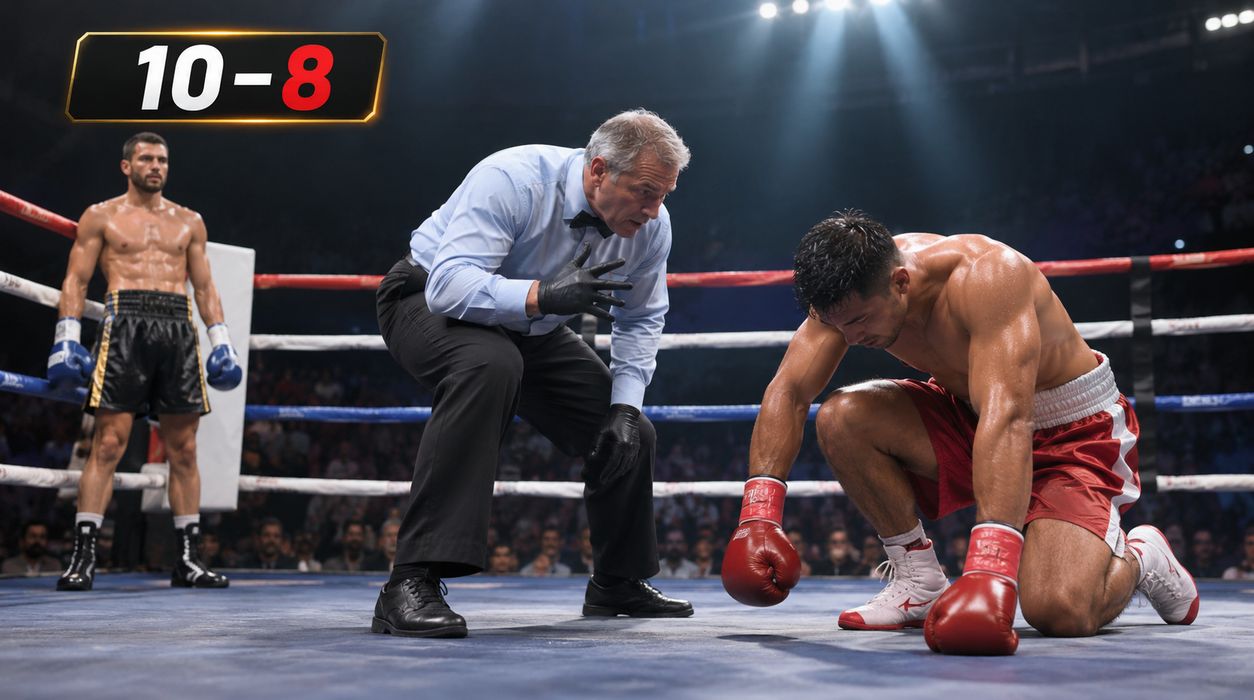
A 10-8 round in boxing means one fighter receives 10 points while the other receives eight points for that round. It usually happens when a boxer scores a knockdown, but a knockdown is not always required. A fighter can also earn a 10-8 round through overwhelming dominance, depending on the judging criteria.
If you have ever watched a boxing match and wondered why the judges awarded a 10-8 instead of a 10-9, the difference matters more than you might think. One dominant round can change the outcome of an entire fight.
Professional boxing uses a scoring method called the 10-Point Must System. Understanding how it works makes it easier to follow championship fights, read official scorecards, and understand controversial decisions.
What Does 10-8 Mean in Boxing?
In professional boxing, a 10-8 score indicates that one boxer won the round by a wider margin than an ordinary 10-9 round.
Most competitive rounds are scored 10-9. The boxer who wins receives 10 points, while the opponent receives nine.
A 10-8 score commonly occurs when the winning boxer knocks down the opponent with a legal punch.
For example:
- Boxer A lands a clean right hand and knocks Boxer B down.
- Boxer B gets back to their feet before the referee completes the count.
- Boxer A maintains control for the remainder of the round.
- The judges typically score the round 10-8 for Boxer A.
However, judges must evaluate the entire round. A knockdown does not automatically guarantee the same score in every possible situation.
According to the Association of Boxing Commissions’ regulatory guidelines, a round can also receive a 10-8 score without a knockdown when one fighter demonstrates clear dominance.
How Does the 10-Point Must System Work?
The 10-Point Must System is the standard scoring method used in professional boxing across most major jurisdictions.
Three ringside judges independently score each round.
Under normal circumstances, the winner receives 10 points, while the opponent receives nine or fewer.
Common Boxing Round Scores
| Score | Meaning |
|---|---|
| 10-9 | One boxer wins a normal competitive round |
| 10-8 | A boxer wins decisively, often with a knockdown |
| 10-7 | A boxer scores multiple knockdowns or achieves exceptional dominance |
| 10-10 | An even round, uncommon in professional boxing |
| 9-9 | A round affected by a point deduction or other scoring circumstances |
These scores are added together to determine the final result when a fight goes the scheduled distance.
The official Unified Rules of Boxing establish the 10-Point Must System as the standard method for judging professional bouts.
Does Every Knockdown Mean a 10-8 Round?
No. Although a single knockdown commonly results in a 10-8 score, judges must consider what happened during the entire round.
Imagine Boxer A controls nearly three minutes of action with clean punches and effective defense.
With only a few seconds remaining, Boxer B lands a counterpunch and knocks Boxer A down.
Boxer B has scored the knockdown, but Boxer A may have performed better throughout most of the round.
Depending on the applicable judging guidelines and the judges’ assessment, the round might be scored differently from the typical 10-8.
This is why a boxing scorecard cannot always be predicted by counting knockdowns alone.
What Judges Consider
Judges commonly evaluate four important factors:
- Clean and effective punching.
- Effective aggressiveness.
- Ring generalship.
- Defense.
Clean, effective punches carry substantial importance.
A boxer who throws 100 punches but lands very few meaningful shots does not necessarily win against an opponent who lands fewer but cleaner and more effective punches.
Can You Get a 10-8 Round Without a Knockdown?
Yes. A fighter can win a 10-8 round without knocking the opponent down.
This is known as a dominant 10-8 round.
It may occur when one boxer overwhelmingly controls the action, lands significant clean punches, and prevents the opponent from mounting meaningful offense.
For example, imagine the following situation:
Boxer A lands repeated combinations, controls the center of the ring, and forces Boxer B into defensive survival mode.
Boxer B remains standing but offers very little effective offense.
A judge may consider the round sufficiently one-sided to award Boxer A a 10-8 score.
However, a fighter merely winning comfortably does not necessarily justify a 10-8.
The dominance must be substantial enough to distinguish the round from an ordinary 10-9.
What Is the Difference Between 10-9 and 10-8 in Boxing?
The difference is the margin by which a fighter wins the round.
A 10-9 round indicates that one boxer performed better.
A 10-8 round indicates a more decisive advantage.
| Factor | 10-9 Round | 10-8 Round |
|---|---|---|
| Typical situation | Competitive round | Knockdown or overwhelming dominance |
| Knockdown required | No | No |
| Winning boxer | 10 points | 10 points |
| Losing boxer | 9 points | 8 points |
| Score difference | 1 point | 2 points |
| Effect on final score | Normal advantage | Larger advantage |
This difference becomes especially important in close fights.
A single 10-8 round can erase the scoring advantage an opponent built by winning two ordinary 10-9 rounds.
For sports fans familiar with point systems in other competitions, understanding the distinction is similar to learning why different events award points differently. SportsVell also explains scoring-related sports concepts in its guide to how long a football game lasts, including how playing time differs across competitions.
How Much Does a 10-8 Round Affect the Final Score?
A 10-8 round can dramatically change a boxing match.
Consider a hypothetical six-round fight.
| Round | Boxer A | Boxer B |
|---|---|---|
| 1 | 10 | 9 |
| 2 | 9 | 10 |
| 3 | 10 | 8 |
| 4 | 9 | 10 |
| 5 | 9 | 10 |
| 6 | 10 | 9 |
| Total | 57 | 56 |
Both boxers won three rounds.
However, Boxer A wins 57-56 because the 10-8 third round creates an additional point advantage.
Without that two-point margin, the score would have been tied.
This example demonstrates why knockdowns are so valuable even when the fight continues.
What Happens If a Boxer Gets Knocked Down Twice?
Two knockdowns in one round commonly result in a 10-7 score for the boxer who scores them.
However, judging remains dependent on the full round and applicable regulations.
A typical example looks like this:
- Boxer A scores the first knockdown.
- Boxer B recovers and continues.
- Boxer A scores a second legal knockdown.
- Boxer B survives until the bell.
- Judges commonly award Boxer A a 10-7 round.
The referee may also stop the contest if Boxer B cannot safely continue.
The World Boxing Federation’s rules explain the distinction between knockdowns, referee counts, and stoppages.
What Happens After a Knockdown in Boxing?
When a boxer is knocked down by a legal punch, the referee begins a count.
The standing opponent must move to a neutral corner.
The referee assesses whether the knocked-down fighter can continue safely.
Under the ABC Unified Rules, a mandatory eight count applies following a knockdown.
That means a fighter who rises quickly must still receive the required count before the referee permits the contest to resume.
A boxer who cannot beat the count may lose by knockout.
A referee can also stop the fight when a boxer appears unable to continue safely.
Is the Mandatory Eight Count the Same as a Standing Eight Count?
No.
A mandatory eight count happens after a knockdown.
A standing eight count involves a referee stopping the action to count for a hurt fighter who has not been knocked down.
The ABC Unified Rules do not permit a standing eight count in professional boxing.
This distinction is important because boxing fans sometimes confuse the two procedures.
Can a Boxer Win a Round After Being Knocked Down?
Yes, it is possible for a boxer to perform better overall despite suffering a knockdown.
Judges evaluate the complete round, not just one moment.
For example, Boxer A might dominate the first two minutes and 45 seconds but suffer a knockdown near the end.
Depending on the applicable scoring criteria, a judge could conclude that the round was closer than a standard 10-8.
Nevertheless, the knockdown remains a major scoring event.
A boxer who suffers a knockdown generally faces a significant challenge in winning that round on the scorecards.
How Do Point Deductions Affect a 10-8 Round?
Point deductions can also change the score of a round.
A referee may deduct points for fouls such as repeated holding, low blows, or other prohibited actions.
Suppose Boxer A wins a round that would ordinarily be scored 10-9.
If the referee deducts one point from Boxer B, the adjusted score may become 10-8.
In this case, no knockdown is necessary.
The score changes because of the official point deduction.
Example
| Situation | Boxer A | Boxer B |
|---|---|---|
| Normal round | 10 | 9 |
| One-point deduction against Boxer B | 10 | 8 |
| Two-point deduction against Boxer B | 10 | 7 |
Only the referee can authorize official point deductions during the contest.
Judges apply those deductions when completing their scorecards.
How Are Boxing Scorecards Calculated?
Each of the three judges independently records scores for every round.
At the end of the fight, the round scores are added together.
The judges’ final totals determine the official decision when the bout goes the distance.
Unanimous Decision
All three judges select the same winner.
Split Decision
Two judges select one boxer, while the third selects the opponent.
Majority Decision
Two judges select one boxer, while the third scores the fight a draw.
Draw
The combined judging results do not produce an overall winner.
These decisions demonstrate why understanding individual rounds matters.
One 10-8 round can influence whether a fight ends in a victory, defeat, or draw.
Sports fans who enjoy comparing competition statistics may also find SportsVell’s article about how many players are on a football team useful for understanding how different sports organize their competitive formats.
Is a 10-8 Round Different in Amateur Boxing?
Amateur and Olympic-style boxing also use a version of the 10-Point Must System, but the judging criteria and competition rules differ from professional boxing.
Under World Boxing competition rules, judges assess scoring blows, technical and tactical superiority, and competitiveness.
A 10-8 score can represent a clear winner of the round.
Unlike the typical professional boxing example, amateur scoring does not depend primarily on whether a knockdown occurred.
Therefore, fans should avoid assuming that every 10-8 amateur round has the same explanation as a professional 10-8 round.
Why Do Boxing Judges Sometimes Disagree?
Boxing judging involves interpretation.
Two judges can watch the same round and reach different conclusions about which fighter landed the more effective punches.
One judge might value clean counterpunching.
Another might believe a fighter’s sustained offense and control were more effective.
Close rounds are especially difficult to score.
Even experienced boxing analysts can disagree about the outcome.
That uncertainty is one reason why controversial decisions remain common topics of discussion among boxing fans.
For readers interested in broader sports statistics, SportsVell’s article on how many acres are in a football field provides another example of how official measurements and rules shape sporting competitions.
Why Is a 10-8 Round Important in Championship Boxing?
Championship fights can be decided by extremely narrow margins.
In a 12-round contest, a single knockdown may change the result even if both fighters win a similar number of rounds.
Consider a fight in which Boxer A wins six rounds and Boxer B wins six rounds.
If every round is scored 10-9, the final result is 114-114.
But if Boxer A earns one 10-8 round while the remaining rounds stay the same, Boxer A wins 114-113.
That single extra point can determine who leaves the ring with a championship belt.
This is why commentators pay close attention to knockdowns and dominant rounds.
Frequently Asked Questions
What does 10-8 mean in boxing?
A 10-8 score means one boxer receives 10 points and the opponent receives eight for a particular round. It usually reflects a knockdown or overwhelming dominance.
Is a knockdown always a 10-8 round?
No. A knockdown commonly produces a 10-8 score, but judges must assess the entire round under the applicable scoring rules.
Can you score 10-8 without a knockdown?
Yes. Judges can award a 10-8 round when one boxer dominates the action sufficiently, even without a knockdown.
What does 10-7 mean in boxing?
A 10-7 round often occurs when one boxer scores two knockdowns or achieves an exceptionally decisive advantage.
Is a 10-10 round allowed?
Yes. Some professional boxing rules permit even rounds, although judges are generally encouraged to identify a winner whenever possible.
Can a 10-8 round decide a boxing match?
Yes. A 10-8 round creates a two-point margin instead of the normal one-point margin, which can determine the final result of a close fight.
How many judges score a professional boxing match?
Professional boxing matches normally use three judges who independently score each round.
Does the referee decide the 10-8 score?
No. Judges score the rounds. The referee determines knockdowns, enforces rules, and authorizes point deductions.
Final Thoughts
A 10-8 round is one of the most important scoring outcomes in professional boxing.
It usually follows a knockdown, but a fighter can also earn the score through overwhelming dominance or benefit from an opponent’s point deduction.
Understanding the difference between 10-9, 10-8, and 10-7 rounds helps fans interpret official scorecards and appreciate how quickly a boxing match can change.
Whether you are watching a four-round professional debut or a 12-round world championship fight, knowing how the 10-Point Must System works makes the action easier to follow.
For additional sports education, explore SportsVell’s guide to how college football players get paid and its article examining former NBA players and their religious affiliations.

Washim is a passionate sports writer and editor at SportsVell.com, covering the latest sports news, match updates, player performances, and expert analysis. He focuses on football, cricket, basketball, NFL, NBA, UFC, and other major sports. His goal is to provide sports fans with accurate, engaging, and easy-to-understand content from around the world.