
Can VAR Review a Second Yellow Card in Soccer? 2026–27 Rule Changes Explained
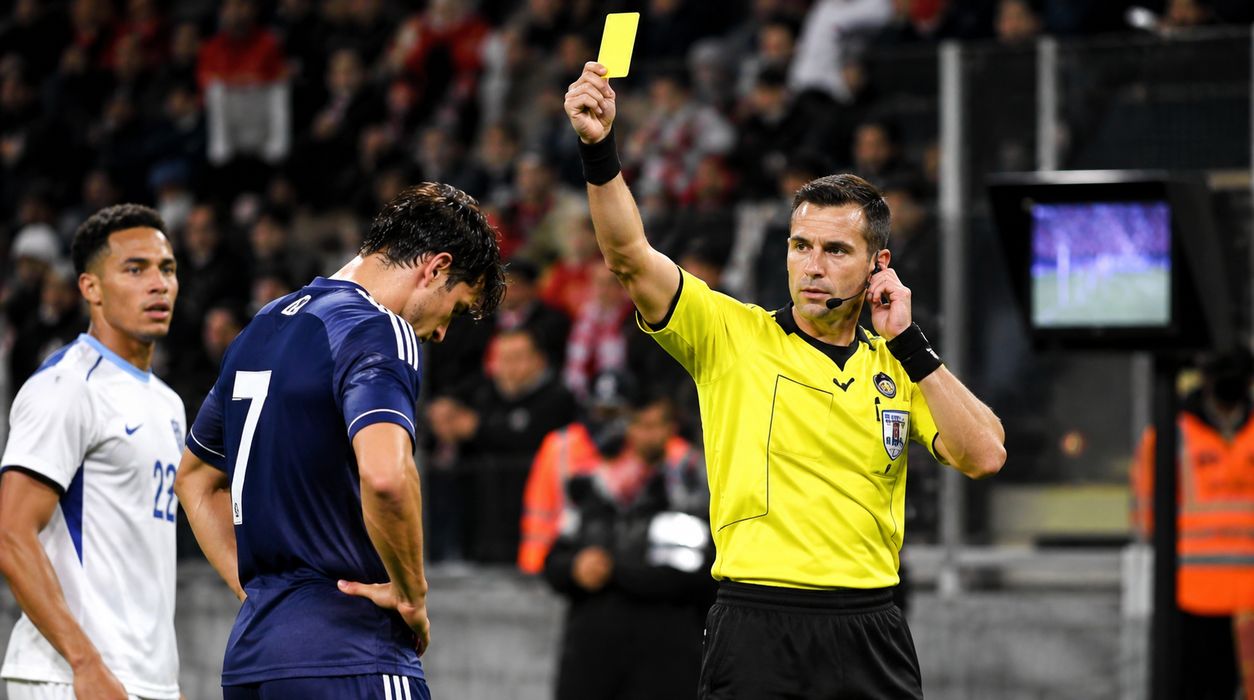
A soccer player makes a challenge near midfield. The referee blows the whistle, reaches into a pocket, and shows a yellow card.
But the player has already been booked.
A red card follows, and the team suddenly faces the prospect of playing the rest of the match with ten players.
Television replays then suggest the referee may have punished the wrong player or misunderstood the challenge.
Can VAR intervene?
Yes. Under the 2026–27 soccer rules, VAR can review a clearly incorrect second yellow card when that caution results in a red card.
This is an important change introduced by the International Football Association Board (IFAB).
Previously, VAR generally could not review second-yellow-card dismissals. Its red-card review powers focused on direct red cards.
The updated protocol allows officials to correct certain obvious second-caution errors that could unfairly change a match.
However, it does not mean every yellow card is reviewable.
This guide explains the new rule, when VAR can intervene, which incidents remain outside its authority, and what happens when a second-yellow dismissal is overturned.
Can VAR Review a Second Yellow Card in 2026–27?
Yes, but only under specific circumstances.
The 2026–27 IFAB VAR protocol allows a review when a player receives a clearly incorrect second yellow card that results in a red card.
That distinction is essential.
VAR cannot review every caution simply because the player or coach disagrees with the referee.
The new provision focuses on a potentially match-changing mistake: an incorrect second caution that causes a dismissal.
For example, imagine a midfielder already has one yellow card.
Later, the referee believes the midfielder has recklessly fouled an opponent and issues another caution.
The player receives a red card and must leave the field.
However, replay footage clearly shows that the midfielder did not commit the offense.
VAR can now alert the referee and recommend reviewing the decision.
If the referee determines that the second caution was clearly incorrect, it can be canceled along with the resulting red card.
The player can remain on the field.
The change is confirmed in the official IFAB Video Assistant Referee Protocol.
What Changed in the 2026–27 VAR Rules?
Before the 2026–27 changes, VAR was generally restricted to four categories of match-changing decisions:
- Goal or no goal.
- Penalty or no penalty.
- Direct red cards.
- Mistaken identity.
A second yellow card was excluded from the normal red-card review category.
That meant a referee could make a clearly incorrect second-caution decision, send a player off, and still be unable to use VAR solely to correct that mistake.
The consequences could be substantial.
A team might lose a player early in a match, change its tactical formation, and spend the remaining minutes defending with ten players.
IFAB addressed that problem by expanding the red-card review category.
The revised protocol includes red cards resulting from clearly incorrect second cautions.
Why Was the Rule Changed?
The main reason was fairness.
A mistaken second yellow card can have the same immediate consequence as an incorrect direct red card.
Both remove a player from the match.
However, the old protocol treated those situations differently.
The change aims to correct obvious errors without turning VAR into a system for reviewing every routine foul or caution.
IFAB announced the adjustment alongside other measures intended to improve match flow and player behavior.
The official IFAB 2026–27 Law Changes explain the amendment.
How Does a VAR Review of a Second Yellow Card Work?
The process follows the established VAR framework.
The referee makes the original decision, and the video assistant referee checks whether the incident falls within the permitted review categories.
If the second caution appears clearly incorrect and results in a dismissal, VAR can recommend a review.
Step 1: The Referee Issues a Second Yellow Card
A player who already has one caution commits an alleged offense.
The referee issues another yellow card.
Because it is the player’s second caution, the referee also shows a red card.
The player is dismissed.
Step 2: VAR Checks the Incident
The video assistant referee examines the available footage.
The purpose is not to reconsider every minor judgment.
VAR looks for clear evidence that the second caution was incorrect.
If the decision is supportable, the original ruling remains.
Step 3: VAR Recommends a Review
If the footage reveals a clear and obvious error, VAR can recommend that the referee review the incident.
The referee may examine the footage at the pitchside monitor.
The referee remains responsible for the final decision.
Step 4: The Referee Makes the Final Decision
If the review establishes that the second yellow card was clearly incorrect, the referee cancels that caution and the resulting red card.
The player can remain in the match.
If the review does not establish a clear error, the dismissal stands.
The exact restart depends on the facts of the incident and any offenses identified during the review.
Can VAR Overturn a Second Yellow Card?
Yes.
A clearly incorrect second caution can be overturned when it has resulted in a red card.
Consider a practical example.
A defender is already on a yellow card.
An attacker approaches the penalty area and falls after moving past the defender.
The referee believes the defender committed a reckless foul.
A second yellow card is issued, followed by a red card.
Replay footage clearly shows there was no contact and that the attacker deliberately simulated the foul.
VAR can recommend reviewing the dismissal.
After reviewing the footage, the referee can cancel the defender’s second yellow card and red card.
The referee may also caution the attacker for simulation.
The restart must reflect the corrected decision.
IFAB provides a similar example in its official VAR protocol guidance.
The important point is that the review corrects an obvious dismissal error rather than merely reconsidering an ordinary caution.
Can VAR Review a First Yellow Card?
Generally, no.
The new rule does not allow VAR to review an ordinary first caution simply because it appears questionable.
For example, imagine a player receiving a yellow card for a late tackle in the 20th minute.
Television replays suggest the tackle was not reckless.
That disagreement alone does not make the caution reviewable.
VAR does not have general authority to inspect every yellow card.
However, a yellow-card incident can be relevant when it forms part of another permitted review, such as mistaken identity or an incident involving a penalty decision.
The distinction is between reviewing a caution as an independent decision and addressing disciplinary consequences within an otherwise reviewable incident.
Can VAR Recommend a Second Yellow Card That the Referee Missed?
No.
This is one of the most important limitations of the 2026–27 change.
VAR can intervene when the referee has issued a clearly incorrect second caution resulting in a dismissal.
It cannot generally intervene merely because the referee missed an offense that might have deserved a second yellow card.
Imagine a midfielder already has one caution.
The midfielder then makes a reckless challenge, but the referee allows play to continue.
Television replays show the challenge could have deserved another yellow card.
VAR cannot recommend a review solely to issue that missed second caution.
The new rule is designed to correct an incorrect dismissal, not to search for additional yellow-card offenses.
This distinction helps prevent VAR from becoming involved in every routine disciplinary decision.
Second Yellow Card vs. Direct Red Card: What Is the Difference?
A player can be sent off in two main ways.
The first is receiving two yellow cards during the same match.
The second is committing an offense that warrants a direct red card.
Both result in dismissal, but their disciplinary grounds differ.
| Situation | VAR Review in 2026–27 |
|---|---|
| Clearly incorrect second yellow resulting in red | Yes |
| Ordinary first yellow card | Generally no |
| Missed potential second yellow | No, not solely for that reason |
| Potential direct red card | Yes, within the protocol |
| Clearly incorrect direct red card | Yes |
| Mistaken identity involving a card | Yes, within the protocol |
A direct red card may be issued for serious foul play, violent conduct, or other sending-off offenses identified in the Laws of the Game.
A second-yellow dismissal results from two separate cautionable offenses.
The new protocol allows review of clearly incorrect second-yellow dismissals without making all yellow-card decisions reviewable.
What Happens After a Second Yellow Card?
The player must leave the field and cannot be replaced.
Their team continues with one fewer player.
A standard soccer match begins with eleven players per team.
If one player is dismissed, that team normally continues with ten.
SportsVell’s guide to how many players are on a soccer team explains the team-size requirements and minimum number of players needed to continue a match.
What Does “Clearly Incorrect” Mean in VAR Decisions?
The phrase is important because VAR is not intended to replace the referee’s judgment on every close decision.
A decision may be controversial without being clearly incorrect.
For example, two referees might reasonably disagree about whether a tackle was careless or reckless.
If the footage does not demonstrate a clear error, the original decision should generally stand.
VAR intervention requires stronger evidence than ordinary disagreement.
The system is intended to correct clear and obvious errors or serious missed incidents within the permitted categories.
Example: A Clearly Incorrect Decision
A player receives a second yellow card for a foul.
Video footage clearly establishes that another player committed the offense.
The incident may qualify for review under the relevant second-caution or mistaken-identity provisions.
Example: A Subjective Decision
A player makes a late challenge.
The referee considers it reckless and issues a second caution.
Replays show contact, but reasonable interpretations of its severity remain possible.
The existence of debate does not automatically establish a clear and obvious error.
The referee’s original decision may therefore remain unchanged.
Can VAR Review Mistaken Identity in 2026–27?
Yes.
Mistaken identity is another area addressed by the updated protocol.
A referee might correctly identify that an offense occurred but issue the card to the wrong player.
The 2026–27 rules allow VAR to assist when a yellow or red card has been shown to a player who did not commit the offense.
Importantly, the updated wording addresses mistaken identity involving players from either team.
For example, two players challenge for the ball.
The referee identifies the offense but mistakenly cautions a player from the wrong team.
VAR can help correct the identity of the offender.
The review of mistaken identity does not automatically permit a complete reconsideration of the underlying foul unless another reviewable category applies.
This is an important procedural limitation.
Can VAR Review a Wrongly Awarded Corner Kick?
The 2026–27 changes also introduced an optional review category for clearly incorrect corner-kick awards.
Competitions may allow VAR to correct such decisions when the error is obvious and the correction can be completed immediately without delaying the restart.
This is not an automatic requirement for every competition.
It is a competition option.
If a corner kick has already been taken quickly, the decision cannot be changed through that procedure.
The purpose is to correct straightforward errors without creating lengthy interruptions.
For context, corner kicks are also important in understanding soccer’s offside exceptions.
A player cannot be penalized for offside when receiving the ball directly from a corner kick, although normal offside rules can apply after a subsequent teammate’s touch.
Does VAR Review Every Red Card Automatically?
VAR checks incidents within its permitted categories, but a formal on-field review is not required for every red-card decision.
There is a difference between a VAR check and a referee review.
During a check, the video assistant referee examines footage to determine whether there is a possible clear and obvious error or serious missed incident.
If the decision appears correct, play can continue without an on-field review.
If an intervention is warranted, VAR may recommend that the referee review the incident.
The referee then makes the final decision.
A review can involve communication with VAR or direct examination of footage, depending on the nature of the decision.
The system is intended to support referees rather than transfer final authority away from them.
What Happens If the Referee Has Already Restarted Play?
The timing of a review matters.
Under the VAR protocol, reviews generally must occur before play restarts.
There are limited exceptions for certain incidents, including mistaken identity and specified serious sending-off offenses.
A clearly incorrect second-yellow dismissal does not create unlimited permission to reopen a decision after play has restarted.
For example, if a player is dismissed following a second caution, officials should resolve any eligible VAR intervention before the subsequent restart.
Once play has restarted, the normal protocol restrictions apply.
This is why communication between the referee, assistant referees, and VAR team is essential.
Does the New Rule Apply in Every Soccer League?
The updated IFAB protocol establishes what VAR is permitted to review.
However, not every soccer competition uses VAR.
A competition must have the necessary technology, trained officials, and authorization to operate the system.
In a match without VAR, the referee and other on-field match officials make decisions using the available information.
The existence of the 2026–27 protocol does not mean every amateur, youth, college, or lower-division match automatically has video review.
Competition regulations and the applicable officiating framework still matter.
For fans, this explains why a decision may be reviewable in a major professional competition but not in a local match without VAR.
Why the Second-Yellow VAR Change Matters for Teams
An incorrect dismissal can change the entire direction of a match.
A team reduced to ten players may need to reorganize immediately.
A coach might replace an attacking player with a defender to protect the back line.
The remaining players may need to cover more space, defend deeper, and reduce their attacking ambitions.
These adjustments can affect possession, scoring opportunities, and physical fatigue.
Correcting an obvious second-yellow mistake can prevent those consequences.
Better Protection Against Match-Changing Errors
A second-yellow dismissal can be just as consequential as a direct red card.
The updated rule provides a way to correct a clear mistake before the match continues.
Greater Consistency
Allowing reviews of clearly incorrect second cautions reduces the difference between how VAR treats two types of dismissal.
More Pressure on Referee Communication
Officials must recognize when a second caution has resulted in a red card and whether the incident qualifies for intervention.
Clear communication helps ensure that an eligible decision is reviewed before the restart.
Possible Interruptions
The expanded review category may occasionally add time to a match.
However, the narrow eligibility requirement is intended to prevent unnecessary reviews of ordinary cautions.
The objective is accuracy in major disciplinary decisions without reviewing every minor incident.
How VAR Decisions Affect Match Tactics
A dismissal forces coaches to make difficult decisions.
A team playing with ten players may shift from a 4-3-3 formation to a more compact defensive shape.
The coach may sacrifice a forward to add defensive cover.
Midfielders may need to work harder to protect central areas.
A successful VAR intervention can prevent these tactical changes when the dismissal was clearly incorrect.
This matters especially in knockout matches, where a single goal or defensive mistake can determine elimination.
Soccer’s disciplinary system is different from those used in American sports.
For example, the NFL uses penalties and ejections under a separate rulebook, while soccer uses yellow and red cards.
Readers interested in those differences can explore SportsVell’s guide to how long a football game lasts.
The comparison shows how different sports balance officiating decisions, timing, and game management.
Common Misunderstandings About VAR and Yellow Cards
Several misconceptions remain common among soccer fans.
Mistake 1: VAR can now review every yellow card.
It cannot. The new second-yellow provision applies to clearly incorrect cautions that result in a red card.
Mistake 2: VAR can recommend any missed second yellow.
No. A missed potential second caution is not independently reviewable under this provision.
Mistake 3: The VAR makes the final decision.
The referee remains the final decision-maker.
Mistake 4: Every controversial second yellow must be overturned.
The footage must establish a clear and obvious error. Ordinary disagreement is not enough.
Mistake 5: Every competition uses VAR.
VAR is available only where the competition has implemented the authorized system.
Mistake 6: A yellow card can never be changed during a VAR review.
Disciplinary decisions can be affected by eligible reviews, including mistaken identity and clearly incorrect second-yellow dismissals.
Frequently Asked Questions
Can VAR review a second yellow card in 2026–27?
Yes. VAR can review a clearly incorrect second yellow card when it results in a red card.
Can VAR overturn a second yellow card?
Yes. If a review establishes that the second caution was clearly incorrect, the referee can cancel the caution and resulting dismissal.
Can VAR review a first yellow card?
Generally, no. An ordinary first yellow card is not independently reviewable merely because the decision is disputed.
Can VAR recommend a missed second yellow card?
No. The 2026–27 protocol does not allow VAR to intervene solely because a player should have received a second caution that the referee missed.
Can VAR review a direct red card?
Yes. Potential direct red-card offenses and clearly incorrect direct red cards remain within VAR’s permitted review categories.
Can VAR correct mistaken identity?
Yes. VAR can assist when a referee clearly cautions or sends off the wrong player, subject to the protocol.
Does the referee have to use the pitchside monitor?
Not for every VAR check. When a formal review is required, the procedure depends on the nature of the incident. The referee always retains final decision-making authority.
Does the rule apply in the 2026–27 Premier League season?
The IFAB protocol permits these reviews in competitions operating VAR under the updated rules. The competition’s implementation and applicable regulations determine its use.
Can a coach demand a VAR review?
No. Coaches and players cannot require the referee to conduct a review simply by requesting one.
Can VAR change a second yellow after play restarts?
The normal protocol restricts reviews after play restarts, subject to specified exceptions. A clearly incorrect second caution does not provide unrestricted authority to reopen a completed decision.
Final Thoughts
The 2026–27 VAR changes address one of soccer’s most frustrating officiating situations: a player being sent off because of a clearly incorrect second yellow card.
Under the updated IFAB protocol, VAR can help correct that mistake.
However, the rule remains deliberately limited.
VAR cannot review every ordinary caution, and it cannot recommend a missed second yellow solely because replay footage suggests one should have been issued.
The referee still makes the final decision, and the clear-and-obvious-error standard remains central to the process.
For players and coaches, the change offers greater protection against an unfair dismissal.
For referees, it provides another tool for correcting major mistakes.
And for fans, it clarifies why VAR may intervene in one second-yellow incident while remaining silent during another.
As soccer continues refining its officiating technology, the central goal remains the same: make important decisions more accurate without unnecessarily interrupting the game.
For more sports rules and explanations, visit SportsVell.
You can also explore how other sports organize teams and manage player participation through SportsVell’s guides to how many players are on a football team and how many acres are in a football field.