
How Many Substitutions Are Allowed in Soccer? 2026–27 Rules Explained
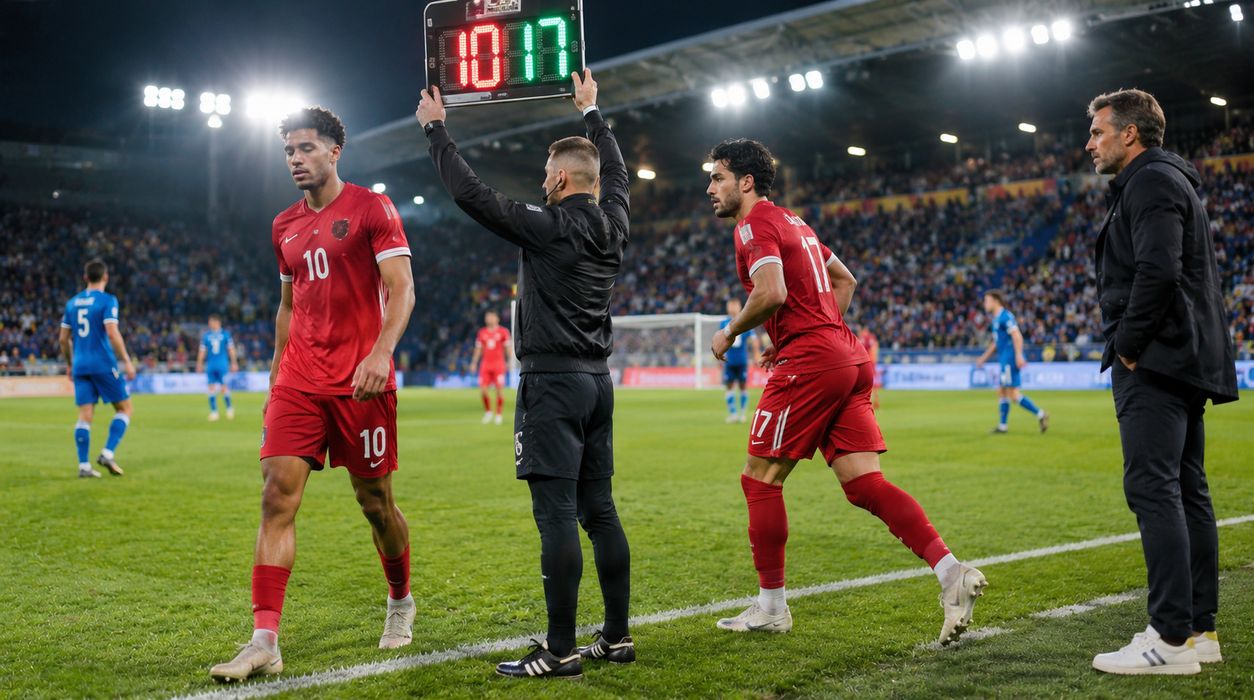
A soccer coach looks toward the bench in the 70th minute. One midfielder is exhausted, a forward has picked up a yellow card, and the team needs a goal.
The coach wants to make three changes, but there is one important question: how many substitutions are still available?
In most top-level professional soccer competitions, teams can make up to five substitutions during a match, using a maximum of three substitution opportunities during normal playing time.
Substitutions made at halftime do not use one of those three opportunities.
The 2026–27 Laws of the Game also include important provisions for extra time, international friendly matches, concussion replacements, and players taking too long to leave the field.
These details matter because having five substitutes available does not necessarily mean a coach can make five separate changes at five different stoppages.
Here is a complete explanation of the current soccer substitution rules, including practical examples and the changes introduced for the 2026–27 season.
How Many Substitutions Are Allowed in Soccer in 2026–27?
Under IFAB Law 3, official competitions may permit teams to use up to five ordinary substitutes, with the exact number determined by the relevant competition authorities.
In top-division club competitions and senior international competitions that allow five substitutes, teams normally have three substitution opportunities during play.
A substitution opportunity is a stoppage when a team makes one or more changes.
For example, replacing three players during the same stoppage uses three substitutions but only one substitution opportunity.
This distinction is essential for understanding the rule.
According to the official IFAB Law 3: The Players, the substitution limits and procedures are determined by the applicable Laws and competition regulations.
Quick Summary of Soccer Substitution Rules
| Situation | 2026–27 Rule |
|---|---|
| Ordinary substitutions in most major competitions | Up to 5 |
| Substitution opportunities during play | 3 |
| Halftime substitutions | Do not use an opportunity |
| Multiple changes at one stoppage | Count as one opportunity |
| Extra-time substitution | One additional substitute if competition rules permit |
| Senior international friendly | Up to 8, or 11 by agreement |
| Additional concussion substitution | Competition option |
| Time allowed to leave field | 10 seconds under the new rule |
| Can a substituted player return? | Generally no, except permitted return-substitution formats |
The five-substitution system is common in professional soccer, but the exact regulations can differ by competition.
Why Are Five Substitutions Allowed in Soccer?
For many years, professional soccer generally allowed three substitutions.
The system changed significantly during the COVID-19 pandemic.
In 2020, IFAB introduced a temporary option allowing five substitutions to help teams manage demanding schedules and player workloads.
The measure was subsequently extended and became a permanent option in 2022.
Today, five substitutions are widely used in major professional competitions.
The additional changes give coaches greater flexibility.
A team can replace tired players, respond to tactical problems, and manage its squad more effectively.
However, the three-opportunity restriction helps prevent excessive interruptions.
Without that restriction, a coach could potentially stop the match repeatedly to introduce individual players.
The current system balances tactical flexibility with the need to keep matches moving.
What Are the Three Substitution Windows in Soccer?
The three substitution windows are the three opportunities a team can use to make ordinary substitutions during play.
They do not refer to fixed periods of the match.
A coach is not required to substitute players in the first, second, or final third of the game.
Instead, the team can choose when to use its opportunities.
Example of Three Substitution Windows
Imagine a team using the following plan:
First opportunity — 55th minute
The coach replaces one midfielder.
Substitutions used: 1.
Opportunities used: 1.
Second opportunity — 70th minute
The coach replaces two forwards.
Substitutions used: 3.
Opportunities used: 2.
Third opportunity — 83rd minute
The coach replaces two defenders.
Substitutions used: 5.
Opportunities used: 3.
The team has now used all five ordinary substitutions and all three opportunities.
This is completely legal under the standard five-substitution system.
Can You Make Three Substitutions at Once?
Yes.
A coach can replace three players during the same stoppage.
Those changes count as three substitutions but only one substitution opportunity.
For example, a team trailing by two goals might introduce three attacking players together.
This allows the coach to change the team’s formation without using multiple opportunities.
What If Both Teams Substitute at the Same Time?
If both teams make substitutions during the same stoppage, that counts as one opportunity for each team.
One team’s substitution does not give the other team a free opportunity.
However, if one team makes several changes during that same stoppage, those changes still count as only one opportunity for that team.
Do Halftime Substitutions Count Toward the Three Windows?
No.
A substitution made at halftime counts toward the maximum number of substitutes used, but it does not count toward the three substitution opportunities.
This creates an important tactical advantage.
For example, imagine a coach replaces two players at halftime.
The team has used two of its five substitutions.
However, all three substitution opportunities during play remain available.
The coach can still make three separate substitution decisions during the second half, provided the total number of substitutes does not exceed five.
Example: Halftime Plus Second-Half Substitutions
A team makes:
- Two substitutions at halftime.
- One substitution in the 60th minute.
- One substitution in the 75th minute.
- One substitution in the 85th minute.
The team has used five substitutions but only three substitution opportunities during play.
This is permitted under the standard system.
Coaches often use halftime strategically because it allows them to change players without consuming an opportunity.
How Many Substitutions Are Allowed in Extra Time?
Extra-time substitution rules depend on the competition regulations.
Under IFAB Law 3, unused substitutions and opportunities can carry into extra time.
Competitions may also allow one additional substitute when a match goes into extra time.
For example, a competition using five substitutions during normal time may permit a sixth during extra time.
However, that additional substitute is not automatic in every competition.
The competition rules must specifically allow it.
Can Teams Make Substitutions Before Extra Time?
Yes.
Substitutions can be made between the end of normal time and the start of extra time.
These changes do not use a substitution opportunity.
Substitutions made at halftime during extra time also do not consume an opportunity.
They still count toward the applicable maximum number of substitutes.
What Happens to Unused Substitutions?
Unused substitutions remain available during extra time.
For example, a team that has used only three of its five ordinary substitutions may still use the remaining two.
If the competition also allows one additional substitute in extra time, the team may have that extra replacement available.
Coaches must carefully track both the number of substitutions and the remaining opportunities.
What Changed in the 2026–27 Soccer Substitution Rules?
The 2026–27 Laws introduced two particularly important changes.
The first concerns international friendly matches.
The second introduces a new time limit for players leaving the field during substitutions.
1. Eight Substitutions in Senior International Friendlies
Under the updated Law 3, senior national teams can use up to eight substitutes in international friendly matches.
Previously, the normal limit was six.
The new rule also allows the teams to agree on using more than eight, up to a maximum of eleven.
Both teams must agree, and the referee must be informed before the match.
The three-opportunity restriction still applies.
This change gives national team coaches greater flexibility to evaluate players and manage workloads during friendly matches.
It does not mean every competitive international tournament automatically allows eight substitutions.
2. New Ten-Second Substitution Rule
The 2026–27 Laws introduce a ten-second time limit for a player to leave the field when being substituted.
The purpose is to discourage players from deliberately delaying substitutions.
If the player takes longer than the permitted time, the incoming substitute must wait before entering.
Under the rule, the replacement cannot enter until the first stoppage after one minute of playing time has elapsed.
The team may therefore temporarily play with one fewer player.
This creates a meaningful consequence for deliberately slow exits.
The change is part of IFAB’s broader effort to improve match flow and reduce time-wasting.
You can review the amendments through the official IFAB 2026–27 Law Changes.
What Happens If a Player Takes Too Long to Leave the Field?
Consider a team leading 1–0 in the final minutes.
The coach substitutes a forward, but the player walks slowly toward the touchline.
The referee instructs the player to leave.
The player fails to exit within the ten-second limit.
Under the new rule, the incoming substitute cannot enter immediately.
Instead, the replacement must wait until the first stoppage after one minute of playing time has elapsed.
The team temporarily has fewer players on the field.
This creates a risk for the team attempting to waste time.
The rule encourages players to leave promptly rather than using substitutions to delay the match.
Does the Player Always Have to Leave at the Halfway Line?
No.
Under the normal substitution procedure, the player being replaced generally leaves at the nearest point on the boundary line unless the referee directs otherwise.
The incoming substitute normally enters at the halfway line after receiving the referee’s signal.
These procedures help make substitutions faster and more orderly.
Can a Goalkeeper Be Substituted in Soccer?
Yes.
A goalkeeper can be replaced just like an outfield player.
The substitution counts toward the team’s ordinary substitution limit unless a specific additional-substitution provision applies.
For example, a coach may replace an injured goalkeeper with a substitute goalkeeper.
A goalkeeper may also be substituted for tactical reasons.
However, changing the goalkeeper does not automatically give a team an extra substitution.
Can an Outfield Player Become the Goalkeeper?
Yes.
Any player may change places with the goalkeeper, provided the referee is informed before the change and the exchange takes place during a stoppage.
This is different from introducing a new substitute.
For example, if a goalkeeper is sent off after the team has used all its substitutions, an outfield player may need to take over in goal.
The team cannot replace a sent-off player with a substitute.
For more information about team structure, see SportsVell’s guide to how many players are on a soccer team.
Are Concussion Substitutions Allowed in Soccer?
Yes, but they depend on the competition.
IFAB permits competitions to implement additional permanent concussion substitutions under its approved protocol.
These substitutions are designed to protect players who have suffered an actual or suspected concussion.
Under the protocol, each team may use a maximum of one additional concussion substitute.
This replacement does not count toward the normal substitution limit.
The player who leaves because of a concussion or suspected concussion cannot return to the match.
Does the Opposing Team Receive an Extra Substitution?
Yes, under the IFAB protocol.
When one team uses an additional permanent concussion substitution, the opposing team receives the option of making one additional substitution.
This provision helps maintain competitive fairness.
The opposing team’s extra substitute may be used for any reason, subject to the protocol.
However, competitions must adopt the relevant procedure before these additional substitutions are available.
The official IFAB Additional Permanent Concussion Substitutions Protocol explains the requirements.
Can a Substituted Player Return to the Game?
In most professional soccer competitions, no.
Once a player has been substituted, they cannot return to the field as a player during the same match.
However, IFAB allows return substitutions in certain forms of soccer.
These include youth, veterans, disability, and grassroots football, subject to approval by the relevant authorities.
Return substitutions are sometimes called rolling substitutions.
For example, a youth competition may allow a player to leave the field, rest, and return later.
That arrangement is not generally permitted in top-level professional soccer.
The applicable competition rules determine whether return substitutions are available.
Can Teams Make Substitutions During Stoppage Time?
Yes.
Teams can make substitutions during added time, provided they have unused substitutes and opportunities.
For example, a coach may introduce a defender in the 92nd minute to protect a narrow lead.
A team may also replace an exhausted player or introduce a specialist before a set piece.
However, substitutions must follow the correct procedure.
The new ten-second rule also discourages players from using slow exits to waste time.
Referees account for time lost through substitutions when determining added time.
This is different from American football, where the game clock and play clock operate under separate rules. SportsVell explains that distinction in how long a football game lasts.
What Happens If a Team Uses Too Many Substitutions?
Teams must follow the substitution limits established by the competition.
Using an ineligible substitute or exceeding the permitted number can create a serious rules issue.
Match officials are responsible for supervising the substitution procedure.
However, the consequences of an administrative breach may also be determined by the competition’s disciplinary regulations.
Depending on the circumstances, a team could face disciplinary proceedings or other competition-specific consequences.
There is no single universal penalty that automatically applies to every substitution violation in every soccer competition.
Coaches and team officials must therefore track their substitutions carefully.
Why Do Coaches Save Substitutions Until Late in a Match?
Substitutions are a major tactical resource.
A coach may decide to save replacements for several reasons.
Managing Fatigue
Players become tired as the match progresses.
Fresh substitutes can help maintain running intensity, defensive concentration, and attacking movement.
Changing Formations
A coach might replace a defender with a forward when chasing a goal.
Alternatively, a team protecting a lead may introduce an additional defensive player.
Protecting Players on Yellow Cards
A player who has already received a yellow card may be at risk of dismissal.
The coach may replace that player to reduce the risk.
Responding to Injuries
Unexpected injuries can force substitutions.
Using every available replacement too early can leave a team vulnerable if another player cannot continue.
Preparing for Extra Time
In knockout matches, coaches may save substitutes to manage fatigue during extra time.
The best strategy depends on the match situation, the players available, and the competition’s substitution rules.
Soccer Substitutions vs. Other Sports
Soccer has a relatively restrictive substitution system compared with several major American sports.
In basketball, players can generally leave and return to the game under the applicable substitution rules.
In American football, teams routinely rotate personnel between plays.
Professional soccer is different because ordinary substituted players generally cannot return.
That makes each substitution a more permanent tactical decision.
For comparison, SportsVell explains the roster structure of American football in how many players are on a football team.
The difference illustrates why soccer coaches must manage their bench carefully.
Unlike sports that allow frequent player rotation, soccer requires coaches to consider the entire remaining match before making changes.
Common Mistakes About Soccer Substitutions
Mistake 1: Every team can make five separate substitutions at five different stoppages.
In major competitions using the standard system, teams have five substitutions but only three opportunities during play.
Mistake 2: Halftime substitutions use a substitution opportunity.
They count toward the substitute limit but do not use an opportunity.
Mistake 3: Every competition allows a sixth substitute in extra time.
An additional extra-time substitute is permitted only when competition regulations allow it.
Mistake 4: International friendlies still have a universal six-substitute limit.
The 2026–27 rules increased the standard maximum for senior international friendlies to eight, with up to eleven by agreement.
Mistake 5: A substituted professional player can return later.
Ordinary return substitutions are not generally permitted in professional soccer.
Mistake 6: A concussion substitute always counts toward the five ordinary replacements.
Under an adopted additional permanent concussion substitution protocol, the concussion replacement is separate from the normal limit.
Frequently Asked Questions
How many substitutions are allowed in soccer in 2026–27?
Most major professional competitions allow up to five ordinary substitutions, normally using three substitution opportunities during play.
Why are there five substitutions in soccer?
The five-substitution option was introduced during the COVID-19 pandemic to help manage player workloads and later became permanent.
Can you make all five substitutions at once?
Yes. A team can make five substitutions during one stoppage if it has all five available and follows the correct procedure.
Do halftime substitutions count?
They count toward the maximum number of substitutions but do not use one of the three substitution opportunities.
How many substitutions are allowed in extra time?
Unused substitutions remain available. Competitions may also permit one additional substitute and opportunity during extra time.
How many substitutions are allowed in international friendlies?
Under the 2026–27 rules, senior national teams may use up to eight substitutes. Both teams can agree to use up to eleven if the referee is informed before the match.
Can a player return after being substituted?
Generally not in professional soccer. Return substitutions are permitted in certain approved youth, veterans, disability, and grassroots formats.
Can a goalkeeper be substituted?
Yes. Replacing a goalkeeper normally counts as an ordinary substitution.
What is the ten-second substitution rule?
A player being substituted must leave the field within the required ten-second period. If the limit is exceeded, the incoming player must wait until the first stoppage after one minute of playing time has elapsed.
Are concussion substitutions included in the five-substitution limit?
Not when the competition uses IFAB’s additional permanent concussion substitution protocol. Such replacements are separate from the normal limit.
Final Thoughts
The answer to how many substitutions are allowed in soccer depends on the competition, but the standard professional system is straightforward.
Teams generally have up to five ordinary substitutions and three opportunities to make them during play.
Halftime substitutions do not use an opportunity, and multiple replacements made during the same stoppage count as one opportunity.
The 2026–27 rules also introduce important changes.
Senior international friendly matches now allow up to eight substitutes, with as many as eleven by agreement.
Players leaving the field during substitutions must also comply with the new ten-second requirement.
Extra-time and concussion substitutions remain subject to specific competition regulations.
For coaches, understanding these rules is essential for managing fatigue, injuries, formations, and match strategy.
For fans, the rules explain why a coach may make several substitutions together or save replacements until the closing minutes.
As soccer continues developing its Laws of the Game, substitutions remain one of the most important tactical decisions a coach can make.
For more soccer explanations and sports guides, visit SportsVell.
You can also explore how other sports manage match structure through SportsVell’s guides to how many rounds are in a boxing match and how long an American football game lasts.