
What Happens If a Soccer Player Takes Too Long on a Throw-In or Goal Kick? (2026–27 Rules)
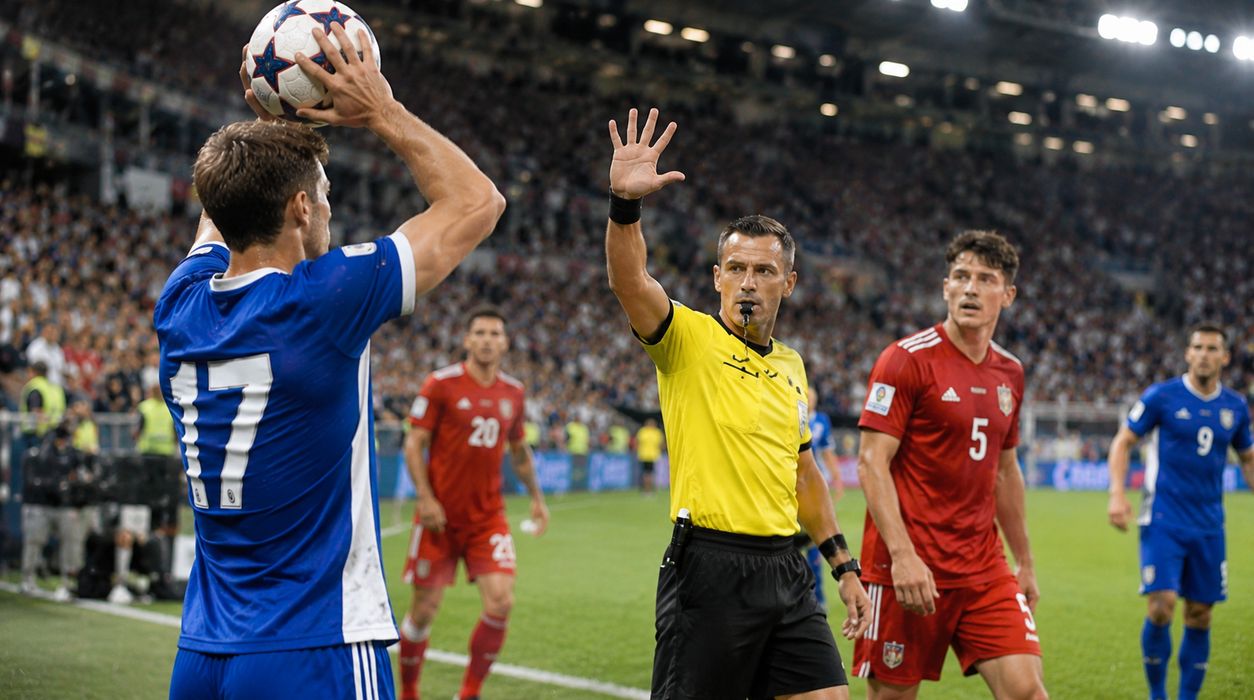
The clock is approaching the 90th minute. One team leads 1–0, and its defender slowly walks toward the sideline to take a throw-in. Instead of restarting play, the defender waits for teammates to move, puts the ball down, and asks another player to take it.
The opposing fans begin complaining. The referee blows the whistle, raises one hand, and starts counting down.
What happens if the defender still refuses to take the throw-in?
Under the 2026–27 soccer throw-in time limit rules, the referee can award the throw-in to the opposing team if the original team deliberately delays the restart and fails to put the ball into play before the five-second countdown expires.
A similar rule applies to goal kicks. However, the punishment is different: a team that fails to take a deliberately delayed goal kick before the countdown expires concedes a corner kick.
These changes were introduced by the International Football Association Board (IFAB) to reduce time-wasting and keep matches moving.
The important detail is that the five-second countdown does not automatically begin every time the ball goes out of play. It is triggered when the referee determines that a team is unfairly delaying the restart.
Here is how the rules work, including the referee’s signals, penalties, exceptions, and practical match examples.
What Is the New Five-Second Rule for Throw-Ins and Goal Kicks?
The five-second countdown is a time-wasting measure introduced in the 2026–27 Laws of the Game.
It applies when the referee determines that a team is deliberately delaying a throw-in or goal kick.
The referee blows the whistle, signals for the restart, and visibly counts down five seconds with a raised hand.
If the ball is not put into play before the countdown expires, possession of the restart is transferred to the opposing team.
The punishment depends on the original restart.
For a delayed throw-in, the opponents receive a throw-in from the same location.
For a delayed goal kick, the opponents receive a corner kick.
The official IFAB throw-in and goal-kick countdown protocol explains when the referee can begin counting and how the punishment is applied.
Quick Summary of the 2026–27 Rules
| Situation | Referee’s Decision |
|---|---|
| Player takes a normal throw-in without deliberate delay | Play continues |
| Team deliberately delays a throw-in | Five-second countdown |
| Throw-in not taken before countdown expires | Throw-in to opponents |
| Team deliberately delays a goal kick | Five-second countdown |
| Goal kick not taken before countdown expires | Corner kick to opponents |
| Player begins the throwing or kicking action as countdown ends | Player should not be penalized solely for that |
| Player excessively delays opponents’ new restart | Yellow card may be issued |
These rules apply to standard soccer matches played under the updated IFAB Laws.
What Happens If a Player Takes Too Long on a Throw-In?
If a player unfairly delays a throw-in, the referee can initiate the five-second countdown.
The referee first determines whether the delay is deliberate.
For example, a defender might slowly retrieve the ball, repeatedly change the player taking the throw, or stand in an incorrect position to waste time.
Once the referee starts the countdown, the team must take the throw-in promptly.
If the ball is not in play by the end of the five seconds, the referee awards the throw-in to the opposing team.
The new throw-in is taken from the same position as the original restart.
Example: A Late Throw-In Delay
Imagine Team A leading Team B by one goal in the 88th minute.
Team A wins a throw-in near the halfway line.
Its defender walks slowly toward the ball, picks it up, and waits.
The referee recognizes the deliberate delay.
After blowing the whistle, the referee raises a hand and starts the five-second countdown.
The defender continues waiting.
The countdown expires without the ball entering play.
Team B receives the throw-in.
This gives the trailing team an immediate opportunity to regain possession and attack.
Does the Referee Have to Warn the Player First?
The referee may verbally warn the player or use the whistle to encourage a quicker restart.
However, the official protocol does not require an additional preliminary warning before the countdown.
To begin the formal countdown, the referee blows the whistle, signals clearly for the restart, and counts down five seconds.
Players should therefore avoid assuming they will always receive several warnings before being penalized.
What Happens If a Goalkeeper Takes Too Long on a Goal Kick?
A deliberately delayed goal kick can now result in a corner kick for the opposing team.
This is one of the most significant changes to the 2026–27 restart rules.
Previously, goalkeepers could sometimes consume valuable seconds by slowly collecting the ball, changing its position, or delaying the kick.
The updated procedure gives referees a clearer response.
When the referee identifies deliberate delay, they initiate the five-second countdown.
If the goal kick is not taken before the countdown expires, the opposing team receives a corner kick.
The corner is taken from the side closest to where the goal kick was to be taken.
The official IFAB Law 16: The Goal Kick confirms this punishment.
Example: Goalkeeper Delays in the Final Minutes
Imagine a goalkeeper protecting a 2–1 lead.
The opposing team shoots wide, resulting in a goal kick.
Instead of preparing the restart, the goalkeeper walks slowly toward the ball.
After collecting it, the goalkeeper moves it from one side of the goal area to the other.
The referee decides that the delay is unfair.
The whistle sounds, and the five-second countdown begins.
The goalkeeper continues adjusting the ball.
The countdown expires before the kick is taken.
The referee awards a corner kick to the opposing team.
The goalkeeper’s attempt to waste time has created a dangerous attacking opportunity.
Does Every Throw-In Have a Five-Second Time Limit?
No.
This is one of the most important points about the new rule.
The five-second countdown is not an automatic timer that starts whenever the ball crosses the touchline.
It applies when the referee determines that the team taking the throw-in is deliberately delaying the restart.
A player may need a reasonable amount of time to retrieve the ball and prepare a legal throw.
For example, the ball might travel several yards beyond the field, requiring someone to retrieve it.
That situation does not automatically constitute deliberate time-wasting.
However, the referee can start the countdown if the player intentionally retrieves the ball slowly or otherwise causes an unnecessary delay.
The referee’s judgment determines when the countdown is appropriate.
Can the Referee Start Counting Before the Player Has the Ball?
Yes.
The referee does not have to wait until the player physically holds the ball.
This prevents players from avoiding the countdown by deliberately delaying the retrieval process.
For example, a player might walk slowly toward a ball resting near the advertising boards.
If the referee determines that the player is deliberately delaying the restart, the countdown can begin before the ball is picked up.
The same principle applies when a goalkeeper unnecessarily delays retrieving or positioning the ball for a goal kick.
This detail makes the rule more effective because it addresses the entire delaying action, not merely the final seconds before the restart.
How Does the Referee’s Five-Second Countdown Work?
The countdown follows a specific procedure.
First, the referee determines that the throw-in or goal kick is being deliberately delayed.
The referee may initially use their voice or whistle to encourage the team to restart promptly.
When beginning the formal countdown, the referee blows the whistle and clearly signals for the restart.
The referee then raises a hand and visibly counts down five seconds.
The countdown may also be accompanied by verbal counting.
If the ball is not in play when the countdown expires, the referee awards the appropriate restart to the opponents.
What If the Player Is Already Throwing or Kicking the Ball?
IFAB’s protocol includes an important practical exception.
A player should not be penalized if they are already in the process of throwing or kicking the ball when the referee reaches the end of the countdown.
For example, imagine a player beginning the forward throwing motion just as the final second expires.
The referee should not penalize the player merely because the ball has not yet fully entered play at that precise instant.
The rule is designed to prevent deliberate delays, not punish a player who has genuinely begun the restart.
Does a Delayed Throw-In Result in a Yellow Card?
Not automatically.
When a team fails to take a deliberately delayed throw-in before the five-second countdown expires, the standard punishment is transferring the throw-in to the opposing team.
The offending player is not automatically cautioned.
Under the 2026–27 protocol, a caution applies if the player or a teammate subsequently excessively delays the restart awarded to the opponents.
For example, a defender loses the throw-in after the countdown expires.
The defender then refuses to give the ball to the opposing team.
That additional excessive delay can result in a yellow card.
The same principle applies to delayed goal kicks.
The countdown violation itself results in the loss of the restart, while further excessive interference with the opponents’ restart can lead to disciplinary action.
What Is the Difference Between the Goal Kick Countdown and the Goalkeeper Eight-Second Rule?
These rules are related but apply to different situations.
The goalkeeper eight-second rule concerns a goalkeeper controlling the ball with their hands or arms inside their own penalty area during play.
The goal-kick countdown concerns a restart after the ball has gone out of play.
The goalkeeper possession rule was introduced for the 2025–26 season.
The new throw-in and goal-kick countdown measures followed in 2026–27.
Key Differences
| Rule | Goalkeeper Eight Seconds | Goal Kick Five Seconds |
|---|---|---|
| Situation | Ball in goalkeeper’s hand or arm control | Ball out of play for a goal kick |
| Countdown | Final five seconds displayed | Five seconds after referee initiates countdown |
| Trigger | Clear goalkeeper control | Deliberate restart delay |
| Penalty | Corner kick | Corner kick |
| Main purpose | Prevent excessive goalkeeper possession | Prevent delayed restarts |
Both rules can result in a corner kick.
However, they have different starting conditions and procedures.
Understanding the distinction prevents confusion when referees award corners without the ball crossing the goal line.
Can a Goal Kick Be Taken by a Defender Instead of the Goalkeeper?
Yes.
A goal kick does not have to be taken by the goalkeeper.
Under Law 16, any player from the defending team may take the goal kick.
The ball must be stationary and placed within the goal area.
It becomes in play when it is kicked and clearly moves.
For example, a center back can take a short goal kick to the goalkeeper or another defender.
The new countdown applies to the team taking the restart, regardless of which player is responsible.
This is especially relevant to teams that build attacks from the back.
A defender cannot deliberately delay the goal kick simply because the goalkeeper is not taking it.
For a basic explanation of player positions, see SportsVell’s guide to how many players are on a soccer team.
Why Did IFAB Introduce the New Time-Wasting Rules?
The main objective is to protect effective playing time.
Soccer uses a running match clock, and repeated delays can interrupt the game’s rhythm.
A team protecting a lead may try to slow the match by taking longer over throw-ins, goal kicks, and substitutions.
Although referees can add time for delays, additional time does not always fully restore the lost momentum.
IFAB therefore introduced measures designed to discourage unnecessary interruptions before they occur.
The five-second countdown creates an immediate consequence.
Instead of relying entirely on added time or a disciplinary warning, the referee can transfer the restart to the opposing team.
That creates a tactical incentive to restart promptly.
Why Not Automatically Give Every Player Five Seconds?
A universal five-second limit would be difficult to apply fairly.
Some balls travel far beyond the boundary.
Players may need time to retrieve them safely.
Other situations involve legitimate delays outside the team’s control.
The updated procedure allows referees to distinguish between ordinary preparation and deliberate time-wasting.
The countdown is therefore a targeted enforcement tool rather than an automatic stopwatch for every restart.
How Will the New Rules Affect Soccer Tactics?
The changes may influence how teams manage possession and organize themselves during restarts.
Faster Throw-In Preparation
Players must recognize when the ball leaves the field and move quickly into useful positions.
A team cannot safely rely on repeatedly switching throw-in takers to waste time.
Quicker Goal Kick Decisions
Goalkeepers and defenders need to decide whether to play short or long without unnecessary hesitation.
Teams that build from the back may benefit from rehearsed passing patterns.
Greater Risk for Teams Protecting a Lead
Deliberately delaying a restart now carries a direct possession penalty.
A team leading by one goal could surrender an attacking opportunity to its opponents.
Better Communication
Players must communicate quickly.
A fullback preparing a throw-in needs teammates to create passing options.
A goalkeeper preparing a goal kick needs defenders to move into suitable positions.
Clear communication reduces hesitation and makes legal restarts easier.
How Do These Rules Compare With Time Management in Other Sports?
Soccer’s continuous clock makes time-wasting different from delays in many American sports.
An NFL game uses a game clock and a separate play clock to regulate when the next play must begin.
Soccer does not normally stop its match clock for every throw-in or goal kick.
Instead, the referee manages delays and adds time when appropriate.
SportsVell explains this distinction in its guide to how long a football game lasts.
American football also uses a different system of team formations and player changes.
Its teams field eleven players, but personnel can rotate frequently between plays.
You can compare the structures in SportsVell’s article about how many players are on a football team.
The important difference is that soccer’s new countdown addresses deliberate delay without requiring a separate play clock for every restart.
Do the New Rules Apply in the 2026 World Cup?
IFAB announced that the 2026 match-flow measures would be implemented at the FIFA World Cup 2026 and other competitions.
The changes were approved at IFAB’s annual general meeting in February 2026.
They form part of the 2026–27 Laws of the Game, which took effect on July 1, 2026, with applicable provisions allowing competitions already underway to adopt changes according to the permitted implementation arrangements.
The countdown measures therefore apply to competitions using the updated Laws.
However, the referee still determines whether a restart is being deliberately delayed.
The rules do not mean every ordinary throw-in or goal kick must be completed within five seconds.
Can Teams Still Take Quick Throw-Ins and Goal Kicks?
Yes.
Quick restarts remain an important tactical option.
A team may take a throw-in promptly to exploit an opponent’s poor positioning.
Similarly, a goalkeeper may take a quick goal kick when the ball is properly positioned and the restart requirements are satisfied.
The new rules do not prevent teams from restarting quickly.
Instead, they discourage unnecessary delays.
A quick throw-in can create a counterattacking opportunity.
A quick goal kick can help a team move the ball forward before opponents organize their defensive shape.
Players must still follow the normal requirements for each restart.
For example, a throw-in must be taken correctly from the appropriate location.
A goal kick must be taken with the ball stationary within the goal area.
Common Mistakes About the Five-Second Countdown
Mistake 1: Every throw-in must be completed within five seconds.
The countdown is initiated when the referee identifies deliberate delay. It does not automatically apply to every throw-in.
Mistake 2: The countdown starts only after the player picks up the ball.
The referee may start it earlier if the player is deliberately delaying retrieval.
Mistake 3: A delayed goal kick results in an indirect free kick.
The updated rule awards a corner kick to the opposing team.
Mistake 4: Every countdown violation produces a yellow card.
The standard punishment is transferring the restart. A caution may follow if the player or a teammate excessively delays the opponents’ subsequent restart.
Mistake 5: The goalkeeper eight-second rule and goal-kick countdown are identical.
They apply to different situations, although both can result in a corner kick.
Mistake 6: A player must be penalized even if already making the throw or kick.
The official protocol says a player should not be penalized when genuinely in the process of taking the restart as the countdown expires.
Frequently Asked Questions
How long does a player have to take a throw-in in soccer?
There is no automatic five-second limit for every throw-in. If the referee determines that a team is deliberately delaying, a five-second countdown can be initiated.
What happens if a throw-in takes too long?
If the referee starts the countdown for deliberate delay and the ball is not put into play before it expires, the opposing team receives the throw-in.
What happens if a goalkeeper delays a goal kick?
The referee can start a five-second countdown. If the goal kick is not taken in time, the opposing team receives a corner kick.
Is the five-second rule new in 2026–27?
Yes. The throw-in and goal-kick countdown measures were introduced in the 2026–27 Laws of the Game.
Does a player receive a yellow card for delaying a throw-in?
Not automatically under the countdown procedure. A caution applies if the player or a teammate excessively delays the subsequent restart awarded to the opponents.
Can the referee start counting before the ball is retrieved?
Yes. The referee can begin the countdown if the player deliberately delays retrieving the ball.
Can a defender take a goal kick?
Yes. Any player from the defending team may take a goal kick, provided the proper procedure is followed.
Where is the corner taken after a delayed goal kick?
The corner is taken from the side of the field closest to where the goal kick was to be taken.
Does the five-second rule apply to corner kicks?
The specific 2026–27 five-second countdown protocol applies to deliberately delayed throw-ins and goal kicks, not automatically to every corner kick.
Can a player avoid punishment by beginning the throwing motion?
The protocol states that a player should not be penalized if genuinely in the process of throwing or kicking the ball when the countdown reaches its end.
Final Thoughts
The 2026–27 throw-in and goal-kick rules give referees a clearer way to deal with deliberate time-wasting.
If a team unfairly delays a throw-in, the referee can begin a five-second countdown.
Failure to take the throw-in before the countdown expires results in possession of the restart being awarded to the opposing team.
For a deliberately delayed goal kick, the punishment is more dangerous: the opponents receive a corner kick.
These penalties are designed to encourage faster restarts without requiring referees to caution players automatically.
The referee’s judgment remains important because the countdown applies to deliberate delays rather than every ordinary restart.
For players and coaches, the lesson is straightforward: prepare quickly, communicate clearly, and avoid unnecessary hesitation.
For fans, the new rules explain why a referee may suddenly reverse a throw-in or award a corner even though the ball has not been touched by an opponent.
The changes represent another step toward protecting effective playing time and maintaining soccer’s natural rhythm.
For more soccer rules and sports explanations, visit SportsVell.
You can also explore how other sports structure their playing areas and match formats in SportsVell’s guides to how many acres are in a football field and how many rounds are in a boxing match.